Built with Anything
ResponseRed | AI-native Incident Response & Web3 Forensics

Bob Vasic
1 collaborator


Response Red — Premium Incident Response Brand, Website, and AI-Assisted Intake Platform
Project type
Brand Identity · Web Design · UI/UX Design · Frontend Development · Backend Platform · AI Workflow · Cybersecurity · Cloudflare Deployment
Live project
Short preview description
A premium enterprise website and secure intake experience for Response Red, an AI-assisted incident response and digital forensics company built for high-stakes cyber events, executive trust, and operational clarity.
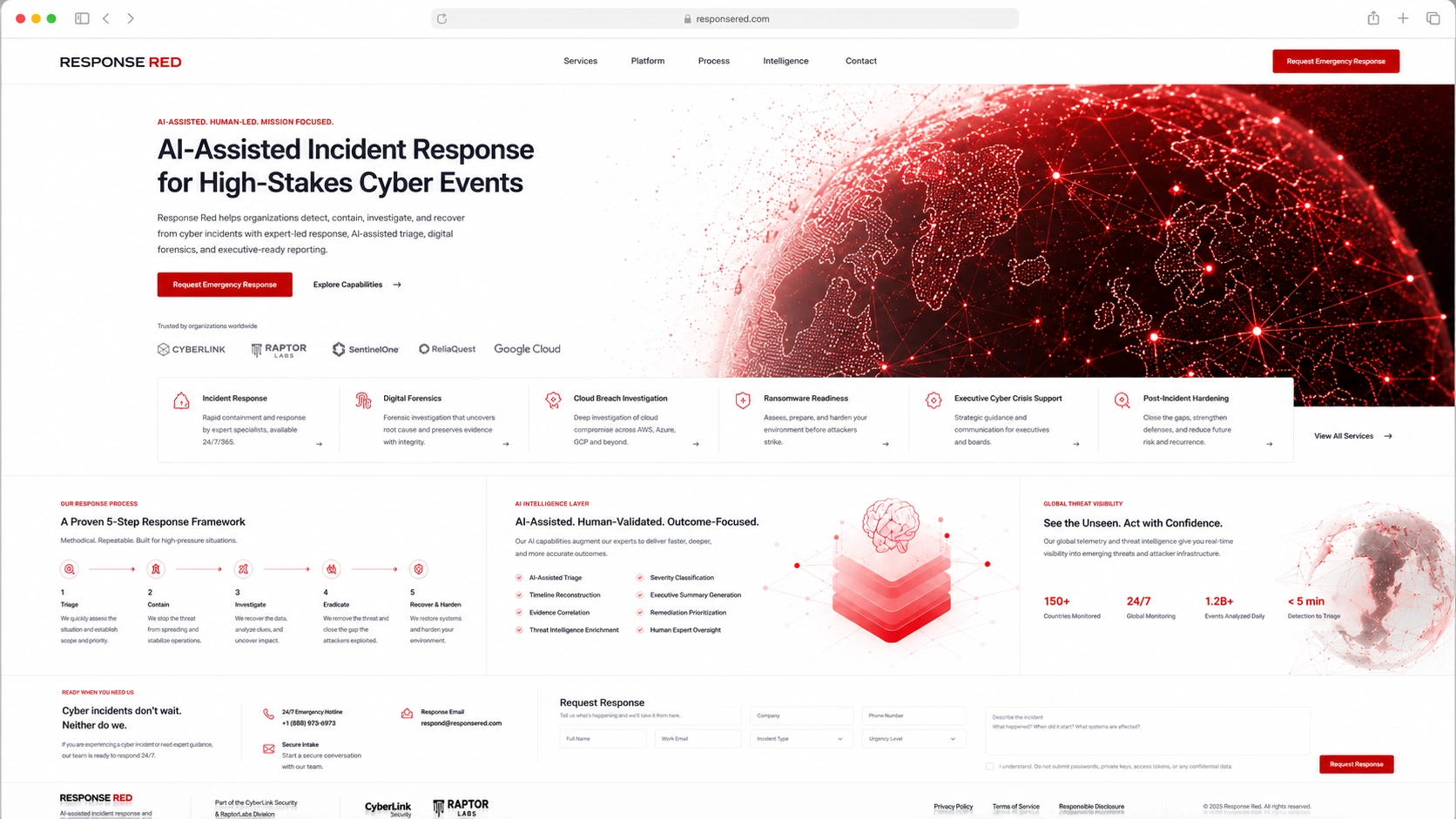
Landing Page
Overview
Response Red needed more than a redesign.
The company operates in a category where trust, speed, clarity, and technical credibility directly affect conversion. A cybersecurity incident response brand cannot look generic, vague, or overly theatrical. It must communicate urgency without panic, AI capability without exaggeration, and enterprise confidence without unnecessary complexity.
The objective was to create a premium digital presence for Response Red — a company focused on AI-assisted incident response, digital forensics, cyber crisis management, and secure incident intake.
The final result is a white-first, crimson-accented, enterprise-grade website and intake experience that positions Response Red as a serious response partner for organizations facing ransomware, cloud compromise, identity compromise, business email compromise, malware, data exposure, and other high-stakes cyber events.
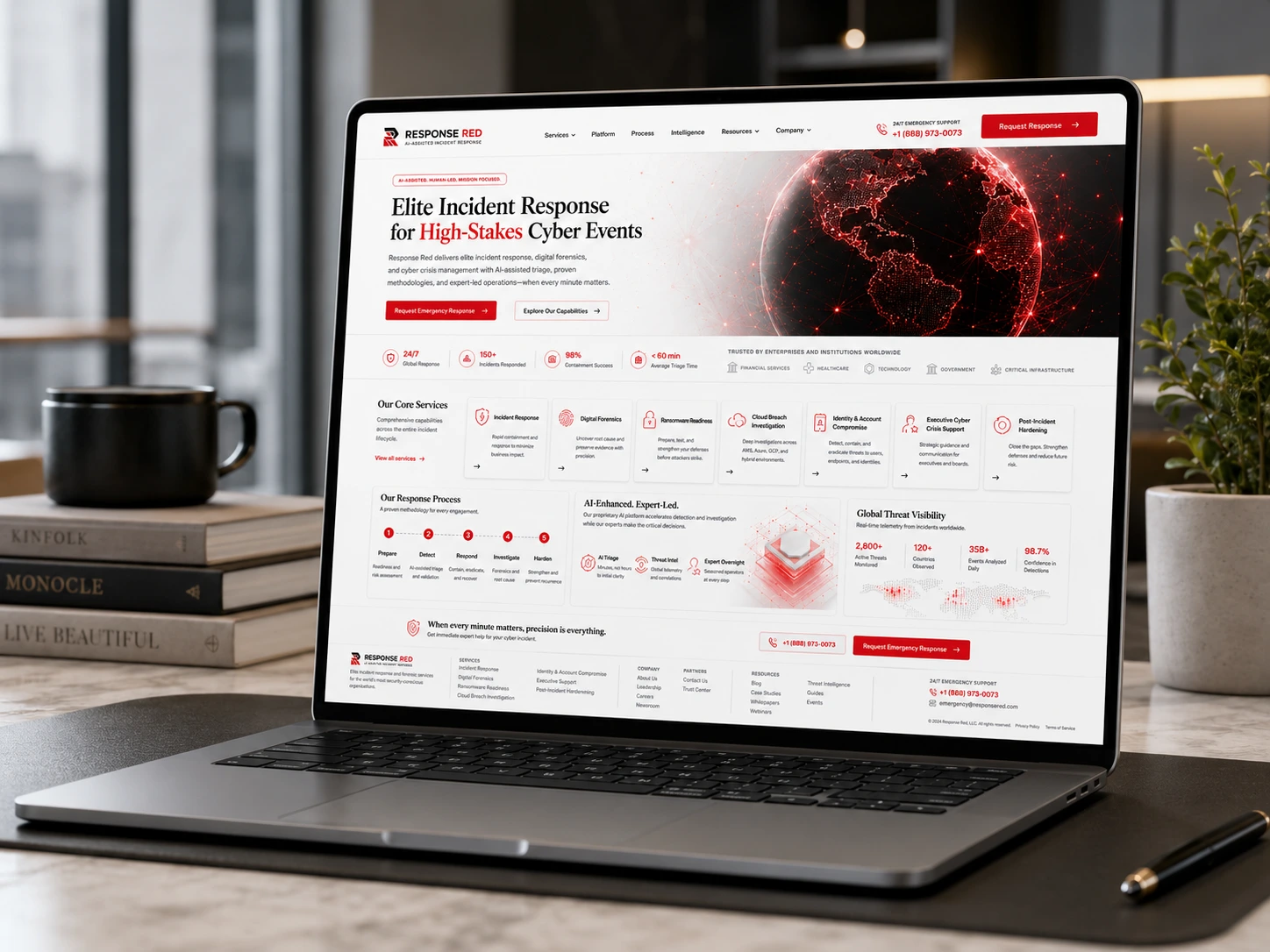
Laptop Preview
The challenge
Cybersecurity websites often fail in one of two directions.
They either become dark, aggressive, and overloaded with hacker-style visuals, or they become so corporate and generic that they could belong to any B2B services firm.
Response Red needed a different balance.
The brand had to feel:
Serious, but not cold
Urgent, but not fear-based
Technical, but not cluttered
Premium, but not decorative
AI-native, but not irresponsible
Enterprise-ready, but still fast and direct
The core challenge was to design and build a website that could immediately communicate trust to founders, CTOs, CISOs, legal stakeholders, compliance teams, and executive buyers during moments where every minute matters.
My role
I handled the project as an end-to-end design and implementation engagement across:
Brand direction
Visual identity system
UI/UX design
Website architecture
Conversion copy structure
Frontend implementation
Backend workflow scaffolding
AI-assisted intake logic
Cloudflare deployment strategy
Security-conscious form and incident intake design
The work was not treated as a simple marketing website. It was designed as a high-trust digital entry point for urgent incident response demand.
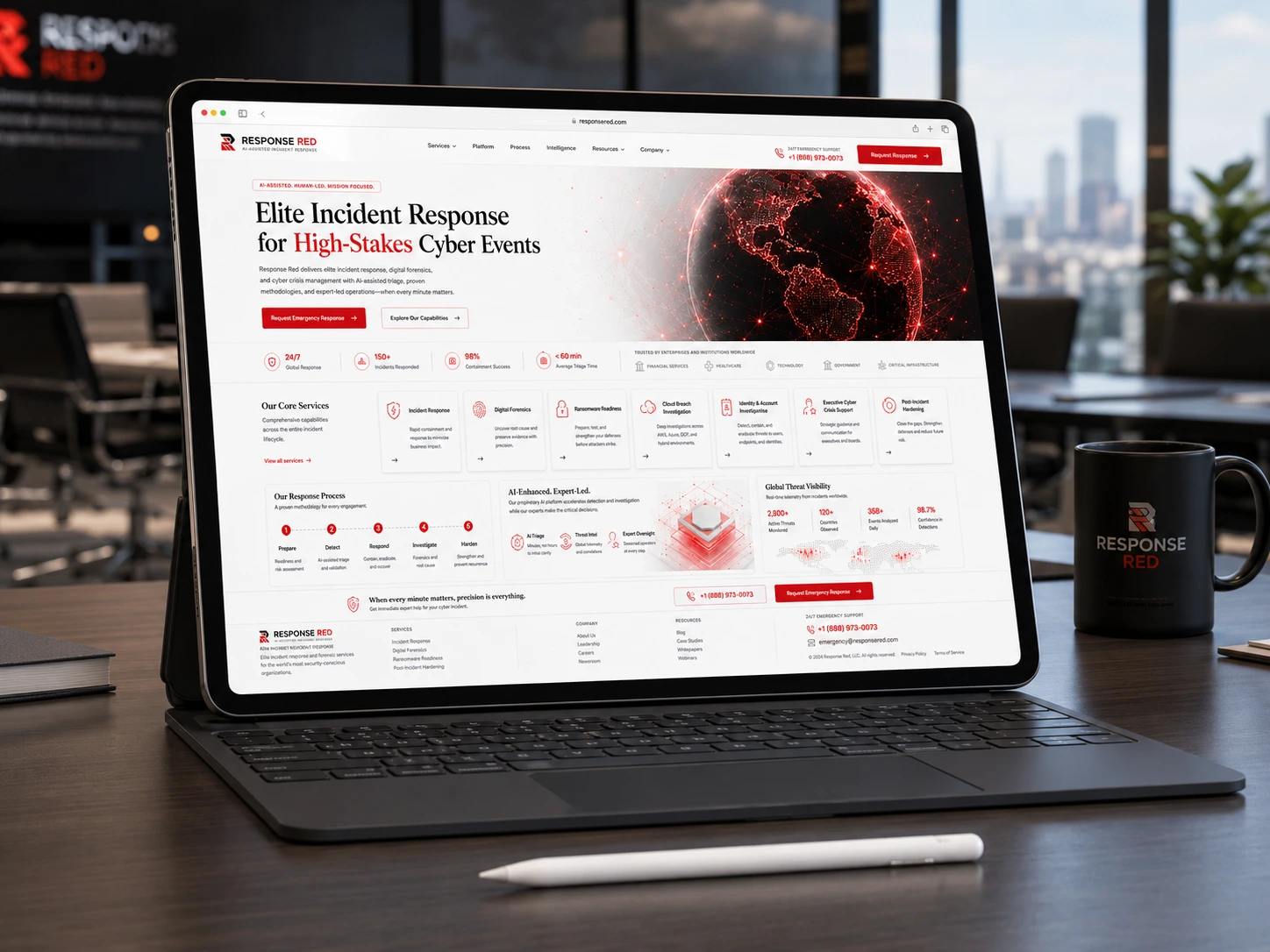
Tablet Version
Visual identity
The visual identity was created from the client’s specifications: a premium white-first interface, restrained grayscale hierarchy, and crimson red accents aligned with the Response Red name and the broader visual language of the client’s cybersecurity and AI division.
The direction intentionally avoided the common cybersecurity cliché of dark neon dashboards, skull-and-lock iconography, and exaggerated “hacker” aesthetics.
Instead, the final system uses:
White as the primary brand surface
Crimson red as the signal color
Deep graphite and grayscale for hierarchy
Thin borders and precise spacing
Large editorial typography
Minimal enterprise cards
Structured service blocks
Cinematic but restrained global threat visuals
Clear CTA hierarchy
Serious, direct, executive-grade copy
The goal was to make Response Red feel calm under pressure.
Design system
The design system was built around a clean enterprise UI foundation:
White-first layout system
Crimson red accent palette
Minimal line icons
High-contrast typography
Responsive card grids
Structured service sections
Motion-safe interaction states
Accessible form fields
Clear information hierarchy
Conversion-focused CTA placement
The final design language gives the site an executive cybersecurity feel without sacrificing speed, readability, or usability.

Fully Responsive and Adaptive
AI-native design workflow
The early design and ideation phase used an AI-native workflow.
Google Gemini was used for strategic exploration, content structure, and positioning refinement. Google Stitch supported early interface direction and high-fidelity wireframing. Google Pomelli was used to help translate brand direction into structured visual identity thinking.
After the visual language was defined, the design system was consolidated into a
DESIGN.md workflow. This gave the implementation layer a persistent reference for colors, spacing, typography, tone, component behavior, and visual rationale.That step was important because the project was built with AI-assisted engineering. Without a structured design memory, coding agents can drift visually between sections. The
DESIGN.md approach helped keep the final implementation consistent across the full site.Implementation workflow
Once the visual identity and look and feel were approved, production implementation was completed through Warp.dev using an agentic terminal workflow.
Claude Opus 4.8 and GPT-5.5 were used across the build process for:
Frontend implementation
Component structure
UI polish
Responsive behavior
Content refinement
Backend endpoint scaffolding
AI intake assistant logic
Cloudflare deployment preparation
Security and performance review
The goal was not to “let AI generate a website.” The goal was to use AI as a controlled production multiplier inside a senior technical workflow.
Every major design and implementation decision was still guided by the client’s brand requirements, cybersecurity context, conversion goals, and security expectations.

Wide Screen
Website architecture
The final website was structured around the actual buying journey for incident response.
The homepage moves through a clear enterprise sequence:
Immediate positioning
High-stakes incident response message
Trust and response signals
Core services
Response process
AI-assisted intelligence layer
Global threat visibility
Secure intake
Group alignment and footer trust signals
The structure was designed to answer the questions an enterprise buyer is likely to have during a security event:
Can this team respond quickly?
Do they understand serious cyber incidents?
Is the process structured?
Is AI being used responsibly?
Is this safe to contact?
Will sensitive information be handled carefully?
Can executives understand the outcome?
Key website sections
Hero section
The hero section introduces Response Red as an AI-assisted incident response and digital forensics company for high-stakes cyber events.
The visual centerpiece is a cinematic red global threat visualization: a particle-based Earth with glowing red network lines, designed to communicate global visibility, response coordination, and cyber crisis intensity without overwhelming the page.
Services
The services section presents Response Red’s core capabilities in a clean enterprise card system:
Incident Response
Digital Forensics
Ransomware Readiness
Cloud Breach Investigation
Endpoint & Identity Compromise
Business Email Compromise
Executive Cyber Crisis Support
Post-Incident Hardening
Each service card was written to be direct, specific, and buyer-oriented.
Response process
The response process was simplified into a clear operational sequence:
Triage
Contain
Investigate
Eradicate
Recover & Harden
This gives the site a mature incident-response structure instead of vague service language.
AI intelligence layer
The AI layer was positioned carefully.
The site does not claim that AI replaces experts or acts autonomously on production systems. Instead, Response Red is positioned around AI-assisted, human-validated response operations.
The AI layer supports:
Incident triage
Timeline reconstruction
Evidence correlation
Threat intelligence enrichment
Severity classification
Executive summary generation
Remediation prioritization
Human expert oversight
This keeps the messaging credible for technical buyers and safe for enterprise legal/compliance audiences.
Secure intake
The contact and intake flow was designed to feel serious and safe.
Instead of a generic “contact us” form, the intake experience is structured around incident urgency and responder readiness. Visitors are guided to describe the incident without submitting dangerous or sensitive materials such as passwords, private keys, access tokens, regulated personal data, or confidential evidence.
That warning was intentional. In cybersecurity, a high-converting form must still protect the client and the response team.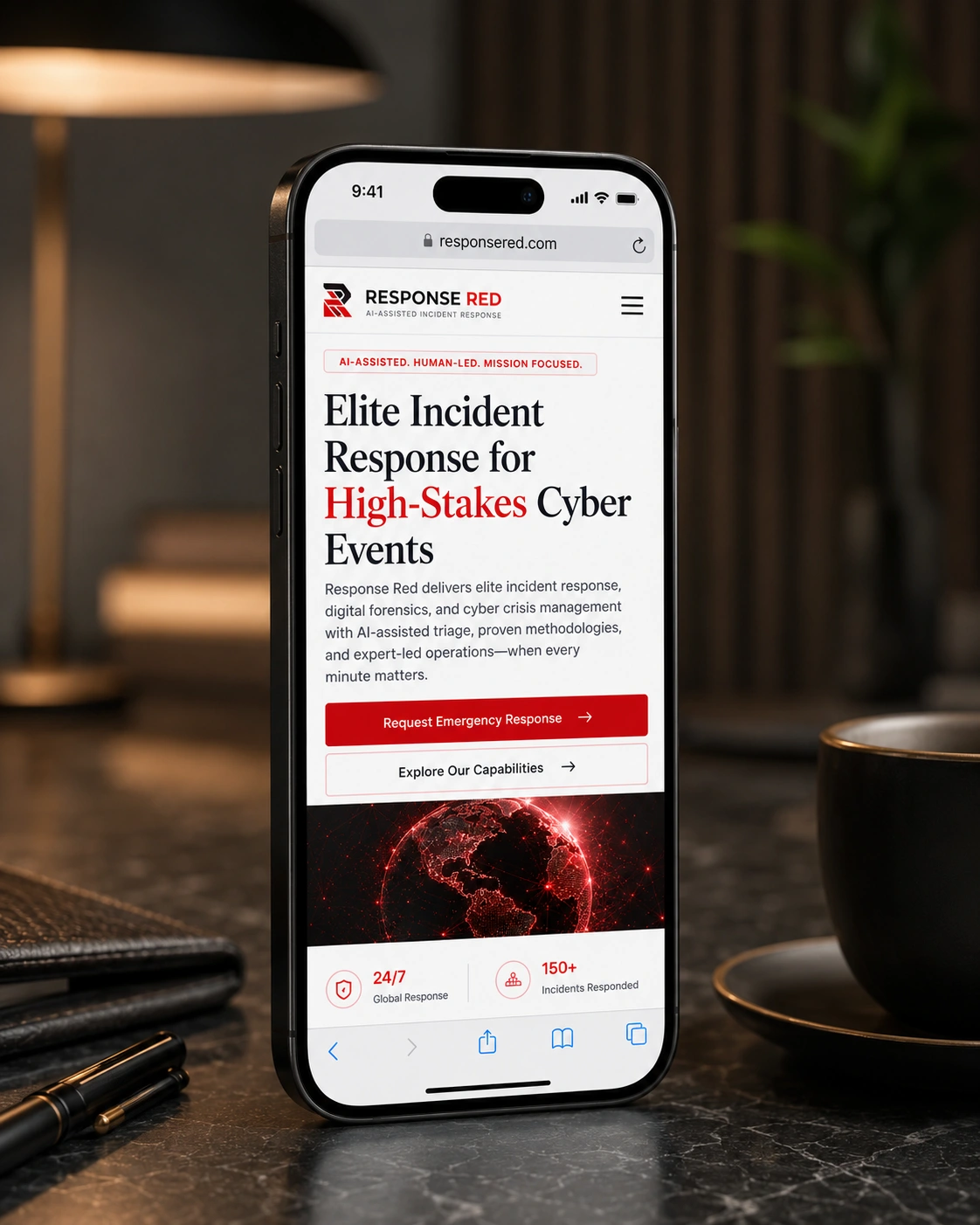
iOS
Backend and AI-assisted intake
Beyond the public-facing interface, the project included backend workflow scaffolding for secure incident intake and AI-assisted triage.
The backend layer was designed to support:
Structured lead capture
Incident type classification
Urgency assessment
Secure intake handoff
AI-assisted incident summaries
Human responder review
Abuse protection
Cloudflare-ready deployment
The AI intake assistant was designed with defensive boundaries. Its role is to help users describe what happened, organize the information into a responder-friendly format, and suggest safe next steps. It is not designed to provide offensive security instructions, bypass guidance, malware advice, or autonomous production actions.
Technical direction
The implementation was designed around a modern, fast, and secure web stack.
Core technical areas included:
SolidJS / TypeScript frontend direction
Material Design 3-inspired UI principles
Motion-safe interaction design
WebGL / particle-based global threat visuals
Cloudflare deployment architecture
Cloudflare Pages / Workers-compatible backend logic
Cloudflare Turnstile-ready abuse protection
AI provider abstraction for intake assistant workflows
Security-conscious form handling
SEO and Open Graph metadata
Mobile-first responsive implementation
Performance-focused visual loading strategy
The result is a site that feels cinematic and premium while remaining clear, fast, and conversion-focused.
Security-conscious design decisions
Because Response Red operates in incident response, the design had to account for security from the first interaction.
Key decisions included:
No request for secrets through public forms
Clear warnings around sensitive data
Human expert oversight language
Defensive AI boundaries
Structured intake instead of freeform chaos
Cloudflare-ready abuse protection
Minimal exposure of operational details
Executive-safe language
No unsupported claims about guaranteed outcomes
The tone was intentionally restrained. In cybersecurity, credibility is stronger than hype.
Outcome
The final result is a premium enterprise website and secure intake experience that gives Response Red a serious digital presence in the cybersecurity market.
The platform now communicates:
What Response Red does
Who it serves
How its response process works
Where AI supports the workflow
Why human expertise remains central
How organizations can request response support safely
The project turned Response Red from a domain into a high-trust brand surface with clear positioning, polished visuals, structured service architecture, and an AI-assisted intake experience designed for real cybersecurity response scenarios.Why this project matters
This project shows how AI can be used professionally in enterprise web production when it is paired with strong design direction, security judgment, and technical ownership.
The value was not simply faster output.
The value came from using AI in the right layers:
Strategic brand exploration
Wireframing and design direction
Persistent design-system memory
Faster production implementation
Safer intake workflows
Stronger content structure
More consistent frontend execution
Response Red needed to feel like a company that responds when the situation is serious.
That became the design principle for the entire project:Calm interface. Red signal. Clear process. Human expertise. AI-assisted speed.Services delivered
Brand direction
Visual identity system
UI/UX design
Responsive website design
Frontend development
Backend workflow scaffolding
AI-assisted intake experience
Cybersecurity copy structure
Cloudflare deployment strategy
Security-conscious form architecture
Case study visual direction
Multi-device presentation assets
Tools and technologies
Google Gemini
Google Stitch
Google Pomelli
DESIGN.md workflow
Warp.dev
Claude Opus 4.8
GPT-5.5
SolidJS
TypeScript
Material Design 3 principles
WebGL / particle visual direction
Cloudflare Pages / Workers architecture
Cloudflare Turnstile-ready intake protection
AI-assisted workflow design
Final note
Response Red was built as a premium cybersecurity brand and operational intake surface for high-stakes environments.
The final website is not just a visual redesign.
It is a trust layer, a conversion layer, and a structured first point of contact for organizations that need serious cyber incident response support.
It is a trust layer, a conversion layer, and a structured first point of contact for organizations that need serious cyber incident response support.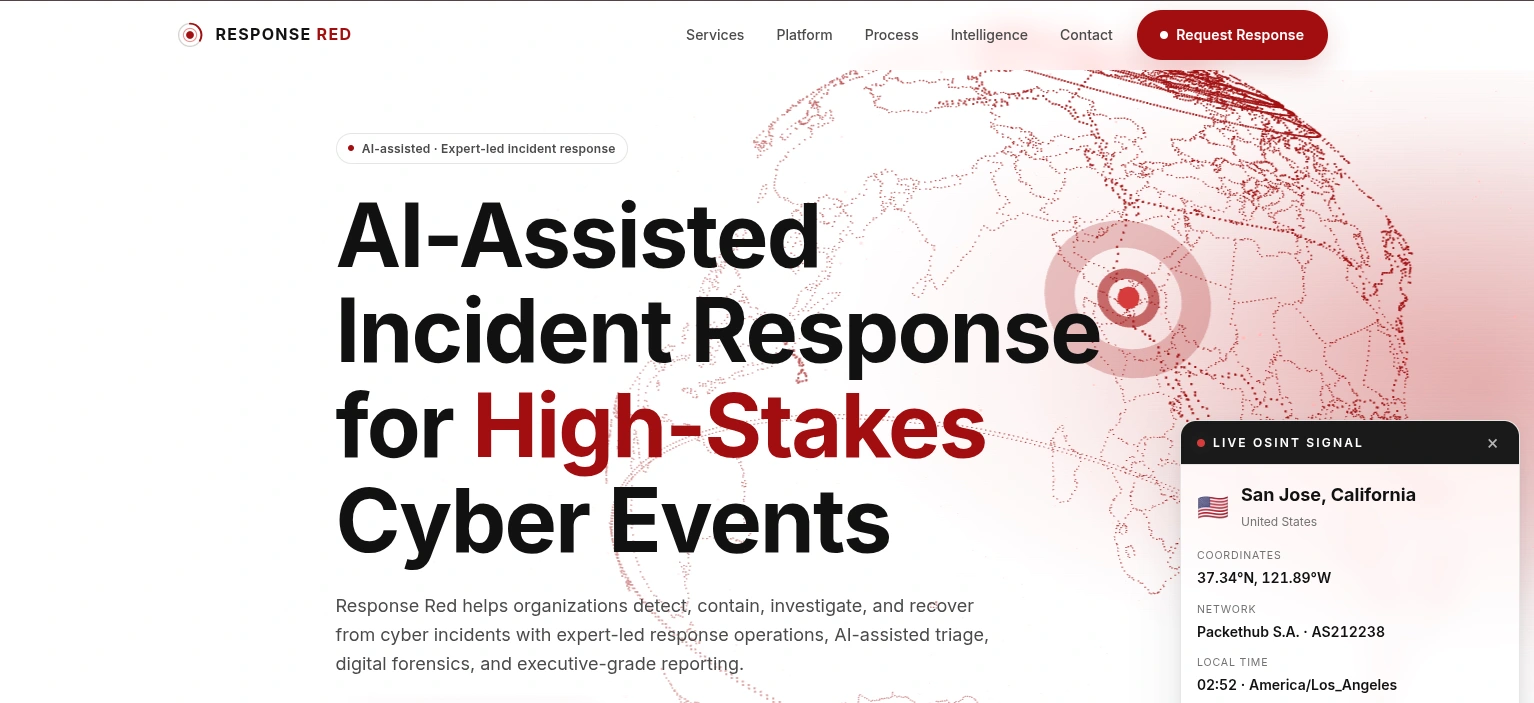
OSINT AI features for a better UX and best practices of providing a proper, correct and intelligence driven Incident Request Report
Like this project
Posted Jul 1, 2026
Expert-led, AI-assisted incident response, digital forensics, and threat containment for high-stakes cyber events.
Likes
10
Views
31
Timeline
Jun 28, 2026 - Jun 30, 2026
Clients
ResponseRed
Collaborators