Soft Landing

Josue Perez


Problem space
The Problem
Therapy, coaching, care, and community tools are built to retain — but the relationships they hold often need a humane ending, and there's no design for that. Retention mechanics turn closure into a trap: guilt prompts, "are you sure?" screens, features that make leaving feel like abandonment.
The design question: what does a dignified ending look like for a support relationship that has done its work?
The retention data tells the rest of the story: over 50% of mental health app users abandon within the first week; by day 30, retention rates for unguided apps fall as low as 3.3%. In therapy itself, research puts premature dropout at 20–50% — with the most common stated reason being that clients didn't feel heard. The industry optimises for re-engagement. No one designed the exit.
Design work
What I Designed
Three personas around endings — each in a different kind of support relationship at a different point of closure.
Eight Crazy-8s concepts for graceful offboarding — rapid ideation on what a "last session" could feel like by design rather than by abandonment.
Ten design principles for humane closure — including anti-retention defaults, dignity preservation, and transition support.
Explicit anti-retention defaults — leaving is easy, dignified, and never punished. The product celebrates its own irrelevance as a sign of health.
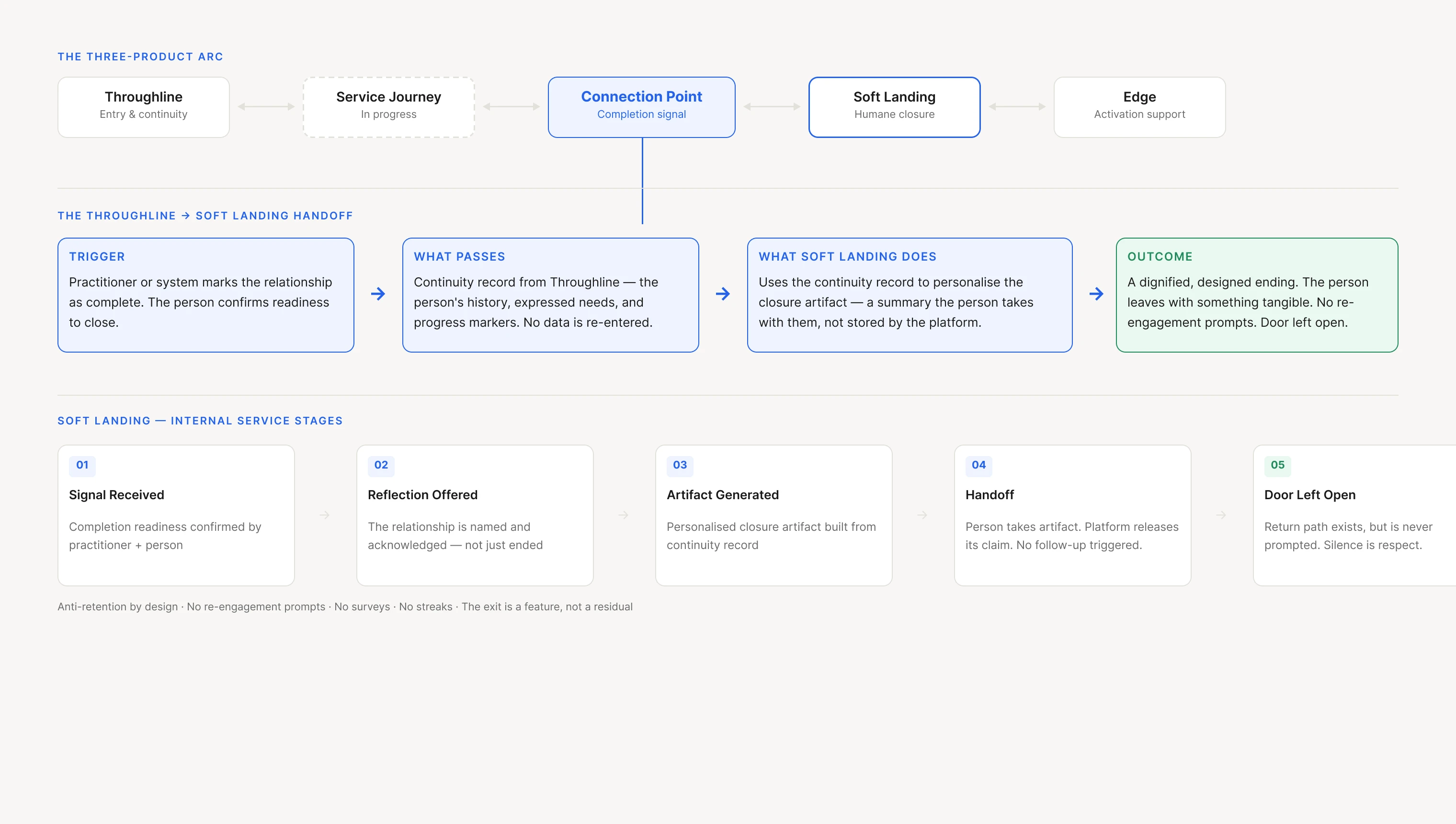
Service flow diagram — Throughline hands off to Soft Landing at the Connection Point. The middle row shows what triggers the handoff and what data passes. The bottom row maps Soft Landing's five internal stages, ending with the door left open, never propped.
Design principles
Ten Principles for Humane Closure
These principles define what anti-retention looks like as a positive design practice — not just what to remove, but what to build in its place:
The exit is a feature, not a residual. Departures are designed with the same care and intention as onboarding.
Closure is not retention. A good ending does not require the relationship to continue — it requires the person to feel complete.
Leave the door unlocked, not propped open. Return is always possible but never prompted, never pressured, never implied.
Silence is a respect signal. No follow-up messages unless the person has explicitly opted into them.
The person takes something tangible. At the close of a care relationship, they leave with something that was theirs — a summary, a record, a reflection.
No ratings. No surveys. No NPS. A vulnerable ending is not a feedback opportunity.
No streaks. No reminders. No nags. Departure incurs no penalty and triggers no re-engagement mechanics.
Make leaving feel like an accomplishment, not an ejection. Graduation, not termination — the product celebrates its own irrelevance as evidence of health.
Soft Landing has a fixed shape. The offboarding flow is bounded. It does not expand into a new onboarding for a different product.
The person does not owe a return. The product holds no claim on them once the relationship is closed.
Rationale
Key Decisions
Design the ending as carefully as the onboarding
The insight that drove everything: onboarding gets enormous design attention because it converts users; endings get none because they lose them. But the quality of an ending is what people remember and tell others. A good ending is the deepest brand signal a care product can send.
Anti-retention as a stated value, not an afterthought
Most ethical design discussions are about what you don't do. Soft Landing names anti-retention as a positive design intent — making leaving easy is a feature, not a failure to convert. This is directly counter to the engagement-maximization playbook, and it's the right call for any product handling vulnerable relationships.
Design status
Concept Framework — Not Yet Validated
This is a design framework, not an evidence-based product
The principles, personas, and offboarding concepts shown here have not been tested with users, therapists, coaches, or care platforms. No formative or summative research has been conducted. Every decision represents design intent and ethical reasoning — not validated conclusions.
Next step: Recruit practitioners (therapists, coaches, community moderators) and end-users to stress-test the principles against real closure experiences before any implementation commitment.
Current state
State of the Work
A concept framework and a pointed point of view — that ethical design includes designing good endings, and that the industry's retention playbook is ethically incomplete for any product handling vulnerable relationships. The framework applies directly to mental health tech, care platforms, coaching tools, and any community product where the relationship matters more than the session count.
Continue reading
Like this project
Posted Jul 17, 2026
Design principles, personas, and flow concepts for dignified, anti-retention offboarding in therapy/coaching and care products.
Likes
0
Views
3
Timeline
Jun 1, 2025 - Jul 31, 2025