Integration Hub — .NET Architecture Concept

Maksim Marozau



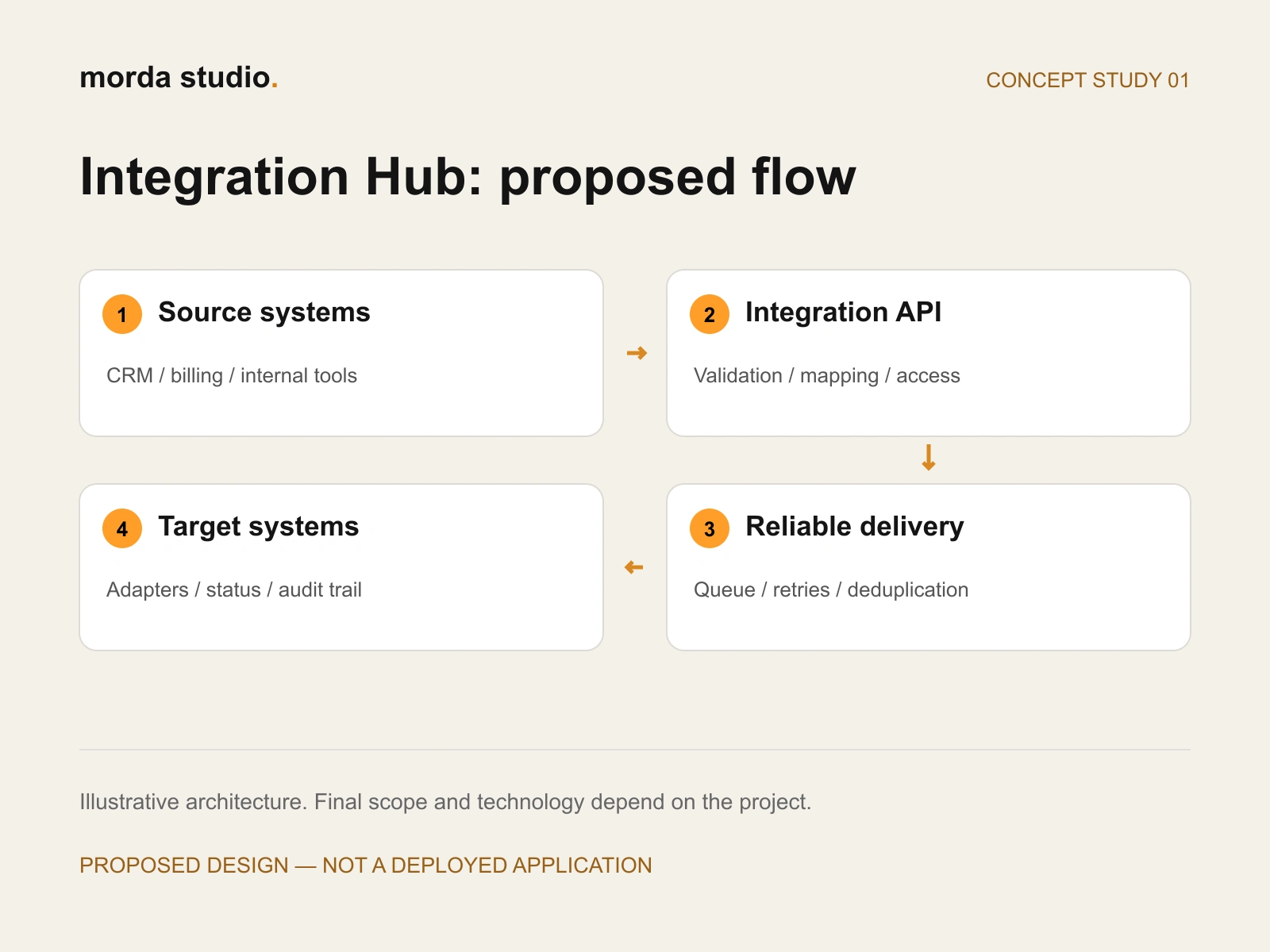
Proposed integration flow — conceptual architecture, not a running application.
Concept study by Morda Studio. This is a proposed architecture and visual explanation, not a delivered client application. No implementation or measured business results are claimed.
The challenge
Business data often has to move between a CRM, billing software, and internal tools. Direct point-to-point connections make failures hard to trace and changes expensive.
The proposed solution
A .NET integration layer would provide a consistent API, validate incoming requests, map data into a shared contract, and route work to system-specific adapters. A durable queue, idempotency keys, and bounded retries would support recovery from temporary failures.
Design decisions
• Keep business rules separate from third-party adapters.
• Record correlation IDs and delivery status for troubleshooting.
• Use explicit data contracts and versioning.
• Provide an operator view for failed deliveries and controlled replay.
Illustrative technology choices
C# and ASP.NET Core for the API, a relational store for delivery records, and a queue for asynchronous work. Final choices would depend on the client’s environment.
A practical first milestone
Connect two agreed systems, define one data flow, and verify mapping, duplicate handling, and failure recovery. The diagram shows the proposed flow; it is not a screenshot of running software.
What this concept demonstrates
How Morda Studio would approach integration boundaries, recoverability, and handover. Actual project scope, implementation, and acceptance tests would be agreed with the client.
Like this project
Posted Oct 12, 2026
Concept study: a proposed .NET integration layer with API contracts, queues, retries and audit trails. Architecture visuals; no implemented client system.