
Making AI reasoning visible
Tracewell is a concept website for a fictional platform. It helps companies see how their AI reached an answer and explain it to a regulator, client, or internal team.
Most AI products look the same: a chat box, a gradient, a promise. The challenge here was to make something invisible, a model’s reasoning, into something people can follow with their eyes.
The idea
One question, one line, one unbroken camera move. The visitor follows a single reasoning trace from the moment a question is asked to the moment an answer forms. No slides and no cuts. The scroll is the journey.
The journey
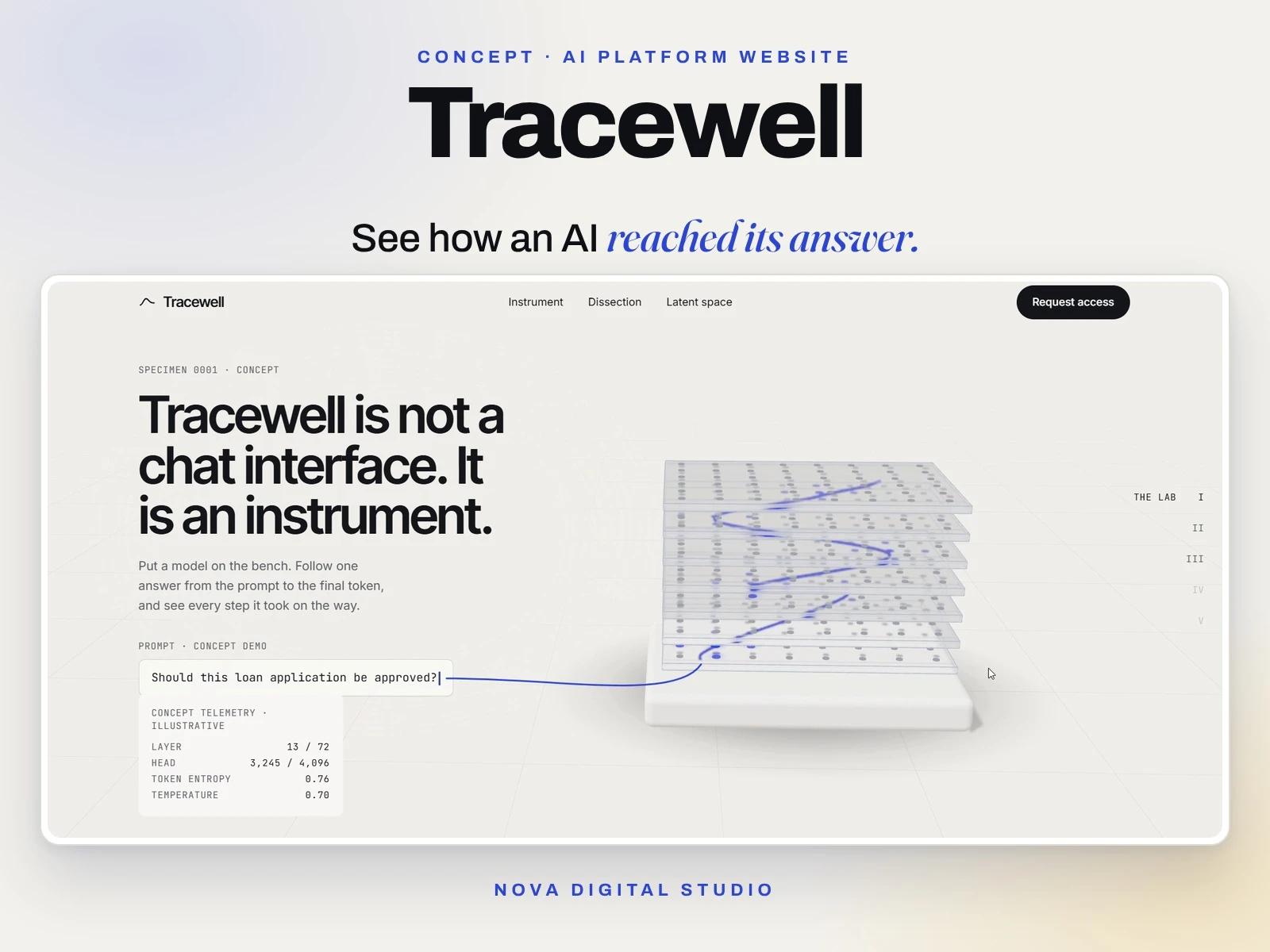
The lab
A real question types itself: “Should this loan application be approved?” A thin blue line grows out of the last word and climbs into a stack of glass layers, the model itself.
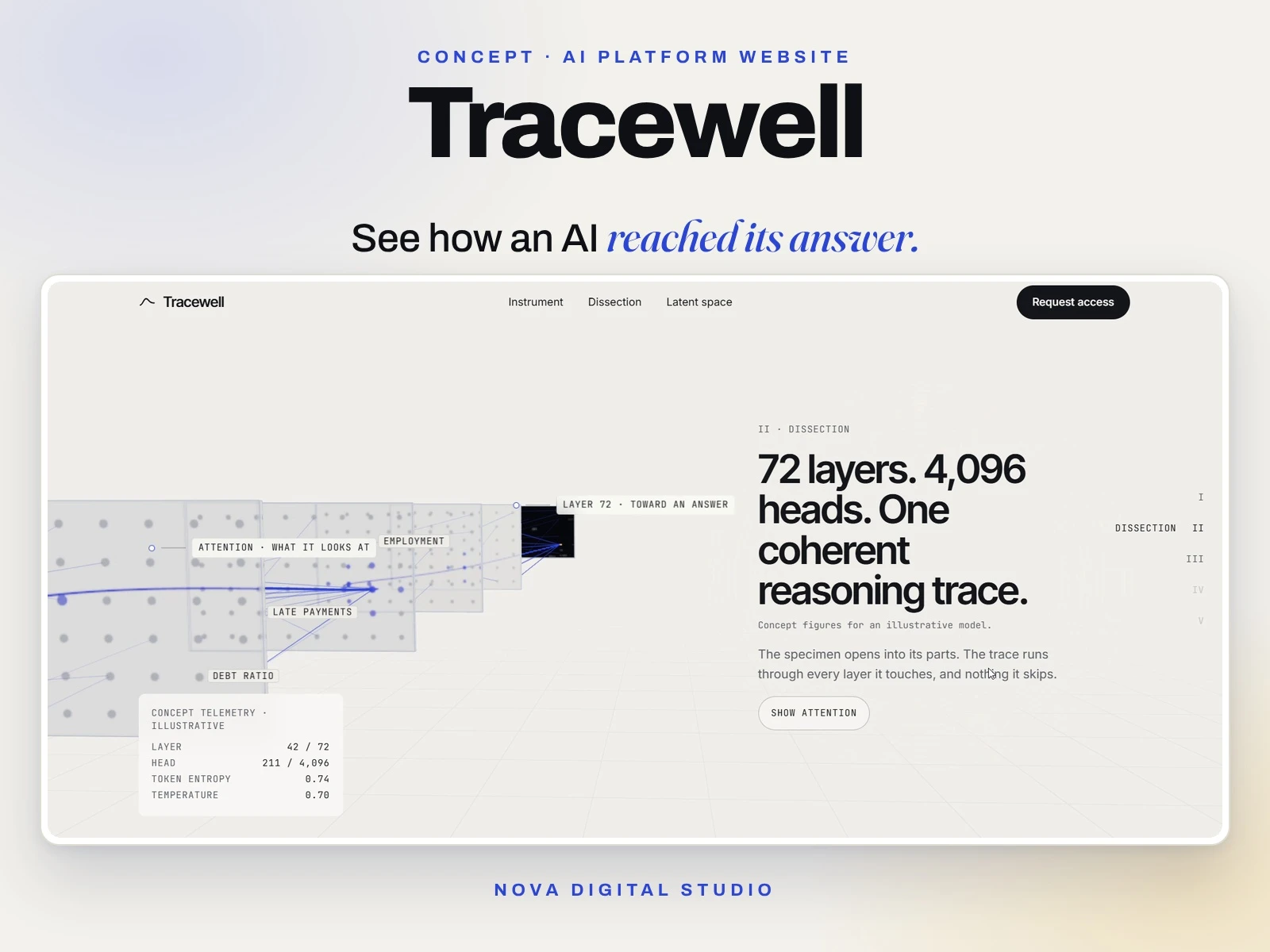
The dissection
The layers fan out like pages. The question’s words sit on the first layer, and thin attention lines show what the model looks at: income, employment, late payments, and debt ratio.
The glass plate
The last layer becomes a window. Inside it, the dark space of the model is already visible, and the camera passes through.
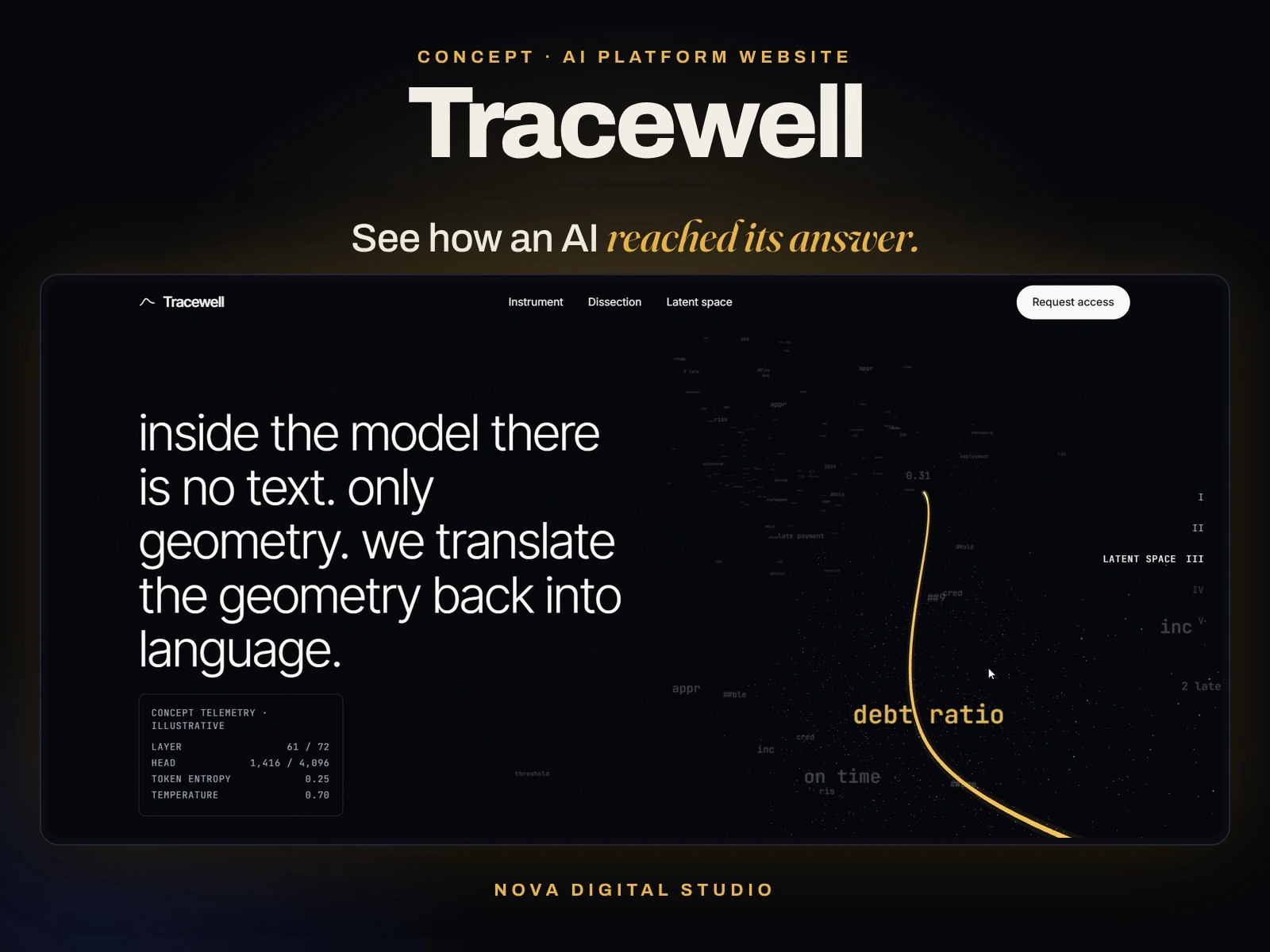
The latent space
The line turns gold and weaves through floating words, lighting them in order as it uses them: income, stable, 6 years, debt ratio, late payment, explained, approved. You watch the answer being put together before it is written. Then a gold haze fills the screen and clears.
What made it work
The first build looked polished but said nothing. A crystal on a plinth could have been a jewellery brand. I rebuilt every 3D object around one test: with the text hidden, can a visitor still tell that a question goes into an AI, it thinks, and an answer comes out?
That test turned abstract shapes into a prompt, glass layers, attention lines, and words.
Details
A live telemetry panel tracks layer, head, entropy, and temperature as you scroll, all illustrative and derived from scroll position. The page shifts from bone white to deep void as you enter the model.
The phone version is designed separately, not just shrunk: scene on top, text below, and a chapter pill at the bottom.
Build
Built with React, TypeScript, Three.js (React Three Fiber), custom shaders, and GSAP ScrollTrigger. Hosted on Vercel.
0 likes · 0 views · Nov 3, 2026
A concept website that turns AI reasoning into a scroll-driven 3D visual journey.

