Built with Framer
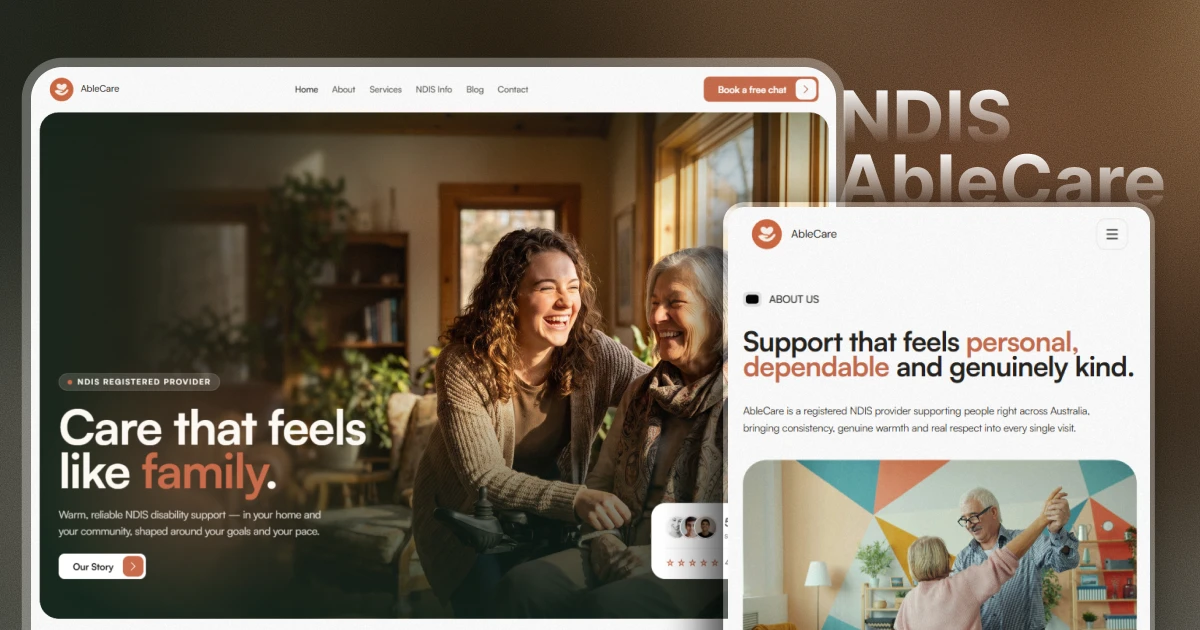
AbleCare : NDIS providers Website

Trupti G. Top 1% Web & Brand Designer


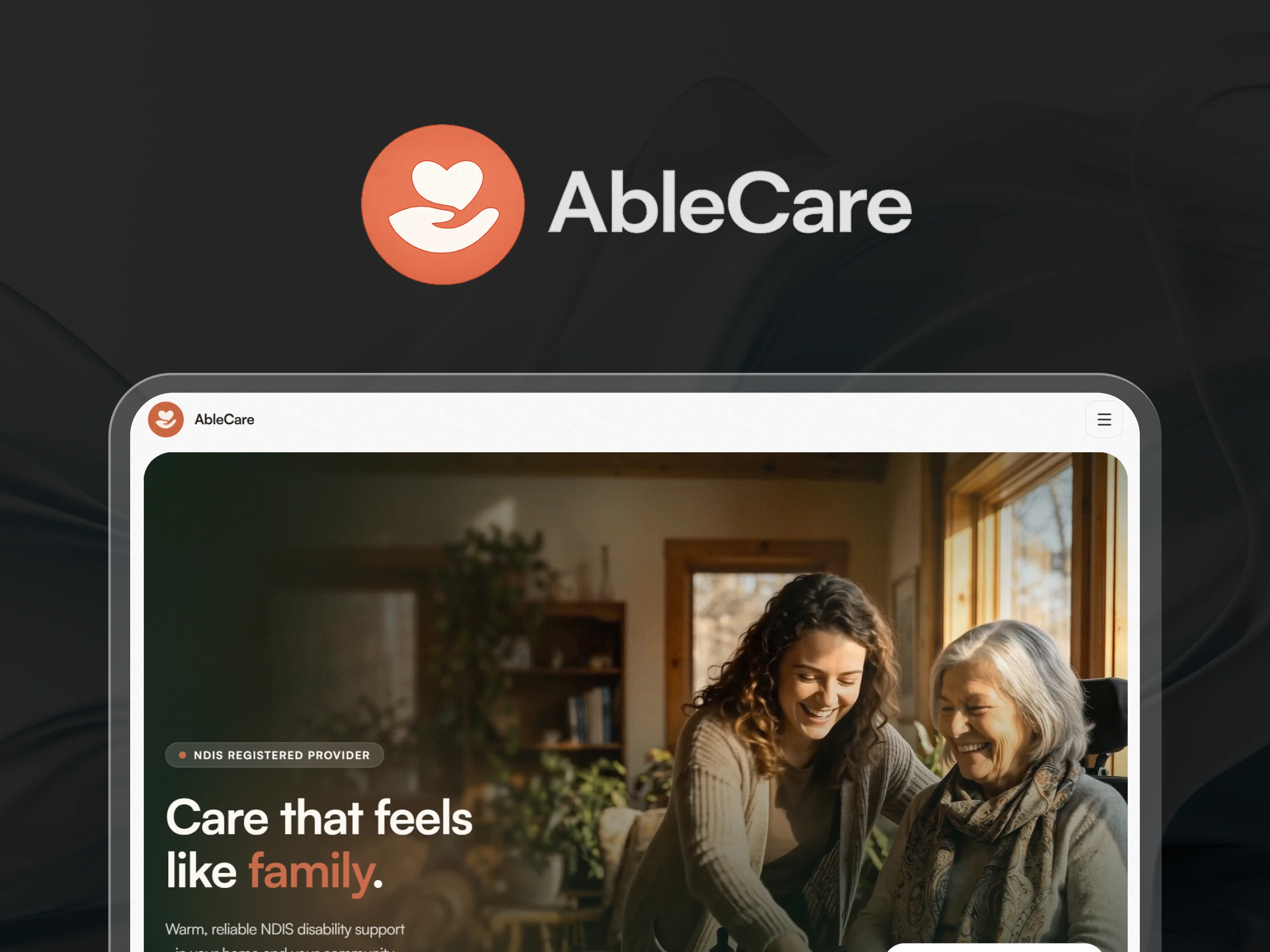
AbleCare: NDIS Disability Care Provider Website
Project Type: Website Template Design + Framer Development
Client: AbleCare
Industry: NDIS / Disability Support / Allied Health / Professional Services
Role: UI/UX Designer + Framer Developer + Framer Designer
Live Site: AbleCare Framer Preview
Framer Marketplace: AbleCare Template by TechUptodate
At a Glance
Eight fully designed static and CMS-powered page types
Two CMS Collections for services and blog content
Dynamic service-detail pages generated from CMS entries
Dedicated NDIS information and funding education hub
Enquiry form designed for participants, families, and support coordinators
Toggleable NDIS registration badge and registration-number field
Built-in Acknowledgement of Country section
Responsive, accessible, searchable, and easy to rebrand in Framer
About the Company
TechUptodate is a Melbourne-based design studio that creates custom Framer templates and digital projects from concept through launch.
AbleCare was developed as a complete website foundation for NDIS-registered organisations, disability support providers, allied health practices, and support coordination teams. The template is designed to help these organisations communicate services clearly, build participant trust, and manage content without relying on a developer.
Project Overview
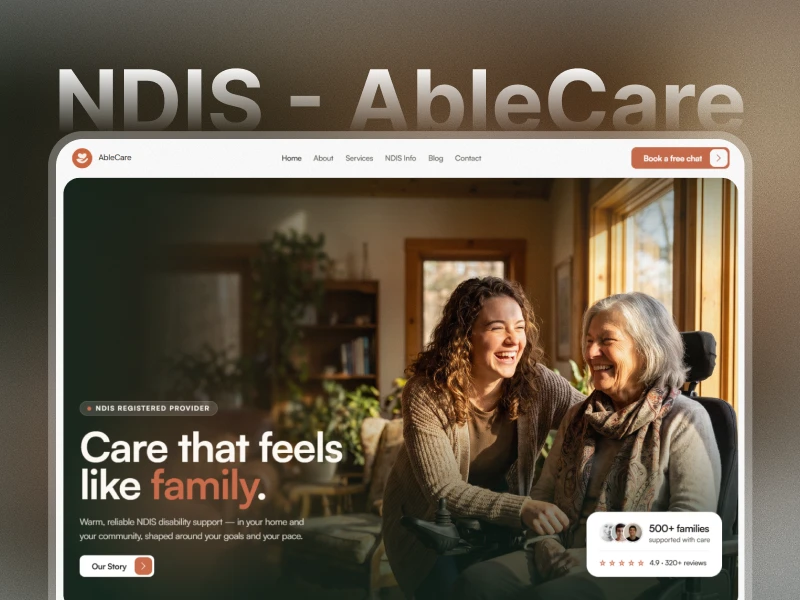
AbleCare is a warm, professional Framer website template built specifically for the Australian disability-support sector.
The project transforms complex service, funding, eligibility, and compliance information into a clear and supportive digital experience. Instead of using the generic blue-and-white visual style common across healthcare websites, AbleCare uses an editorial layout, human-centred imagery, warm colours, accessible typography, and plain-language content.
The final template combines service discovery, NDIS education, organisational credibility, CMS-powered articles, participant enquiries, team information, and conversion-focused contact points in one scalable website system.
Project Objective
NDIS providers need to communicate detailed information while remaining approachable, respectful, and easy to understand.
The primary goals were:
Create a trustworthy and human-centred disability-support website
Explain NDIS services and funding categories in plain language
Organise services around Core, Capacity Building, and Capital Supports
Help participants and families identify relevant support options
Present registration, safeguarding, and compliance information clearly
Support educational content through an SEO-ready blog
Simplify service and article publishing through Framer CMS
Guide users towards a free, no-pressure conversation
Ensure the experience remains accessible across devices
Scope of Work
This was an end-to-end template design and Framer development project:
NDIS industry and competitor research
Website strategy and information architecture
UI/UX design direction
Responsive Framer development
Reusable component and section creation
CMS architecture for services and articles
Dynamic service-detail page development
Blog index and article-template development
NDIS eligibility and funding information page
Team, values, registration, and compliance sections
Participant-focused enquiry form
Map and contact-information integration
Search, animation, slideshow, and sticky-scroll setup
Accessibility and responsive optimization
Marketplace preparation and publishing
The Challenge
Disability-support websites must communicate trust before asking visitors to make contact.
Participants and families are often evaluating more than a list of services. They need to understand whether an organisation is registered, whether its workers are consistent and dependable, how services connect to an NDIS plan, and whether the provider will respect personal goals, routines, privacy, and independence.
At the same time, NDIS terminology can feel complicated. Funding categories, plan-management options, eligibility requirements, provider registration, support coordination, and service types can quickly overwhelm users.
The design challenge was to present this information clearly without making the website feel clinical, bureaucratic, or impersonal.
The template also needed to work for different organisations, from independent support coordinators to larger providers offering personal care, community access, independent living, respite, allied health, assistive technology, and home modifications.
Client Goals
To become a practical template for disability-support organisations, AbleCare needed:
A warm and credible visual identity
Clear navigation for participants and families
Plain-language explanations of NDIS funding
Flexible service-management tools
Strong registration and safeguarding signals
Educational resources for first-time participants
Accessible and readable page layouts
Mobile-first responsiveness
Clear enquiry and phone-contact options
Simple visual editing without code
A scalable structure for future services and articles
Project Process
1. Research & Planning
The project began by examining how NDIS providers communicate with participants, families, carers, and support coordinators.
The Marketplace listing states that AbleCare was informed by real NDIS-provider websites, competitor research, and terminology used across the National Disability Insurance Scheme.
The research focused on common user questions:
What support services are available?
Which part of my NDIS plan funds this service?
Am I eligible for the NDIS?
How do I apply?
What is the difference between funding categories?
How can my plan be managed?
Is the organisation registered and compliant?
How do I contact the right person?
These questions shaped the site architecture and content hierarchy.
2. Sitemap & CMS Architecture
The website was structured around eight essential page types:
Home
About
Services
Service Detail
NDIS Information
Blog and Blog Detail
Contact
Privacy Policy
Two CMS Collections were created for services and blog articles. Every new service entry can automatically generate a consistent detail page without requiring the user to rebuild the layout.
This approach gives providers a scalable system for adding services, funding information, articles, guides, and participant resources.
3. UI/UX Design Direction
The design direction intentionally moves away from generic clinical website styling.
The visual system combines:
Warm, earthy colours
Editorial typography
Human-centred lifestyle photography
Generous spacing
Soft card treatments
Clear information hierarchy
High-contrast text
Supportive calls to action
Subtle motion and scroll interactions
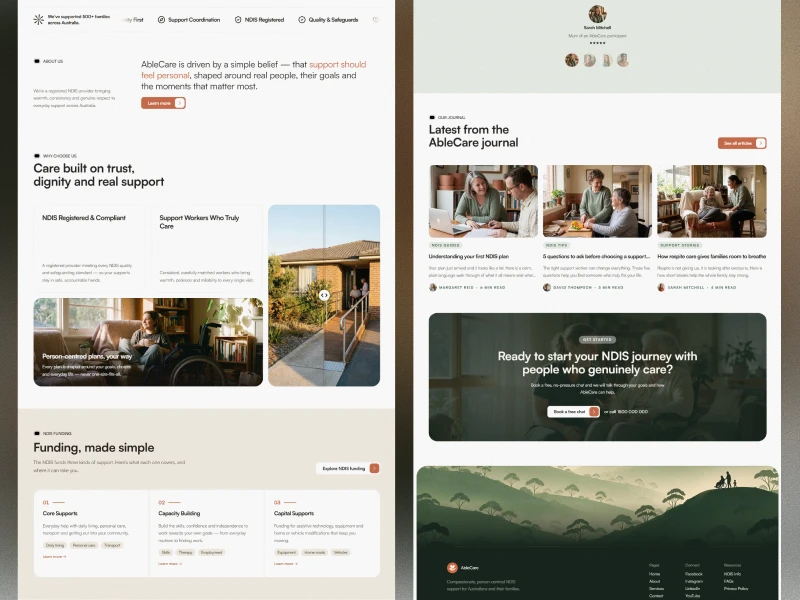
The homepage opens with the message “Care that feels like family,” followed by participant-focused support messaging, credibility indicators, organisational values, NDIS funding categories, services, testimonials, educational articles, and a final contact invitation.
4. Service Discovery Experience
Services are grouped according to the way NDIS funding is structured.
The template supports categories such as:
Core Supports
Capacity Building
Capital Supports
Example services include personal and daily living, community access, independent living, respite and short stays, support coordination, therapy and allied health, assistive technology, and home modifications.
Each service card can communicate:
Service title
Support category
Short description
Included support types
Funding source
Availability
Relevant audience
5. CMS-Powered Service Pages
Every service can connect to a dedicated CMS-powered page.
The service-detail layout provides space for:
Service overview
Included support activities
Support category
Funding information
Availability
Intended participant group
Related services
Contextual enquiry action
For example, the Personal & Daily Living page presents personal care, meal support, household assistance, medication reminders, mobility assistance, NDIS funding, availability, and a direct service enquiry.
This gives providers a consistent way to explain every service without manually designing individual pages.
6. NDIS Education Experience
A dedicated NDIS Information page was created to reduce uncertainty for new participants and their families.
The page breaks the journey into understandable sections:
What the NDIS is
Who may be eligible
Evidence requirements
How to apply
What an NDIS plan can fund
Core, Capacity Building, and Capital budgets
Plan-management options
Common NDIS terminology
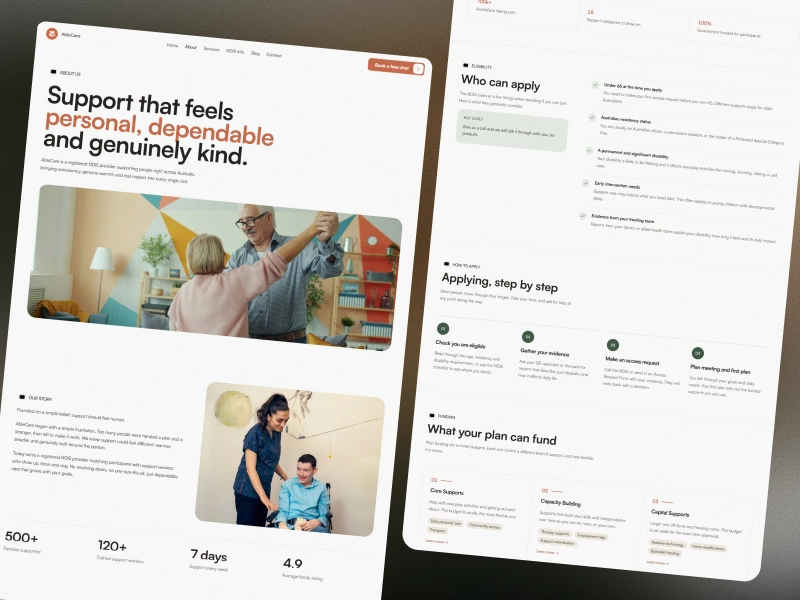
The application process is presented as a clear sequence covering eligibility, evidence gathering, access requests, planning meetings, and the first plan. The page also includes a glossary for terms such as SIL, SDA, STA, MTA, Support Coordination, and NDIA.
7. Trust & Compliance Content
Trust-building elements were treated as core content rather than decorative additions.
The About page includes:
Organisational story
Mission and vision
Person-centred values
Reliability and accountability principles
Team-member profiles
Registration information
Practice-standard statements
Worker-screening information
Complaints and incident processes
Independent quality-audit messaging
Acknowledgement of Country
The NDIS registration badge and registration-number field can be toggled, allowing both registered and non-registered organisations to adapt the template appropriately.
8. Blog & Educational Content
The CMS-powered blog supports NDIS guides, participant tips, support stories, and community information.
The article system includes:
Category
Article title
Summary
Featured image
Author profile
Publication date
Reading time
Rich-text content
Related articles
Contextual contact CTA
Example topics cover understanding a first NDIS plan, choosing a support worker, respite care, Capacity Building funding, and community access.
This structure helps providers answer common questions while building long-term search visibility and participant confidence.
9. Enquiry & Conversion Flow
The conversion journey is designed to feel supportive rather than sales-driven.
Calls to action use reassuring language such as:
Get in touch
Talk to our team
Let’s find the right support for you
Have a free, no-pressure chat
Enquire about this service
The contact page includes fields for name, email, phone number, user type, and message. The Marketplace listing states that the form is designed to route enquiries from participants, family members, and support coordinators. It also includes contact details, business hours, office information, and an embedded map.
10. Responsive Development & Quality Assurance
The template was developed using a mobile-first approach and prepared for responsive use across desktop, tablet, and mobile.
Quality assurance focused on:
Navigation usability
Keyboard-friendly interaction
Text readability
Colour contrast
Form usability
CMS consistency
Responsive images
Touch-friendly controls
Service-page scalability
CTA visibility
Search experience
Animation performance
The official listing describes the template as accessible by design, with readable typography, strong contrast, and keyboard-friendly navigation.
The Solution
Design
AbleCare delivers a warm editorial identity that feels professional without becoming clinical.
Human-centred imagery, soft natural colours, clear typography, and generous spacing help communicate dignity, care, and reliability. The interface supports an emotional sense of reassurance while keeping important service and funding information easy to scan.
User Experience
The website guides visitors through a clear journey:
Understand the provider’s approach
Review trust and compliance signals
Learn how NDIS funding works
Browse relevant support services
Open a detailed service page
Read educational resources
Contact the organisation or enquire about a service
CMS & Development
Two CMS Collections manage services and blog content.
Providers can add new service entries and articles without changing page layouts. Dynamic templates automatically maintain a consistent hierarchy, spacing system, CTA structure, and visual identity.
Trust & Accessibility
Registration fields, team profiles, organisational values, compliance messaging, safeguarding information, and an Acknowledgement of Country help providers present important trust signals clearly.
Accessible typography, strong contrast, keyboard-friendly navigation, and responsive layouts make the experience easier to use across different devices and user needs.
Key Features
Eight complete page types
Two CMS Collections for services and blogs
Dynamic service-detail pages
CMS-powered article templates
Services grouped by NDIS funding category
NDIS eligibility and application guide
Funding and plan-management explanations
NDIS terminology glossary
Toggleable registration badge
Editable registration-number field
Team and organisational-values sections
Compliance and safeguarding content blocks
Built-in Acknowledgement of Country
Participant and family testimonials
Routed enquiry form
Embedded contact map
Site search
Appear effects
Slideshows and tickers
Sticky scrolling
Layout templates
Code components
Global colour and text styles
Responsive, mobile-first layouts
Accessibility-conscious navigation
Deliverables
Complete AbleCare Framer template
Responsive homepage
About page
Services directory
CMS-powered service-detail template
NDIS Information page
CMS-powered blog index
CMS-powered article template
Contact page
Privacy Policy page
Services CMS Collection
Blog CMS Collection
Service cards and related-service components
Registration and compliance sections
Team and values components
Testimonials and trust-stat sections
Enquiry form
Contact and map section
Responsive navigation and footer
Global typography and colour styles
Marketplace-ready template package
The Results
Framer Marketplace Launch
AbleCare was released as a free Framer Marketplace template on July 22, 2026, under Framer’s Limited License.
Complete NDIS Website System
The final product delivers eight essential page types and two CMS Collections in one consistent website system.
Easier Service Management
Providers can add services through the CMS and automatically create matching detail pages without manually rebuilding layouts.
Clearer Participant Education
The dedicated NDIS information experience organises eligibility, applications, funding categories, plan management, and common terminology into plain-language sections.
Flexible Industry Use
The template is designed for:
NDIS-registered providers
Disability support organisations
Allied health practices
Support coordination businesses
Independent care providers
Community-access services
Respite and independent-living providers
Faster Customization
Global typography and colour styles allow organisations to replace the demo brand and adapt the visual system without coding or rebuilding individual pages.
Content Management Efficiency
AbleCare simplifies ongoing website management through Framer CMS and global styles.
Users can:
Add and update support services
Generate new service-detail pages automatically
Group services by funding category
Update service availability and funding information
Publish NDIS guides and educational articles
Manage authors, categories, dates, and reading times
Edit team members and organisational values
Toggle registration-related content
Replace contact and office information
Rebrand colours and typography globally
Update metadata and page content visually
Publish changes without developer support
Tech Stack
Design & Development: Framer
Content Management: Framer CMS
Collections: Services and Blog
Lead Capture: Framer Forms
Discovery: Site Search
Interactions: Appear Effects, Slideshows, Tickers and Sticky Scrolling
Components: Layout Templates and Code Components
Optimization: Responsive Breakpoints, Global Styles and Accessibility Settings
Lessons & Insights
This project showed that disability-support websites must balance clarity, dignity, compliance, and emotional trust.
Key insights included:
Plain-language content reduces anxiety around complex services
Trust signals should appear throughout the journey, not only on the About page
Service information is easier to understand when aligned with funding categories
Registration and compliance fields should remain flexible for different provider types
Warm editorial design can communicate professionalism without feeling clinical
CMS-powered service pages reduce long-term maintenance
Educational content supports both participant confidence and organic visibility
Contact flows should feel reassuring and pressure-free
Accessibility must influence typography, contrast, navigation, and content structure from the beginning
A scalable healthcare template must support both small providers and growing multidisciplinary teams
Like this project
Posted Aug 5, 2026
AbleCare is a warm, accessible Framer template for NDIS providers, with CMS services, funding guides, blogs, forms, responsive pages, and fast editing.
Likes
0
Views
19
Timeline
Jul 28, 2026 - Aug 4, 2026