
Role: Senior Software Engineer (contract) · backend, infrastructure and AI agent
Timeline: August to October 2026
Stack: TypeScript, AWS CDK, Lambda, DynamoDB, SQS, EventBridge, Amazon Bedrock, Bedrock AgentCore, Strands Agents SDK, Cognito, Twilio
Tennum lets tenants report a repair by text while an AI assistant coordinates the landlord, the vendor and the visit. I built the serverless backend on AWS (Lambda, DynamoDB, SQS, EventBridge, Bedrock AgentCore, Twilio), where the AI only proposes and code decides who gets each text, what needs approval and what gets paid. It's backed by about 2,000 automated tests, 148 alarms and a self-deploying CDK pipeline, and I closed it out with a full written handoff and a recorded walkthrough.
The problem
Self-managing landlords with 5 to 25 units spend their days relaying messages. A tenant reports a leak, the landlord calls a plumber, the plumber asks for a photo and a time, and the landlord passes everything back and forth. Tennum's goal: let the tenant text one number, and have an AI assistant coordinate the whole repair while the landlord only approves what matters.
The hard part was not getting an AI to write friendly texts. It was making sure it could never text the wrong person, contact a vendor without permission, approve money, or leak one landlord's data to another, no matter what a message said.
What I built
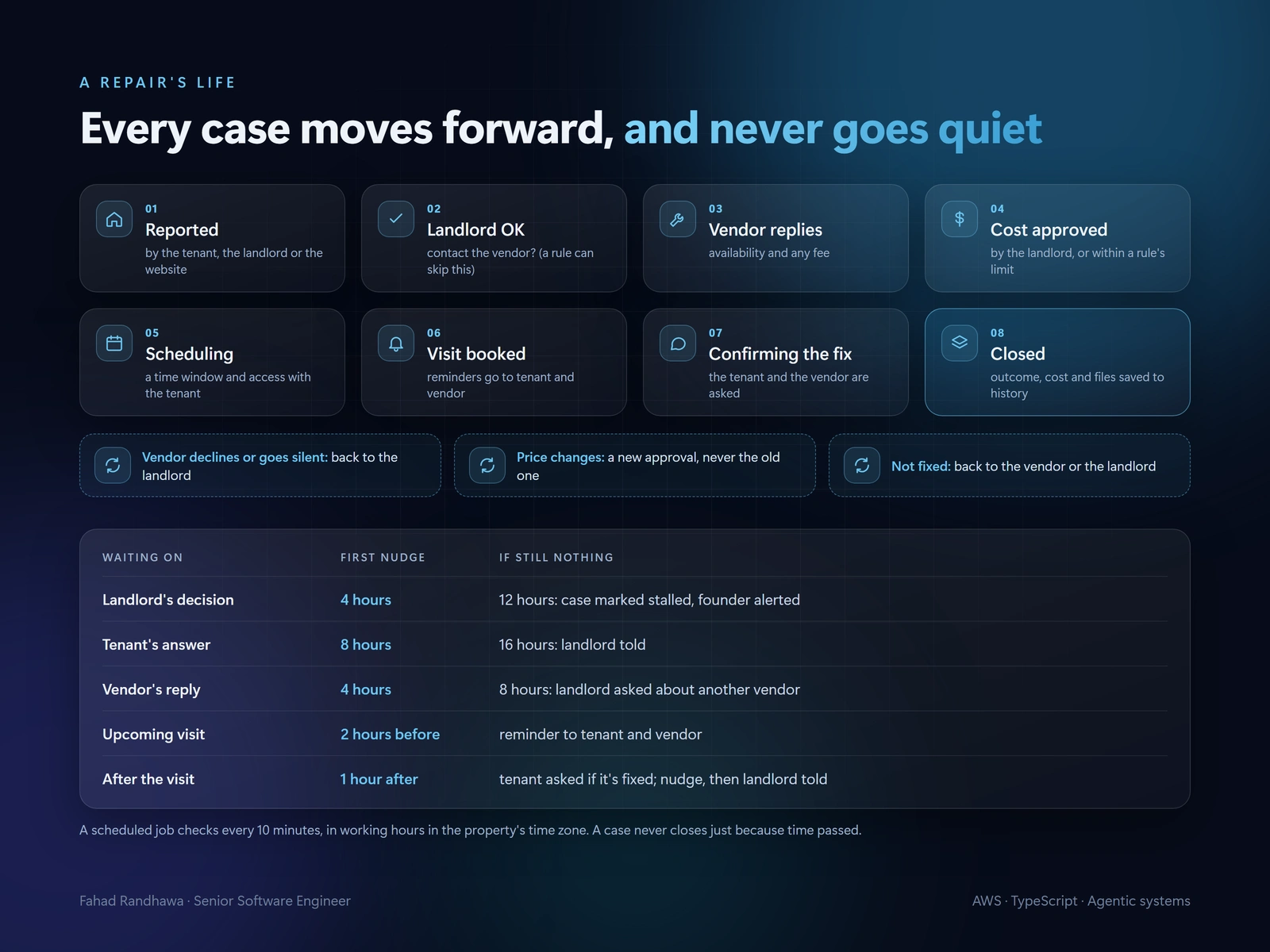
A serverless, event-driven backend on AWS where the AI talks and code decides:
- The texting pipeline. Inbound SMS and MMS from Twilio are signature-checked, queued in order per conversation (SQS FIFO), deduplicated, stored, and handed to the agent. Every outgoing text is checked again, right before it is sent, for opt-outs and paused cases.
- The AI agent. It runs on Amazon Bedrock AgentCore and acts only through tools that call internal, IAM-signed APIs. It proposes actions; it never picks a phone number or decides that something is approved.
- The repair workflow. Cases, vendor job texts with photos, landlord approvals, quotes, visit booking and completion, all moving through a defined set of states with explicit loops back (a vendor declines, a price changes, the problem isn't fixed).
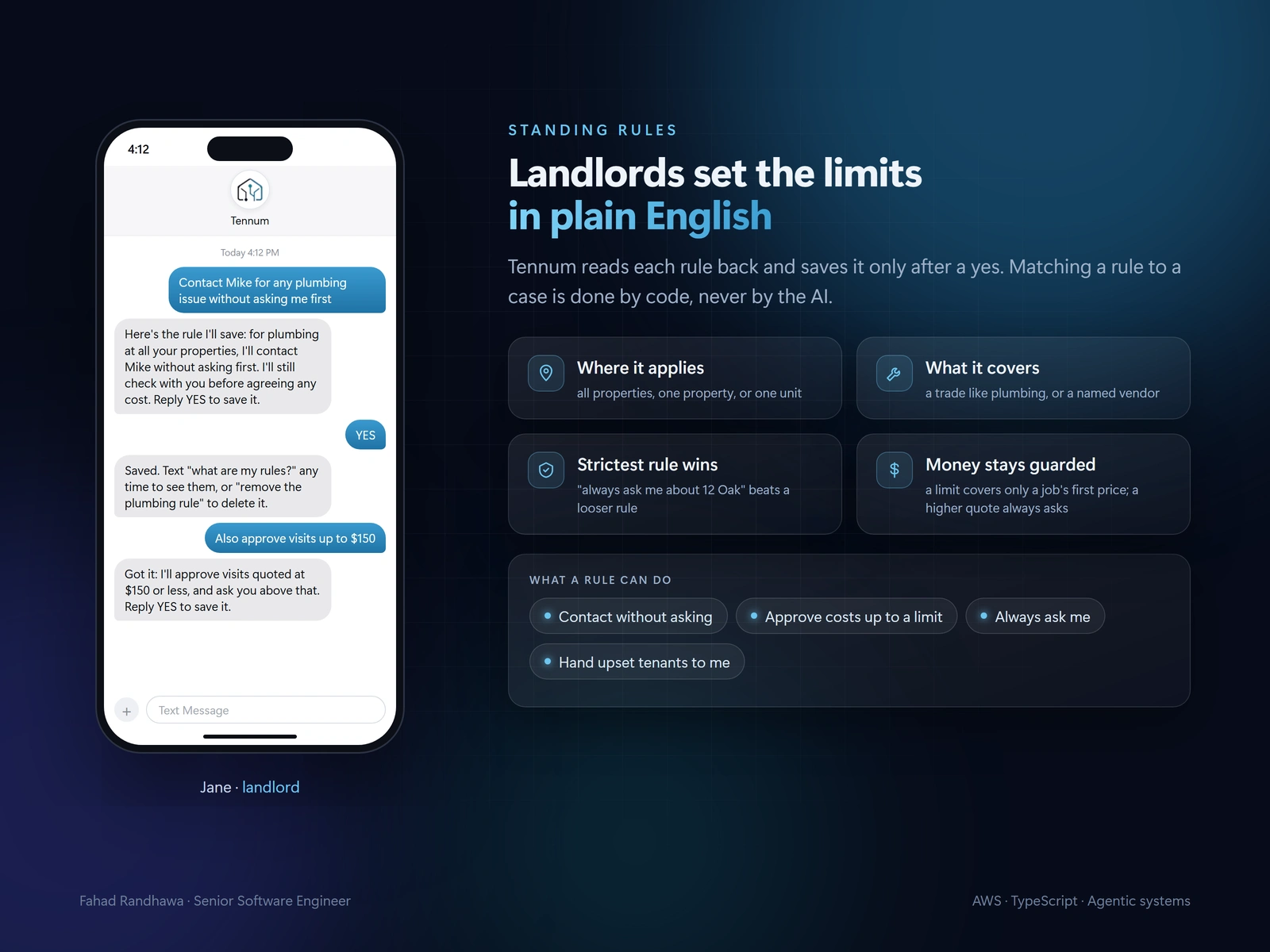
- Approvals and standing rules. "Contact Mike for any plumbing issue" or "approve visits up to $150" are matched in code, strictest rule first. Each approval covers one vendor, one job and one amount, and expires after 48 hours. A plain "yes" counts only when exactly one request is waiting.
- A scheduler that never lets a case go quiet. An EventBridge job runs every 10 minutes and sends reminders, nudges and escalations within the property's working hours. Every case must always have a next step, someone it waits on, and a due time.
- SMS consent and opt-outs. Consent texts, YES, STOP and START handling, including Spanish and phrase opt-outs, enforced before any send.
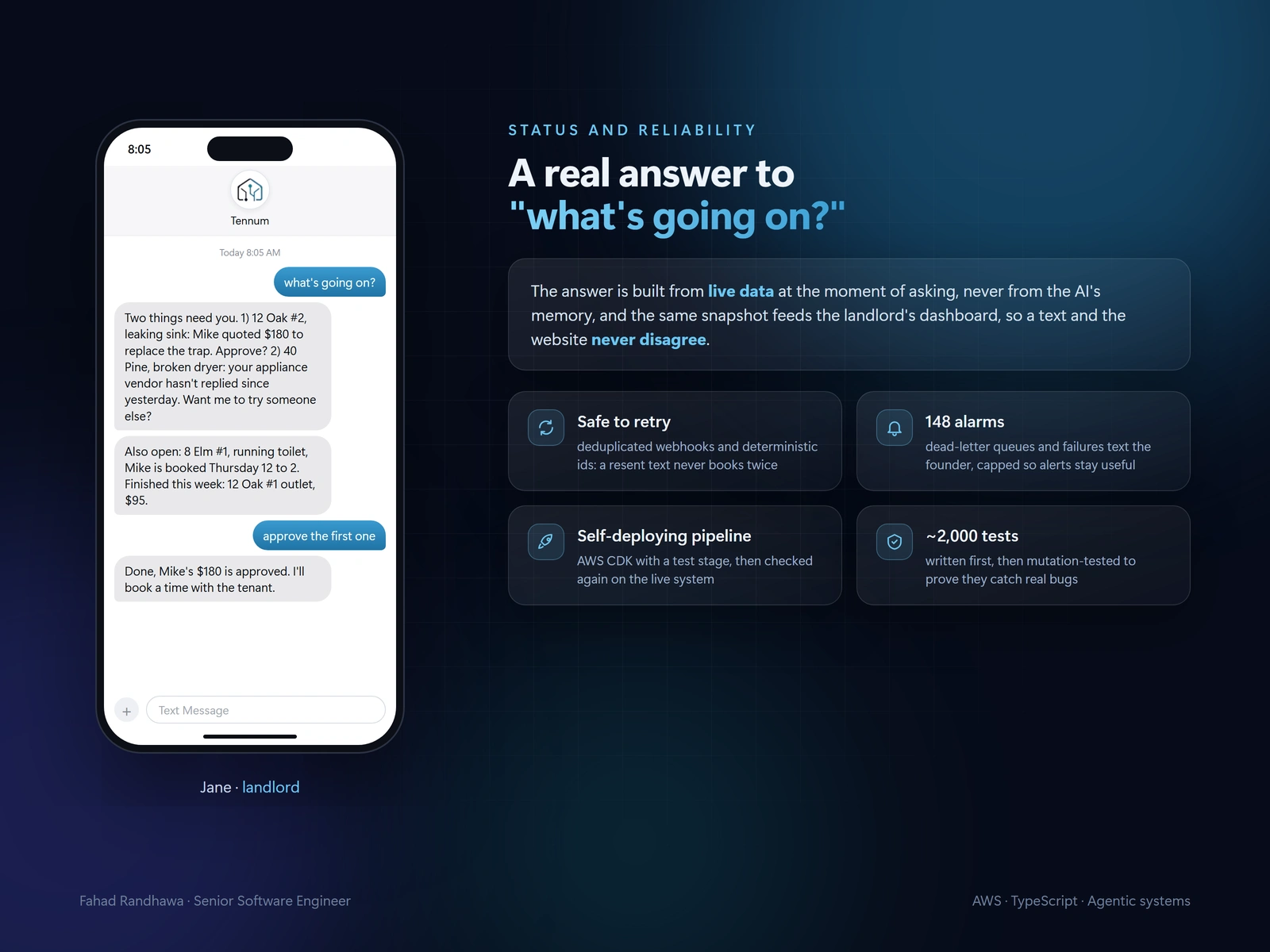
- The website APIs. Cognito-secured endpoints for the landlord's dashboard, sharing one portfolio snapshot with the agent, so a text answer and the website never disagree.
- Operations. 148 CloudWatch alarms, dead-letter queues, capped SMS alerts to the founder's phone, and a self-deploying CDK pipeline with a test stage before the live environment.
Five rules, enforced by code, never by the model
1. Data stays with its landlord. The owner comes from the signed-in token, and every read is checked against it.
2. No vendor contact or cost without authority. Code checks for an approval or a matching rule before anything goes out.
3. The case picks the recipient. Phone numbers come only from records.
4. Nothing consequential happens twice. Deterministic message ids and one decision per reply make retries and duplicate webhooks safe.
5. No case goes quiet. Every case write is validated, and the scheduler chases anything overdue.
How I worked
- Test first. Each fix had a test shown failing before the change, then mutation testing to prove the tests catch real bugs. About 2,000 automated tests across 9 services.
- Independent reviews. Every change got a two-pass review covering every path into a rule, not just the diff.
- Verified live. After every deploy I read the result back from the live AWS environment (code, tables, routes, permissions) rather than trusting a green pipeline.
Outcome
- Texting runs live on real phones: a tenant reports a repair, the case opens, and the landlord is asked whether to contact the vendor, within seconds.
- The full repair flow, approvals, standing rules, follow-ups, consent, photos and alerting are deployed to the live pilot environment.
- At the founder's request, I closed out with a written handoff in the repository. It covers setup and deployment, every service and secret, how the system works, a strict feature-by-feature gap list against the spec, known issues and running costs. I also gave a recorded walkthrough, so the founder could take the product forward himself.
By the numbers: 21 Lambda functions · 27 DynamoDB tables · ~2,000 automated tests · 148 CloudWatch alarms
1 like · 0 views · Nov 14, 2026
An AI texting assistant on AWS that coordinates rental repairs between tenants, landlords and vendors, with every safety rule enforced in code, not by the model


