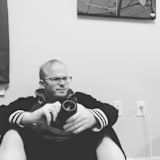
Achieving a World Record: 777 Films in a Year

Zachariah Swope

(This article serves as a portfolio sample demonstrating storytelling, SEO writing principles, and social media strategy. It explores the discipline and purpose behind achieving a unique world record.)
Most people picture a movie-watching record as endless popcorn and cushy seats, a dream for any movie lover. The popcorn part was true. The rest was anything but. Achieving the Guinness World Record for Most Films Seen in a Cinema in One Year required more grit, structure, and mental endurance than I ever expected. It was less about entertainment and more about structure, stamina, and showing up even when I didn’t feel like it.
Between July 5, 2022, and June 30, 2023, I watched 777 films in theaters. That number beat the previous record, but this wasn’t just about chasing a certificate. I took on the challenge to bring attention to two causes I care deeply about: autism awareness, and suicide prevention through the American Foundation for Suicide Prevention (AFSP). That purpose kept me grounded when the routine became exhausting, repetitive, or just plain hard.
II. The Gauntlet: Discipline Beyond the Screen
This wasn’t something I pulled off just because I had free time or liked movies. It took discipline every single day. Guinness has strict guidelines, and if you don’t follow them exactly, your attempt gets thrown out. That meant treating this less like a casual hobby and more like a second job layered on top of my full-time one.
Strict Rules: No Shortcuts, No Distractions
Every movie had to be watched from the very first logo to the final credit roll. No skipping trailers. No leaving early. It didn’t matter how many times I’d already seen the movie. I saw Puss in Boots: The Last Wish 47 times, for example. That was just part of the deal. Phones stayed off. No texting. No bathroom breaks. No drifting off, even in a quiet matinee after a long day. I had to stay fully present, every time.
Proof or It Didn’t Happen
It wasn’t enough to just watch the movies. I had to document everything. That meant keeping every ticket stub, writing detailed logs, and getting witness statements from theater staff. Miss one piece of evidence, and it could jeopardize the entire record. It forced me to develop systems and stay organized, even on days when I was running on fumes. In a strange way, it reminded me of professional work environments where precision and consistency matter. You can’t just “sort of” do something. It has to be exact.
Stacking on Top of a Full Work Week
The most exhausting part wasn’t the movies. It was fitting them in around a full-time job. I worked standard Monday through Friday hours. Most days, I’d clock out in the afternoon, grab a quick bite, then head straight to the theater for two or sometimes three back-to-back screenings. Weekends were even more intense. I had to schedule everything out carefully, down to the minute, just to make it all work. If something unexpected came up, I had to adjust fast. There were no off days. This wasn’t binge-watching. It was a carefully managed, high-pressure routine that required structure, mental focus, and a whole lot of stamina.
III. Purpose Over Comfort: Why I Kept Showing Up
There were plenty of moments when it would’ve been easier to stop. Nights when I felt burned out or emotionally flat. Mornings when the idea of another dark theater felt like a weight. What got me through those moments wasn’t adrenaline or love of cinema. It was purpose.
This record attempt wasn’t random. It was built around a cause I care deeply about. As someone on the autism spectrum, I wanted to use this project to create visibility and conversation. At the same time, I committed the effort to suicide prevention in memory of people I’ve lost and in support of those still struggling. The American Foundation for Suicide Prevention became a natural partner in this goal.
Knowing that each film viewed and each hour logged was part of something bigger gave the effort meaning. It helped me stay focused on the larger picture. That motivation was the fuel I relied on when the process felt mechanical or tiring. It transformed the grind into a mission.
This wasn’t just about breaking a record. It became a long-form statement about persistence, visibility, and the potential to connect storytelling with advocacy.
IV. What the Theater Taught Me About Professional Discipline
The process taught me more than how to pace myself through a year of movie marathons. It built habits that carry directly into my work as a content creator and strategist.
1. Precision Creates Trust
Guinness requires proof, and proof means every detail must be accurate. That forced me to refine how I track, store, and review information. In my professional writing, that same skill shows up in SEO optimization, editorial calendars, and fact-based content. Accuracy isn’t optional. It’s a baseline.
2. Time Management Isn’t a Concept. It’s a Practice
I didn’t get more time. I just used it more intentionally. Working a full-time job while watching 15 to 20 films a week made planning non-negotiable. That structure sharpened my approach to content workflows, revision timelines, and campaign deadlines. If you don’t have a system, the work slips.
3. Purpose Creates Energy
There’s a reason burnout didn’t win. Every time the process felt heavy, I reminded myself who I was doing this for and why it mattered. The same principle applies to creative projects. When the “why” is clear, the work becomes sustainable, even when it’s hard.
V. Reel Impact: What This Record Means Beyond the Certificate
This challenge was never just about movies. It was about what happens when you commit to something fully, tie it to purpose, and follow through no matter how inconvenient it gets.
The record is real, and I’m proud of it. But I’m even more proud of what it taught me: how to structure a goal, manage a project over a long timeline, and keep showing up with focus, even when results take time. That’s what makes content effective; not just words on a page, but purpose backed by execution.
Today, those same habits shape how I build SEO content strategies, lead long-form storytelling projects, and maintain consistency in voice and vision. Whether the goal is a better organic ranking or a message that genuinely connects, the same skills apply: discipline, structure, and intention.
Tags
Welcome to a showcase of strategic social media planning! As a content creator passionate about connecting unique narratives with their audiences, I believe even a developing movie concept can benefit from a clear, intentional social media presence.
This post outlines a speculative social media strategy for my own developing movie script, ‘The Way You See Me.’ It’s a character-driven dramedy exploring an autistic man’s journey through dating, self-ableism, and the search for authentic connection.
Below, you’ll find a breakdown of the film’s core concept, target audience, my chosen platform strategy, distinct content pillars, and concrete examples of social media posts. Each element is designed not only to build an engaged community around the film’s important themes but also to highlight its inherent marketability. This showcases my strategic mindset and creative approach to promoting character-driven movies.
I. Introduction of ‘The Way You See Me’
Title: “The Way You See Me”
Logline: An introspective autistic man navigates modern dating while confronting internalized ableism, seeking genuine connection in a world that often demands conformity.
Genre: Dramedy / Indie Drama with romantic elements.
Core Themes: autism, authentic representation, the challenges of dating on the spectrum, internalized ableism, the search for belonging, and the journey to self-acceptance.
Target Audience:
Young adults (late 20s-30s) interested in character-driven stories.
Neurodivergent individuals and their allies.
Fans of indie films that explore nuanced emotional journeys (for fans of movies that explore connection with the sincerity of The Princess Bride or the introspection of The Truman Show).
Those interested in discussions around mental health, self-ableism, and authentic relationships.
Social Media Goals for This Film:
Build an engaged community around the film’s core themes even before production.
Generate authentic conversation about neurodiversity, dating, and self-acceptance.
Highlight the film’s unique perspective and its market potential as a fresh, representative story.
Attract interest from those who champion diverse and meaningful storytelling.
II. Platform Strategy
For ‘The Way You See Me,’ a multi-platform approach focusing on visual storytelling, community engagement, and thematic discussion would be most effective. I’ve selected Instagram, Twitter/X, and TikTok as primary channels, each playing a distinct role in connecting with our target audience:
Instagram: Ideal for visual storytelling, character mood boards (using Auden’s movie inspirations or River’s photography style), poignant quotes from Auden’s journal or Zeke’s wisdom.
Twitter/X: Perfect for fostering discussions on the film’s themes (self-ableism, dating norms, masking), sharing relevant articles, and engaging with advocacy communities.
TikTok: Great for short, relatable snippets; Auden’s internal monologues, awkward dating moments (like with Carrie), or even Zeke’s pithy advice.
Optional: Facebook groups for community building, Reddit for AMA-style discussions with me as the writer about the themes.
III. Content Pillars & Sample Posts
With these platforms in mind, the next step is to define the core content themes, or pillars, that will guide our social media narrative and allow us to connect authentically with our target audience. Here are some key pillars and sample posts:
1. Pillar: #MeetAuden (Introducing the Protagonist)
Sample Instagram Post (Static Image):
Visual: A stylized flat lay photo featuring Auden’s red Moleskine journal, a copy of Jurassic Park (a well-loved DVD), and a pair of headphones.
Caption: Meet Auden. His emotional language? Movies. His confidant? This red journal. Dive into his world in ‘The Way You See Me,’ a story about an autistic man seeking connection in his late 20s. What movies form your “emotional architecture”? #TheWayYouSeeMe #AudenWilder #AutismInFilm #CharacterIntro #JurassicPark”
Strategic Rationale: This post aims to visually introduce Auden through his key symbol and interests, creating immediate intrigue. By asking an engaging question related to how audiences connect with movies, it starts building a community around shared emotional experiences.
Marketability Angle: Showcasing a protagonist with unique, endearing traits and a love for iconic films can draw a specific, passionate audience interested in character-driven narratives and relatable nostalgia, signaling a clear target demographic.
2. Pillar: #DatingOnTheSpectrum (Exploring a Core Theme)
Sample Twitter/X Post (Text-Based):
Text: Auden’s date with Carrie in ‘The Way You See Me’ is a masterclass in “trying to play the game” when the rules feel written in another language. He blames himself for being autistic. How do we combat self-ableism in dating, especially for neurodivergent individuals? #TheWayYouSeeMe #AutismAndDating #SelfAbleism #NeurodiverseLove
Strategic Rationale: Sparks discussion, positions film as conversation starter.
Marketability Angle: Taps into existing conversations, highlights authenticity.
3. Pillar: #WisdomOfZeke (Highlighting Supporting Character & Theme; Adapted from Video)
Sample Instagram Post (Quote Graphic):
Visual: A bold graphic over a gritty, urban backdrop, featuring Zeke’s quote: “The movies ain’t fake, kid. They’re just honest in a way life’s scared to be.” Attribute it to Zeke – ‘The Way You See Me’.
Caption: Straight wisdom from Zeke. Sometimes truth comes from the most unexpected voices. ‘The Way You See Me’ explores finding clarity and connection in the everyday. What unexpected wisdom has shaped your view? #TheWayYouSeeMe #Zeke #MovieQuotes #LifeLessons #IndieFilm #CharacterQuotes
Strategic Rationale: Uses a powerful quote to convey a film theme through a memorable supporting character. Quote graphics are highly shareable on Instagram and can spark reflection.
Marketability Angle: Highlights strong, quotable dialogue and memorable supporting characters, which increase a film’s depth and potential for fan engagement.
4. Pillar: #TheDelanyMirror (Exploring Relationships & Self-Acceptance; Carousel)
Sample Instagram Carousel Post (Series of Static Images/Text Graphics):
Slide 1 (Visual): A warm, candid-style photo representing Delany (or a symbolic image of an anchor). Text overlay: “Delany: The Anchor.”
Slide 2 (Text Graphic): Auden’s VO quote: “I thought if I was quiet enough, agreeable enough, maybe someone would choose me. But I was already someone worth choosing.”
Slide 3 (Visual/Text): A symbolic image representing platonic love or clarity. Text: “Her profound, non-romantic love is the mirror Auden needs for self-acceptance. ‘The Way You See Me’.”
Caption: It’s not always romantic love that changes us. Sometimes, it’s the friend who sees us clearly. Delany’s role in Auden’s journey in ‘The Way You See Me’ explores the power of acceptance in finding oneself. #TheWayYouSeeMe #FriendshipGoals #SelfAcceptance #Neurodiversity #PlatonicLove
Strategic Rationale: Explores nuanced relationship, promotes emotional intelligence of the film.
Marketability Angle: Appeals to audiences interested in complex relationships, positions film as emotionally mature.
5. Pillar: #UnderstandingSelfAbleism (Educational/Insightful Content)
Sample Facebook or LinkedIn Post (Text-Heavy with a Simple Graphic):
Visual: A simple, clean graphic with the term “Self-Ableism” and a brief definition or a question mark.
Copy: What is self-ableism? For many autistic individuals, like Auden in ‘The Way You See Me,’ it’s the internalized belief that their autistic traits are flaws to be hidden or “fixed.” It’s that voice saying you’re “too much” or “not enough.” Our story aims to shed light on this often unspoken struggle and the journey towards self-acceptance. What does authentic representation of such internal conflicts mean to you? #TheWayYouSeeMe #SelfAbleism #Autism #MentalHealthAwareness #RepresentationMatters
Strategic Rationale: This post educates the audience on a core theme of the film, positioning the project as thoughtful and socially conscious. It invites deeper engagement on platforms like Facebook or LinkedIn where longer discussions can thrive.
Marketability Angle: Demonstrates the film’s potential to contribute to important social conversations, attracting audiences interested in meaningful content and potentially garnering press or festival attention for its thematic depth.
6. Pillar: From the Writer’s Desk
Sample Instagram Post (Image + Caption) or Twitter/X Thread:
Visual: A photo of conceptual writing space. A notebook, a pen, maybe some movie memorabilia that inspired Auden’s character.
Caption/Tweet 1 (of a thread): Crafting Auden’s voice for ‘The Way You See Me’ has been a journey into understanding the nuances of masking and the deep yearning for genuine connection that many autistic individuals experience. It’s more than just a script; it’s an exploration… (continue for a few tweets if a thread).
Strategic Rationale: This “behind-the-scenes” approach from the writer builds a personal connection with the potential audience, fostering trust and authenticity around the project’s development.
Marketability Angle: Showcases the writer’s passion and commitment to the story, which can be a compelling factor for industry professionals looking for projects with a strong, authentic voice behind them.
V. Conclusion: Connecting Story with Audience
In essence, this social media strategy for ‘The Way You See Me’ demonstrates a clear path to cultivating an engaged community around its poignant themes of autism, self-ableism, and the quest for genuine connection. By leveraging targeted platforms, distinct content pillars, and authentic sample posts (as illustrated above), this approach is designed to spark meaningful conversation, showcase the film’s unique market appeal, and ultimately prepare ‘The Way You See Me’ to resonate deeply with its intended audience. It underscores the potential for thoughtful, character-driven stories to find their place and make an impact when supported by an equally considered and authentic online presence.
Like this project
Posted May 13, 2025
Achieved a world record by watching 777 films in a year, raising awareness for autism and suicide prevention.
Likes
0
Views
8
Timeline
Jul 4, 2022 - Jun 29, 2023