Social Media Strategy for 3isfor | Rebrand Launch and Awareness

Maia Anderson Rembert

I joined 3isFor as a freelance social media strategist to bring structure to a growing brand ecosystem spanning the For Good Podcast, apparel, and future initiatives.
During an approximately 2½-month engagement, I audited the podcast’s existing social performance, built its strategic foundation and reporting infrastructure, and helped the team identify the operational gaps standing between ideas and execution.
THE ENGAGEMENT AT A GLANCE
Completed a cross-platform social media audit using historical data that primarily predated my engagement
Authored the For Good Podcast’s organic social media strategy across Instagram, TikTok, YouTube, Threads, and LinkedIn
Built a reporting dashboard with weekly, monthly, quarterly, annual, and campaign-level views
Developed a 45-day organic social launch strategy for For Good’s first apparel drop
Created profile optimization and rebrand recommendations for the 3isFor Instagram presence
Built a Notion-based content strategy workspace and trained the team on how to use it
Identified workflow, access, ownership, and creative-production gaps that were limiting execution
Important context: The engagement ended before the strategy could be fully implemented and measured. Historical audience and performance figures are treated as the baseline I analyzed, not as results I produced.
THE CHALLENGE
3isFor was developing a connected brand universe: the For Good Podcast hosted by JoJo and Vanessa Simmons, a purpose-led apparel line, and future initiatives. The team had strong creative talent, recognizable founders, an established podcast audience, and meaningful partnerships. What it lacked was a shared social media operating system.
The work surfaced four connected challenges:
Strategy: The podcast, parent brand, and apparel initiatives needed clearer roles instead of competing or duplicating one another.
Measurement: Analytics existed across Metricool and native platforms, but there was no consistent reporting cadence or central dashboard for decision-making.
Operations: Social planning and creative production moved on different timelines, with unclear handoffs, ownership, and approval paths.
Access: Meta, TikTok, YouTube, LinkedIn, Linktree, and shared-file access issues repeatedly limited analysis and execution.
My role was to assess what already existed, define the strategic direction, and build enough structure for the wider team to execute consistently.
THE BASELINE I INHERITED
The first step was understanding the performance the brand had already generated. Using Metricool data from December 1, 2025 through February 28, 2026—a period that primarily predated my mid-February start—I documented an existing organic audience of 17.32K Instagram followers, 13.9K YouTube subscribers, 1,372 TikTok followers, and 155 Threads followers for the For Good Podcast.
Those figures were not outcomes of my work. They gave me the evidence needed to identify what the team should protect, improve, and systematize. The audit showed that:
Instagram Reels were the podcast’s strongest repeatable format.
Emotional, family-centered storytelling generated deeper interaction, while celebrity associations expanded discovery.
TikTok was showing early momentum and needed consistent access and publishing.
JoJo and Vanessa’s personal audiences were significant—but underused—amplification opportunities.
YouTube performance tracked closely with publishing consistency, making Shorts an obvious low-lift distribution opportunity.
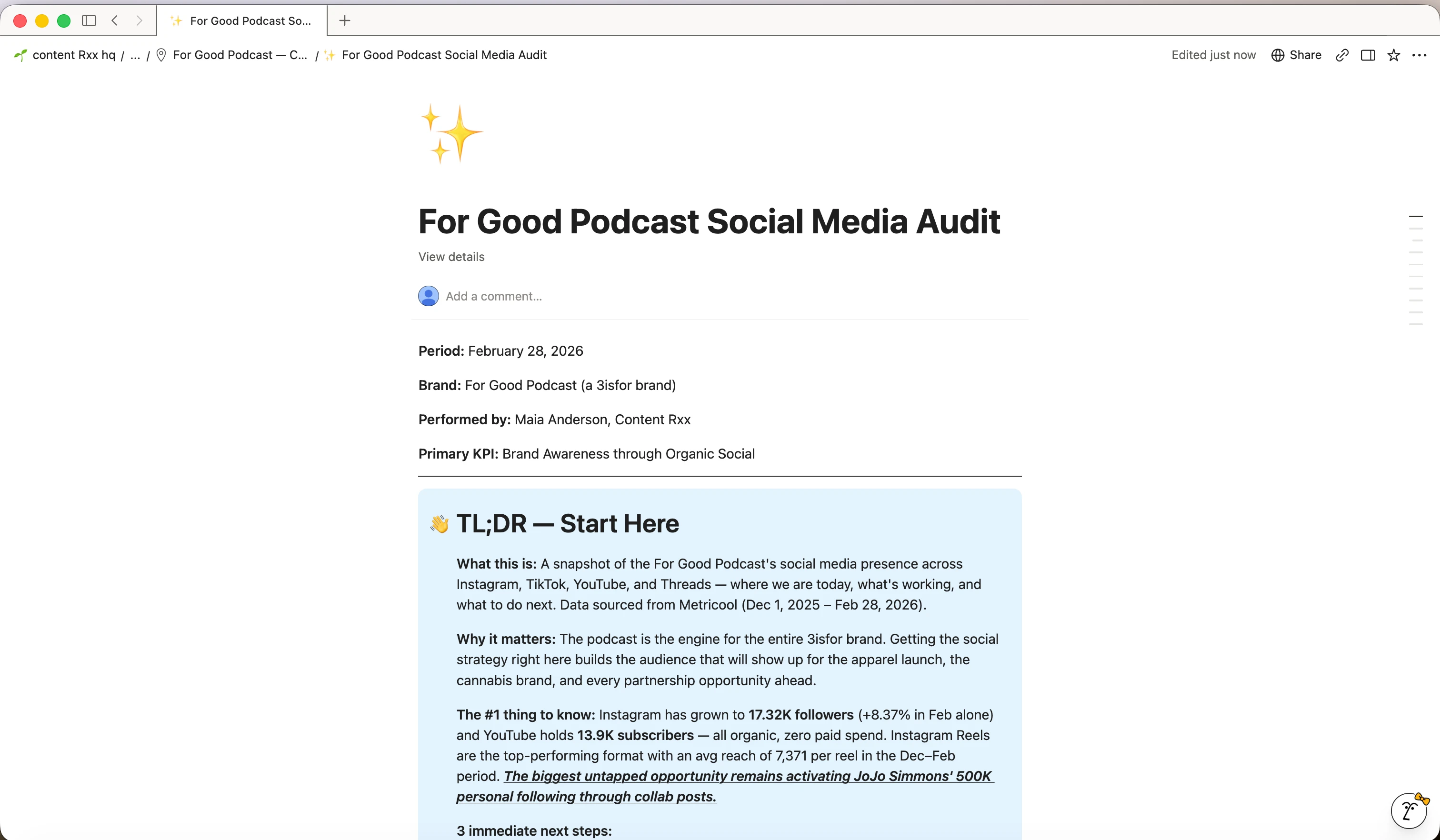
custom audit shared with team through notion
HOW I WORKED
I worked as an embedded strategist within a cross-functional team—not as the person independently creating and publishing every post.
I partnered with Amari on social execution and analytics inputs; Danica on storytelling, podcast production, and approvals; Brian on the relationship between marketing, paid media, and organic social; Kelly and other creative partners on production feasibility; and Sherra, Caitlin, the founders, and operational leads on priorities, access, and decision-making.
That collaboration mattered because the problem was larger than content ideas. Strategy depended on knowing who owned the decision, who had platform access, when creative could realistically be produced, and how podcast, merchandise, partnerships, and founder visibility fit together.
My approach was to:
Audit the existing audience, content, channels, and workflows.
Turn the findings into a clear organic social point of view.
Translate that strategy into reporting, campaign, and content-planning systems.
Surface blockers directly rather than quietly building around them.
Give the team practical tools it could continue refining after handoff.
WHAT I BUILT
A cross-platform audit that separated signal from noise
I analyzed historical performance across Instagram, TikTok, YouTube, and Threads, documented the strongest content patterns, clarified the role of each platform, and translated the findings into prioritized recommendations. The audit established brand awareness as the organic social north star while acknowledging that podcast downloads were not yet connected to the reporting system.
The For Good Podcast’s organic social strategy
I created a strategy that defined how the podcast should show up, what each platform should do, how one episode could become a larger content ecosystem, and how the team could use JoJo, Vanessa, and guest collaboration posts more intentionally. The strategy also added community-oriented formats so the brand would not rely exclusively on promotional episode clips.
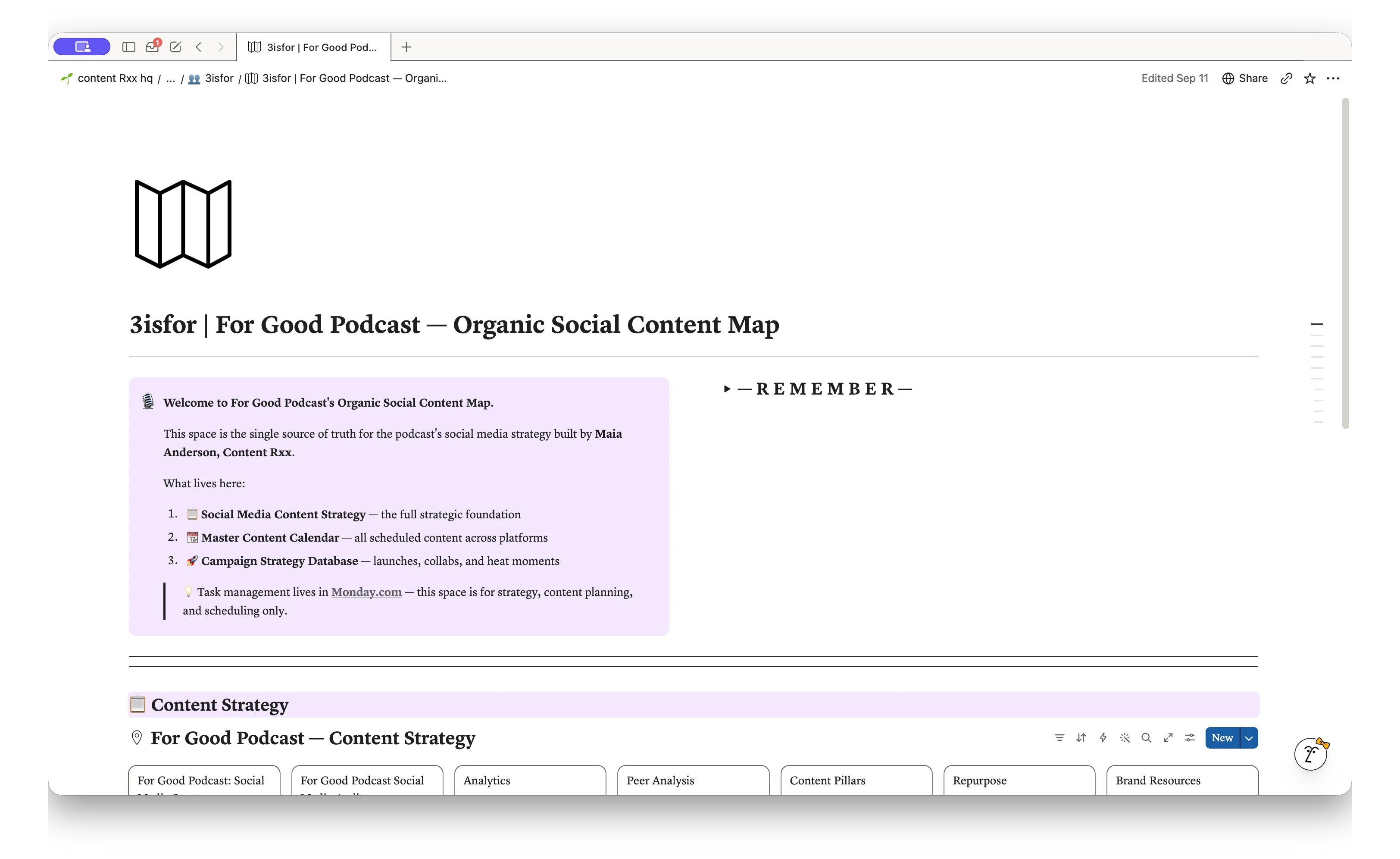
custom notion social media dashboard created for cross functional planning & overview
Reporting infrastructure for decisions—not vanity metrics
I built a central analytics dashboard with weekly, monthly, quarterly, annual, and campaign views. It was designed to combine Metricool data with native-platform and podcast-download inputs, create a repeatable reporting cadence, and help social, storytelling, marketing, and leadership work from the same source of truth.
Because much of the available data predated my engagement, the value of this work was the infrastructure and analysis—not claiming the historical reach as my result.
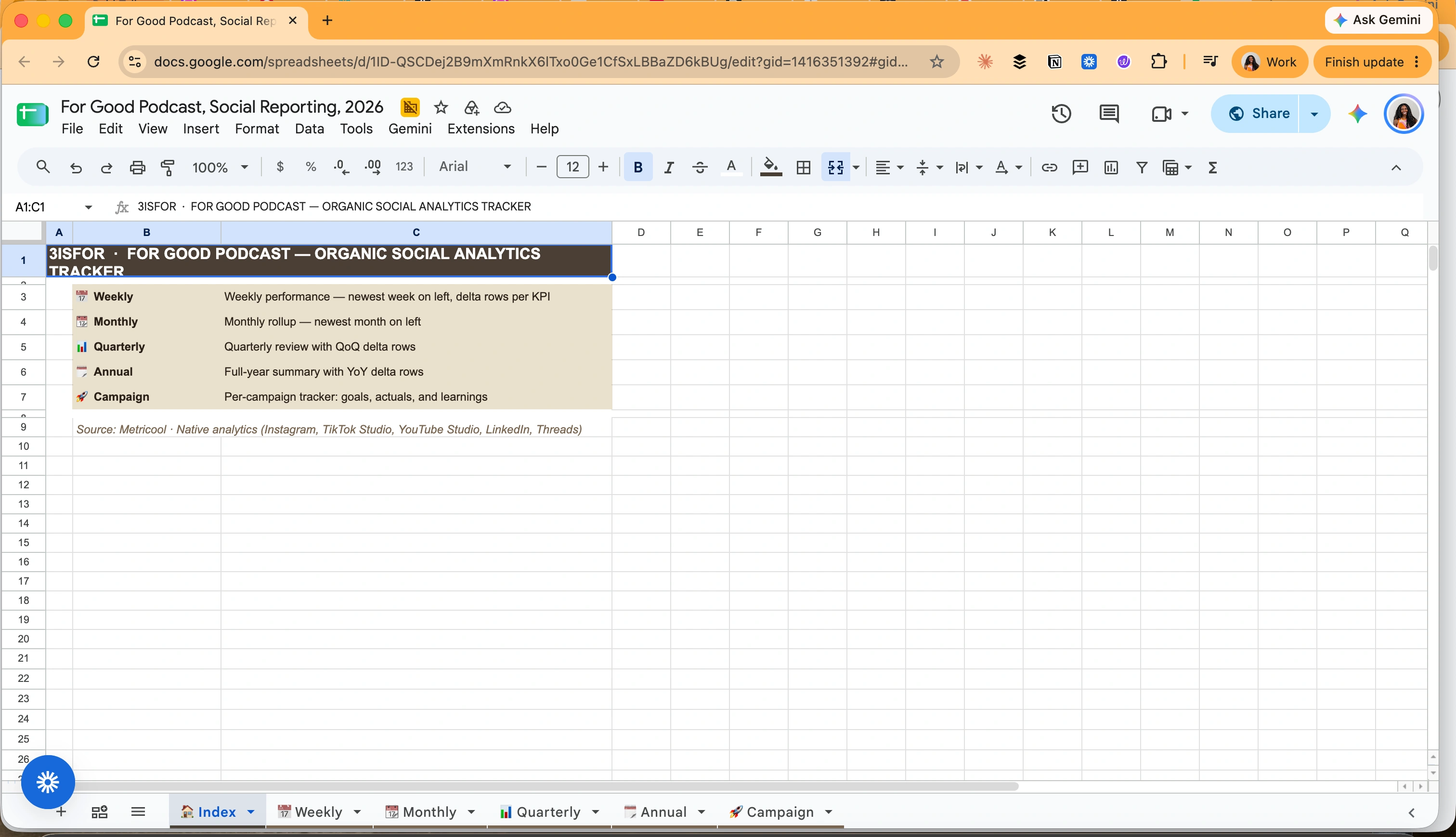
custom spreadsheet created to track social metrics so they're data that can be analyzed well
Organic launch strategy for Drop 01
I developed a 45-day social plan for the first For Good apparel drop, including pre-launch, launch, and post-launch phases; content cadence; founder and partner amplification; platform roles; creative requirements; and community touchpoints. The drop connected Naughty by Nature’s “OPP” legacy with the Last Prisoner Project and a 4/20 block-party moment.
The strategy was completed and reviewed, but execution was affected by shifting launch decisions, missing or delayed social-ready creative, and later pauses in the broader apparel plan. That distinction matters: I built the campaign framework, but I do not claim outcomes the team did not have time to generate or measure during my engagement.
Channel and brand-ecosystem recommendations
I challenged the idea that every arm of the business needed to communicate in the same way. I recommended clearer jobs for the parent brand, podcast, and shop; profile and pinned-post improvements; stronger handle consistency; dedicated link infrastructure; and intentional pathways between podcast audience growth and the products or initiatives 3isFor planned to launch.
A usable content workspace—and team enablement
I built a Notion-based content strategy environment with the audit, channel strategy, content planning, campaign resources, and calendar structure in one place. I also led a team tutorial covering the content calendar, database views, documentation, and practical workflow so the system was not dependent on me being the only person who understood it.
WHAT CHANGED DURING THE ENGAGEMENT
This was a foundation-building engagement rather than a completed growth case study. By the end of the work:
The team had a documented organic social strategy instead of relying only on inherited habits and weekly episode promotion.
Historical analytics had been translated into an actionable baseline and a repeatable reporting structure.
The podcast had clearer platform roles, content opportunities, and amplification recommendations.
Social’s creative and operational dependencies were visible enough to address directly in planning conversations.
The team had a centralized Notion workspace and training for continued use.
A launch-ready organic campaign framework existed for the first apparel drop, even though broader business changes limited its full execution.
These are the outcomes I can stand behind: strategic clarity, infrastructure, documentation, and a stronger shared understanding of what consistent execution would require.
HOW THE ENGAGEMENT ENDED
The role was originally structured as a 12-month contract. Approximately 2½ months in, 3isFor underwent a company restructuring and ended the engagement early.
At that point, I was still refining the analytics reporting system and supporting implementation across the podcast and apparel work. The shortened timeline meant there was not enough time to fully deploy the strategy, establish a clean post-strategy measurement period, or attribute audience growth and reach to my work.
What I left behind was the strategic foundation: the audit, organic social strategy, reporting dashboard, campaign plan, channel recommendations, content workspace, and documented operational gaps the team would need to solve to execute well.
Like this project
Posted Sep 16, 2026
Built 3isFor’s social strategy, analytics dashboard, campaign plan, and Notion content system: turning scattered efforts into a clear operating foundation.
Likes
1
Views
46
Timeline
Feb 16, 2026 - May 1, 2026
Clients
3isFor