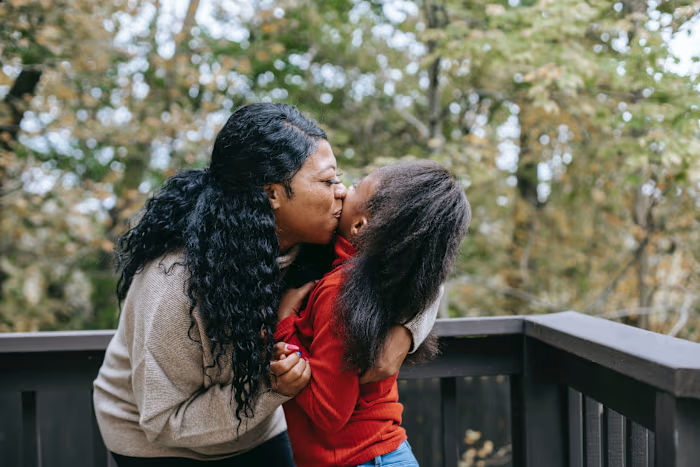
Setting Healthy Boundaries with Your Child

Emily Koczur

Wondering how to set boundaries with your child—especially without using punishments or rewards?
You’re not alone.
Many parents struggle with boundaries, especially if they weren’t taught how to set or stick to them growing up.
If you’re a people-pleaser or someone who often says yes to others and no to yourself, boundary-setting can feel darn impossible.
But it’s a skill you can learn—and it’s one of the most powerful tools you can offer your child.
In this post, you’ll learn how to talk to your child about boundaries and set clear, age-appropriate limits that foster connection and reduce unwanted behavior.
Boundaries are personal rules for how we engage with others—and they vary from person to person.
Navigating those differences is hard for adults, let alone kids.
Healthy boundaries act as a safety net. They protect us from unwanted behavior, help us guard our emotional energy, and reinforce our right to control our own bodies.
Teaching children how to set and respect boundaries equips them to protect their well-being and advocate for themselves.
And as a parent, honoring your own boundaries helps you protect your peace, too.
Talk to your child about the concept of boundaries.
Four ways to do that are:
Use the word “boundaries”
Point out real-life examples
Practice with pretend scenarios
Model healthy boundaries
Introduce your child to the concept of boundaries by talking about them and say the word itself.
Boundaries.
What are they? How can they be helpful? (Reread the above section again if you’re unsure of how to respond!)
Define it in a way your child can understand.
Use shows like Bluey, books, or everyday moments to show your child what boundaries look like (and what lack thereof looks like).
Role-play common situations, like saying:
“No, thank you” to unwanted hugs
“Please don’t touch my things.”
“I need space right now.”
“I don’t like being tickled.”
“That hurts my feelings.”
Learn how to apply healthy boundaries for yourself.
How to set boundaries with your child in a healthy way
Learning how to set boundaries with your child takes time and patience.
It might even be the most challenging relationship in which to practice this skill, so give yourself some grace as you learn and model it!
Here’s a quick cheat sheet for setting healthy boundaries with young children:
Let them know you’re practicing. “I’m learning how to set boundaries, too.”
Stay firm on non-negotiables: Safety and respect are not up for debate
Be flexible with the rest: For negotiables, invite their input and work together
Explain the “why:” Help them understand the reason behind the limit
Be consistent: Repetition helps boundaries stick
Use consequences, not punishments or rewards: Natural and logical consequences teach better than bribes or threats
Children are little sponges—they absorb everything we say, even the quiet stuff. No matter their age, you can start talking with them about boundaries.
Let them know you’re trying something new—something consistent and firm—because you value your relationship and want to help both of you grow this important skill.
For example, if your child asks for a second cupcake and you say no, you can say:
“I’ve been thinking about how I handle some things with you. I’m going to start practicing being more consistent with these rules.”
“I want to try something different. Before, I might have let you have another cupcake sometimes, but from now on, it’s just one after dinner.”
This openness helps your child understand the changes and shows you’re working on boundaries together. (And that openness is a key component of gentle parenting).
One of the best ways to practice setting boundaries with your child is by focusing first on the non-negotiable limits—those with little to no wiggle room.
You know – the 8 o’clock bedtime, not jumping on you when you’re sore, and no yelling during arguments.
For instance, if bath time is at 7:00 (and you need the time after they go to bed for you/work/etc.), you turn on the water whether your child feels ready or not.
Setting these firm boundaries creates predictability and helps your child feel safe and secure.
Knowing how to set boundaries with your child also means learning when to be flexible.
It might seem counterproductive, but giving a little wiggle room can actually support their growth.
You’ve probably heard the advice to “choose your battles wisely”—and it applies here. 100% here.
For example, say your child has a 45-minute video game limit with a timer set. When the timer goes off, they’re supposed to stop playing, but sometimes they don’t.
Do you immediately argue with them to turn it right off?
Or do you help them learn time management with gentle reminders?
This balance is important and nuanced.
Allowing flexibility shows your child that not everything is black or white, just like adults sometimes struggle to stop what they’re doing when fully engaged.
Other examples include:
Bedtime routine: While weekdays may be firm, maybe you allow 30 extra minutes on weekends
You give them more screen time if they are watching something educational – or are just having a blast
Think food – you set rules about healthy meals, but might allow occasional treats or let your child decide between healthy options
One key to setting clear boundaries with your child is explaining the reasons behind your rules.
Kids want to understand why rules exist or why you say no to their requests.
Instead of brushing it off, use their curiosity as a chance to explain calmly and clearly.
“I said no to jumping on my bed because I need quiet and stillness right now.”
“Too much sugar gives you energy at first, but then you’ll feel tired. I want you to feel good when we visit your friends later.”
“We’re only buying what’s on the list because that’s what we planned.”
Your child doesn’t have to fully agree with every reason, but they do need to respect it—just like adults honor each other’s boundaries.
Consistency is key when learning how to set boundaries with your child. Avoid flip-flopping on inflexible rules—at least most of the time.
Strive to stay firm, grounded, and calm. Kids often need limits repeated because repetition helps their brain develop and understand expectations.
So, when your patience is tested, remember that sticking to boundaries consistently is part of helping your child learn and feel secure.
When teaching boundaries, it’s important to emphasize consequences.
Not punishments or rewards.
Punishments—like shame, guilt, or taking things away—make a child feel bad but don’t teach accountability.
Rewards might get compliance in the moment but can reduce your child’s internal motivation to respect boundaries over time. This is called the overjustification effect.
Consequences, on the other hand, are the natural outcomes of behavior. They teach responsibility and ownership, helping children understand that their actions have real effects without feeling shamed or bribed.
Learning how to set boundaries with your child takes patience and practice.
Start by openly talking about limits and explaining why they exist. For flexible boundaries, invite your child’s input to make them feel heard and involved.
Boundaries are essential for healthy relationships, and as a parent, you are one of the best role models your child has for setting and respecting them.
Share this post with your friends!
Like this project
Posted Jul 29, 2025
Guided parents on setting healthy boundaries with children.
Likes
0
Views
12