Rebuilding NestLink's Real Estate SaaS Platform

Muhammad Hassan
Verified


NestLink: Bolt MVP to Production in 15 Weeks
Led a three-person team to rebuild a real estate SaaS for production scale.
Demo Video
Banner
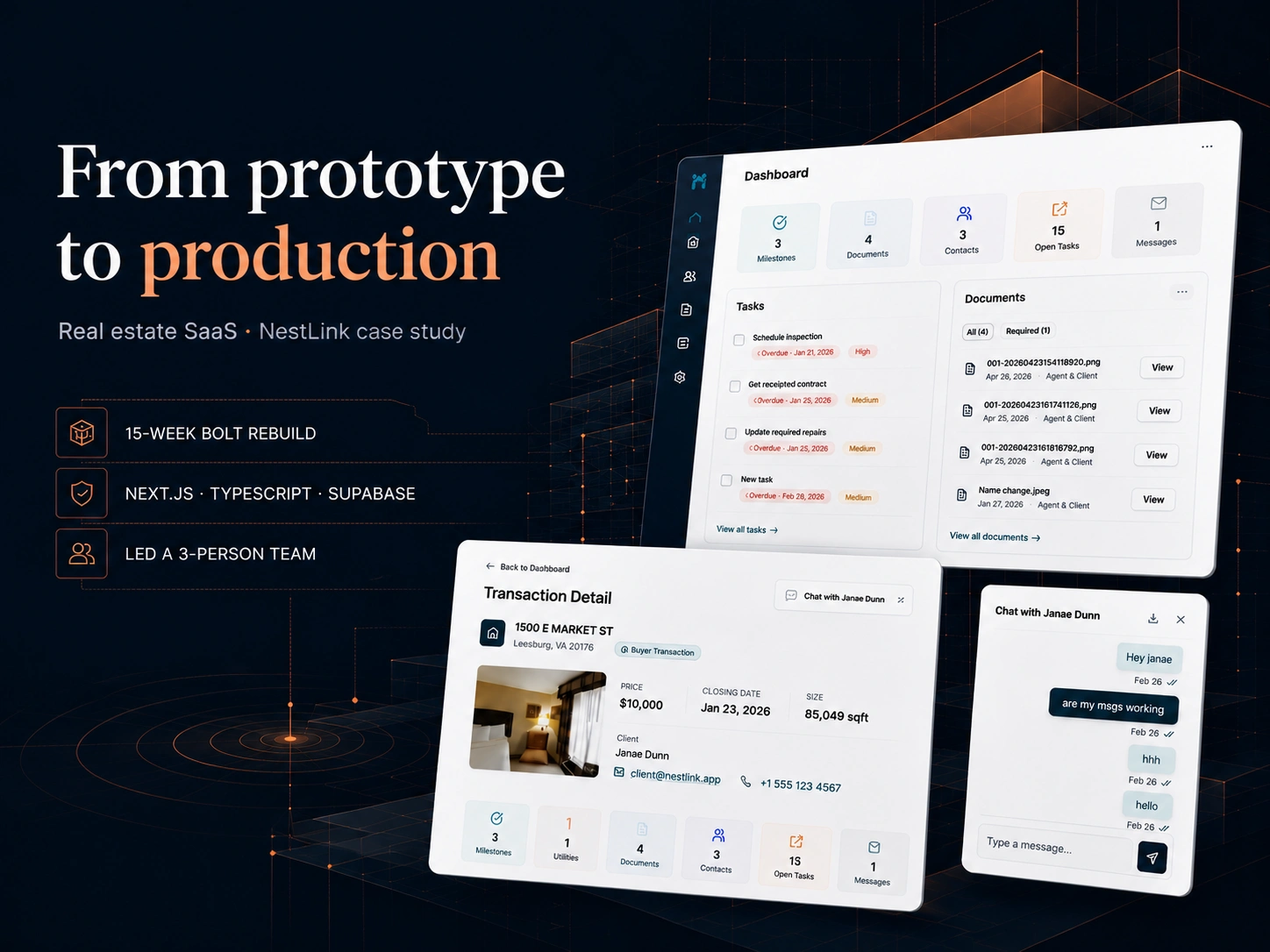
NestLink: Bolt MVP to Production in 15 Weeks
Led a three-person team to rebuild a real estate SaaS for production scale.
The starting point
Janae had built her real estate platform on Bolt to validate the concept. The MVP worked enough to prove the market, but the codebase was held together with duct tape. Auth was wide open. The data model couldn't support multi-tenancy at scale. Real estate agents were starting to ask when they could run their full transaction pipeline on it, and the current code wouldn't survive that load.
She had a choice: keep patching, or rebuild for production. She chose rebuild.
The decision and team setup
I assessed the existing codebase and laid out three paths with honest trade-offs:
Patch and hope. Cheap upfront, expensive every month after.
Selective rewrite of the bottleneck systems. Split outcomes, still ships with technical debt.
Full rebuild with the Bolt prototype as functional spec. Most expensive upfront, cleanest long-term.
We aligned on full rebuild. 15 weeks, milestone-based. I led a three-person team: myself as lead developer making architecture calls, another developer pairing on feature delivery, and a QA specialist running structured testing through Linear.
What I built
A full multi-tenant real estate SaaS with three user roles (Admin, Agent, Client), real estate-specific workflows, and the operational depth required to run actual transactions through it.
Stack:
Next.js, TypeScript, Tailwind for the frontend
Supabase with row-level security policies for multi-tenant data isolation
PostgreSQL for the relational data, with careful indexing on high-traffic queries
Stripe for subscription billing
Google Workspace (Gmail, Calendar) for transaction-related communication and scheduling
What's in the platform:
Admin dashboard with platform-wide metrics, user management, security controls
Agent dashboard with active deals, upcoming tasks, performance metrics
Transaction detail view with financials, closing and possession tracking, key contacts, in-app messaging
Mobile experience with calendar integration, working hours, financial details, document review
Document workflows for purchase agreements, disclosure statements, HOA docs
Notifications system for milestone passes (closing date, effective date, contract date)
Tutorials and onboarding for new agents
The architecture decisions
A few choices worth calling out:
Shared database with RLS policies over schema-per-tenant. Right call for the expected tenant count, simpler migrations, native Supabase support.
Server-side rendering for agent-facing surfaces. SEO doesn't matter, but cold-start performance does for agents loading deal pages mid-call.
Linear-driven sprint cadence with structured code review and QA at every milestone. Slower than cowboy-pushing to main, but production stability was the point.
What shipped
Production-ready platform running real transactions. Multi-tenant, role-based, scalable beyond the original Bolt MVP's structural ceiling.
How I work
I take on rebuilds like this in 12-20 week milestone-based engagements with a small team. If you're sitting on a vibe-coded MVP that's stopped scaling, the right move is usually a structured rebuild before the technical debt costs you more than the rebuild would. I can lead that work.
Like this project
What the client had to say
Hassan has been Nestlink's lead engineer on retainer for over a year. Itemized scoping, no surprise scope creep, clear communication, and shipped the platform to App Store and Google Play. Operates like a partner, not a contractor.


Janae Dunn, NestLink
Jun 12, 2026, Client
Posted May 16, 2026
Took a Bolt MVP to production: multi-tenant real estate SaaS with 4-role RBAC, Stripe billing, Google Workspace. Live on App Store and Play Store.
Likes
2
Views
106
Timeline
Dec 1, 2025 - Apr 19, 2026
Clients
NestLink