Day Zero: Cape Town's Water Crisis and Political Dynamics

Corah Walker

Day Zero and the Politics of Water Scarcity
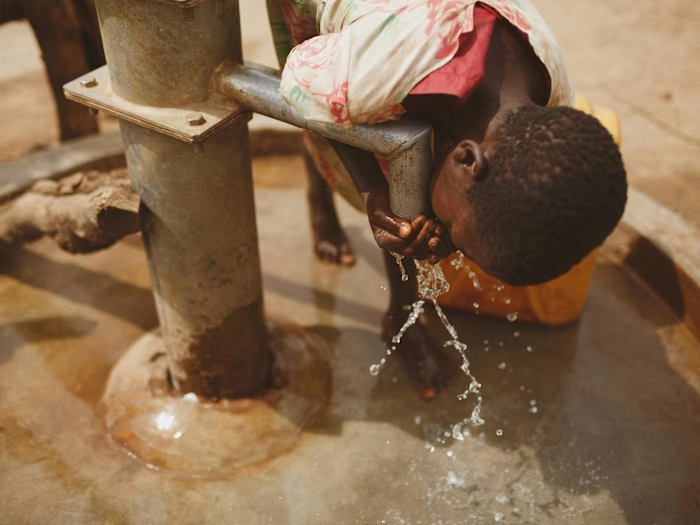
When the world learned that Cape Town—a cosmopolitan city of four million perched on the edge of the Atlantic—might run out of municipal water in 2018, the phrase “Day Zero” leapt from policy white papers into global consciousness. For months, the countdown ticked down in chilling headlines: the day the taps would shut off, the city’s dams would finally empty, and residents would line up at communal collection points under the watch of police or soldiers. Beneath the technical details, Cape Town’s brush with Day Zero tells a deeper story about a political drama that didn’t end when the rains finally came.
As someone whose work has taken me from California’s drought-parched valleys to Cape Town, South Africa, this crisis struck a familiar chord. Water scarcity, I’ve learned, is never just about rainfall or pipes. It is always about who decides, who waits, who adapts, and who is left out when survival is rationed.
Thanks for reading Undercurrents! Subscribe for free to receive new posts and support my work.
Watching a City Hold Its Breath
By the time Cape Town’s mayor announced “Day Zero,” the threat was no longer abstract. What began as a slow-moving drought, a few dry years, transformed into a citywide ordeal. Millions are forced to cut their daily usage to 50 liters, affluent residents lose the sanctuary of gardens and swimming pools, and working-class families face even longer lines at public taps.
At first, the city sought to use information as leverage: publishing an online “water map” to publicly shame high-usage households, and sending officials to install flow restrictors on repeat offenders; all measures aimed at pushing compliance without provoking direct revolt. City boosters argued this was pragmatic crisis management. Critics saw scapegoating as private borehole drilling soared in wealthy suburbs, and informal settlement dwellers, already surviving on the strictest rations, were blamed for broader systemic failures.
The reality was more subtle: the burden of averting disaster shifted from technocrats and politicians to ordinary citizens. As Dr. Gina Ziervogel’s retrospective makes clear, Cape Town’s crisis “shifted the burden of avoiding a water disaster from the city to its citizens.”
Brokers, Bricolage, and Everyday Authority
This scramble to adapt revealed fractures far older than the drought itself. South Africa is one of the most unequal societies on earth, a fact nowhere clearer than in the geography of Cape Town, with its leafy enclaves and crowded townships. While “Day Zero” was billed as a communal risk, the experience of queuing, bartering, or buying extra water exposed legacies of segregation, poverty, and distrust.
Informal brokers emerged, quietly filling plastic jugs at springs or transporting water to where pipes had run dry. As in Cochabamba’s famed Water War, these “invisible infrastructures” played a vital role, understood by those who needed them, ignored or resented by those who could afford to pay their way out.
Tensions spilled into the open: by November 2018, protests at City Hall were dominated by black residents from informal settlements, whose “normal” was always scarcity. For them, the panic of Day Zero was not new, just suddenly visible to the city’s ruling classes.
The Political Life of Scarcity
Around the world, Day Zero became a meme: a warning headline for São Paulo, Chennai, and Los Angeles, places where nature’s volatility collides with human limits. But the politics always play out locally. In São Paulo, taps nearly ran dry when mismanagement and drought collided; in Chennai, short-term monsoon failures exposed decades of underinvestment, corruption, and growing inequality.
Los Angeles, facing its own drought, saw rural communities suffer while the metropolis leveraged money and political muscle to ensure the city’s pipes kept flowing. Infrastructure investment, data-driven management, and public trust—in short supply in Chennai, contested in São Paulo, deployed but unequally in Los Angeles—became the axes on which fate turned.
What these stories share is a transformation. Water, usually invisible, emerges as the substance of politics, exposing how decisions are made and whose futures matter.
What Can Be Done
Cities facing their own Day Zero moments can draw several lessons, not only technical, but political:
Center Equity: Make social vulnerability, not just average consumption, the measure of resilience. Keep lifeline access affordable and guaranteed, especially for those who already live with scarcity.
Decentralize and Diversify: Invest in a polycentric mix of water sources—such as stormwater capture, groundwater, rain tanks, and recycled water—so that failures in one system do not doom the entire city.
Engage Communities as Partners: From township networks to neighborhood water committees, treat local knowledge and informal systems as assets, not obstacles. Invite them to the table, not only when counting losses but when planning solutions.
Build and Maintain Trust: Transparent, two-way communication, ranging from crisis alerts to soliciting feedback, prevents the spiral of rumor, panic, and blame. The credibility earned in the drought will last into the next crisis.
Use Crisis to Spur Innovation: Cape Town’s experience shows that radical consumption cuts, new technologies, and creative governance are possible under pressure. But they must be institutionalized, not allowed to fade with the next rainstorm.
Political Scientist Toolkit
Each week, I’ll spotlight how political scientists build evidence and insight around big, urgent issues. My aim is not just to analyze—but to equip you, as a reader, with pathways to dig deeper for yourself. Political science provides valuable, practical tools for understanding water scarcity, privatization, and climate-driven crises. Here’s how scholars break down the politics beneath the headlines:
Case Studies: Compare outcomes across Cape Town, Cochabamba, California, Chennai—seeing not just who solved scarcity, but whose lives were reshaped, and how.
Policy Analysis: Examine the rules and reforms that establish limits and allocate resources, assessing whether stated intentions align with actual outcomes.
Equity Impact Studies: Utilize data from census counts and price surveys to identify who is protected, who pays more, and who is left out.
Participatory Indices: Measure whether communities have genuine voting power or merely token input in decision-making.
Critical Policy Reading: Follow the path of reforms shaped by global banks or national governments, always asking: whose interests dominate, and whose are bypassed?
These methods bring the deeper patterns—of power, exclusion, and possibility—into sharper focus.
Resources to Explore For Yourself
City of Cape Town Water Outlook (2018, 2020): Official reports on drought management, restrictions, and future planning.
NBER “Dodging Day Zero” Working Paper (2025): Deep dive into inequality, adaptation, and the privatization of resilience in the crisis.
Retrospectives by Dr. Gina Ziervogel & African Centre for Cities: On-the-ground analysis of social impacts and the politics of adaptation.
Breakthrough Institute & SIWI Case Studies: Sober, critical reflections on what “success” meant for different groups.
Recommended Readings
Gina Ziervogel, “Unpacking the Cape Town Drought: Lessons and Challenges for Climate Adaptation”
Alexander Abajian et al., “Dodging Day Zero: Drought, Adaptation, and Inequality in Cape Town” (NBER, 2025)
Karen Bakker, Privatizing Water: Governance Failure and the World’s Urban Water Crisis
Jessica Budds, Water, Power and the Production of Inequities
Elinor Ostrom, Governing the Commons
What Holds After “Zero”?
There’s a sense of relief in Cape Town now when the rains come and the dams refill. But for many, the return to “normal” is ambiguous. What was called off for some had never really ended for others. As in every city on the front lines of climate stress, the biggest lessons are not written in liters or rainfall records, but in the social contracts thrashed out under pressure.
Day Zero, in the end, is not a calendar date but a permanent question. How will we govern when the next threshold is crossed? Who gets to decide, and who waits? Whose resilience is protected, and whose is rationed away?
As climate change deepens old divides and tests even the most robust infrastructure, the search for answers to these questions will only grow more urgent. In every scarcity lies the possibility, risky, demanding, but real, of building a politics that has room for everyone.
Why “Undercurrents”?
Because the most critical shifts often go unseen. Because these aren’t abstract forces—they’re already shaping how we govern, adapt, and survive.
We don’t need more reaction. We need orientation. The ability to read patterns, make sense of uncertainty, and move forward, not in panic, but with purpose.
I write this not from a tower, but from the deck of a sailboat, and from the threshold between what was and what’s becoming.
If you’re someone who feels the undercurrent, who knows change is coming faster than our institutions are prepared for, then this space is for you.
Welcome aboard.
What to Do Now
Subscribe to get weekly essays in your inbox
Reply and introduce yourself—I want this to be a conversation
Share with others who care about water, power, and survival
Breathe—then prepare
We can’t stop every storm.
But we can learn to sail through it.
— Corah
Thanks for reading Undercurrents! Subscribe for free to receive new posts and support my work.
Like this project
Posted Oct 28, 2025
Analyzed Cape Town's Day Zero water crisis and its political implications.
Likes
0
Views
3
Timeline
Sep 24, 2025 - Sep 25, 2025