Spring Theory Website Redesign

Minhal Jafar
Verified



Overview
Spring Theory connects universities and companies through experiential learning and applied research. As the organization expanded its partnerships with leading brands and academic institutions, the website needed to do more than look modern—it needed to clearly explain a complex collaboration model while establishing enterprise-level credibility.
The redesign focused on positioning Spring Theory as a strategic connector between academic insight and real-world business impact, using clarity, trust signals, and storytelling to guide users from first impression to engagement.
The Challenge
Spring Theory serves two distinct audiences:
Universities, seeking meaningful, real-world projects for students
Companies, seeking research-backed insights and early access to emerging talent
Previously, it was difficult for users to quickly understand how Spring Theory supports both sides of this relationship. The challenge was to communicate value without overwhelming visitors or fragmenting the experience by audience type.
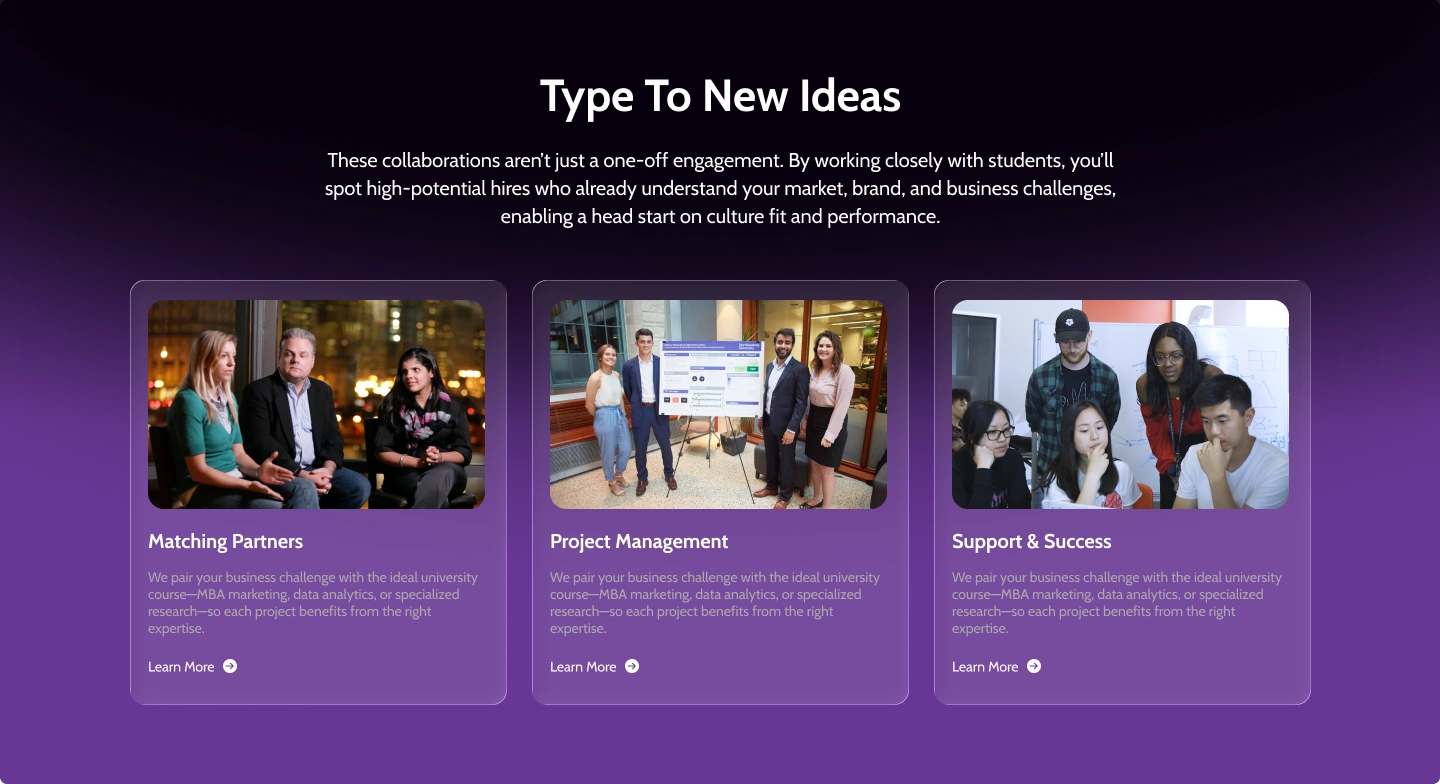
This section reframes Spring Theory’s offering around outcomes—new ideas, strong execution, and long-term success—making the value immediately tangible.
Strategy
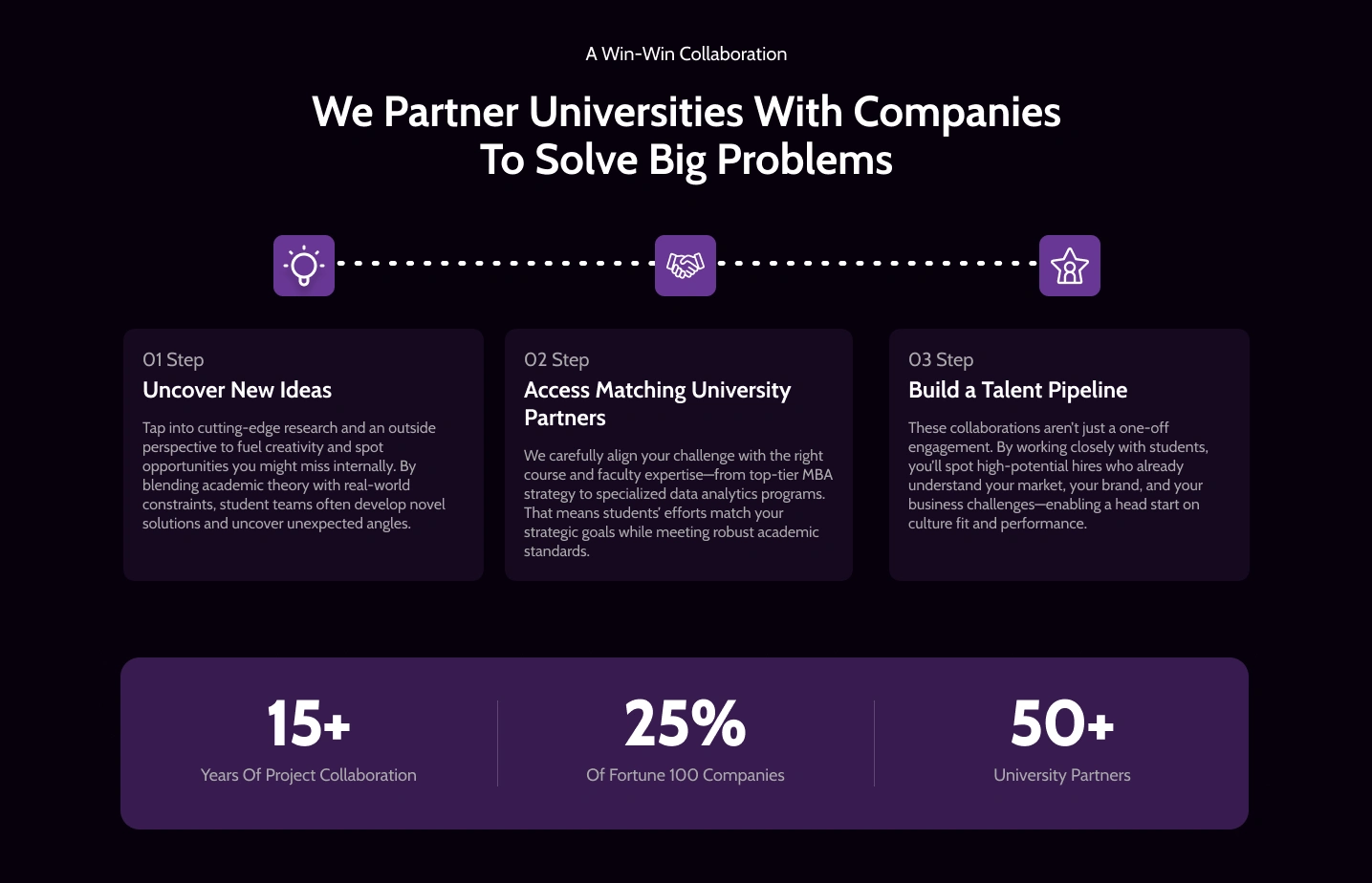
To reduce friction and build confidence, the collaboration model was distilled into a simple, linear story. Instead of leading with services, the site leads with how collaboration works and why it benefits everyone involved.
Supporting metrics—years of collaboration, Fortune 100 engagement, and university partners—reinforce legitimacy and scale, helping enterprise users quickly trust the model.
Showing Proof Through Real Outcomes
Trust is built through evidence. The Success Stories section anchors the site in real-world impact by highlighting recognizable brands and clearly framed results.
Each case follows a simple narrative:
Challenge the company faced
Process driven by academic collaboration
Outcome achieved through student-led insight
This approach demonstrates that Spring Theory delivers actionable value—not just academic exercises.
Process & Scalability
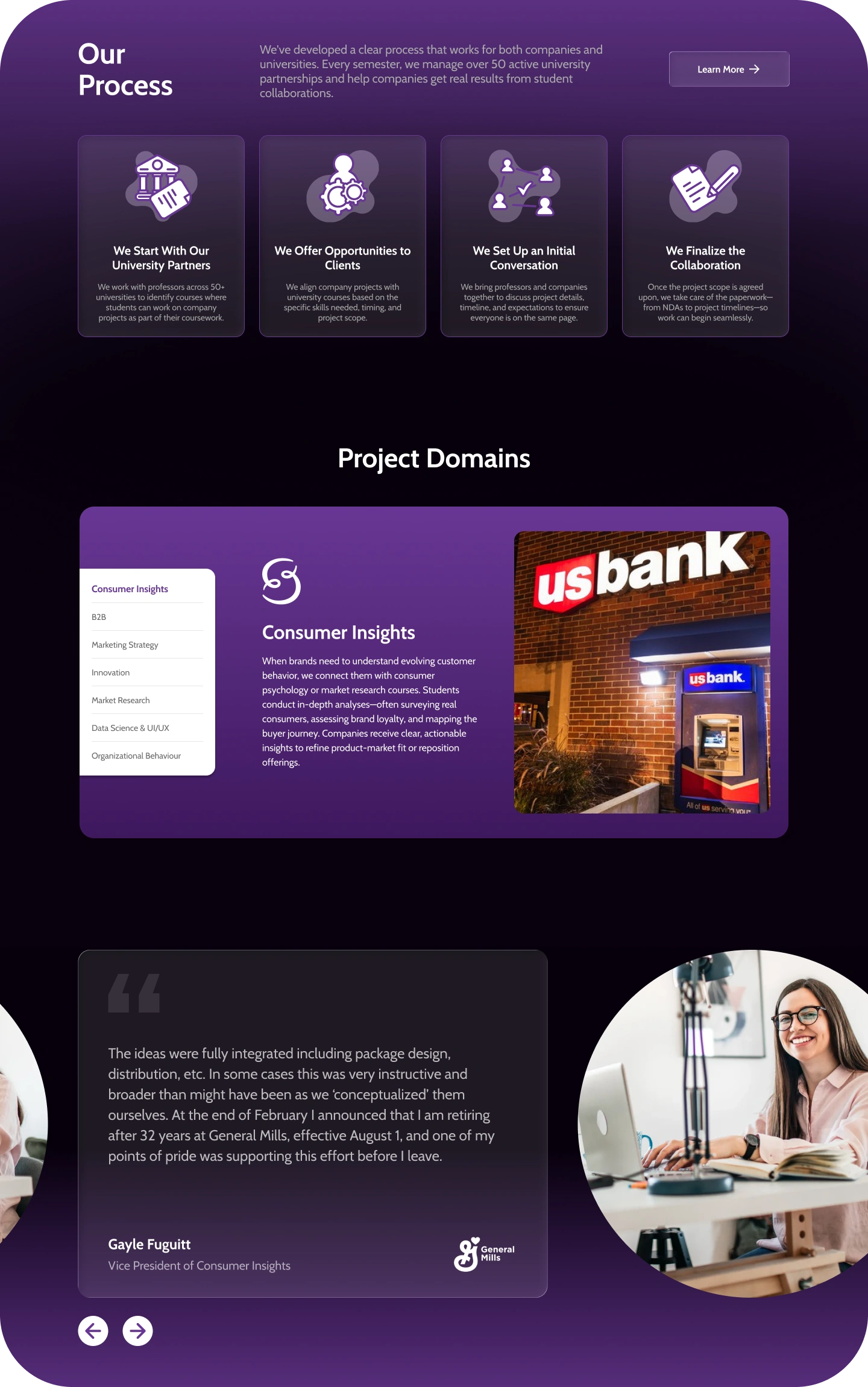
Behind every collaboration is a structured process that supports both universities and companies. This section breaks that process into clear, approachable steps—from identifying university partners to finalizing collaboration logistics.
The modular card layout allows the experience to scale as Spring Theory adds more partners, programs, and project types, without increasing cognitive load for users.
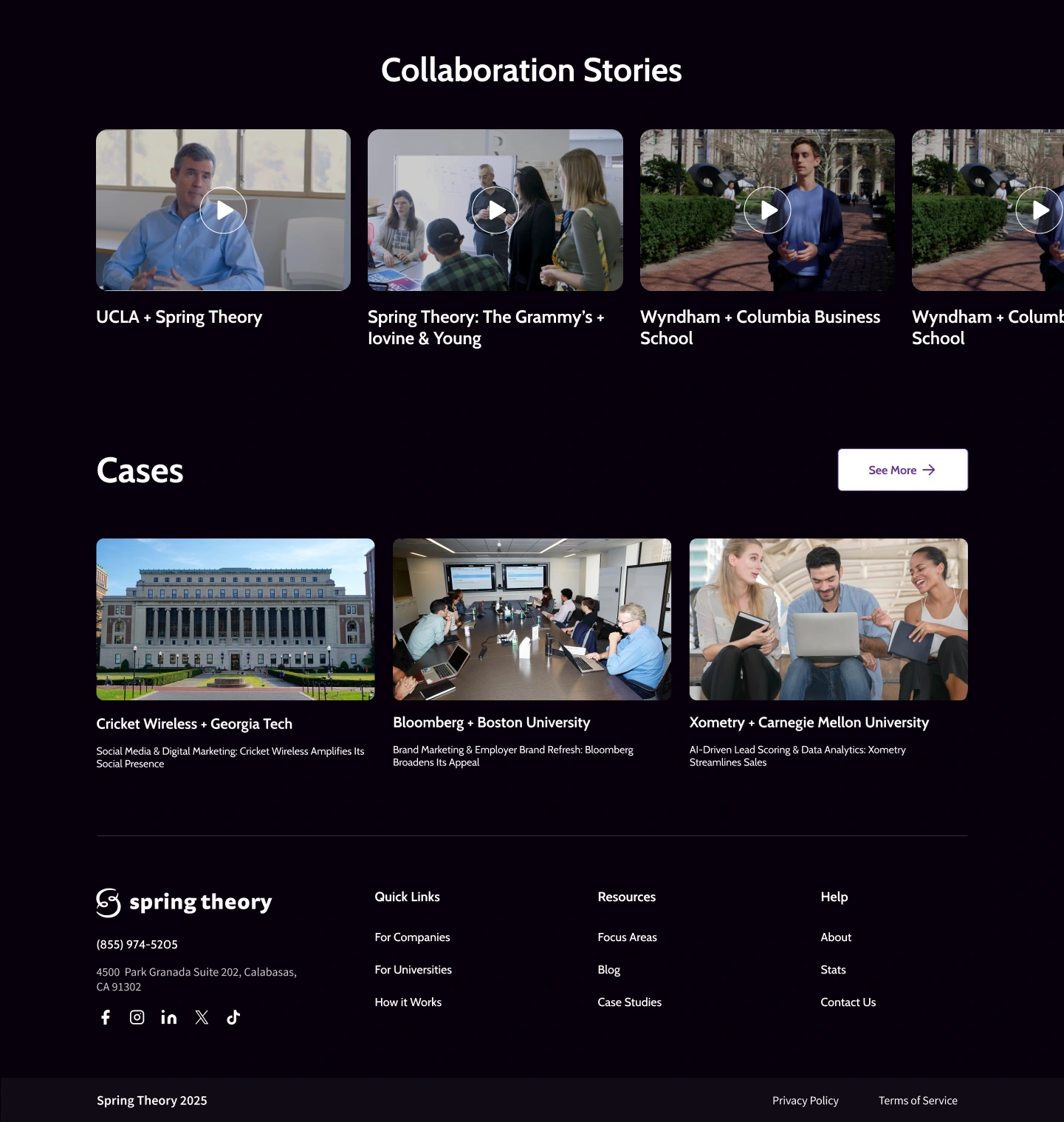
Humanizing the Impact
The final sections broaden the scope of Spring Theory’s work while reinforcing its credibility. Project domains help companies quickly identify where their needs align, while testimonials add a human perspective to the outcomes.
By pairing real projects with authentic voices, the site balances data-driven credibility with emotional trust—reinforcing the long-term value of collaboration.
The redesigned website transforms Spring Theory’s complex ecosystem into a clear, confident narrative. It now functions as:
A credibility platform for enterprise partners
A clarity tool for first-time visitors
A scalable foundation for future growth
Most importantly, it communicates Spring Theory’s value in seconds—bridging academia and industry through clarity, proof, and purpose.
Reflection
This project emphasized the role of design as translation. By aligning messaging, structure, and visuals around a single core idea, the site turns complexity into confidence—allowing Spring Theory’s impact to speak for itself.
Like this project
Posted Jan 23, 2026
Redesigned Spring Theory's website to boost clarity and engagement.