AI Legal Research & Contract Drafting Platform

Jijo Maitra


AI Legal Research + Contract Drafting
Orthos.ai — Product Case Study
Role Co-founder / Principal Designer
Company Orthos.ai
Domain Legal Technology
Scope End-to-end product design
The two most important tools in a lawyer's workflow had the same problem: nothing could be trusted.
Legal research in Indonesia was fragmented and unreliable. Lawyers spent hours cross-referencing regulations across government websites, regional portals, and scattered PDFs with no single source of truth. When regulations updated, teams had no way to know unless they manually rechecked. Information was often outdated, contradictory, or incomplete, making confident legal advice difficult to deliver.
Contract drafting had the same problem in a different form. Teams either started from scratch each time or relied on outdated boilerplates buried in email folders and shared drives. Every new deal meant recreating the same clauses with slight variations. Versions multiplied, inconsistency spread, and there was no reliable way to ensure contracts reflected current regulations or internal standards.
"The root of both problems was the same: there was no single source of truth to build from."
The breaking points
01 — No reliable source for legal research
Lawyers manually cross-referenced government websites, regional portals, and PDFs that were frequently outdated or contradictory. Regulatory updates arrived with no notification. Research quality varied entirely by individual expertise.
02 — Contract drafting started from zero every time
Teams rewrote the same clauses repeatedly across deals. Templates lived in email threads and shared drives with no version control. There was no way to guarantee a draft reflected current law or internal standards.
03 — Junior lawyers depended entirely on seniors
Without a trusted system to query, junior lawyers could not produce reliable research independently. Every output required senior validation, creating a bottleneck that did not scale.
The answer was not a better search engine. It was a verified source layer.
Most legal AI tools fail because they let the model reason beyond what it knows. The result is confident-sounding answers that cannot be verified, which is worse than no answer at all in a legal context.
The design decision here was architectural before it was visual. The AI had to be constrained to a verified source base. Not as a limitation, but as the entire value proposition. If every answer traces back to a specific, current regulation, lawyers can present that reasoning to clients, colleagues, and courts. If it does not, the tool is a liability.
Two products. One source of truth.
The platform unifies two workflows: AI-powered legal research grounded in verified sources, and template-driven contract drafting built for reuse.
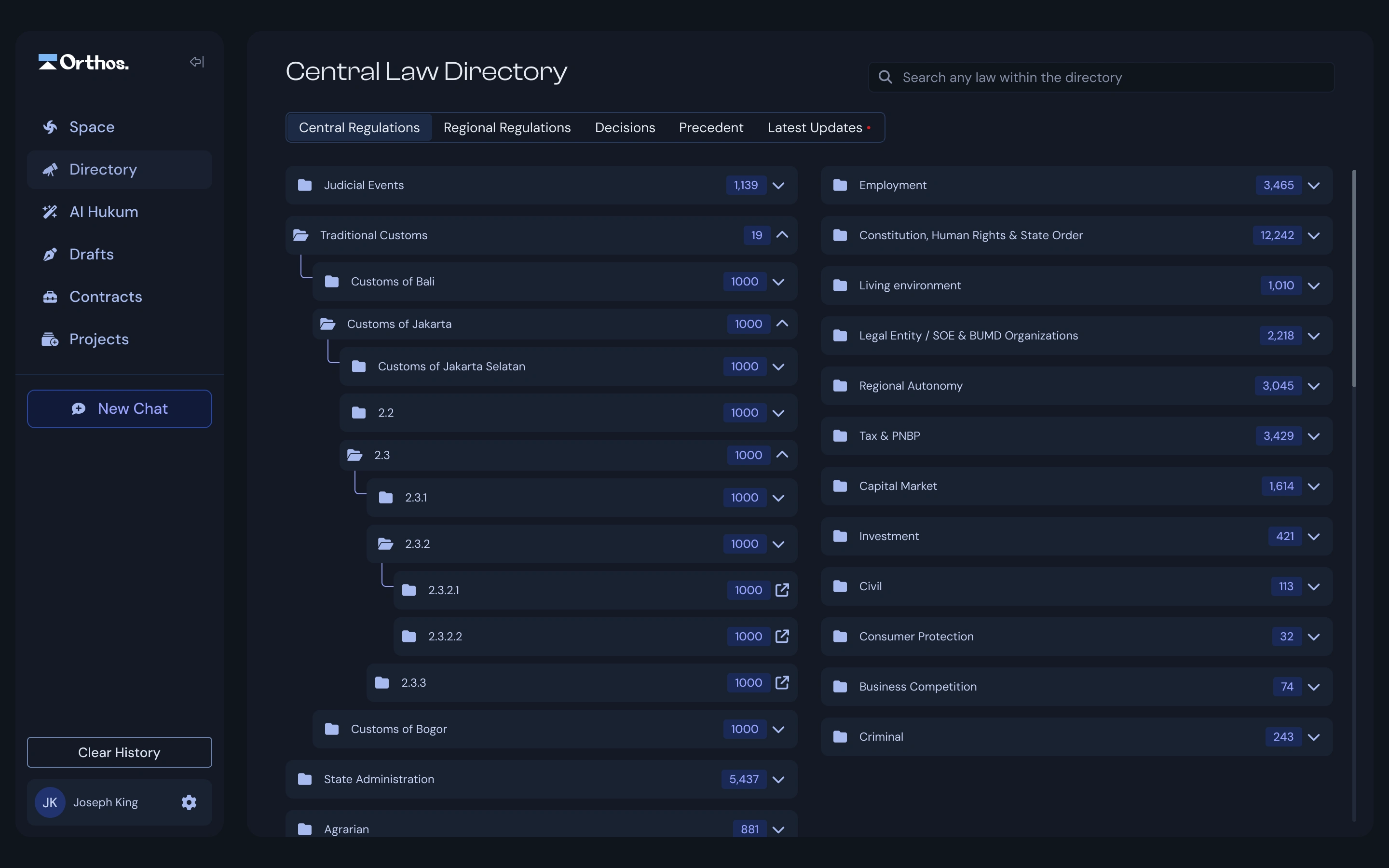
For legal research, we built a self-updating Central Law Directory that automatically ingests Indonesian regulations, government decisions, and regional updates as they are published. The AI queries exclusively against this verified source base, so every answer is traceable to a specific regulation. No inference beyond the sources. No hallucinations. Lawyers get accurate, citable answers backed by law.
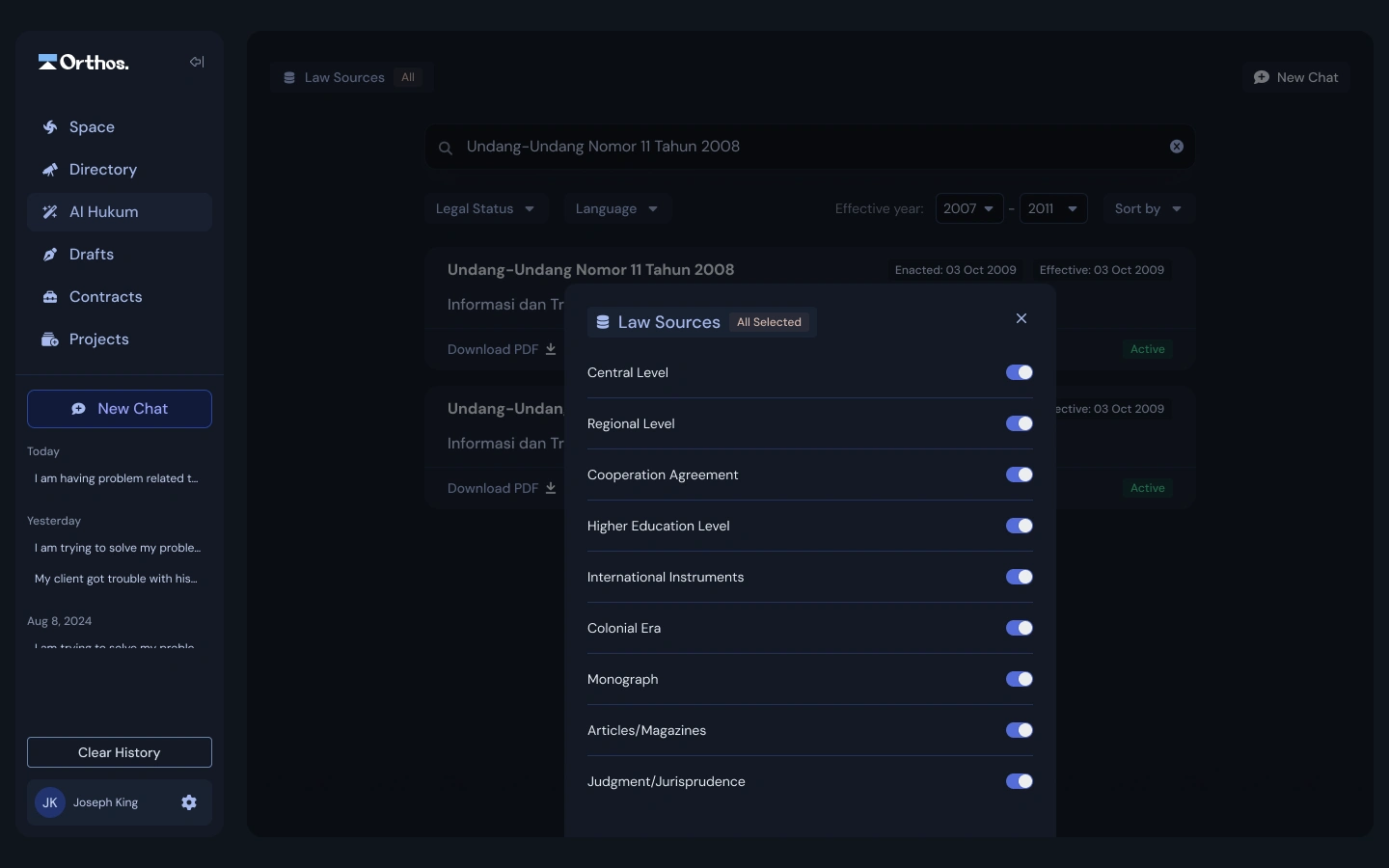
Law sources availability for refined search
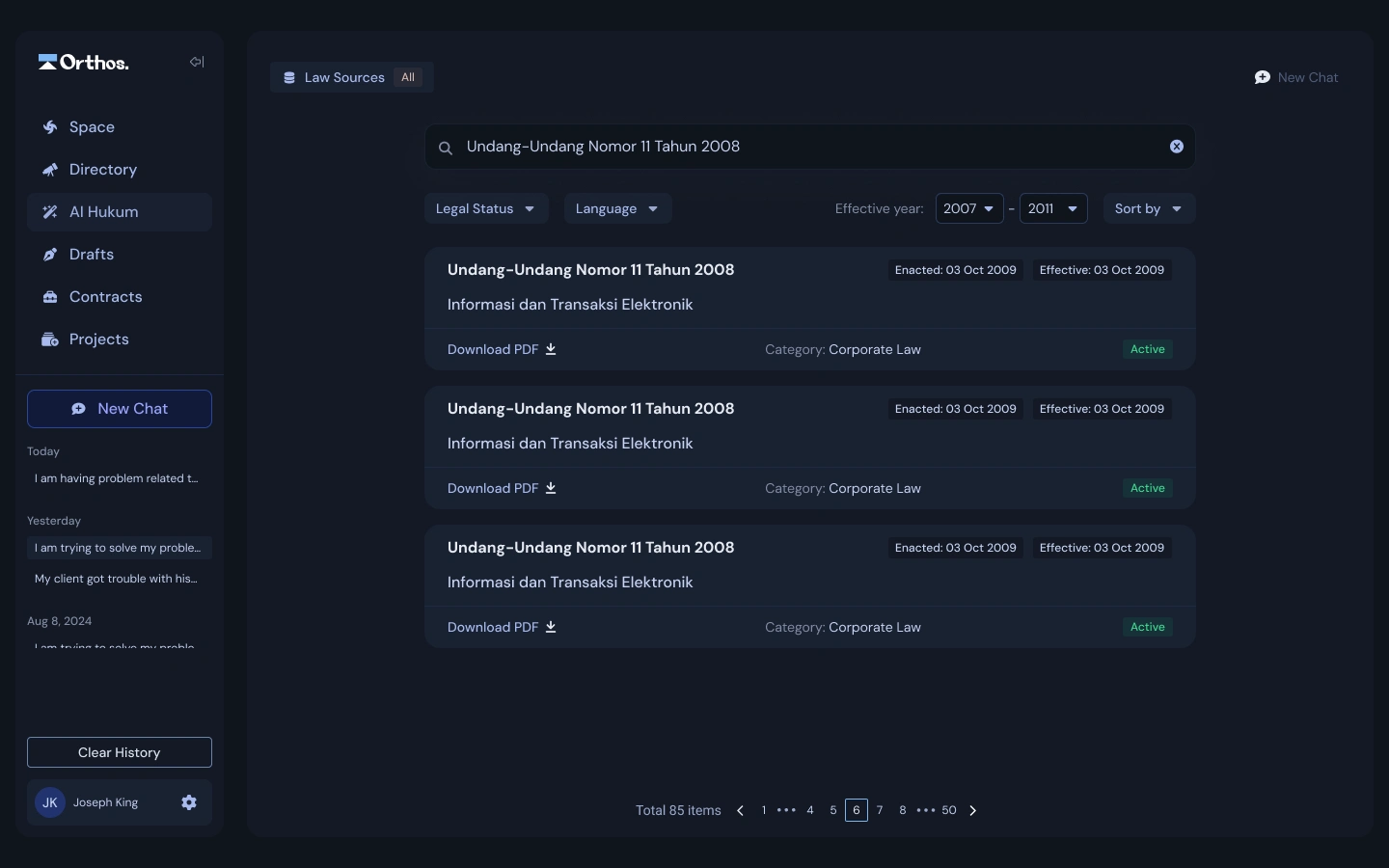
List of regulation based on the query
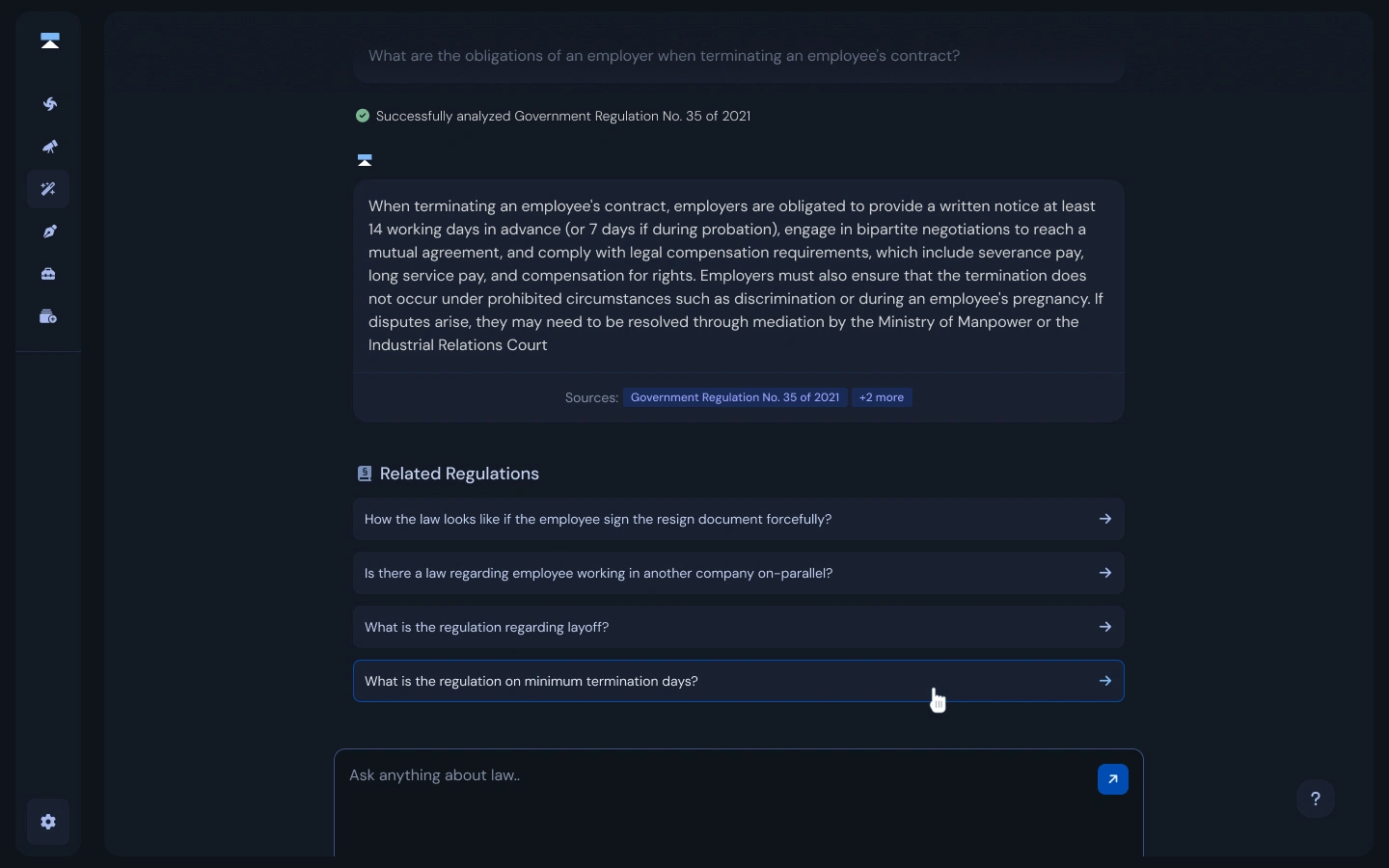
AI driven legal research for deeper analysis
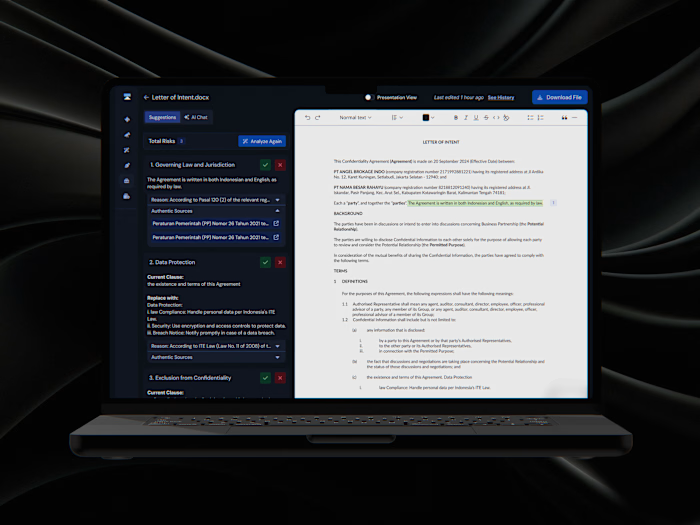
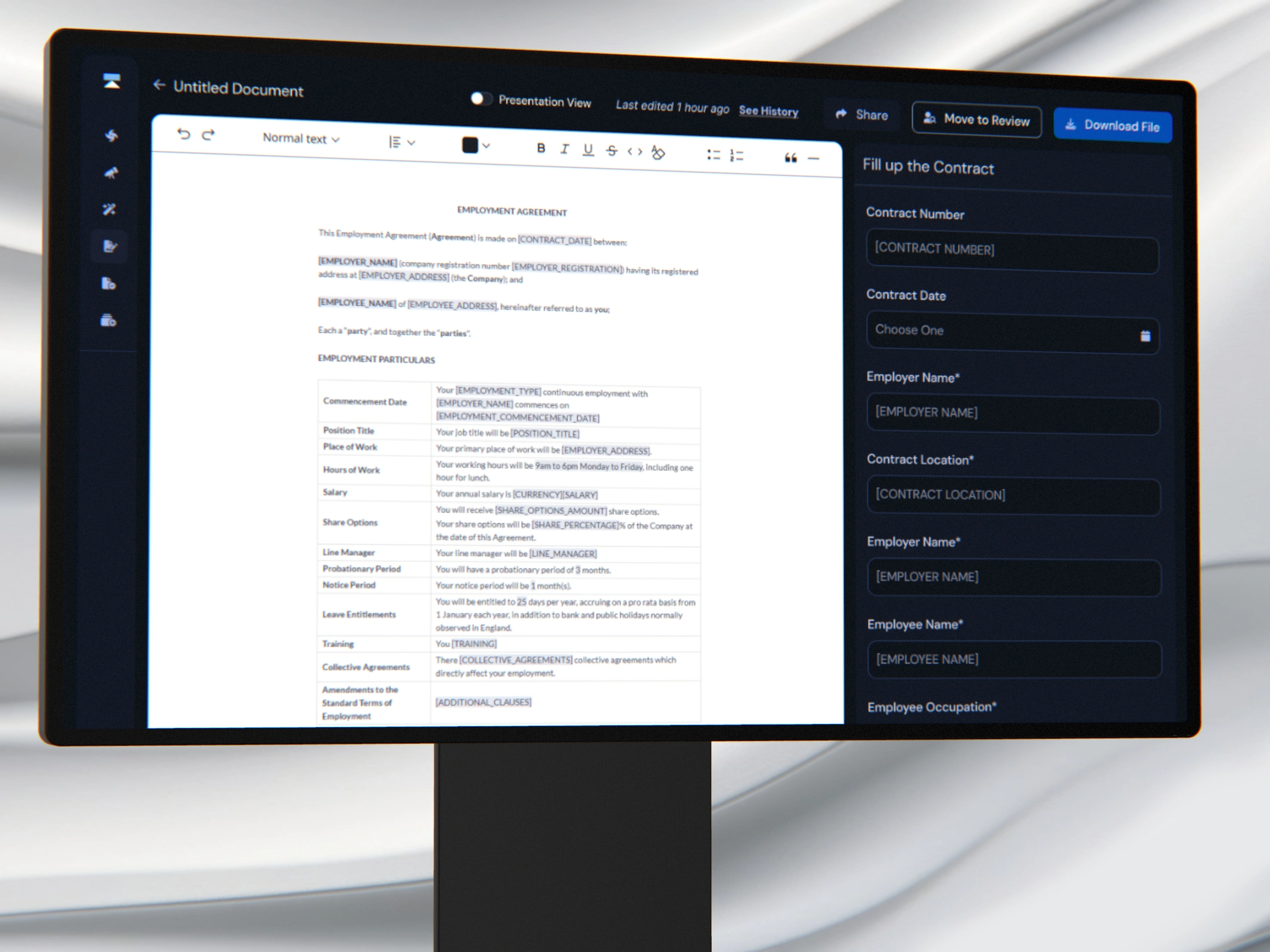
For contract drafting, teams have three paths into a document. They can prompt the AI directly to generate a draft from scratch, pick from a library of ready-made templates and customize from there, or upload an existing contract as a reference and let the system produce a new draft modeled on it. Whichever path they take, the output is a structured document with placeholder variables for party names, dates, obligations, and financial terms. Filling a contract becomes as simple as completing a form.
Contract drafting flow: prompt to structured draft with placeholders
Document upload and analysis flow
Design Decisions
Each decision defended the core premise: every output must be traceable.
Source-only AI responses.
The research engine is deliberately constrained to the legal directory. This was not a technical limitation but a design principle. Legal advice requires traceable authority. Allowing the model to reason beyond verified sources would undermine the entire value of the tool.
Citations as a primary UI element.
Every AI response surfaces its source regulations as clickable citations, not as footnotes. This keeps traceability visible and immediate rather than buried, which matters when a lawyer needs to verify or present their reasoning to a client or court.
Directory as a living system.
The Central Law Directory is not a static database. It updates automatically as new regulations are enacted. The interface reflects recency with enactment dates, effective dates, and active or inactive status on every entry, so lawyers always know whether a regulation is current.
Templates as reusable forms.
Contract drafting is modeled after form-filling, not document editing. Placeholders replace the variable parts of a contract so the structural and legal work is done once. This reduces the surface area for error and speeds up the most repetitive part of contracting.
Industry-filtered search.
Legal queries are filtered by industry context, not just keywords. A question about employment termination in manufacturing returns different regulatory weight than the same question in fintech. The filter reduces noise and surfaces the most relevant regulations first.
Suggested questions as onboarding.
The home screen surfaces suggested questions and previous searches to reduce the blank-input problem. Lawyers unfamiliar with how to query the system are guided toward productive starting points without needing a tutorial.
Impact
Metric Result Legal research time Reduced from hours to minutes Hallucination risk Eliminated by constraining AI to verified directory Contract generation time Reduced by 70% through placeholder-driven templates Version inconsistency Eliminated by centralizing templates as single source of truth Regulatory coverage Expands automatically as directory ingests new laws Junior lawyer independence Able to produce accurate, regulation-backed research without senior review at every step
Traceability is not a feature. It is the entire premise.
Legal research fails when lawyers cannot trust their sources. Contract drafting fails when teams cannot trust their templates. The platform solves both by making the source layer the foundation. The law directory is the ground truth for research. The template library is the ground truth for drafting. Everything the AI produces and every contract generated traces back to a verified, maintained source.
The result is a system where lawyers spend less time hunting for information and less time recreating documents, and more time applying the expertise that actually requires a lawyer.
Tools
Figma, React, Node.js, PostgreSQL, Gemini API, EditorJS
A few app screenshots
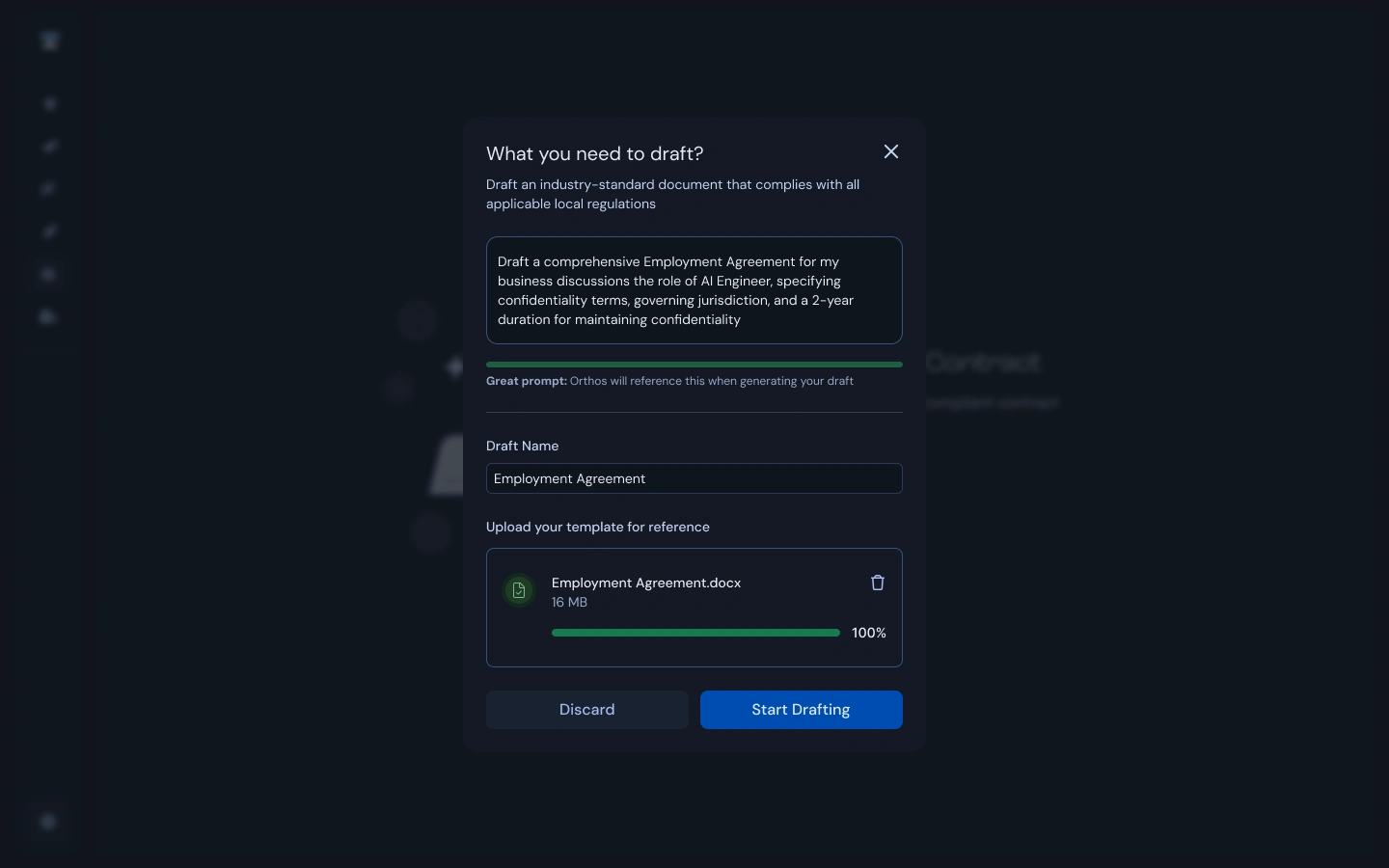
Contract draft prompt modal with uploaded document as reference
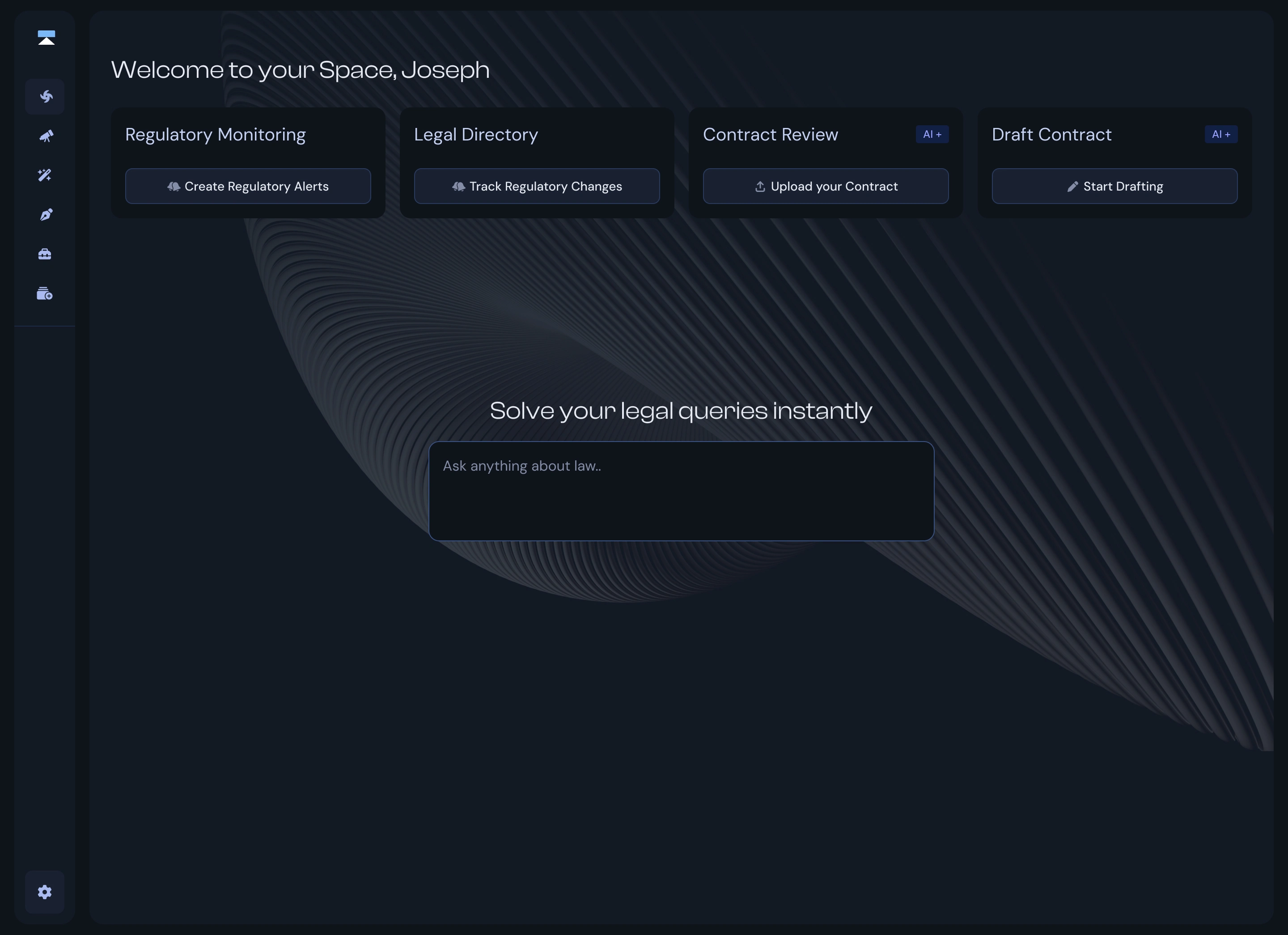
Home, a centralized place for all the legal operations
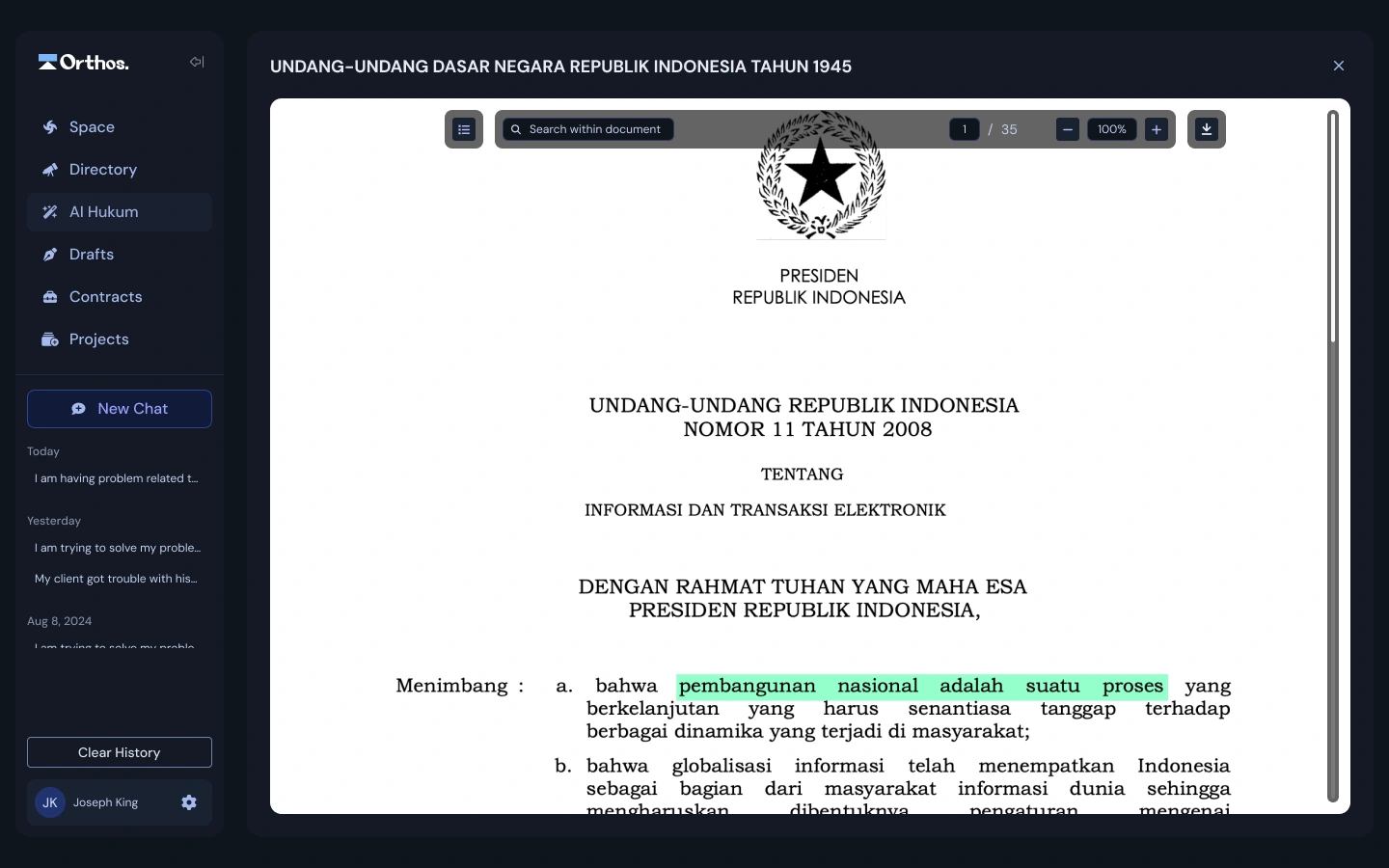
Regulation details page
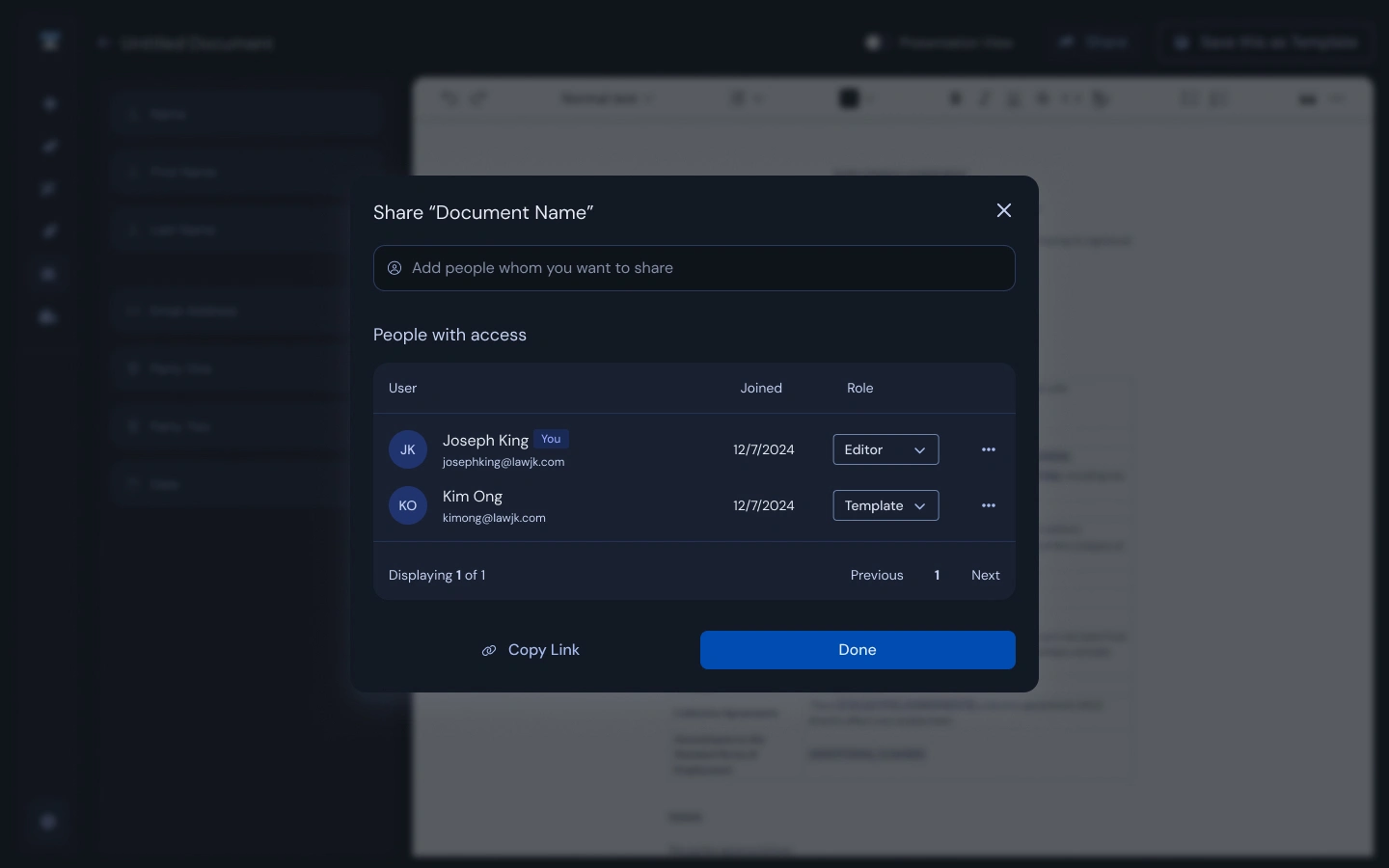
Share functionality
Like this project
Posted May 22, 2026
Legal research and contract drafting platform with AI-driven features for Indonesian judicial system.