AI Clinical Phenotype Mapping Platform Development

Abdul Wahab


Turning Unstructured Clinical Narrative Into Standardized, Actionable Genomic Insight
This case study details how Digital Dividend, a software development agency, built an AI-powered clinical terminology mapping and phenotype interpretation platform for a healthcare technology client.
Industry:
Healthcare / Genomics Technology
Market
AI Solution
AI-Powered Clinical NLP & Gene Interpretation Platform
Timeline
4 Months
Challenge
Manual, inconsistent mapping of clinical narratives to phenotype terms
Outcome
Faster, more consistent phenotype standardization and gene-phenotype insight
AI Clinical Phenotype Mapping Case Study - The Challenge - Digital Dividend
The Challenge
Clinicians routinely document patient histories using ICD-10 codes and free-text clinical narratives. Converting these observations into standardized Human Phenotype Ontology (HPO) terms is a complex, manual process. Key issues included:
Time-Intensive Manual Mapping: Identifying relevant HPO terms by hand was slow and inconsistent across clinicians.
Fragmented Interpretation: Connecting patient phenotypes to gene associations required piecing together evidence from scattered sources.
Slowed Diagnostic Workflows: Manual terminology work delayed both diagnosis and research timelines.
Limited Evidence Access: Clinicians and researchers lacked an efficient way to surface supporting literature for a given phenotypic profile.
The client needed a system that could standardize clinical language automatically, connect it to genomic evidence, and support diagnostic and research workflows in real time.
The AI Solution
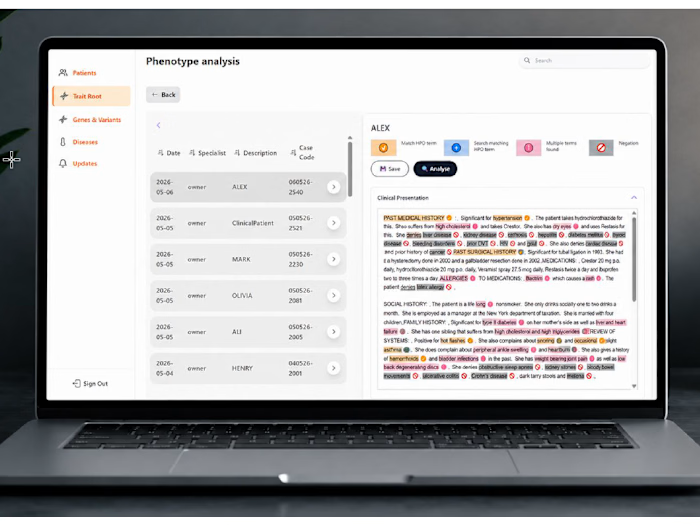
Digital Dividend developed an AI-powered clinical terminology mapping and phenotype interpretation platform that automates the conversion of physician observations and clinical histories into standardized HPO terms. The platform combines Large Language Models (LLMs), machine learning algorithms, and Clinical BERT to analyze clinical narratives, laboratory findings, and ICD-10 terminology in real time.
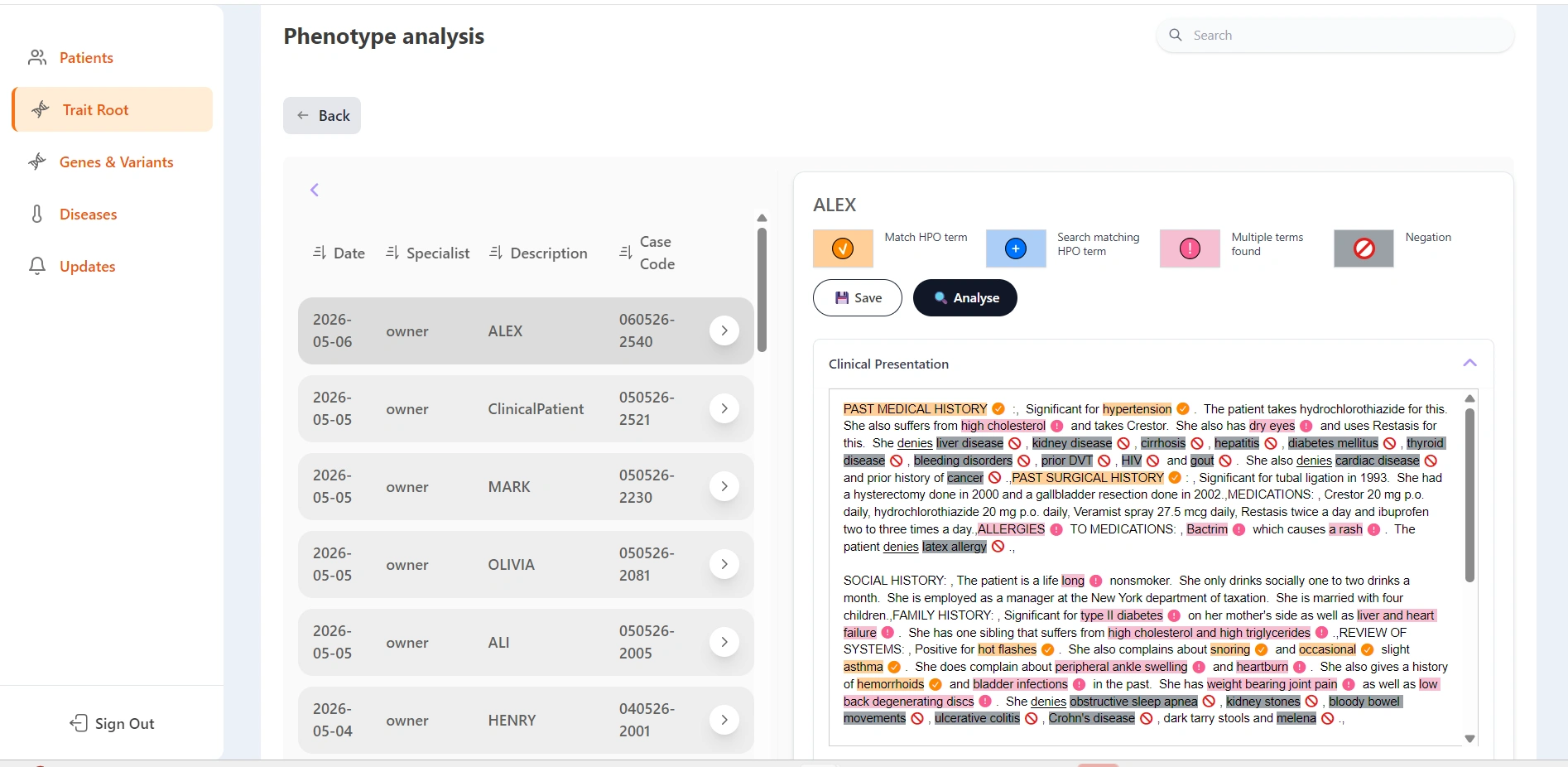
The system identifies key medical concepts, extracts relevant phenotypic information, and maps it to the most accurate HPO terms. Beyond standardization, the platform categorizes patient phenotype profiles, analyzes gene-phenotype relationships, and identifies candidate genes to support clinical interpretation and diagnostic workflows while also recommending relevant scientific literature based on each patient’s phenotypic profile.
See our AI Agent Development Services and AI Software Development pages to see how our team applies agentic AI and machine learning to complex, domain-specific workflows.
Solution Highlights
Automated ICD-10 to HPO Mapping: Converts coded and free-text clinical data into standardized phenotype terms.
Clinical BERT-Based Standardization Pipeline: Purpose-built medical NLP model trained for clinical language.
Negation & Assertion Detection: Distinguishes confirmed, denied, and uncertain findings to avoid false-positive phenotype mapping.
Gene-Phenotype Association Analysis: Identifies candidate genes linked to a patient’s standardized phenotype profile.
Evidence-Based Literature Recommendations: Surfaces relevant research to support clinical interpretation.
Real-Time Processing: Analyzes clinical narratives, lab findings, and ICD-10 data as it’s entered.
Technology Stack & Rationale
Category Technology Purpose AI / NLP Models Large Language Models (LLMs) + Clinical BERT Analyze clinical narratives, lab findings, and ICD-10 terminology in real time Terminology Standardization Automated ICD-10 → HPO mapping pipeline Converts free-text and coded clinical data into standardized Human Phenotype Ontology terms Entity & Context Analysis Negation detection & assertion-status algorithms Identifies negated, uncertain, or historical findings so only confirmed phenotypes are mapped Knowledge Linking Ontology entity linking (HPO, SNOMED, MedDRA) Resolves extracted concepts to standardized medical ontologies for interoperability Genomics Gene–phenotype association engine Identifies candidate genes from standardized phenotype profiles Research Support Literature recommendation engine Surfaces relevant scientific studies based on each patient’s phenotypic profile Core Stack Python, Golang, Angular, PostgreSQL, Vector Database Application logic, front end, and structured/embedded data storage
Business Impact
Reduced manual clinical terminology mapping effort
Accelerated phenotype identification and standardization workflows
Improved consistency and accuracy of clinical documentation
Enhanced gene discovery and diagnostic support processes
Strengthened evidence-based clinical research and investigation workflows
Enabled faster, more efficient clinician decision support
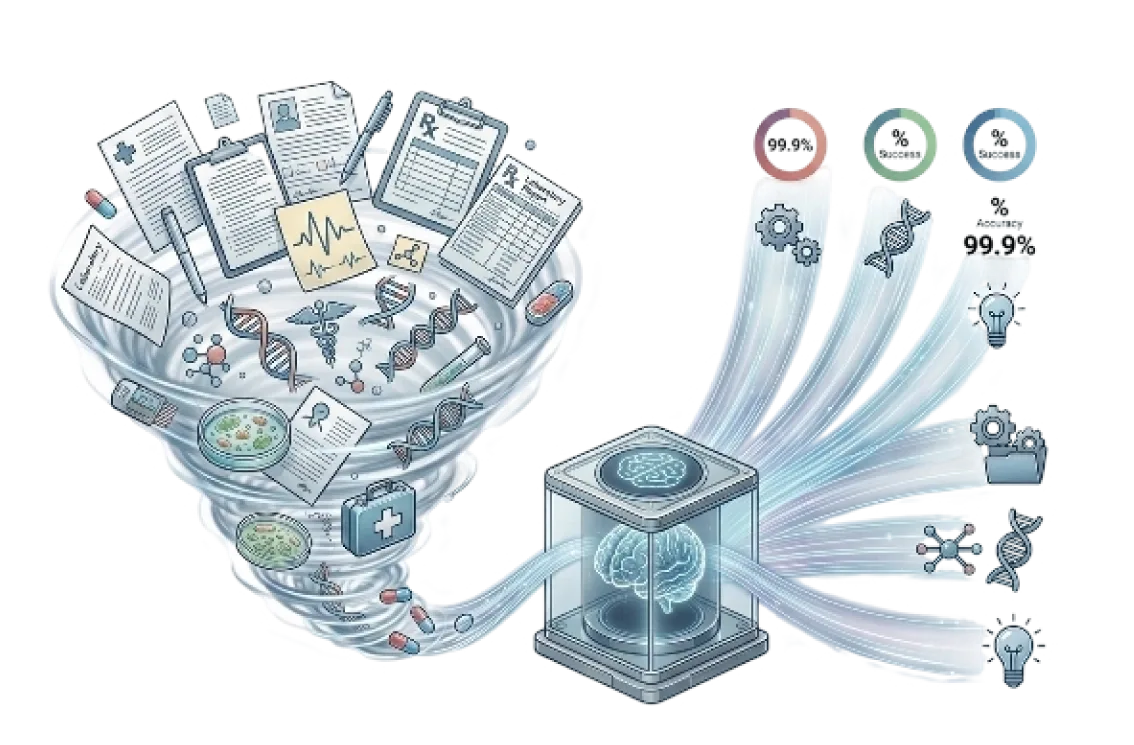
Business Impact - AI Clinical Phenotype Mapping Case Study - Digital Dividend
Like this project
Posted Aug 28, 2026
Developed an AI platform for phenotype mapping to speed up genomic insights.