Digital Infrastructure Cost Attribution Brief

Jooyeol Kim


The USTR Overreached — but South Korea’s Telecom Companies Are Not Innocent
7 min read
Apr 29, 2026
--
Network Usage Fees and the Fight Over Who Pays for Digital Infrastructure
The U.S. Trade Representative placed South Korea’s network usage fee debate on a list of what it presented as absurd foreign trade barriers. The implication was simple: nowhere else in the world does this — except Korea.
That is a strange frame.
In South Korea, mandatory network usage fees have been debated. But once that debate appears on a trade-barrier list, its meaning changes. A domestic dispute over infrastructure costs starts to look like a bizarre foreign rule designed to harass American companies.
Putting something on a list turns explanation into stigma.
Still, criticizing the USTR’s framing does not make South Korea’s telecom companies innocent. They have long had a steady claim on the user’s monthly paycheck. They sell high-speed access, connectivity, and what has now become a basic passageway into everyday life.
Payday briefly revives the bank account. Then everyone arrives with a claim on it. Rent takes its share. Credit card bills take theirs. Insurance, subscriptions, utilities, and then the telecom bill arrives. Connectivity is no longer optional. Banking apps, identity verification, two-factor authentication, public services, work messages, delivery apps, maps, medical appointments — without internet access, many doors of ordinary life simply close.
Users are already paying for digital infrastructure.
That is why the network usage fee debate is not simple. The USTR’s overstatement does not absolve South Korea’s telecom carriers. Distrusting those carriers does not absolve large American platforms either.
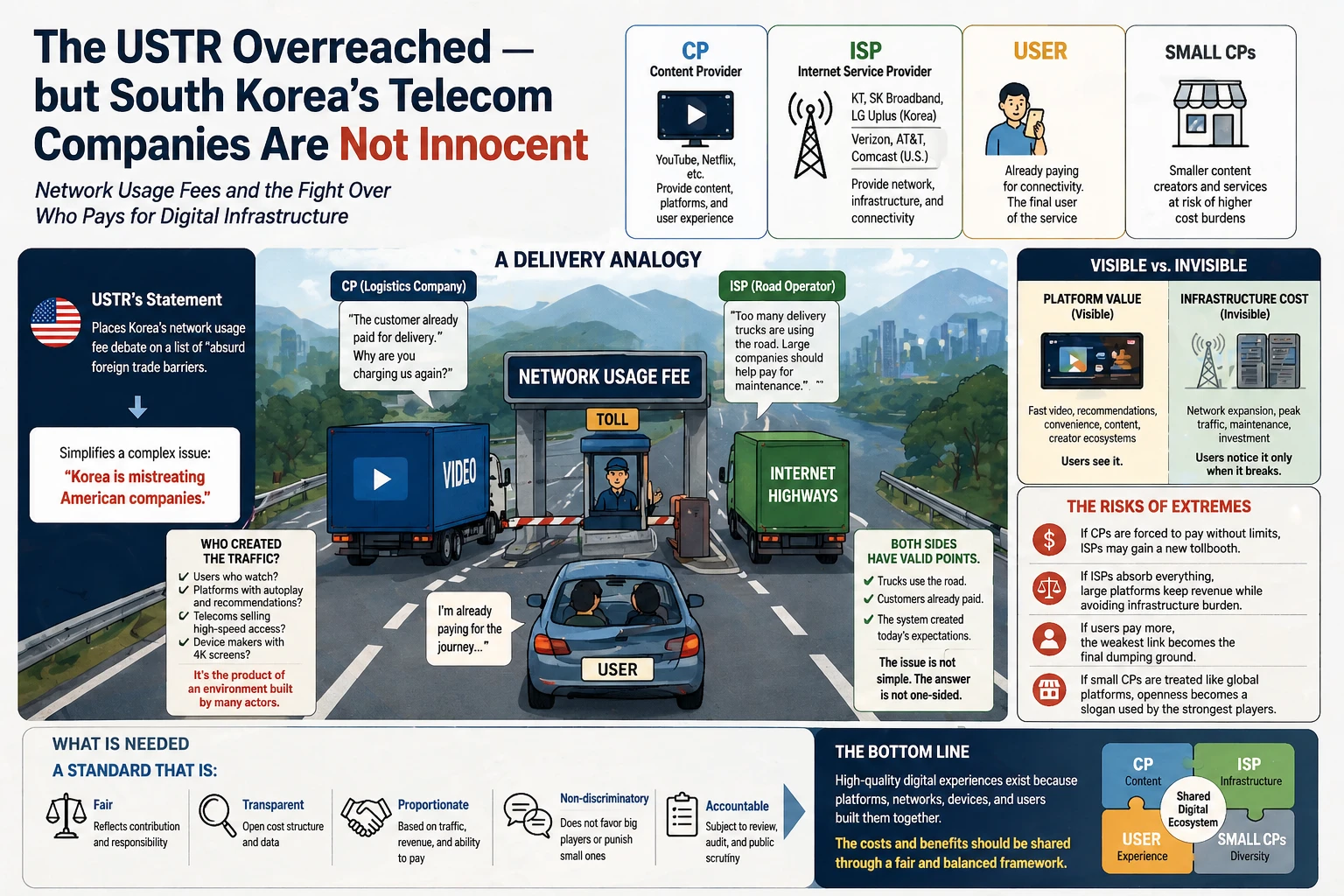
Here, CP means “content provider”: companies such as YouTube, Netflix, or other platforms that provide the content and services users watch. ISP means “internet service provider”: companies such as Verizon, AT&T, or Comcast in the United States, and KT, SK Broadband, or LG Uplus in South Korea. CPs provide what appears on the screen. ISPs provide the paths that keep the screen from freezing.
The danger in the USTR’s statement is not just that its wording is rough. It turns a complicated cost-allocation dispute into a simple story: South Korea is mistreating American companies. But the fight was never that simple. The service on the screen, the network beneath it, the user who already pays, and the smaller services that may be forced to absorb new costs are all part of the same structure.
A delivery analogy helps.
Imagine content providers as large logistics companies sending packages. Internet service providers are closer to the highways and last-mile roads those delivery trucks use. Users are already paying, in some form, to receive the goods.
Then one day, the road operator says:
“Too many delivery trucks are using the road. Large logistics companies should help pay for maintenance.”
The logistics company replies:
“The customer already paid for delivery. Why are you charging us again?”
Both claims sound plausible. Delivery trucks do use the road. Customers have already paid. But the issue does not end there.
Fast delivery did not become normal because of logistics companies alone. Road operators sold faster routes. Market competition normalized faster delivery. Consumers came to expect it as the standard service. The whole system helped create the expectation.
Network usage fees work the same way.
4K video did not fall from the sky. Autoplay is not a natural event. Recommendation systems are not accidental traffic flows. High-speed internet plans, smartphones, high-resolution televisions, premium streaming services, platform competition, and rising user expectations all helped create a world where “high quality” became normal.
At first, 4K was an option. Over time, options become baselines. Lower quality stops feeling like a choice and starts feeling like a degraded experience. Users appear to choose, but they are choosing inside a standard that has already been built around them.
So the question “who created the traffic?” is too thin.
Did users create it by watching the video? Did platforms create it through recommendation systems and autoplay? Did telecom carriers create it by selling high-speed access? Did device makers create it by selling 4K screens?
There is no single answer. High-bandwidth traffic is the product of an environment built by multiple actors.
In this dispute, platforms point to the value they create: fast video, convenient recommendations, access to content, creator ecosystems, user experience. That value is visible. Users see it directly on the screen.
Telecom carriers point to the costs they bear: network expansion, peak traffic, maintenance, access quality, infrastructure investment. Those costs are less visible. Users usually notice the network only when the video freezes. When everything works, the network does not feel like infrastructure. It feels like the internet simply exists.
This creates an asymmetry. Platform value is visible. Infrastructure cost is made invisible. The visible side becomes “value.” The invisible side becomes “the background.”
But invisible cost is still cost. Visible value is not proof that only one side created it.
That is why the network usage fee debate cannot be handled as a simple yes-or-no question. If content providers are forced to pay without limits, ISPs may gain a new tollbooth. If ISPs are told to absorb everything, large platforms may keep the revenue from high-bandwidth services while avoiding the infrastructure burden. If users are asked to pay more, the weakest link becomes the final dumping ground. If smaller content providers are treated like global platforms, openness becomes a slogan used by the strongest players.
What is needed is a standard for cost attribution.
That standard cannot be total traffic alone. Traffic volume matters, but it is not enough. We have to ask who helped normalize the traffic, who profited from it, who can adjust default settings and quality standards, who can absorb additional costs without collapsing, and who can pass those costs down to weaker actors.
The key issue is absorptive capacity.
Some actors can take a hit without immediately breaking. They have cash, legal teams, policy teams, pricing power, lobbying capacity, global markets, and time. One shock does not push them out of the game.
Other actors lose room to move after even a small hit. Users cannot inspect contracts between telecom carriers and platforms. They cannot negotiate interconnection terms. They cannot participate in trade disputes. Smaller content providers do not have the cash reserves or policy machinery of global platforms. A small increase in cost can become an entry barrier.
Fair cost attribution is not simply about who has more money. It is about who helped create the cost, who earned revenue from the environment that created it, who can influence the structure, and who can bear the burden without being pushed out.
Large content providers cannot simply walk away from responsibility. They helped design high-quality video, autoplay, recommendation systems, and attention economies. They earned revenue from them. “Internet openness” is a real concern, but it is not a license to reduce their cost responsibility to zero.
ISPs cannot play the victim either. They sold high-speed access, charged users for connectivity, and benefited from a concentrated market position. If telecom carriers invoke network investment and infrastructure sustainability, they must show that any new money actually goes to network investment, quality improvement, and user protection. Otherwise, it is just a new tollbooth wearing the language of public infrastructure.
The U.S. trade frame makes the dispute even more complicated. Domestically, CPs and ISPs fight over who should bear the cost. Above that fight, the United States tries to reshape the field itself. A bill that might otherwise land partly on large platforms becomes, through the trade frame, a barrier South Korea must defend against.
The battlefield moves.
The question shifts from “who should bear network costs?” to “whether South Korea is allowed to make such rules at all.”
That is why the government’s role is not simple. The government is not merely another payer. It has to block downward cost transfer, monitor whether telecom carriers turn the issue into protected revenue rather than real network investment, check large-platform cost avoidance, protect users and smaller content providers, and defend South Korea’s ability to make domestic infrastructure policy under external trade pressure.
None of this is easy. No allocation will perfectly satisfy every condition. Reality has a way of punching beautiful principles in the face. Everyone has a plan until they get hit.
So this standard is not an automatic answer machine. It is a checkpoint for claims. It asks who created the cost, who profited from it, who can shape the system, who can absorb the hit, and who is trying to pass the burden to weaker actors.
The USTR’s framing is therefore overstated. Treating South Korea’s network usage fee debate as if it were already an absurd trade barrier is rough both in fact and in framing.
But criticizing that overstatement should not mean taking the telecom industry’s side. If South Korean telecom carriers want to speak in the name of network investment and infrastructure sustainability, they need to prove that this is not just a new tollbooth. They need to show that it leads to actual investment and user protection.
Positions are relative. Responsibility is structural.
The network usage fee debate looks like a fight over traffic costs. More accurately, it is a fight over burden attribution: between visible platform value and invisible infrastructure cost, who receives the final bill?
And if that bill comes back to users again, the answer should be simple.
Users are already paying.
Like this project
Posted May 24, 2026
Policy brief on network usage fees, platform value, infrastructure cost, and user burden in South Korea’s digital economy.