Climate Wavers

Abdulqoyyum Aileru


Climate Wavers, an AI-Driven Social Network for Climate Disaster Response
Role: Technical Lead & Full-Stack Engineer
Stack: TypeScript, Python, Kafka / Redis / AMQ streams, MariaDB, OAuth & SSO, NLP & computer vision models
The Problem
When a climate disaster hits, the first reports rarely come from official channels. They come from people posting what they see. That information is fast but scattered, unverified, and hard to act on. Response teams need signals, not noise, and communities need reliable guidance before, during, and after an event.
Climate Wavers set out to close that gap: a social platform where people share what's happening on the ground, and AI turns those posts into structured, actionable disaster intelligence. The goal went beyond reacting to disasters. We wanted to help predict and analyze them.
My Role
I led a cross-functional team of engineers and ML practitioners from concept to deployment, owning the overall architecture while working hands-on across the frontend and backend. I set technical direction, made the core architecture decisions, and oversaw the full development lifecycle.
The Solution
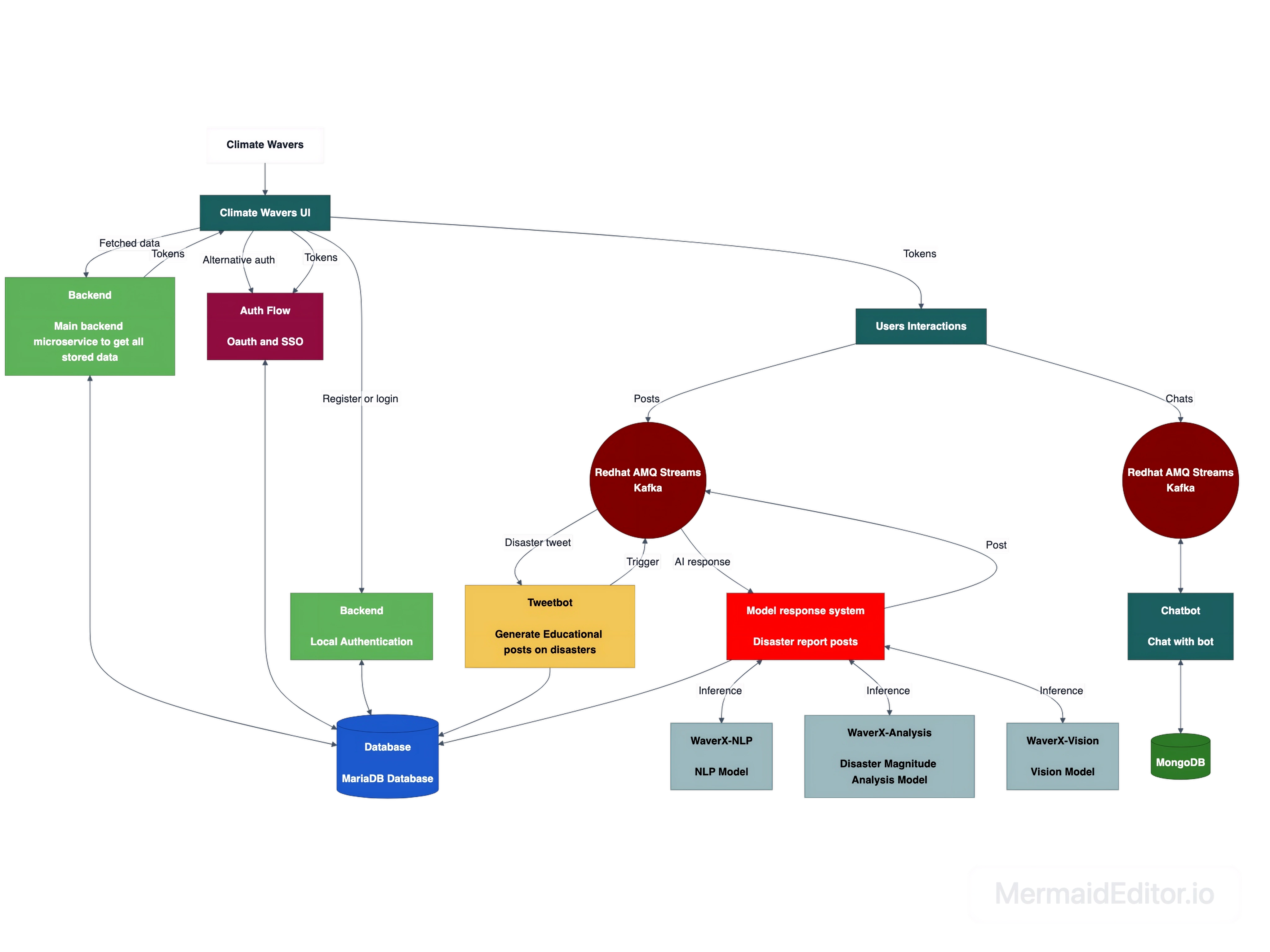
Climate Wavers runs as a set of focused microservices, each with one clear job, connected through event streams:
A community platform at the core. Users sign up through local authentication or OAuth/SSO, then post, interact, and chat in real time. Every interaction flows through message streams rather than direct calls, so the platform stays responsive under load.
An AI model response system. When a user posts a disaster report, it's routed to the WaverX AI suite. WaverX-NLP reads and classifies text, WaverX-Vision analyzes uploaded images, and WaverX-Analysis estimates disaster magnitude. Results flow back into the feed as AI responses, so a raw post becomes an assessed report.
An educational Tweetbot. A dedicated service listens for disaster-related activity and generates educational posts, turning moments of crisis into moments of awareness.
A conversational chatbot. Users can ask questions and get guidance through a chat service that runs on its own stream, isolated from the main feed.
The Results
The platform increased early detection accuracy by 40% and scaled to handle 50% more concurrent users after the move to a microservices framework. Stakeholders gained real-time disaster pattern recognition that sharpened decision-making when timing mattered most.
What This Shows
I can take an ambitious, socially meaningful idea and turn it into a working system: leading people, designing architecture that scales, and shipping AI into production rather than leaving it in a notebook.
Like this project
Posted Feb 25, 2025
I led the team that built Climate Wavers, an AI social network that turns on-the-ground posts into real-time disaster intelligence. Detection accuracy rose 40%.
Likes
0
Views
11
Timeline
Oct 25, 2023 - Jul 22, 2024