The Last Dinner of Manners

Magda Zielinska


The Last Dinner of Manners
After reading a confession from a man who once healed hearts, I wondered — when did manners become our last religion?
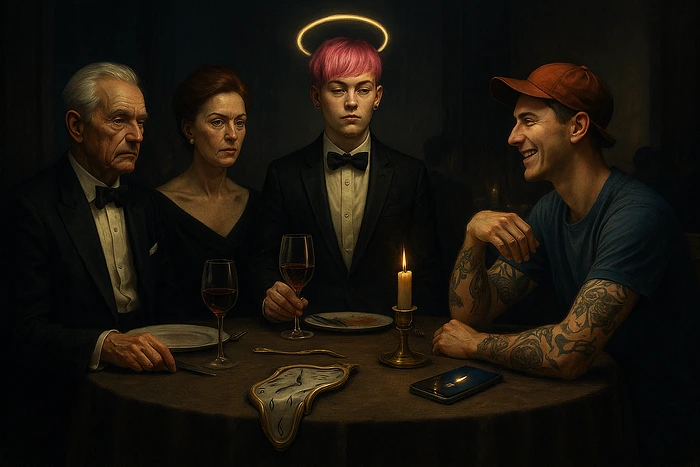
Dying Etiquette” Turkish Bazaaar × ChatGPT
© Turkish Bazaaar. All rights reserved
Studies show that etiquette is one of the last social codes linking generations.
But when a former doctor described a boy’s T-shirt as “the death of manners,”
the debate became something deeper — a question of identity, class, and loss.
A dinner.
A fork.
A boy in a baseball cap scratching his arm –
and suddenly, the end of civilization.
Funny, isn’t it?
If it were a banker in a suit picking his nose,
no one would write an essay about the death of elegance.
But because it was a boy in a T-shirt,
it became an apocalypse of taste.
A classic case of cultural collision at a table for two.
He probably longs for the days when dinner was a ceremony
and waiters looked like whiskey commercials.
There’s something almost tender in that.
Perhaps he isn’t really angry at the young.
It seems he’s mourning the loss of ritual –
the illusion that dinner was still a sacred act,
but only if you were properly dressed.
The world, meanwhile, moved on,
and now he sits at the table like at a relic –
a fork in one hand, confusion in the other.
He’s not defending etiquette.
He’s holding on to the structure that once made him feel safe.
In that structure, dinner = ceremony,
elegance = respect,
form = meaning.
Without it, he feels like a salmon swimming upstream.
Once, the restaurant was a theatre of distance.
Now it’s a stage for equality.
To him, it looks like decay.
To the young — liberation.
This is the eternal duel:
– The old: Dress up, it’s a sign of respect.
– The young: Be yourself, it’s a sign of freedom.
It’s not about T-shirts or tattoos.
It’s about meaning losing its shape.
He doesn’t really crave order –
he just aches for a world where something still matters.
But the world isn’t here to fit you.
You are here to expand enough to hold it.
And if you prefer bow ties and silence at the table –
choose such places.
Not everything has to resonate.
It’s enough that you find what plays in tune with you.
I can eat ramen among people in tracksuits and feel reverence.
Or dine from crystal glasses and feel nothing.
Taste, respect, and beauty share one element — presence.
Like the waiter with pink hair and a tattoo on his hand,
looking you in the eyes — alive, attentive,
holding that microscopic particle of I want you to feel good.
If someone serves me like a process, not a person –
even a filet mignon tastes like paper.
Even if he’s perfectly dressed, smells expensive,
and fits the restaurant’s definition of grace.
Aesthetics stopped being moral currency.
Once, well-dressed meant well-mannered.
Now, authentic means more.
The world doesn’t need form anymore –
it was never the essence, only the costume of respect.
And the funniest part?
He might call colorful people unicorns
without noticing he’s become one –
a hand-stitched relic from the age of manners,
surviving his own extinct civilization.
The young call it freedom.
He sees it as the fall of culture.
But it wasn’t really the world that offended him –
it was his own beliefs sitting at the table before he did.
There’s something else beneath his judgment –
a quiet jealousy he would never admit.
Not hatred of youth,
but longing for their freedom.
He wishes he could wear what he wants, speak how he feels,
exist without the weight of performance.
In his politeness, he was raised to obey the choreography of approval.
The young move without asking permission.
He tends to mistake that for arrogance,
when it’s really the sound of a life he never allowed himself to live.
“Since I pay, I demand” — that line no longer works.
Money doesn’t buy harmony — only the bill.
The world stopped being a service
and became an encounter.
This isn’t the age where you can pay for silence
and receive proof you’re right.
At least not in a restaurant.
And perhaps that’s the saddest irony.
A man who once healed hearts
never quite learned to hear them outside a stethoscope.
Intelligence — high.
Awareness — shallow.
Empathy — conditional.
Not evil, just the blindness of education.
The world taught him to see symptoms, not existences.
To analyze the body, but never the presence.
The boy in the baseball cap — the one scratching his arm — probably didn’t judge him.
But he surely judged the boy for existing too freely.
That might be the last irony left:
the wild ones have more grace than the polished.
Further Reading — A Bibliography for the Disoriented
Margulis, Lynn — Symbiotic Planet (because even bacteria know how to coexist).
de Waal, Frans — Mama’s Last Hug (on empathy, before it became a workshop).
The Institute of Misplaced Etiquette — Annual Report, 2024.
Kropotkin, Peter — Mutual Aid (before capitalism rebranded it as teamwork).
The Museum of Former Decency — permanent exhibition, closed on weekends.
Dr. E. Manners, PhD (probably) — The Emotional Hygiene of Polite Collapse.
Forks & Feelings: A Post-Cutlery Manifesto — Department of Lost Table Manners, 2023.
Elegance in the Age of Sweatpants — Proceedings of the Society for Cultural Regression.
The Psychology of Napkin Placement — Journal of Social Panic, Vol. 7.
Turkish Bazaaar — Field Notes on Human Contradictions (ongoing).
This piece is part of the ongoing series “Vision Notes / Creative Reset” — published on Sundays.
Quiet reflections and intuitive sketches.
A pause between endings and beginnings.
Turkish Bazaaar
Like this project
Posted Oct 31, 2025
A reflection on manners, identity, and cultural shifts in dining etiquette.
Likes
0
Views
4