Driver Activity and Rest Planning Module Development

Arkadiusz Staniek


Journey Planner — Driving & Rest Planning Module
Overview
Journey Planner is a constraint-based planning module developed as part of the ETS2 EU Digital Tachograph desktop application. It converts a driver's current tachograph state and a delivery target into an explainable sequence of driving, breaks, rests, calendar waits, and operational work.
The module is deliberately read-only: it evaluates a snapshot of the current state and never mutates the driver's recorded activity history.
Problem
A route duration alone is not enough to answer whether a delivery is feasible. The calculation must account for several interacting constraints:
continuous, daily, weekly, and fortnightly driving capacity;
45-minute breaks, including completion of an existing split break;
regular and reduced daily rest;
weekly-rest deadlines and reduced-rest compensation awareness;
regulatory week boundaries and restored driving capacity;
delivery windows and post-arrival operational work;
stale telemetry or unresolved activity gaps that reduce confidence.
A useful result also needs to explain why each non-driving segment was added.
Solution
The planner captures an immutable snapshot containing the selected driver's rule evaluation, canonical activity history, unresolved gaps, game time, world generation, and session identity. A deterministic planning engine advances that state one segment at a time and chooses the earliest supported continuation.
Each output segment contains its time range, activity, driver slot, reason, and information about any supported exception. The result includes the earliest arrival, completion time, deadline margin, warnings, confidence, and a usage summary.
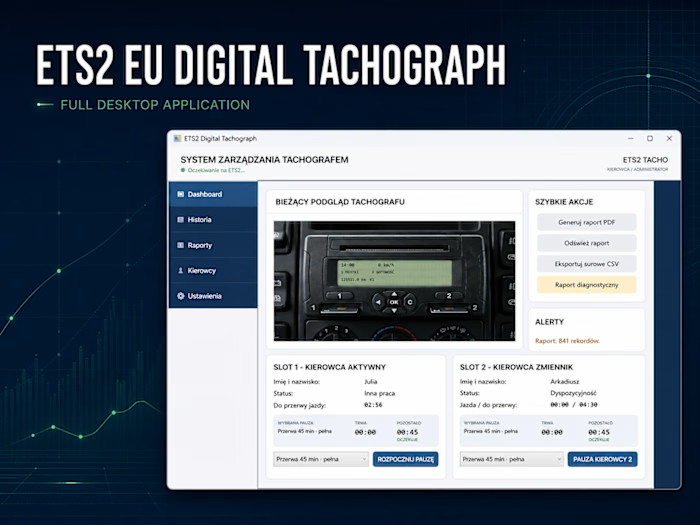
The image above is the UI design mockup used to shape the implemented planner. Its PDF-export control remained outside the current release scope; the portfolio does not claim that feature as shipped.
Key features
earliest supported driving-and-rest plan from the current driver state;
continuous, daily, weekly, and fortnightly capacity checks;
regular and reduced daily-rest scheduling;
weekly-rest scheduling and compensation-obligation awareness;
split-break completion and calendar-boundary waiting;
delivery deadline and post-arrival work calculation;
single-driver and crew-planning domain contracts;
explicit statuses for insufficient data, unresolved gaps, stale snapshots, missed deadlines, and calculation safety limits;
explainable plan segments and warnings;
desktop presentation of the calculated segment timeline.
Technical approach
Snapshot isolation
Planning runs against a captured state instead of live mutable objects. The snapshot identity combines the driver slot, activity session, world generation, game-time position, history high-water mark, and regulatory calendar offset. The application checks that identity again before presenting a result. If the card, session, activity, gap state, or telemetry position changed during the calculation, the result is marked stale rather than presented as current.
Deterministic state transition engine
The core algorithm advances through typed segments such as
Drive, Break, DailyRest, WeeklyRest, OtherWork, and CalendarWait. Each transition updates the relevant counters and deadlines. This keeps the calculation auditable and makes edge cases testable without the UI.Bounded calculation
Maximum segment, elapsed-time, and visited-state limits protect the desktop application from unbounded searches. Repeated states are detected, and the planner returns an explicit terminal status instead of hanging or guessing.
Presentation boundary
The WPF view model translates domain segments, warnings, confidence, and deadline margins into a readable timeline. Planning logic remains independent of controls and formatting.
Verification
Dedicated RuleEngine, Application, and Desktop tests cover the algorithm, contracts, safety limits, stale-snapshot handling, delivery planning, crew boundaries, and view-model behavior. The wider solution is continuously built and tested in GitHub Actions.
Technologies
C# and .NET 9
WPF and MVVM
deterministic domain modelling
SQLite and Entity Framework Core as the history source
xUnit
GitHub Actions
Result
The module turns a complex time-based state into a plan that a user can inspect: when driving can continue, when rest is required, which constraint caused a wait, and whether the delivery window is still achievable. From a portfolio perspective, it demonstrates algorithmic business logic, safe state handling, clear separation between domain and UI, and regression-driven development.
Related project
Like this project
Posted Aug 10, 2026
Constraint-based planner creating explainable driving, break and rest timelines from driver state, delivery windows and implemented rules.
Likes
0
Views
12
Timeline
Aug 1, 2026 - Aug 4, 2026