Startup Financial Model | 36-Month Operating Plan

Oluwajuwon Adediji

MODELING COCKPIT
A practical operating model for early-stage planning
See the operating story before you build the fundraising slide.
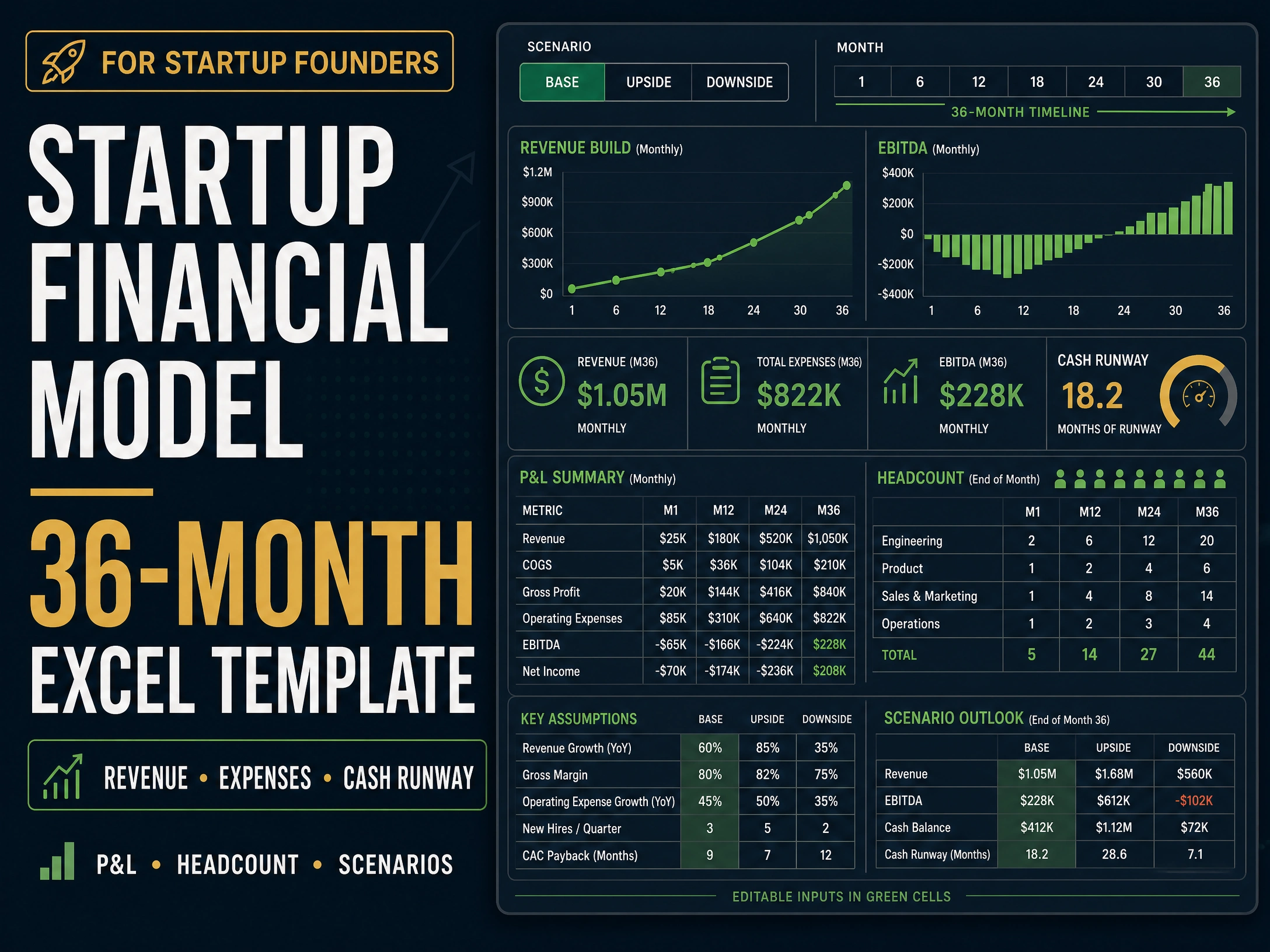
Start with a 36-month Excel model for revenue, costs, hiring pace, EBITDA, cash runway, and funding assumptions—then replace the placeholders with your actual operating data.
Starter Financial Model for Startups (Excel) Live price: Rating:
MODELING COCKPIT $29
Fundraising narratives are stronger when the operating assumptions are visible
A blank spreadsheet slows planning, while an unexamined model can hide the assumptions that drive the story. This template gives you a structured starting point with clear input cells, linked outputs, and room to stress-test cases.
Pre-seed and seed founders, operators, and early-stage teams preparing an operating plan or a finance conversation.
Practical by designWork from real inputs, real evidence, and visible next actions.
Clear about limitsUse the resource as a system for better work, not as a promise of outcomes.
Ready to adaptStart with the structure, then fit it to your context, tools, and professional judgment.
A working model you can inspect, stress-test, and explain
Build month by month
Plan 36 months of revenue, costs, headcount, P&L, cash runway, and fundraising timing.
Separate inputs from outputs
Use blue assumption cells and review the formulas instead of treating the workbook as a black box.
Prepare a finance conversation
Use the dashboard and scenario views to explain how operating assumptions affect revenue, EBITDA, and runway.
Everything you need to start with structure.
Use the pieces together as a workflow, or begin with the part that solves your immediate bottleneck.
36-month monthly operating model
Assumptions sheet with blue input cells
Revenue build with customers, churn, ARPC, COGS, and gross profit
Headcount plan and fully-loaded people-cost view
Monthly P&L with EBITDA and planning taxes
Cash runway and fundraising-month view
Dashboard with key outputs and revenue / EBITDA chart
Quick-start PDF guide and responsible-use notes
A simple path from input to next action.
Set assumptions
Enter and document the operating assumptions that matter for your model.
Inspect the mechanics
Review revenue, costs, headcount, P&L, and cash outputs against the inputs.
Start with a clearer next step.
Validate important decisions and investor materials with a qualified finance professional.
Be the first to review
Product details
Build a practical 36-month operating model before you build your next fundraising slide.
The Starter Financial Model for Startups is an editable Excel workbook for pre-seed and seed founders who need a clearer view of revenue, costs, hiring pace, cash runway, and funding assumptions without starting from a blank sheet.
What you get
36-month monthly operating model
Assumptions sheet with blue input cells
Revenue build with customers, churn, ARPC, COGS, and gross profit
Headcount plan and fully-loaded people-cost view
Monthly P&L with EBITDA and planning taxes
Cash runway and fundraising-month view
Dashboard with key outputs and revenue/EBITDA chart
Quick-start PDF guide and responsible-use notes
Best for
Founders, operators, and early-stage teams preparing a first operating plan, evaluating hiring pace, or organizing assumptions for a finance conversation.
How to use it
Edit the blue cells, review the formulas, stress-test downside and upside cases, and replace every placeholder with your actual operating data before sharing externally.
Important: This is a planning template, not accounting, tax, legal, valuation, investment, or fundraising advice. Validate important decisions and investor materials with a qualified finance professional.
A few useful boundaries before you begin.
Is this an accounting, valuation, or fundraising model?
It is a starter operating model for planning. It is not accounting, tax, legal, valuation, investment, or fundraising advice.
Can I share it with investors immediately?
Replace every placeholder, review formulas, validate assumptions, and have a qualified finance professional review important materials first.
What makes it beginner-friendly?
The workbook starts with a structured 36-month layout, visible input cells, linked outputs, and a quick-start guide rather than a blank sheet.
Like this project
Posted Aug 22, 2026
Built an editable 36-month operating model covering revenue, costs, headcount, EBITDA, cash runway, and funding assumptions for early-stage planning.
Likes
0
Views
1