Hydrogen at Sea: Transforming Maritime Shipping

Mykyta Ierisov

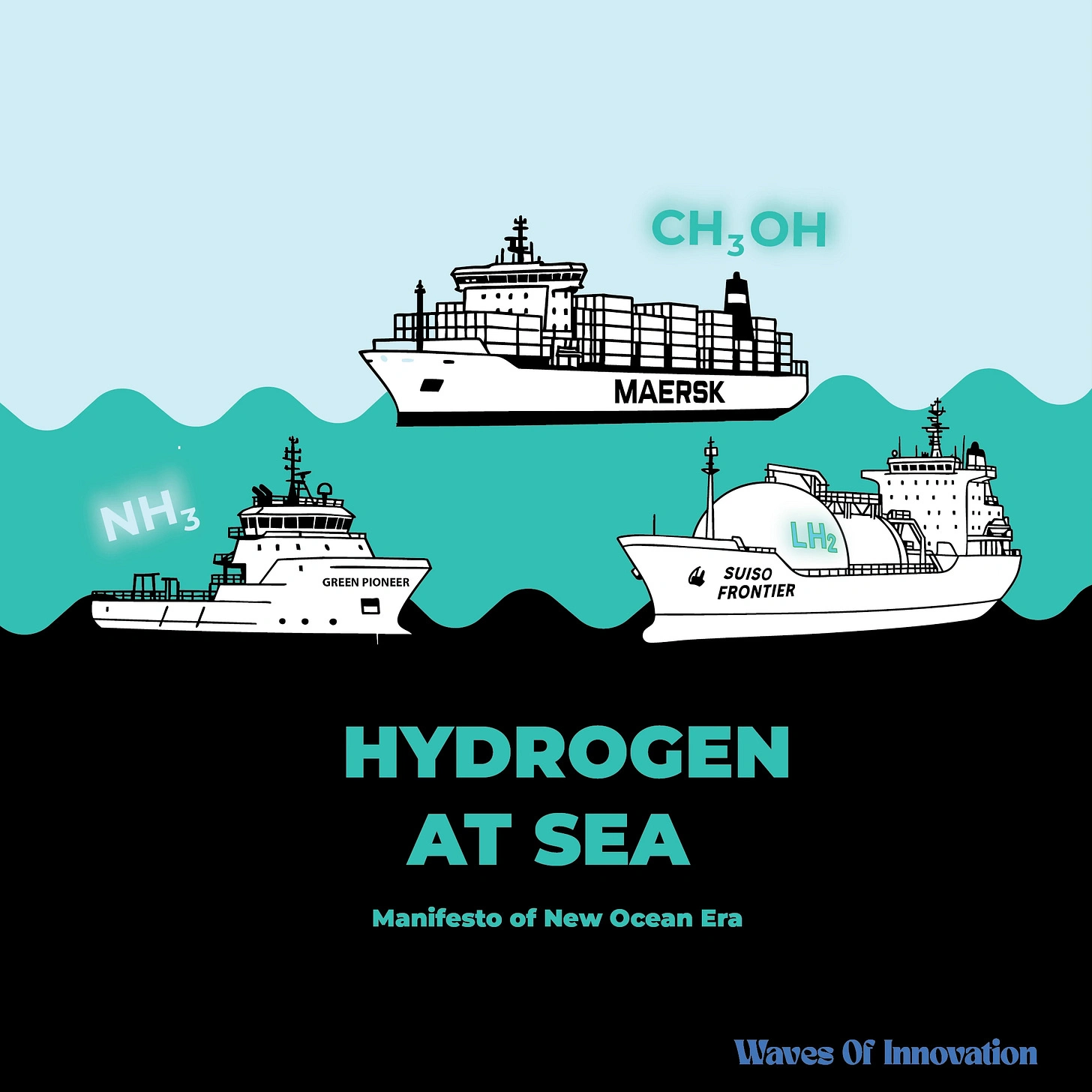
As the world sails toward net-zero, the maritime industry stands at the dawn of its most profound transformation. Hydrogen at Sea explores how ammonia and methanol are reshaping global trade, ports, and propulsion from molecules to meaning. This is not just a story of technology, but of renewal - the beginning of a new ocean era powered by wind, sun, and human imagination.
1. A New Wave Of Propulsion
The Shipping Industry is responsible for around 3% of global emissions today. Yet it is not as much as Livestock (meat) industry, which is responsible for about 14%, more than all transportation sector combined. [1] However, shipping industry is one of the world’s fastest growing sources of carbon emission - the percentage is expected to rise to 8% by 2050.
Imagine a ship crossing the Pacific without burning a single drop of fossil fuel. We are living in times, when it is not a science fiction, but a reality.
IMO (International Maritime Organisation) in April of this year introduced a draft NZF (Net-Zero Framework) to decarbonise shipping industry by 2050.
IMO’s Net Zero Framework proposals:
The International Maritime Organization’s proposed Net-Zero Framework (NZF) would, for the first time, create a global system to cut greenhouse-gas emissions from international shipping, with the aim of reaching net zero around 2050. It would apply to most large ocean-going vessels and make emissions rules legally binding. The plan combines technical standards, financial penalties, and incentives to push shipowners toward cleaner fuels and technologies while ensuring that funds are available to help developing nations adapt.
At its core, the NZF would introduce greenhouse-gas fuel-intensity limits — caps on how much carbon ships can emit per unit of energy — tightening over time from 2028 onward. Ships that exceed their limits would have to buy “remedial units” or pay into an IMO Net-Zero Fund, effectively creating a global carbon-pricing system for shipping. Money raised would be used to reward low-emission ships, fund clean-fuel infrastructure, and support poorer countries in the transition, although the exact details as to who will benefit from the fund are yet to be thrashed out.
The framework is designed to be fuel-neutral, meaning operators can choose any fuel or technology as long as their overall emissions fall within the limits.
Supporters say the NZF would provide long-term certainty for investors and accelerate adoption of zero-carbon fuels such as ammonia, hydrogen, and advanced biofuels, while critics argue the draft rules are too slow and complex to align with the Paris 1.5°C goal.
Concerns also remain about enforcement, equity between nations, and how accurately the system will account for full life-cycle (“well-to-wake”) emissions. Still, the proposal represents the IMO’s most comprehensive and enforceable attempt yet to decarbonize global shipping, turning earlier voluntary targets into a mandatory, market-based framework.
However, during the vote - US anti-climate government led by D.Trump waged a war against the NZF making coalition with another fossil-fuel producers like russia and Saudi Arabia.
The US president said on social media that he was “outraged” at the votes at the global shipping regulator in London and would not back the “Global Green New Scam Tax on Shipping... in any way, shape or form”.
The US government has already warned of visa restrictions for crews, extra port fees for countries backing the NZF and sanctions against officials.
The vote outcome of IMO committee in London was to postpone a decision about NZF for 1 year.
However, some countries are deferring the progress - the technologies are already here and transition to green fuels for shipping is inevitable.
The International Chamber of Shipping says there is no Plan B to the IMO scheme, warning that a failure to set up a scheme would lead to a patchwork of carbon-tax programmes introduced around the world.
Hydrogen insight writes:
Whereas the delayed IMO plan would have directed money raised from a carbon levy into a fund that would reward green shipowners, promote clean energy schemes and provide financial backing to small island states most affected by climate change, the regional schemes would be akin to taxes that would go straight into government coffers.
EU is now leading the transition to green-fuel in maritime shipping:
FuelEU Maritime rules:
FUelEU Maritime requires all ships weighing more than 5,000 tonnes to reduce emissions by 2% from the start of 2025 against a reference emissions intensity of 91.16 grams of CO2 equivalent per MJ of energy used.
This progressively rises to 6% from 2030, 14.5% from 2035, 31% from 2040, 62% from 2045, and finally 80% from 2050.
Emissions savings will be calculated based on energy used while at port in a member state’s jurisdiction, while travelling between two member states’ ports, or half of the energy used on voyages between a member state and a non-EU country.
A second rule will force operators of seaborne vessels to use at least 1% of green hydrogen-based fuels by 2034. And to incentivise the uptake of so-called renewable fuels of non-biological origin, FuelEU allows greenhouse gas emissions savings from using these fuels to be counted twice up to the end of 2033.
Non-compliance would lead to financial penalties that would amount to about double the cost of compliance.
However, if ships exceed compliance, owners can bank the surplus credits for future years or to offset dirtier ships in their pool.
2. The Evolution of Maritime Decarbonisation
Maritime decarbonisation has entered a new phase - beyond LNG and wind-assist - into the era of hydrogen molecules and carbon-free propulsion.
Phase 1: Efficiency & Compliance Era (2010 – 2020)
The first wave of “green shipping” was driven by IMO’s sulphur cap (2020) and Energy Efficiency Design Index (EEDI) rules.
Shipowners focused on incremental improvements:
Hull optimization
Slow steaming
Waste-heat recovery
Better voyage routing
These reduced fuel consumption but didn’t fundamentally change the fuel chemistry - ships still ran on heavy fuel oil (HFO) or marine diesel
Phase 2: LNG Transition (2015 – 2023)
Liquefied Natural Gas (LNG) emerged as the “bridge fuel.”
It reduced SOₓ and NOₓ by up to 90%.
Cut CO₂ by ~20% compared to HFO.
Benefited from existing natural-gas infrastructure.
Major fleets adopted it: CMA CGM, Shell, TOTE Maritime, etc.
However, LNG is still a fossil fuel, and methane slip (unburned CH₄ emissions) undermines its climate advantage.
So while LNG improved air quality, it could not deliver net-zero.
The most important thing about LNG that it is a fossil fuel, and fossil fuel is a finite resource, while renewable resources are in abundance across the Earth.
Phase 3: Wind-Assist & Hybrid Solutions (2020 – 2025)
As carbon targets tightened, wind-assist technologies returned — modernized with automation and composites:
Rotor sails (Norsepower, Anemoi)
Wing sails (Oceanbird, BAR Technologies)
Kites (Airseas, SkySails)
These deliver 5–20 % fuel savings, depending on route and conditions. In favourable conditions the wind propulsion promises upto 50% of fuel savings.
Parallel advances in battery-hybrid systems and shore-power electrification helped reduce emissions in ports.
Still, these were add-ons, not primary propulsion transitions, however there are cases of Wind Propulsion driven vessels.
Phase 4: The Molecule Revolution — Hydrogen & Derivatives (2025 – 2050)
Now the industry is crossing into a fundamentally new phase - changing the molecules themselves, not just the methods of propulsion.
This includes:
Hydrogen (H₂): Used in fuel cells or internal combustion engines.
Ammonia (NH₃): A hydrogen carrier and carbon-free fuel candidate.
Methanol (CH₃OH): Liquid at ambient conditions, easier to store.
Synthetic fuels (e-methanol, e-diesel): Produced using captured CO₂ + green H₂.
This phase shifts focus from energy efficiency → to energy transformation.
IMO’s Revised GHG Strategy (2023): Net-zero by 2050; 20–30 % reduction by 2030, 70–80 % by 2040, this effectively renders LNG transitional, and pushes zero-carbon fuels to the core of compliance planning.
The focus is shifting from how ships burn fuel to what the fuel is.
3. The Hydrogen Promise
3.1. What Hydrogen Really Is
Hydrogen (H₂) is not an energy source like oil or coal - it’s an energy carrier.
That means it stores and delivers energy, but we must first produce it using another energy source (like wind, solar, or natural gas).
Once produced, hydrogen can be stored, transported, and converted back into power or heat - similar to a battery, but using molecules instead of electrons.
3.2. How It Produces Energy
There are two main ways hydrogen releases energy:
3.2.1. Combustion
Hydrogen can be burned in an engine or turbine (similar to diesel or LNG).
The reaction is:
2H2 + O2 → 2H2O + Energy
The only byproduct is water vapor (H₂O) - no carbon dioxide, no soot, no sulfur oxides.
That’s why it’s called a zero-carbon fuel.
(However, small nitrogen oxides (NOₓ) can form at high combustion temperatures, but they can be minimized with modern control systems.)
3.2.2. Fuel Cell Reaction
Hydrogen can also be used in a fuel cell, where it doesn’t burn - it reacts electrochemically with oxygen from the air:
2H2 + O2 → 2H2O + Electricity + Heat
This process generates electric power directly, with no combustion and zero emissions besides pure water and heat.
It’s like a chemical battery that runs as long as it’s fed hydrogen.
In ships, fuel cells can power:
Propulsion motors
Auxiliary systems
Onboard electricity
3.3 Promise for Maritime Industry
Hydrogen has the highest energy content per kilogram of any fuel.
Energy density (by weight):
Hydrogen = 120 MJ/kg
Diesel = 45 MJ/kg
LNG = 50 MJ/kg
That means 1 kg of hydrogen contains about 3 times more energy than 1 kg of diesel.
So, for ships where weight matters (like ferries, research vessels, or future container ships), hydrogen offers a powerful energy-to-mass ratio, allowing for lightweight propulsion systems compared to heavy batteries.
However - hydrogen is very light, so it takes up a lot of space unless it’s:
Compressed (e.g. 350–700 bar tanks), or
Liquefied (cooled to –253°C).
This is the main engineering challenge: it’s energy-dense by weight, but not by volume - hence the ongoing research into ammonia and liquid organic hydrogen carriers (LOHCs) for large oceanic vessels.
Hydrogen itself is just a molecule - its environmental footprint depends on how you make it.
Hydrogen becomes especially powerful when integrated into a renewable ecosystem - for example, offshore wind farms or desert solar plants.
4. Types of Hydrogen and Their Colors
The “colors of hydrogen” are not literal - they’re a symbolic way to describe how the hydrogen is produced and how clean (or not) it is.
When we talk about hydrogen as fuel for shipping industry, we mainly refer to 3 types of hydrogen: grey, blue and green.
Global Trend :
Today, ~95% of the world’s hydrogen is still grey (from fossil gas).
The next decade (2025–2035) will see rapid growth in green and blue hydrogen due to:
Falling renewable-energy costs
Carbon-pricing pressure
Large national hydrogen strategies (EU, Japan, Chile, Canada, Namibia, etc.)
Green hydrogen is the only one that can decarbonize shipping completely, especially when converted into green ammonia or methanol.
Blue hydrogen may act as a bridge fuel, helping ports and industries transition while renewable capacity scales up.
5. Real-World Projects and Case Studies
5.1 Norled’s MF Hydra – world’s first liquid hydrogen ferry (Norway, 2023).
MF Hydra is the world’s first-powered ferry. Delivered in 2021, the 82.4-meter-long vessel can accommodate up to 300 passengers and 80 vehicles.
Norled (Norwegian Public Roads Administration) says that Norway is at the forefront of the green shift in maritime transport.
Norled is showing the way of combination emerging technology to produce a green shift with 20 years of experience of ferry innovation behind them.
In 2000, MF Glutra was the first car ferry in the world to run on liquefied natural gas (LNG).
MF Ampere was the world’s first propeller-driven electric ferry.
Norway is at the forefront of the green shift in maritime transport, and the Norwegian Public Roads Administration is once again showing the way for the combination of new technology and the green shift.
Norled’s MF Hydra began operating in Norway in March 2023. Built by Westcon, it runs on a triangular route in Norway and uses two hydrogen fuel cells (200kW each) to produce zero-emission electricity, with water vapor being the only byproduct. The two cells produce total 400kW power output for hybrid-electric propulsion driven system, while hydrogen is stored in 80m3 cryogenic tanks. The vessel is also backed with wo 440 kW diesel generators and a 1.2-1.5 MWh battery system being able to cruise at speed of 9kts is estimated to lower emission by 95% [2]
5.2 Fortescue’s Green Pioneer - world’s first ammonia powered vessel
The Green Pioneer is the world’s first ammonia dual-fuel vessel.
This 75-metre ship shows the potential to bypass transitional fuels like biofuels and liquefied natural gases by converting its standard engines to run using ammonia as a dual fuel. It’s a game-changer in the push to cut fossil fuels from the maritime supply chain.
Fortescue also made world’s first’ digital fuel certificate pilot for ammonia bunkering.
The milestone transaction, conducted in collaboration with the Green Hydrogen Organisation (GH2) and Trovio, featured the Forstescue Green Pioneer- the world’s first ocean-going dual-fuel ammonia-powered vessel - during a recent fuel transfer at the Port of Rotterdam.
The certification was issued through Trovio’s CorTenX registry platform, which securely captures comprehensive end-to-end supply chain data, including port and vessel information, transaction timestamps, and relevant sustainability metrics.
According to the partners, the digital certificate ensures auditable transparency by documenting the sustainability characteristics of the fuel - covering its origin, handling processes, and transfer details.
Fortescue’s Green Pioneer is an Offshore Supply Vessel (OSV) It is a dual-fuel vessel, capable of running on ammonia and diesel (or HVO) with 20m3 tank of ammonia storage on deck.
Fortescue and Green Pioneer paving the way for ammonia as a next generation fuel to meet 2050 target of net-zero in shipping industry. [3]
5.3 Green methanol vessels as bridge technology.
Methanol is a liquid alternative fuel that can be produced renewably and used to power ships today - a practical bridge between fossil fuels and a hydrogen-based maritime future.
Methanol - also known as methyl alcohol (CH₃OH) - is a simple liquid alcohol that can be used as a fuel or chemical feedstock. It is a colorless, light, and flammable liquid which burns with a clean, almost invisible flame. It is also toxic if ingested or inhaled — not the same as drinking alcohol (ethanol).
Methanol is very lucrative as marine fuel because can be burned in modified diesel engines, or used in fuel cells to generate electricity for propulsion.
Its appeal:
Liquid at room temperature → easy to store and transport (unlike hydrogen, which needs high pressure or cryogenic tanks).
Lower carbon intensity than heavy fuel oil or marine diesel.
Existing infrastructure (tankers, bunkering, pipelines) can often be adapted to handle methanol.
There are three main “colors” depending on how it’s produced.
Maersk in pioneering the way with large with large dual-fuel methanol container vessels.
It’s fleet of 18 vessels is already complete and operating.
The total list is:
Ane Maersk is first of the series; Then: Astrid Maersk, Antonia Maersk ,Alette Maersk, Alexandra Maersk, Angelica Maersk, A.P. Møller, Adrian Maersk, Albert Maersk, Alva Maersk, Arthur Maersk, Axel Maersk, Berlin Maersk, Beijing Maersk, Bangkok Maersk, Brisbane Maersk, Brussels Maersk
CMA CGM is also joining the race and launched its first methanol-powered container vessel -CMA CGM Iron, which made its maiden voyage in March 2025. It will be first of 12 new 13,000 TEU dual-methanol vessels, which will be delivered in 2025 and 2026 by
The vessels names are CMA CGM Cobalt, Argon, Platinum, Mercury, Helium, Krypron, Thorium, Osmium, Silver, Copper, Gold
The total order is valued at about 2 billion USD and will be fulfilled by HD Hyundai Samho Heavy Industries (South Korea).
On March 20, 2025, CMA CGM also signed an agreement - “Green Methanol Long Term Supply Cooperation Agreement” to develop a fully integrated green methanol value chain.
Under this agreement, Shanghai Electric Group will provide mid-to-long-term green methanol fuel supply for CMA CGM. In partnership with SIPG, green methanol will be transported via land-sea combined logistics from production base in Taonan to Shanghai Yangshan Port, the world’s largest container port. [4]
5.4 Green Fuel Hubs
“Challenges at sea must first be addressed ashore.”
A supporting ecosystem of production, logistics, and bunkering infrastructure must be established to enable meaningful maritime transition.
Yet even in this complex landscape, we already see pioneers leading the way - laying the foundations of a new regenerative economy.
5.4.1. Port of Rotterdam
The Port of Rotterdam is one of the most advanced and important seaports in the world - and it’s at the frontline of the green energy and maritime transition.
Overview:
Location: Netherlands, at the mouth of the Rhine and Meuse rivers.
Status: Europe’s largest port and one of the top 10 globally.
Annual throughput: Over 440 million tonnes of cargo.
Specialization: Crude oil, containers, LNG, chemicals, and now - renewable fuels and hydrogen.
It stretches over 40 kilometers, from the city center to the North Sea, and serves as Europe’s main logistics and energy hub - connecting the continent to global trade routes.
Strategic Importance:
Port of Rotterdam has a direct access to the North Sea, it is a deep-water port suitable for the largest vessels, linked by river to Germany, Switzerland, and Central Europe, making it a gateway to the European hinterland.
Integrated rail, road, and pipeline systems connect it like veins to industrial zones all across Europe makes it truly a heart of European commodity transportation.
Sustainability & Energy Transition:
Rotterdam is leading the transformation toward a climate-neutral port by 2050.
Its strategy focuses on:
Hydrogen economy (production, import, and distribution).
Carbon capture and storage (CCS) under the North Sea.
Biofuels and synthetic fuels production.
Electrification of port operations and logistics.
Offshore wind integration into industrial clusters.
Hydrogen Hub of Europe:
Rotterdam aims to become Europe’s Hydrogen Gateway with key hydrogen initiatives:
HyTransPort.RTM pipeline: A 32 km hydrogen pipeline connecting producers, storage sites, and industrial users across the port area.
Hydrogen Import Terminals: Partnerships with global players to import green hydrogen and ammonia.
H-Vision Project: Producing blue hydrogen for industrial use while capturing CO₂.
Shell’s Holland Hydrogen 1: Europe’s largest electrolyser (200 MW) under construction on Maasvlakte 2, powered by North Sea wind.
These projects together make Rotterdam a prototype for the future hydrogen economy.
Innovation & Digitalization:
Smart Port Infrastructure: Drones, digital twins, AI-driven traffic control, and IoT systems optimize ship arrivals and reduce idle emissions.
PortXchange platform: Collaborative digital platform that helps ships synchronize arrival times - saving fuel and CO₂.
Automation: Fully automated container terminals (e.g., APMT Maasvlakte II).
Circular & Industrial Symbiosis:
Rotterdam’s industrial cluster is shifting from linear (extract–use–waste) to circular:
Shared steam and CO₂ networks among refineries and chemical plants.
Waste-to-energy and bio-refinery projects.
Focus on reusing materials, heat, and CO₂ within the port ecosystem.
Vision for 2050:
By 2050 we can envision Rotterdam as being completely net-zero in port operations with 100% renewable energy use. It is becoming a model port for sustainable global logistics with major export/import of green hydrogen, synthetic fuels, and renewable electricity.
“The beating green heart of Europe’s energy transition.”
5.4.2 Port of Antwerp–Bruges
“Hydrogen Gateway of Europe”
Overview:
The Port of Antwerp–Bruges (PAB) has emerged as one of the most dynamic maritime and industrial ecosystems in Europe.
Formed in 2022 through the merger of the Ports of Antwerp and Zeebrugge, it combines deep-sea accessibility, vast industrial zones, and a world-leading chemical cluster.
Handling over 270 million tonnes of cargo annually, it connects 800 destinations worldwide and serves as a critical hub for energy, logistics, and innovation in North-West Europe.
Today, the port’s mission extends far beyond trade - it aims to become a climate-neutral energy and circular-industry hub by 2050, leading Europe’s green-molecule transition.
Strategic Importance:
Located at the crossroads of major North Sea shipping routes and the European hinterland, the Port of Antwerp–Bruges serves as a natural gateway for renewable molecules - hydrogen, ammonia, and methanol.
It is home to the largest integrated chemical cluster in Europe, hosting global players like BASF, INEOS, and TotalEnergies, all transitioning to low-carbon feedstocks.
Its location provides direct links to Germany, France, and the Netherlands through a dense network of pipelines, railways, and waterways, enabling the port to function as a molecular corridor - importing green fuels and distributing them across the continent.
In essence, Antwerp–Bruges is not only a maritime port but also Europe’s energy valve for the coming hydrogen economy.
Hydrogen Hub of Europe:
Fluxys and Advario are jointly developing a new ammonia (NH₃) import terminal at the Advario Gas Terminal site in Antwerp. The terminal is intended for “renewable and low-carbon ammonia as a carbon-neutral raw material and fuel
The design includes connection to hydrogen pipelines, and the plan is that imported ammonia may be converted back into hydrogen in the port cluster. [5]
The port is a member of the Hydrogen Import Coalition (together with DEME, Engie, Exmar, Fluxys, WaterstofNet). The coalition published a roadmap for hydrogen and hydrogen-carrier import, transport, storage and distribution in Belgium. [6]
The port’s NextGen District innovation hub is hosting a very large AEM (Anion Exchange Membrane) electrolyser demonstration in partnership with Power to Hydrogen. The project is reported to be the largest of its type in a commercial/industrial port environment to date. [7]
PAB is actively developing bunkering infrastructure for alternative fuels, including ammonia. For example, the port is targeting ammonia bunkering operations by 2026.
The port has also introduced the world’s first methanol-powered tugboat (“Methatug”) and a hydrogen-powered tug (“Hydrotug 1”), showing commitment to low-carbon shipping and port-fleet operations
The port has joined the “green shipping corridor” initiative between Sweden and Belgium, which involves ammonia-fueled Ro-Ro vessels by 2030.
Innovation:
Antwerp–Bruges functions as a living laboratory for clean technologies.
Through its NextGen District, the port invites startups and global pioneers to pilot scalable circular-energy solutions - from electrolysis systems and carbon-capture units to biorefineries.
Circular Economy:
Circularity is embedded in the port’s design.
As home to one of Europe’s most integrated petrochemical clusters, Antwerp–Bruges is transitioning from a linear fossil model to a circular material cycle.
Industrial symbiosis projects already allow companies to reuse waste heat, CO₂, and by-products within the cluster.
New ventures in plastics recycling, bio-refineries, and green-feedstock production are turning the port into a circular-industry testbed - where nothing is wasted and every molecule finds a new purpose.
Vision & Challenges:
Snapshot of Status (2025):
Ammonia import terminal (Fluxys/Advario) in FEED/feasibility phase. Fluxys
Ammonia bunkering trials targeted around 2025–2026. Quantum Commodity Intelligence
Hydrogen import roadmap published; first imports expected circa 2026. Port of Antwerp-Bruges+1
Electrolyser pilot (NextGen District) underway for hydrogen production. Power to Hydrogen
Green shipping corridor (Sweden-Belgium) with ammonia-fueled vessels by 2030.
While targets (1 M t H₂/yr, 10 M t NH₃/yr) are ambitious, achieving them requires major investment in import terminals, pipelines, storage, cracking/processing plants, bunkering logistics. The permitting, financing and coordination will be complex.
The Port of Antwerp–Bruges envisions a climate-neutral industrial ecosystem by 2050, powered by renewable molecules, closed-loop materials, and intelligent logistics.
Its vision is to evolve from “fossil gateway” to “green energy hub” - the heart of Europe’s hydrogen and ammonia economy.
“Where oil once flowed, hydrogen will flow. Where carbon was emitted, carbon will be captured.”
The Port of Antwerp–Bruges is writing the blueprint for the green ports of the 21st century.
5.4.3 Yara - World Largest Ammonia Distributor
Overview:
While not a port, Yara Clean Ammonia is headquartered in Oslo, Norway and operates the largest global ammonia network with 15 ships and access to 18 ammonia terminals and multiple ammonia production and consumption sites across the world, through Yara. Revenues and EBITDA for the full year 2022 were USD 4,422 million and USD 249 million respectively. [8]
Founded in 1905 as part of Norsk Hydro, Yara has grown into a global agricultural and industrial company operating in over 60 countries.
Yara’s core product - ammonia (NH₃) - has traditionally been used as a feedstock for fertilizers, but the company is now pivoting toward green ammonia as a zero-carbon energy carrier for shipping, industry, and energy storage.
Yara handles around 8–9 million tonnes of ammonia annually, making it the largest trader and distributor of ammonia in the world. The company owns or co-owns ammonia terminals in key ports such as Sluiskil (Netherlands), Brunsbüttel (Germany), Porsgrunn (Norway), and Pilbara (Australia).
Yara has explicitly positioned itself at the center of the global hydrogen transition by focusing on green and blue ammonia production.
Key projects include:
Yara Porsgrunn (Norway)
A flagship project to produce green ammonia using renewable hydroelectricity.
Partnered with Statkraft and Aker Horizons under the venture Yara Clean Ammonia (YCA).
Goal: reduce emissions by up to 800,000 tonnes of CO₂ per year.
Yara Pilbara (Australia)
Produces ammonia using natural gas but is transitioning to blue and green ammonia via carbon capture and renewable integration.
Supported by the Australian Government and ARENA (Australian Renewable Energy Agency).
Yara is one of the strongest advocates for ammonia as a maritime fuel:
Developing ammonia bunkering infrastructure at key European ports (e.g., Port of Antwerp–Bruges, Sluiskil, Hamburg, Singapore).
Partnering with shipbuilders and engine manufacturers (like Wärtsilä and MAN Energy Solutions) to enable ammonia-fueled vessels.
Engaged in pilot projects for ammonia-powered tugs and coastal ships, as part of the EU’s “Zero Emission Shipping Mission.”
In 2023, Yara announced plans to deliver the world’s first container ship powered by clean ammonia, targeting operations around 2026 - a major milestone in maritime decarbonization.
In September 2024, Yara Clean Ammonia completed the world’s first ship-to-ship (STS) transfer of ammonia at anchorage in a port environment in Western Australia. This milestone proves that ammonia can safely and effectively serve as a zero-to-near-zero emission marine fuel, paving the way for a decarbonized maritime industry.
Strategic Partnerships:
Yara collaborates with major global players:
Enbridge (Canada) → large-scale blue ammonia plant in Texas (~1.2 million tonnes/year).
Iberdrola (Spain) → green ammonia production from solar-powered electrolysis.
Höegh Autoliners & NorthSea Container Line → joint development of ammonia-fueled shipping routes.
Port of Antwerp–Bruges → building ammonia import & bunkering infrastructure.
These partnerships anchor Yara’s ambition to be a top supplier of clean ammonia for shipping, power, and industry.
Vision:
Yet, Green ammonia remains 2–3× more expensive than conventional ammonia.
Yara envisions a world where:
“The same molecule that feeds the planet will also fuel it.”
Its long-term mission is to transform its entire ammonia supply chain — from grey to green — and become the global backbone of the renewable hydrogen economy.
By 2050, Yara aims to produce and distribute carbon-free ammonia at global scale, enabling net-zero agriculture, shipping, and industry.
5.5 Ammonia and Methanol comparison - two pillars of Green Shipping
Why Ammonia ?
Ammonia is a colorless gas made of nitrogen and hydrogen. It’s widely used today in fertilizer production but is now emerging as a carbon-free fuel and hydrogen carrier.
Even though Hygrogen is the future of green shipping - transportation of Hydrogen is challenging. Hydrogen gas must be stored at –253 °C (cryogenic) or under very high pressure - both costly and technically complex on large ships. Ammonia, by contrast, becomes liquid at just –33 °C or under moderate pressure (~10 bar), making it far easier and cheaper to handle.
Ammonia is Hydrogen Carrier
All this makes ammonia a suitable hydrogen carrier. At the destination, it can be cracked back into hydrogen gas for use in fuel cells or industry. This makes ammonia a bridge molecule - allowing renewable hydrogen to move across oceans safely and efficiently.
Fitting into existing Engine Systems
Ammonia can be burned directly in internal combustion engines or used in solid-oxide fuel cells.
Because ships already carry cryogenic fuels (like LNG), adapting systems to ammonia is technically feasible. Hydrogen, on the other hand, would require entirely new storage, piping, and safety systems on board.
Emissions:
Ammonia acting as a Hydrogen carrier also can be green, blue etc depending on how hydrogen has been produced. But when burning it is not emitting any Carbon vapour because it does not contain Carbon molecules.
Infrastructure:
Ammonia has been produced, shipped, and stored safely for over 100 years for fertilizer and industrial uses.
More than 120 ports worldwide already handle ammonia - giving it a ready-made logistics network that hydrogen lacks. Bunkering infrastructure is developing to be operational in 2025 - 2026.
Why Methanol ?
Methanol is a simple liquid alcohol made of carbon, hydrogen, and oxygen. It’s already used globally as a chemical feedstock and is now gaining popularity as a low-carbon marine fuel.
Unlike hydrogen or ammonia, it can be handled, stored, and transported using existing liquid-fuel infrastructure - making it the easiest clean fuel to adopt without radically redesigning ships.
Easy Handling:
Methanol is liquid at room temperature and pressure, so:
No cryogenic cooling is needed (unlike hydrogen).
It can be stored in standard fuel tanks and bunkered with existing pipelines.
Refueling procedures are similar to today’s marine diesel operations.
Engine Compatibility:
Modern methanol engines are dual-fuel, meaning they can run on methanol and conventional marine fuel.
MAN Energy Solutions and Wärtsilä already offer commercially available methanol engines.
Infrastructure:
Global methanol trade and storage already exist for the chemical industry.
Bunkering infrastructure is rapidly expanding - ports like Rotterdam, Singapore, and Shanghai are already methanol-ready. This allows shipping companies to scale operations without waiting for new global infrastructure (unlike hydrogen or ammonia).
Lower Emissions Profile:
When used as fuel, methanol:
Emits virtually no sulfur oxides (SOₓ) or particulate matter.
Cuts nitrogen oxides (NOₓ) emissions by 60–80 %.
Can achieve up to 95 % CO₂ reduction when produced from renewable sources.
Even with grey methanol, switching from heavy fuel oil still improves local air quality around ports and coasts.
Transitional and Scalable:
Methanol is not only a cleaner fuel - it’s also a stepping stone:
It can be synthesized from biomass, CO₂, or green hydrogen, meaning the same engine and storage can be used across generations of cleaner fuel.
This flexibility helps shipowners invest confidently today, knowing vessels can later switch to renewable methanol without redesign.
Summary:
Ammonia is being adopted in shipping because it is carbon-free, globally available, energy-dense, and compatible with the emerging hydrogen economy - making it one of the most promising long-term solutions for truly zero-emission ocean transport.
Methanol is used in shipping because it is liquid, scalable, engine-ready, and globally available - delivering major emission reductions now and paving the way for fully renewable, carbon-neutral shipping in the future.
5.6 Suiso Frontier - world’s first liquefied hydrogen (LH₂) carrier
Suiso Frontier is the world’s first liquefied hydrogen (LH₂) carrier, built by Kawasaki Heavy Industries (KHI).
It was launched in 2019 and delivered to the HySTRA consortium (Hydrogen Energy Supply Chain project) - a joint initiative between Kawasaki, Iwatani, Shell Japan, and J-Power, with support from the Japanese and Australian governments.
The vessel is designed to transport liquefied hydrogen from Australia to Japan, marking a key step in Japan’s goal to build a full hydrogen supply chain.
Technical Specifications:
Type: Liquefied Hydrogen Carrier
Length: ~116 meters
Cargo capacity: ~1,250 m³ of liquefied hydrogen (~88 tonnes of H₂)
Cargo temperature: –253 °C (liquid hydrogen’s boiling point)
Propulsion: Diesel-electric system
Builder: Kawasaki Heavy Industries, Kobe Works
Flag: Japan
The cargo containment system is a double-shell, vacuum-insulated spherical tank, designed to minimize heat ingress and hydrogen boil-off (vaporising). The system maintains ultra-low temperatures to keep hydrogen in liquid form - which has 1/800th the volume of its gaseous state.
Strategic Importance:
Suiso Frontier represents Japan’s hydrogen import ambitions, particularly to:
Diversify energy sources away from fossil fuels and nuclear dependency.
Build infrastructure for carbon-neutral fuels, in line with Japan’s 2050 Net-Zero target.
Pioneer global standards for hydrogen shipping safety, handling, and certification.
The Australia–Japan Hydrogen Supply Chain (HySTRA Project):
The Suiso Frontier’s maiden voyage (early 2022) transported liquefied hydrogen from Hastings, Victoria (Australia) to Kobe, Japan.
Hydrogen was produced from brown coal (lignite) using gasification, with CO₂ captured and stored - making it a blue hydrogen demonstration.
Challenges and Future Outlook:
Challenges:
Liquefaction energy cost (~30% of total hydrogen energy content).
Vapor management during long voyages.
Lack of global LH₂ infrastructure and ports certified for hydrogen handling.
Future steps:
Kawasaki and partners plan to scale up to larger vessels (up to 160,000 m³ LH₂).
Transition from blue to green hydrogen, produced from renewables.
Integration with Japan’s Kawasaki LH₂ terminal, opened in Kobe for unloading and regasification.
Symbolism:
The Suiso Frontier stands as a “proof-of-concept vessel” for the hydrogen economy -
showing that maritime transport of liquefied hydrogen is technically feasible.
It’s both an engineering milestone and a strategic prototype for future clean-fuel trade routes.
Challenges on the Horizon
The transition to zero-emission shipping has clearly begun - methanol and ammonia are no longer ideas, but fuels under construction.
Yet, between ambition and adoption lies a wide sea of technological, economic, and regulatory challenges.
6.1 Production and Supply Gaps
Green fuel availability remains the biggest bottleneck.
Today, less than 1 % of global ammonia and methanol production is “green.”
Most still comes from fossil natural gas, meaning CO₂ reductions are limited.
Scaling renewable production will require massive investments in electrolyzers, CO₂ capture, and renewable power - far beyond current capacity.
Key challenge: The world needs thousands of new green-fuel plants before ships can run truly emission-free.
6.2. Cost Competitiveness
Green ammonia and methanol currently cost 2–5 times more than conventional marine fuels.
Even with efficiency gains, fuel cost could represent up to 70 % of voyage expenses in early adoption years.
Until large-scale production and carbon pricing align, shipowners will struggle to justify the switch economically.
Key challenge: Achieving price parity with fossil fuels through scale, subsidies, and carbon taxes.
6.3. Infrastructure and Bunkering
Only a handful of ports - Rotterdam, Antwerp-Bruges, Singapore, Sines — are preparing for alternative-fuel bunkering.
For global fleets to operate freely, a network of certified, safe bunkering terminals must emerge across major trade routes.
Ammonia’s toxicity and methanol’s flammability demand new safety codes, crew training, and specialized storage systems.
Key challenge: Building a global green-fuel logistics chain as reliable as today’s oil system.
6.4. Technology Maturity
Methanol engines are proven but still new at large scale; efficiency and durability data are limited.
Ammonia engines are in prototype phase, facing combustion stability and NOₓ-emission challenges.
Fuel cells promise quiet, zero-emission operation but remain costly and power-limited for large vessels.
Key challenge: Turning laboratory success into robust, ship-scale reliability.
6.5. Regulation and Certification
The IMO’s net-zero 2050 strategy gives direction but lacks clear short-term enforcement.
Fuel safety codes (IGF Code revisions) for ammonia are still being written.
Carbon-intensity reporting and lifecycle accounting (well-to-wake) vary across jurisdictions.
Key challenge: Establishing consistent international rules to unlock investment confidence.
6. Supply-Chain Coordination
Green shipping doesn’t happen in isolation - it depends on energy producers, ports, shipyards, financiers, and regulators working in sync.
Fragmentation across regions and technologies risks slowing global adoption.
Key challenge: Aligning energy and maritime sectors into one integrated ecosystem - from solar field to ship propeller.
7. Human Capital and Safety
New fuels mean new training, new risks, and new responsibilities.
Crews must learn to handle cryogenic systems, toxic vapors, and dual-fuel engines safely.
Without upskilling and international certification, the energy transition could stall at the human level.
Key challenge: Building the zero-emission workforce of the future.
8. Strategic Uncertainty
The industry is investing in multiple fuel pathways simultaneously - methanol, ammonia, hydrogen, biofuels.
No single “winner” is guaranteed, creating uncertainty for investors and shipowners.
Key challenge: Navigating the transition decade (2025–2035) with flexible strategies and modular ship designs.
The horizon is bright, but the seas are uncharted.
The next decade will test not only technology - but the world’s ability to cooperate, invest, and adapt fast enough to make clean shipping real.
7. The Future Course and Beyond
By 2030, the course of maritime energy will no longer be defined by fossil molecules.
Across the world’s ports - from Rotterdam to Singapore, Sines to Vancouver — a new generation of ships will refuel with ammonia, methanol, and hydrogen instead of heavy fuel oil.
What once powered tractors and fertilizer plants will now propel container giants and coastal ferries, closing the loop between industry, agriculture, and ocean transport.
7.1 The Decade of Transition (2025–2035)
The coming decade will mark the “deployment era” of clean marine fuels.
Methanol will dominate early adoption - a liquid, adaptable bridge between the fossil and renewable worlds.
Ammonia will follow, moving from demonstration to large-scale bunkering at strategic ports.
Hydrogen and fuel-cell vessels will grow in regional fleets — ferries, research vessels, and offshore supply ships - powered directly by green electricity.
Global ports will become energy ecosystems:
Importing renewable molecules from Chile, Namibia, and Australia.
Cracking them into hydrogen for local industry.
Supplying ships with green fuels through certified, safe corridors.
7.2 A New Industrial Order:
The shift to green fuels will reshape global trade patterns.
Countries rich in wind and solar potential - such as Chile, Namibia, Morocco, and Australia - will emerge as exporters of green molecules, not just raw materials.
Energy-importing nations like Japan, Germany, and the Netherlands will become hydrogen terminals, rebuilding their ports around liquid fuel storage, cracking, and carbon capture systems.
Shipping companies will evolve into energy operators, managing not only fleets but also the molecules that feed them.
In this new economy, the ocean becomes the energy grid - a moving network connecting renewable sources with demand centers across continents.
7.3 Digitalization and Efficiency:
By 2030, zero-emission fuels will merge with smart ship technologies:
Real-time weather routing to optimize fuel use.
AI-based energy management for hybrid power systems.
Digital twins for predictive maintenance and lifecycle emissions tracking
7.4 The Port as a Living Organism:
Ports will no longer just handle cargo; they will breathe energy in and out.
Electrolysers will hum beside container cranes.
Ammonia cracking units will feed hydrogen pipelines.
Waste CO₂ from nearby industries will be captured and reused for synthetic fuel production.
Each port will become a node in a global circular economy, where energy, carbon, and data flow seamlessly between sea and land.
7.5 Human and Environmental Renaissance
As the maritime world decarbonizes, the ocean itself will become a symbol of regeneration.
Cleaner fuels mean:
No sulfur haze over coastal cities.
Less underwater noise from efficient propulsion.
New green jobs in shipyards, research, and renewable logistics.
A new generation of seafarers will emerge - engineers fluent in chemistry, data, and energy systems - the navigators of the post-carbon age.
Beyond 2050: A Zero-Emission Ocean:
By mid-century, the vision is clear:
Ships crossing oceans powered entirely by molecules of wind, sun, and water.
Ports acting as energy sanctuaries, balancing import, storage, and circular reuse.
Carbon as a controlled and recycled element, no longer a pollutant but a building block.
The sea that once carried coal and oil will carry the very fuels that end their era.
The future of shipping will not be written in the smoke of its funnels -
but in the quiet chemistry of hydrogen, ammonia, and methanol.
The horizon ahead is not only blue - it’s green, luminous, and alive.
8. The New Ocean Era
A century ago, the world’s oceans carried the oil that fueled industry, power, and progress.
Today, they are preparing to carry something else - hope.
The age of hydrocarbons is giving way to an era of molecules born from sunlight, wind, and water.
Steel giants once driven by smoke and noise are evolving into quiet, electric ecosystems, breathing nothing but air and releasing nothing but vapor.
Ports that once smelled of crude now hum with the rhythm of electrolysers, wind turbines, and circular industry.
This is not only a technological shift - it is a new relationship between humanity and the sea.
The ocean is returning to its ancient role - not merely as a route for commerce, but as a living conduit of renewal.
The same currents that carried fossil fuels will now carry hydrogen, ammonia, and methanol, linking continents in a network of clean energy.
Ships will become moving nodes of the global grid, and ports - gateways of balance, where carbon, energy, and life are harmonized.
The maritime world, once a symbol of extraction, becomes a vessel of restoration.
This transformation is also a human story.
Engineers, sailors, scientists, and dreamers are rewriting the operating code of civilization - one molecule at a time.
The transition is not easy. It demands courage, investment, and imagination.
But for those who dare, the reward is immense:
A world where the ocean no longer divides - it connects.
A sea no longer polluted - but empowered.
Like this project
Posted Mar 9, 2026
Explored hydrogen's transformative potential in maritime shipping toward net-zero.