Hydrogen Economy in Global Shipping

Mykyta Ierisov

Why at all do we need hydrogen ? Well, it is the time for the world to shift from the fossil fuels, which are limited and when extracted destroying the eco-system and polluting the atmosphere when burned. Our civilisation posses already all the necessary technologies to produce and use the renewable energy. Hydrogen itself is not the energy source, it is an energy carrier, which allows to store the energy.
Energy surplus produced by renewables such solar, wind,tide etc can be converted to hydrogen through the process known as electrolysis and effectively stored and used on-demand by various users and industries.
Shipping is just a such industry, which is the most effective way to move cargo across the globe. However, emissions of the ship’s engine contribute about 3% of global GHG emissions, and because the shipping industry will remain the most effective way to move cargo in the foreseeable future this number is expected to growth by 8% till 2050.
So far electrical driven propulsion is utilised mostly as hybrid technology, meaning that vessel is operating on batteries and a back-up power source - usually diesel.
The biggest operational range for electrical driven vessels are: 20–60 NM / 2–4 h for harbour tugs, 10–50 NM for coastal or Ro-Ro ships and 30–80 NM for offshore vessels which all has a recharge base ashore.
Of course, such a small range is not suitable for deep-sea or ocean-going vessels which travel many miles between ports and facing adverse weather condition along the route.
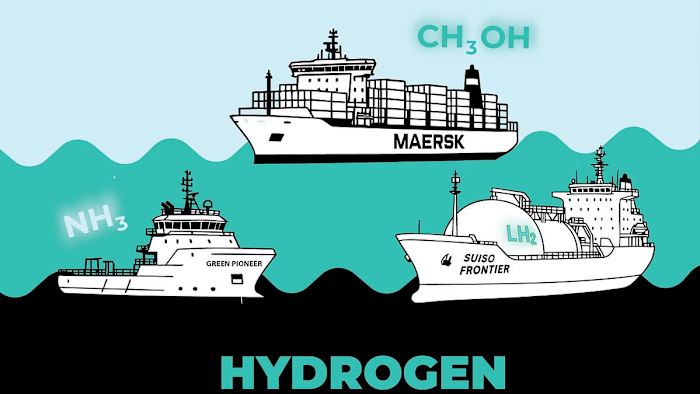
This vessels require to stock onboard fuel for all voyage usually and some extra as well for emergency. Hydrogen and hydrogen carriers can effectively be burned in ship’s engine or used fuel cells. There are other solutions such as methanol. Green methanol can reduce emissions significantly, however so it is has carbon molecule in it can not considered fully “green”. On other hand when hydrogen is burned it produces only water vapour. If you are interested to explore the differences between the methanol and hydrogen, you can read my another article here.
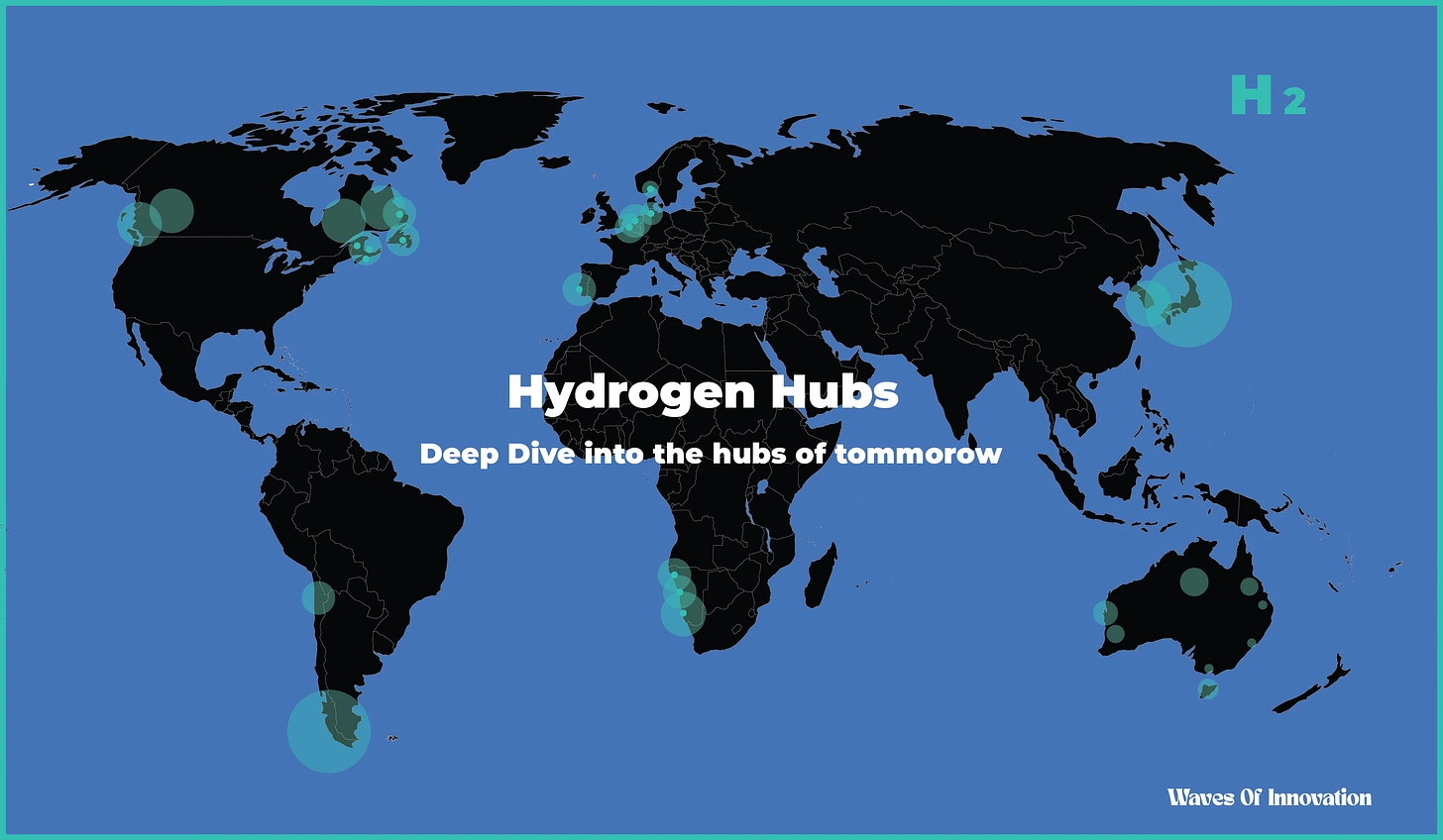
This post is mapping emerging hubs of hydrogen economy, shaping the future world of shipping and energy.
Hydrogen Import Hubs
According to the Green Hydrogen Organisation, 200 million tonnes of green ammonia and methanol would be required by 2040 if IMO NZF (Net Zero Framework) will be adopted.
IMO delegates voted 57 to 49 to postpone any decision on the NZF (Net-Zero Framework) until October 2026, despite the majority of countries stating support for the emissions-reduction measure at the start of the four-day meeting in London
Russia’s unjustifiable war of aggression against Ukraine that began in February 2022 has dramatically shifted the energy landscape in Europe. While EU wants to cut dependency on fossil fuels and russia - a lot of hydrogen import would be required for EU. Germany alone would importing 50-70% of hydrogen to decarbonise its heavy industries and would require 3-4 million tons annually.
Let’s explore the world’s major nods and projects shaping the shipping economy of tomorrow.
Subscribe
Even though Europe (and other regions) are investing in electrolyzers, domestic renewable capacity is limited.
To meet future demand for green fuel, hydrogen will become a traded global commodity - like oil or LNG today.
So, major ports (Rotterdam, Antwerp, Hamburg, Singapore) are transforming into energy gateways that import hydrogen and its derivatives for local industries, transport, and power generation.
1. Port of Rotterdam
The Port of Rotterdam is the largest port in Europe and one of the ten largest ports in the world. It has declared a mission to become carbon neutral by 2050 and is now transforming into a key hub of the EU’s circular and hydrogen economy.
Rotterdam aims to become EU hydrogen gateway with a key projects:
1.1 Shell’s Holland Hydrogen 1: Europe’s largest electrolyser (200 MW) under construction on Maasvlakte 2, powered by North Sea wind.
1.2 HyTransPort.RTM pipeline. A 32 km hydrogen pipeline connecting producers, storage sites, and industrial users across the port area , where Shell becomes a first user of the pipeline. [1]
1.3 H-Vision Project: Producing “blue hydrogen” by capturing refinery waste gases. The hydrogen is then used for refining and chemical industry.
When industry will switch from fossil fuels to “green hydrogen”, blue hydrogen can be used as a back up fuel during wind or solar shortages. [2]
Deltalinqs
227 subscribers
Copy link
2. Port of Antwerp–Bruges
Formed in 2022 through the merger of the Ports of Antwerp and Zeebrugge, PAB also aims to become carbon neutral by 2050, leading Europe’s green-molecule transition.
Antwerp–Bruges functions as a living laboratory for clean technologies.
Through its NextGen District, the port invites startups and global pioneers to pilot scalable circular-energy solutions. [3]
The key of projects of PAB:
2.1 “Methatug” & “Hydrotug 1”
First methanol-powered tugboat “Methatug” [4]. It’s dual-fuel tug, which can operate both on methanol and traditional fuel. Bunkering tank capacity is 9,5 tons of methanol which allows “Methatug” to operate for 2 weeks in Antwerp docks.
World first hydrogen-powered tug “Hydrotug 1”. The Hydrotug 1 consists of two BeHydro V12 dual-fuel medium-speed engines that can run either on hydrogen or on traditional fuel. The tug can store 415 kg of compressed hydrogen in 54 gas cylinders installed on the deck and eliminates emissions equivalent to 350 cars. [5]
2.2 Ammonia and Hydrogen Carriers Import
By around 2030, Port of Antwerp–Bruges aims to import about 1 million tonnes of hydrogen and hydrogen carriers (derivatives) per year, thus PAB positioning itself not just for Belgian demand, but for North-West Europe.
Fluxys joined forces with Advario to build ammonia import terminal for PAB
Industry uses both hydrogen carriers and pure hydrogen gas. Port of Antwerp-Bruges is working on plants that extract the gas from hydrogen carriers. Air Liquide is thus building a pilot plant for cracking ammonia (NH3) on an industrial scale in the port of Antwerp.
Also Fluxys hydrogen will undertake the development and operation of a hydrogen pipeline network, which will be part of the “European Hydrogen Backbone”.
2.3 PAB published a hydrogen roadmap, while first imports expected around 2026 [6]
2.4 Electrolyser pilot (NextGen District) underway for hydrogen production, which is expected to produce 12,500 tons of green hydrogen annually. [7]
Subscribe
Emerging Hubs of Renewable Energy Export
A profound transition is underway as energy-rich regions move from fossil-fuel extraction to renewable energy export. Countries which economies traditionally benefited from mining and natural resources export now because of the falling cost of solar and wind technologies and the global push for net-zero emissions are discovering their abundant renewable energy potentials.
This transformation marks a historic re-alignment of energy geography, where countries such as Chile, Namibia, Canada and Portugal on the way to become leaders in green energy sector.
Regions with abundant sun, steady wind, and available land are discovering that renewable electricity can now be produced more cheaply than fossil energy - and converted into green hydrogen, ammonia, and e-fuels for international trade. As shipping, aviation, and heavy industry seek low-carbon alternatives, these new energy commodities are creating a map of renewable corridors that mirror, and may eventually replace, today’s oil routes.
Chile
Chile made one of the largest energy transitions in the world and by 2030 Chile could become one of the world’s cheapest producers of green hydrogen and ammonia if its resource potential and infrastructure are realised. [8] The Atacama Desert is one of the sunniest and driest places on Earth; its extremely low cloud cover and high solar irradiance create excellent conditions for solar power. [9]
Magallanes Region (Southern Chile – Patagonia / Strait of Magellan region) has exceptional wind resources (onshore) with capacity factors that in some studies are indicated at 60% or more, which is very high for wind according to analysis of Columbian University.
Chile’s renewable energy goals (70% renewables by ~2030, carbon neutrality by ~2050) support development.
Why Chile is Positioned for Green Ammonia Export
The region is already hosting major solar projects: e.g., the Oasis de Atacama Solar Complex (≈1 GW) in 2025 is expected to produce ~3.1 TWh annually.
The Largest in Latin America complex integrates four powerful solar farms: Azabache (60 MW), Domeyko (204 MW), Campos del Sol (375 MW), and Finis Terrae (160 MW).
Because of this abundance of renewables, Chile’s government and industry see the potential to produce green hydrogen (and derivatives like ammonia) at very competitive cost.
Why Ammonia ?
Ammonia (NH₃) is emerging as one of the main “carriers” of hydrogen for export – easier to transport than pure hydrogen in many circumstances. [10]
Chile’s National Green Hydrogen Strategy sets out an ambition to develop large-scale green hydrogen production, including for export and for domestic decarbonisation.
The government has a set target to produce the cheapest green hydrogen in the world with a price below $1.5 per kg by 2030.
Targets include: by 2030, to have 5 GW of electrolyser capacity by 2025 and 25 GW by 2030 (according to some sources) in order to become one of the world’s leading exporters. [11]
The coast of ammonia is estimate at 500 EUR per tonne in the Atacama desert in the nearest future.
HyEx project is building the pilot plant powered by existing solar PV capacity via a coupled with 26 MW electrolysis capacity to produce 18,000 tonnes of ammonia per year and scaling up to 700,000 tonnes per year coupled with 2 GW electrolyser [12]
HNH Energy (a European consortium) proposes a massive project in the Magallanes region: aiming for ~270,000 tons of green hydrogen and ~1 million tons of green ammonia per year, supported by wind power (1.4 GW) and a multipurpose port facility. [13]
TotalEnergies (TE H2’s Magallanes) is starting permitting for a US$ 16 billion green hydrogen + ammonia export-oriented facility in Chile. Construction is slated to start mid-2027, commercial operation around 2030.
The first customer will be VNG Handel & Vertrieb - German company; the ammonia will be shipped to port of Rostock where it will be cracked back to hydrogen to meet industrial demand. First phase estimated 90,000 tonnes of hydrogen per year, while project could be scaled up to 800,000 tonnes of H2 [14]
Chile could become one of the world’s cheapest producers of green hydrogen and ammonia by 2030 if its resource potential and infrastructure are realised.
Namibia
Namibia’s average wind speed is over 5 m/s, with the coastal region averaging about 7 m/s, and 13 m/s in Lüderitz. Solar energy potential is 3000 KWh per m2 in some areas.
All this numbers are considered world-class, while Namibia Green Hydrogen Programme (NGH2P) sets aim to make Namibia a renewable energy and green manufacturing powerhouse, targeting markets on the continent and beyond.
Three clusters on the country’s Atlantic coast have been considered around which wider ecosystem will be built with estimated value generation of of around $7.8 billion in 2050 and supplying markets of Europe and Asia, whey are: Lüderitz (south valley), Walvis Bay (central valley) and Cape Fria (north valley).
Hyphen Hydrogen Project located in Lüderitz plans to develop 7.5 GW of renewable energy (4 GW wind and 3.5 GW solar) with expected output of 2 MPTA (million tons per annum) of renewable ammonia so supply demand in Europe, South Korea and Japan.
Cleanergy Solutions Namibia (by CMB.TECH) is project located in Erongo region, their ambition includes “powering deep-sea vessels with green ammonia” via their Namibian plant in port of Walvis Bay. Project features 5 MW electrolyser which will produce renewable hydrogen. They also set up a Hydrogen Academy to up skill the local population for the future demand of green jobs.
Daures Green Hydrogen Village. Small-scale pilot project linking hydrogen/ammonia production with agriculture and domestic uses. It aims to produce 18 tons of green hydrogen and 100 tons of green ammonia per year, showcasing domestic “downstream” use, not just export.
Canada
Canada has published it’s Hydrogen Strategy and aimed to leverage its geopolitical stable conditions, abundant natural resources, skilled workforce and innovation to become a leader in emerging hydrogen market. While Canada set goal to become net-zero by 2050, strategy is leveraging low-risk approach developing mostly blue hydrogen production for local and global demand.
Canada has strategic access to Atlantic and Pacific oceans with high-innovative ports.
In the East, Atlantic Canada’s abundant and untapped wind resources and immediate proximity to Atlantic shipping routes will allow wind-to-hydrogen electrolysis projects to become reliable suppliers of clean hydrogen European markets.
West Coast ports provide direct access to Asian markets, where demand for blue hydrogen is expected to grow, particularly in South Korea and Japan.
Hydrogen Production
There are total 80 projects on various stages of development to bring 5 million tonnes of annual low carbon hydrogen production capacity online if all were to become fully operational, and represent over $100 billion in potential investment.
Most of these projects will produce low-carbon hydrogen through electrolysis or natural gas reforming (via steam methane reforming (SMR) or autothermal reforming (ATR)) with carbon capture and storage (CCS). [15]
Key Projects:
Air Liquide’s 20 MW proton exchange membrane electrolyser in Bécancour, Québec, began operating in January 2021, and was the largest electrolyser plant in the world at that time. It produces 3,000 tonnes of blue hydrogen annually.
Phase 1 of the project: Design includes a ~300 MW hydrogen electrolysis plant and ~240,000 tonnes per year of green ammonia production would be operational in 2026 .Phase 2 is aimed to scale up 1 MTPA of green-ammonia - all destined to European Markets which should start in 2027~2028.
The project will use 200MW wind to ammonia electrolysis for export with planned expansion in future up to 500MW, beginning operation in 2027.
Along with traditional renewables (wind, solar) project is exploring advanced small modular reactor (SMR) technology.
300 MW electrolyser which has been awarded block of of renewable electricity from Hydro‑Québec with expected output of 230,000 to 240,000 tonnes of renewable ammonia annually.
Totalling $4 billion in investments for the region, the Projet Mauricie consists of 1GW (1000 MW) of solar/wind input and 150MW +a block of hydroelectric supply (~150 MW) via the grid with expected output of 70,000 tonnes (green H2) to decarbonise hard-to-electrify Québec industry sectors.
The name “Toqlukuti’k” (pronounced ‘dok-loo-goo-tik’) comes from the Mi’kmaq language of the Miawpukek First Nation and means “working together” - reflecting the partnership intent.
Phase 1: Purpose to harness Newfoundland’s strong wind resources to power green-hydrogen and, ultimately, green-ammonia production about 500 MW intended to supply power for hydrogen production at the Come by Chance Refinery.
Later phases: Expanding wind capacity up to around 5 GW (5000 MW) and building out hydrogen → ammonia conversion + export infrastructure.
The wind development is planned to be ~4 GW of onshore wind farms in the region (with 11GW potential ). In its full scale the project is expected to produce about 210 000 tonnes of green hydrogen per year, equivalent to approximately 1.2 million tonnes of green ammonia per year. The first phase intends to deliver ~400 000 tonnes of green ammonia by 2026.
Joint venture by French Renewable Energy company - EDF and renewables developer Abraxas Power - “Exploits Valley Renewable Energy Corporation.” EVREC project is going to feature 3.5 GW of wind farms, a 150 MW solar array, and hydrogen/ammonia production (2.6 GW electrolyser) with output of 1 million tonnes of green ammonia per year by 2028 ~ 2030
Alberta:
Alberta is home to the Hydrogen Centre of Excellence (HCoE), led by Alberta Innovates with investments of $50 million by Alberta Government. Alberta has a strong legacy in hydrogen (primarily via natural-gas derived hydrogen for refining and chemicals), sizeable natural-gas reserves, existing infrastructure, CCUS (carbon capture utilisation & storage) potential, and skilled energy sector workforce. This making a province as emerging hydrogen hub.
Hydrogen Canada Corp. is planning a large “clean hydrogen/ammonia” facility expected by 2028. Its goal is ~1 million tonnes per year of “clean ammonia” and hydrogen production tied to CCS. The project is aimed to export blue ammonia to South Korea and Japan through BC terminals.
Alberta produces 2.5 Million tonnes H₂ per year (mostly grey/blue), which makes the province one of North America’s largest hydrogen producers.
The Edmonton Region Hydrogen Hub launched the 5000 Hydrogen Vehicle Challenge (e.g buses, trucks) within 5 years.
British Columbia:
BC is a home for BC Centre for Innovation and Clean Energy (CICE) now known as NorthX funded by BC Government, Shell and federal Government.
The Vancouver area is a major hub of Canada’s hydrogen innovation, fuel cell and manufacturing companies, it also area of greatest concentration of operational hydrogen refuelling infrastructure.
October 24, 2025 - Burnaby, BC - HTEC has officially opened the Burnaby Clean Hydrogen Production Facility, including British Columbia’s first commercial-scale clean hydrogen electrolyzer. The combined output is 1.8 tonnes of clean hydrogen per day dedicated to fuelling zero-emission vehicles.
The company also plans a 15-tonne-per-day liquefaction plant in North Vancouver - set for 2026 - to supply hydrogen for up to 60 heavy-duty trucks or 4,000 cars.
Portugal
Portugal is very well positioned as emerging Hydrogen Export Hub in Europe.
Portugal is one of the leading economies in Europe based on renewable energy composition in the final energy consumption and aims to achieve 80% of electricity sector consumption through renewables by 2030.
In 2019, Portugal recorded €0.0147/kWh in a solar auction - one of the lowest in the world at the time.
Portugal has among the highest solar and wind potential in Europe.
Solar Energy:
Southern Portugal (Alentejo & Algarve): 1,700–2,100 kWh/m²/year, among the highest in Europe. Central/Northern Portugal: around 1,400–1,700 kWh/m²/year.
Installed capacity (2024): ≈ 3.8 GW solar PV.
Planned by 2030 (NECP target): ~9 GW solar PV.
Wind Energy:
Onshore wind potential:
Strongest in the northwest and along the Atlantic ridge, average wind speeds of 7–9 m/s at 100 m height.
Installed capacity (2024): ≈ 6.2 GW onshore wind.
Offshore potential:
Shallow areas limited, but floating offshore wind (like WindFloat Atlantic) taps deepwater potential.
Targets by 2030: up to 2 GW offshore wind, mostly floating.
Hydropower:
7 GW installed of installed hydro remains the backbone of Portugal’s renewable mix.
This is one of the headline projects, located at the Sines Industrial & Logistics Zone (ZILS)
Phase 1: ~500 MW electrolyser capacity, producing ~50,000 tons of green hydrogen and ~300,000 tons of green ammonia annually. Investment ~€1.3 billion.
Phase 2: Expansion to ~1.2 GW electrolyser capacity, up to ~1,000,000 tons of ammonia/year with total investment ~€2.8 billion.
The country’s national hydrogen strategy outlines ambitions not only for domestic use but also for positioning Portugal as a producer and exporter of low-carbon hydrogen and its derivatives (such as ammonia) to Europe, aiming to increase hydrogen production capacity to 2–2.5 GW of installed electrolysis capacity by 2030.
Subscribe
Like this project
Posted Mar 9, 2026
Freelancer wrote about hydrogen's role in green shipping innovations and global economy.
Likes
0
Views
12