Automated Lead Qualification System for Wellness Practices

Janelle Baird


I had a problem with my lead generation.
Generic “Get a Custom Blueprint” forms were bringing in everyone—from practitioners just starting to think about systems to practices whose enrollment flow was actively losing them clients.
They all filled out the same form. They all got the same follow-up email.
I couldn’t tell who was ready to invest and who was just researching until they replied to my emails.
Time wasted figuring out fit: Email threads with people who “just want to understand the options” took the same effort as threads with Crisis-level leads whose payment processing was currently broken.
No way to segment before contact: I didn’t know if someone needed partnership ($2.5K/month), a build ($4-6K one-time), or just DIY guidance until we’d exchanged several emails.
Manual follow-up for everyone: Every lead got the same “here’s how partnership works” email, whether they scored Foundation-level (minor inefficiencies) or Crisis-level (revenue actively leaking).
No self-qualification: Leads didn’t know if they were ready for me. So they reached out hoping I’d tell them.
Result: Hours per week reading and responding to leads, half of which were wrong-fit.
If you’re a wellness practice collecting leads through generic contact forms or PDF downloads, you’re probably facing a version of this same problem—just with your clients instead of mine.
A lead magnet that:
Diagnosed specific pain points – Not “do you need systems?” but “where are your systems failing right now?”
Qualified leads by severity – Foundation vs Crisis aren’t the same conversation
Delivered immediate value – Not just “we’ll email you results”
Enabled targeted follow-up automatically – Crisis tier gets my attention within 24 hours. Foundation tier gets educational content.
Not a form. A diagnostic system that did the qualification work for me.
The quiz does the qualification. Brevo does the nurture. I focus on Crisis conversations.
Strategic Decisions (Before Any Code)
Before building anything, I mapped out what data I actually needed to qualify leads.
Not “would be nice to know.” What I needed to make smart decisions about who to spend time on.
Decision 1: Diagnostic Over Generic
Not “want systems tips?” → “where are your current systems failing?”
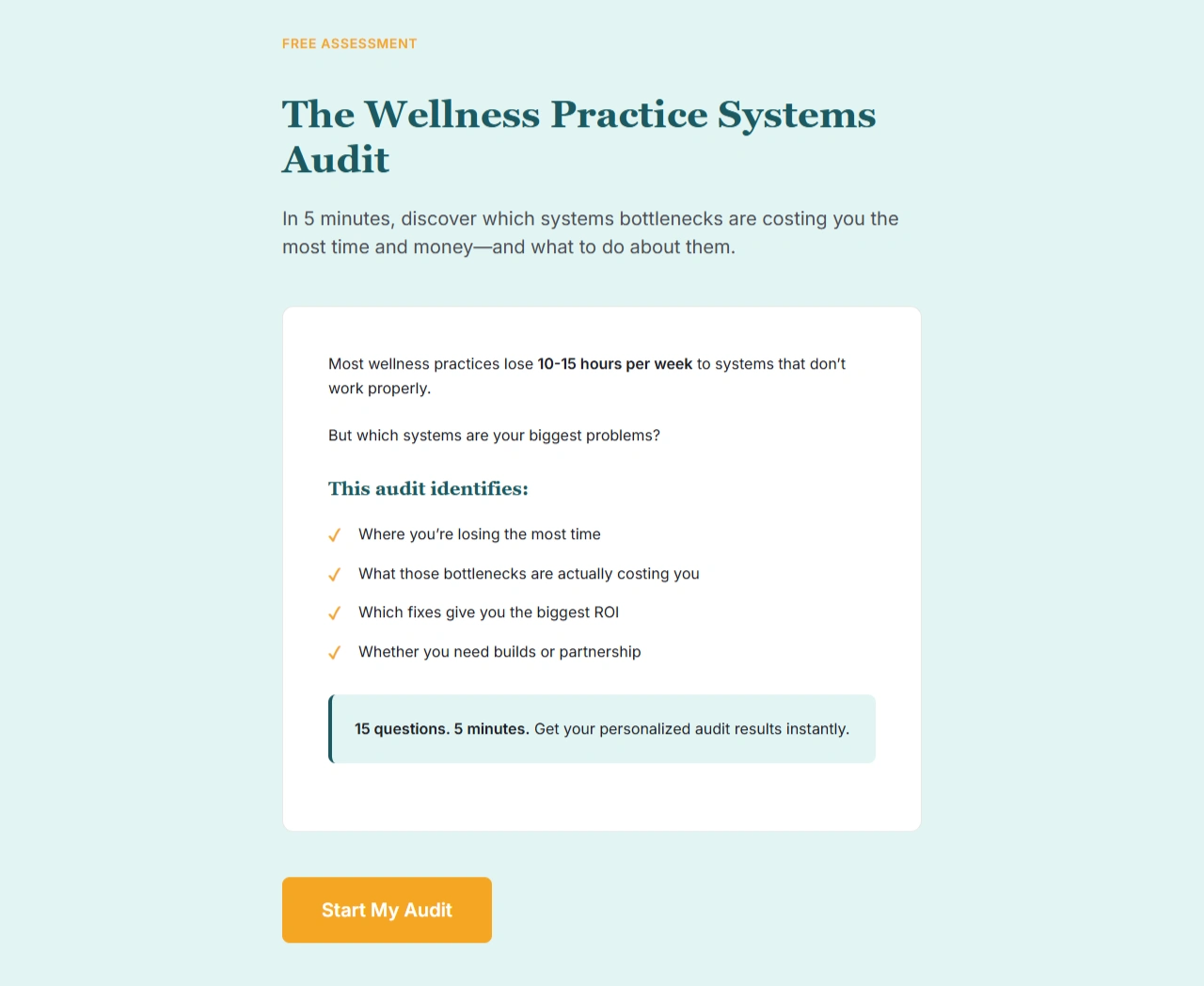
15 questions across 4 categories:
Enrollment & Payment – Are you losing clients or revenue at the sign-up stage?
Client Communication – Are you answering the same questions manually, repeatedly?
Content Delivery – Can clients find what they need, or are they emailing you?
Practice Management – Are you drowning in admin that could be automated?
Scoring system: 0-45 points total (granular enough to segment, simple enough to calculate in real-time).
Each question scored 0-3 based on severity:
0 = No problem (“automated”)
1 = Minor issue (“mostly works”)
2 = Significant gap (“manual process”)
3 = Crisis (“falling through cracks”)
Why this matters: I don’t just know their total score. I know where they’re struggling. Enrollment score of 12/15 + Content score of 3/12 = different conversation than reversed scores.
Decision 2: Tier System Over Linear Scale
Four tiers based on total score:
Foundation (0-10 points): Minor inefficiencies. DIY guidance appropriate.
Gaps (11-20 points): Some manual processes. Could go builds or partnership.
Bottleneck (21-35 points): Systems limiting growth. Partnership sweet spot.
Crisis (36-45 points): Revenue leaking, hours bleeding, urgent opportunity for big wins.
Why tiers matter: Each tier gets different next steps in their results email.
Foundation tier = “Here are 4 things you can DIY right now” Crisis tier = “Your systems are under pressure right now—let’s get you breathing room fast. Email me directly.”
Automatic qualification. Crisis tier isn’t failure—it’s clarity. They know exactly where they stand and what level of help makes sense.
Decision 3: Immediate Value Delivery
Not “we’ll email you results.”
Show tier + score on results screen immediately. THEN ask for email to get full personalized analysis.
Why this sequence works: They get value whether they give me their email or not. No bait-and-switch.
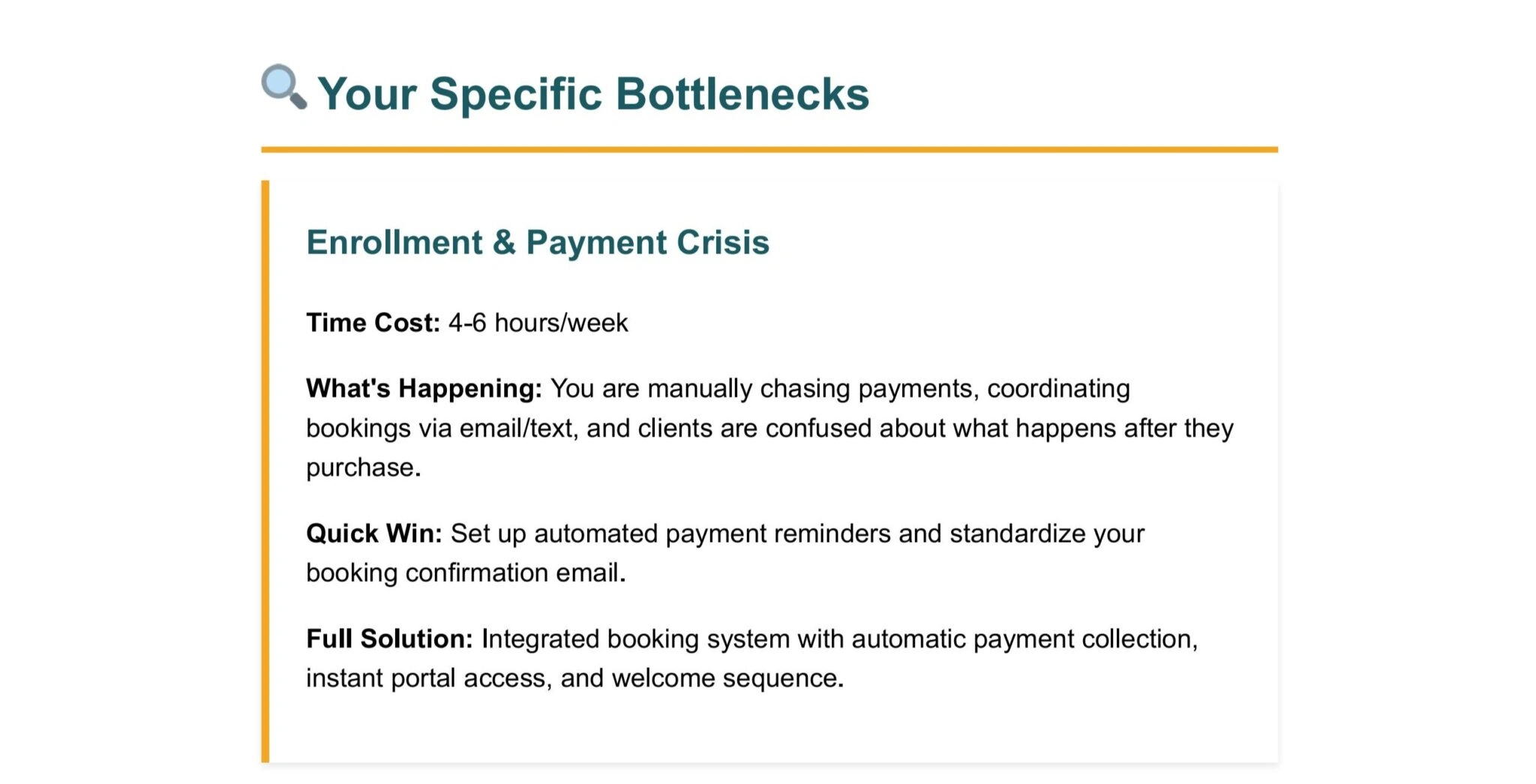
The full results email includes their specific bottlenecks, time cost estimates, 4-step prioritized action plan, and tier-specific next steps. They walk away smarter even if they never hire me.
Decision 4: Integration Over Isolation
Quiz sends 8 data points to Brevo CRM automatically: name, email, total score, tier, 4 category scores, completion date.
Why this enables targeted nurture:
Brevo automation rules trigger based on tier:
Crisis tier → tag “HIGH_INTENT” → I get notification → personal email within 24 hours
Bottleneck tier → partnership nurture sequence (7 emails over 3 weeks)
Gaps tier → mixed sequence (partnership vs builds comparison)
Foundation tier → educational content only (no sales push)
Three screens, progressive commitment:
Screen 1: Intro – Hook, benefit, “Start Quiz” (no email required yet)
Screen 2: Questions (15 total) – One question at a time, four answer options, click answer → visual feedback → auto-advance in 300ms, progress bar updates.
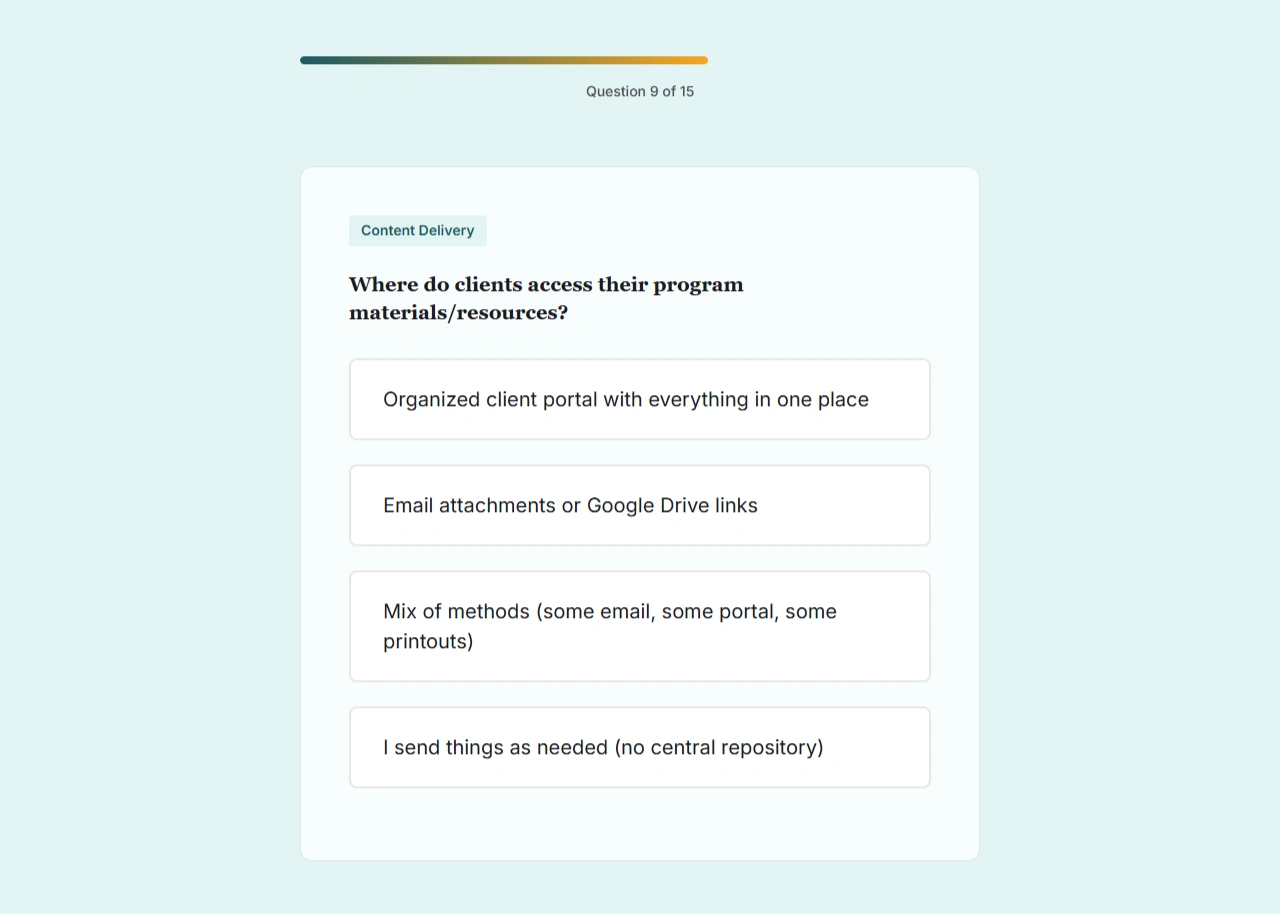
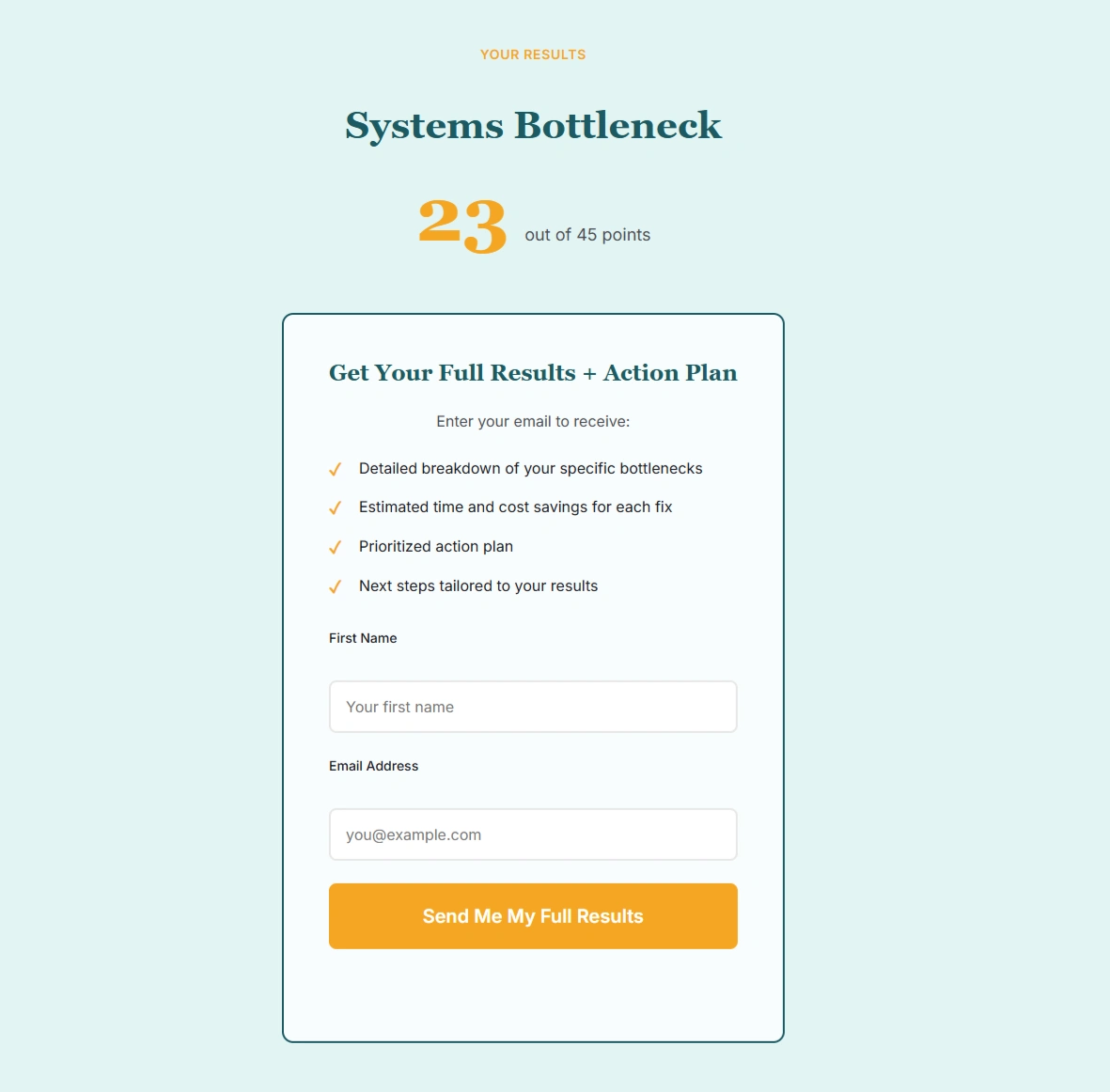
Real-time calculation as they answer. Each of 4 categories accumulates points. Total score determines tier. Category scores determine which bottlenecks appear in email.
Example result:
Total: 28 points (Bottleneck tier)
Enrollment: 12/15 (Crisis-level), Communication: 6/9 (Significant gap), Content: 7/12 (Moderate gap), Management: 3/9 (Minor issue)
This data drives dynamic email content. Not a template with name merge tags.
If enrollment_score ≥ 9: Add “Enrollment & Payment Crisis” card with time cost estimate (8-12 hrs/week), quick fix (abandoned cart emails), full solution (automated enrollment flow).
If communication_score ≥ 6: Add “Client Communication Overwhelm” card with time cost (5-8 hrs/week), quick fix (FAQ page), full solution (self-service portal).
Result: Each person gets 1-4 bottleneck cards specific to their situation, plus 4-step prioritized action plan based on their worst-scoring category, plus tier-specific next steps.
After email submission, all 8 data points go to Brevo via REST API. Automation rules trigger immediately based on tier.
Crisis tier? I get a notification. I email them within 24 hours: “Saw you scored 38 on the systems audit. Your enrollment score was 14/15—that’s actively costing you revenue. Want to talk this week?”
Foundation tier? They enter educational sequence. No sales push.
The result: Zero manual work after quiz submission. Qualified leads segmented automatically. Targeted follow-up based on pain level.
What This Actually Delivers
Instant diagnosis (no waiting)
Personalized action plan (specific to their scores)
No sales pitch (tier-appropriate next steps)
Actual value whether they hire me or not
Qualification happens automatically
Segmentation for targeted follow-up
Data on where practices struggle most (content planning gold)
Time saved—I only reach out to Crisis tier (~15% of leads)
Before quiz:
Generic form, same follow-up for everyone
No pain level data until email thread
Hours/week on wrong-fit leads
After quiz:
8 data points per lead vs 2
Crisis → I reach out within 24 hours
Bottleneck → partnership nurture
Foundation → educational content only
Pre-qualified before any conversation
Real impact: Every lead is pre-qualified. I know their enrollment score is 12/15 and content score is 3/12 before I send the first email. Conversation starts from “I see enrollment is your main bottleneck—that 8 hours/week on payment follow-up is killing you” not “so what brings you here today?”
What You Can Steal From This
You probably don’t need a 15-question diagnostic quiz for your wellness practice. But the principles apply to any lead generation.
1. Qualify Before You Capture
Generic contact forms collect volume. Smart forms collect intelligence.
Instead of “Name, Email, Message,” ask questions that reveal readiness:
What’s your biggest challenge right now? (Multiple choice with specific options)
How long have you been dealing with this? (Timeline reveals urgency)
What have you already tried? (Shows sophistication level)
You don’t need fancy scoring. Just data points that help you know who to prioritize.
2. Deliver Value Immediately
Don’t gate everything behind “we’ll email you.” Show them something useful BEFORE asking for email.
My quiz: See tier + score → Then email form → Then full results
Your practice: Assessment tool that shows preliminary results on-screen, interactive calculator that gives instant numbers, diagnostic that reveals their score before asking for contact info.
Not everyone needs the same message. Use intake responses, quiz results, or assessment data to trigger different sequences.
Crisis-level leads get “let’s talk this week” outreach. Foundation-level leads get educational nurture.
Your CRM (even basic like Mailchimp or ConvertKit) can segment based on form responses.
My quiz saves me hours per week I used to spend on email threads with unqualified leads.
Ask yourself:
Does this lead magnet tell me who to prioritize?
Does it enable different follow-up based on readiness?
Does it deliver value whether they hire me or not?
Does it reduce time I spend on wrong-fit conversations?
If the answer is no, you’re leaving efficiency on the table.
Lead generation that qualifies, segments, and nurtures WITHOUT you touching it. So you focus on conversations with people who are actually ready.
Why I Built This (And Why It Matters)
I spent 12 years running a grocery business on custom automation. Order processing: 8 hours → 15 minutes. Payment collection: 100%. Bad debt: disappeared.
I didn’t guess what to automate in Month 1. I built it over 3 years as problems emerged.
That’s how partnership works.
This quiz is the evolved version of my lead generation. Started with a basic “Get a Custom Blueprint” form. Collected emails. No qualification. No segmentation.
I learned what questions I was asking in email threads to figure out fit. What pain points mattered. What indicated someone was Crisis-level vs Foundation-level.
Then I built the quiz—incorporating everything I’d learned from months of manual qualification. Two days of actual build time. But it was built on the foundation of knowing exactly what data I needed because I’d been collecting it manually first.
That’s continuous improvement. Not building everything upfront and hoping it works. Building basic, learning what actually matters, then building better.
Not a build that sits unchanged while your business model shifts. Not a template that can’t adapt when you add new services.
Partnership for continuous optimization.
That’s what I do for wellness practices: implement and manage technology that continuously improves as you scale.
Your enrollment flow in Month 1 might be fine. By Month 6, you need group bookings. By Month 12, you need payment plans. Partnership means those features get built when you need them—not guessed at in Month 1.
Try the quiz yourself: thrivewellnesssystems.com/wellness-practice-systems-audit
See how qualification + personalization actually works.
Explore partnership details: thrivewellnesssystems.com/systems-partnership
Email me directly: janelle@thrivewellnesssystems.com
Especially if you scored Bottleneck or Crisis tier.
Like this project
Posted Jan 30, 2026
Developed a diagnostic quiz to qualify and segment leads for wellness practices.