Built with Framer
The Counselling Room Website Development

Blessing Adewale
Verified


The Counselling Room
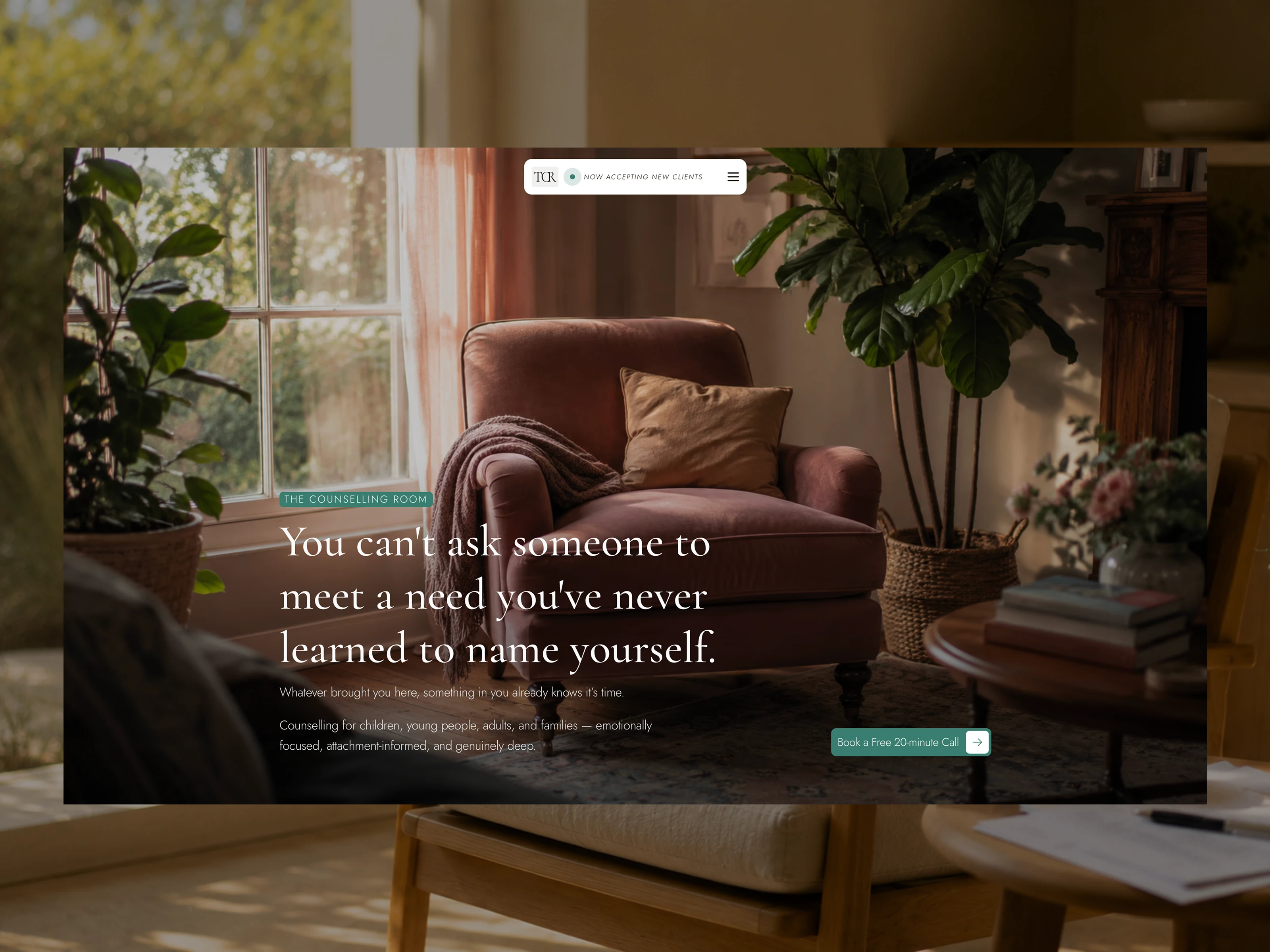
A Framer Website for an EFT-Informed Counsellor Serving Children, Adults, and Families Across New Zealand
The Brief
Sabrina Barbara is an Emotionally Focused Therapy-informed counsellor and ICEEFT Life Member based in Wellington and Hawke's Bay, New Zealand. She works with children from age six, young people, adults, parents, and whole families — specialising in grief, loss, anxiety, life transitions, and the emotional impact of family separation.
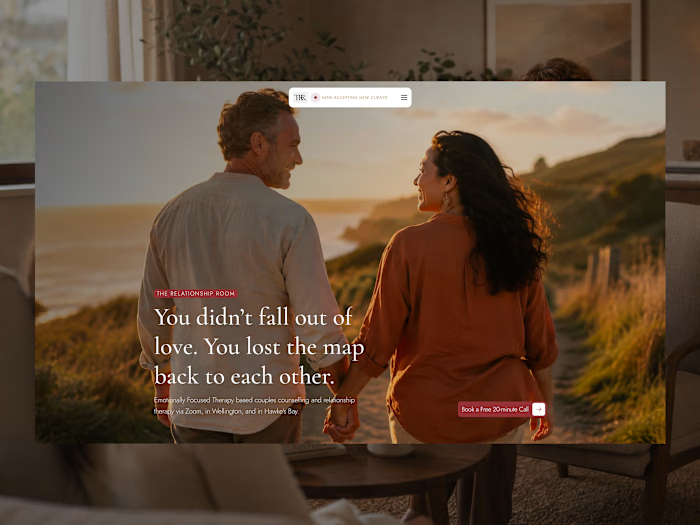
The Counselling Room was the second site in a four-site ecosystem built for Sabrina's practice. Where the first site (TheRelationshipRoom.nz) focused on couples and relationships, this one needed to speak to a much wider and more varied audience — people arriving from very different points of pain, at very different stages of life.
The brief wasn't just "build a counselling website." It was: build a site that could meet a grieving parent, a struggling teenager's family, a burnt-out adult, and a child going through their parents' separation — all on the same page — and make each of them feel genuinely seen.
The Challenges
Speaking to multiple audiences without losing clarity Unlike a couples counselling site with one primary visitor type, The Counselling Room serves children, young people, adults, parents, and whole families — each with a different emotional reality, different vocabulary, and different questions. The site needed to speak to all of them without becoming generic.
Translating complex therapeutic concepts into plain language Terms like Emotionally Focused Therapy, EFIT, ICEEFT, attachment-informed practice, and experiential therapy all needed to be explained warmly and clearly — assuming zero prior knowledge — while maintaining clinical credibility.
Capturing the burnout and breakdown audience A significant portion of visitors arrive not through a clear presenting issue but through exhaustion — burnout, quiet breakdown, the sense that something has been building for years and has finally said no more. This audience needed its own space in the content architecture.
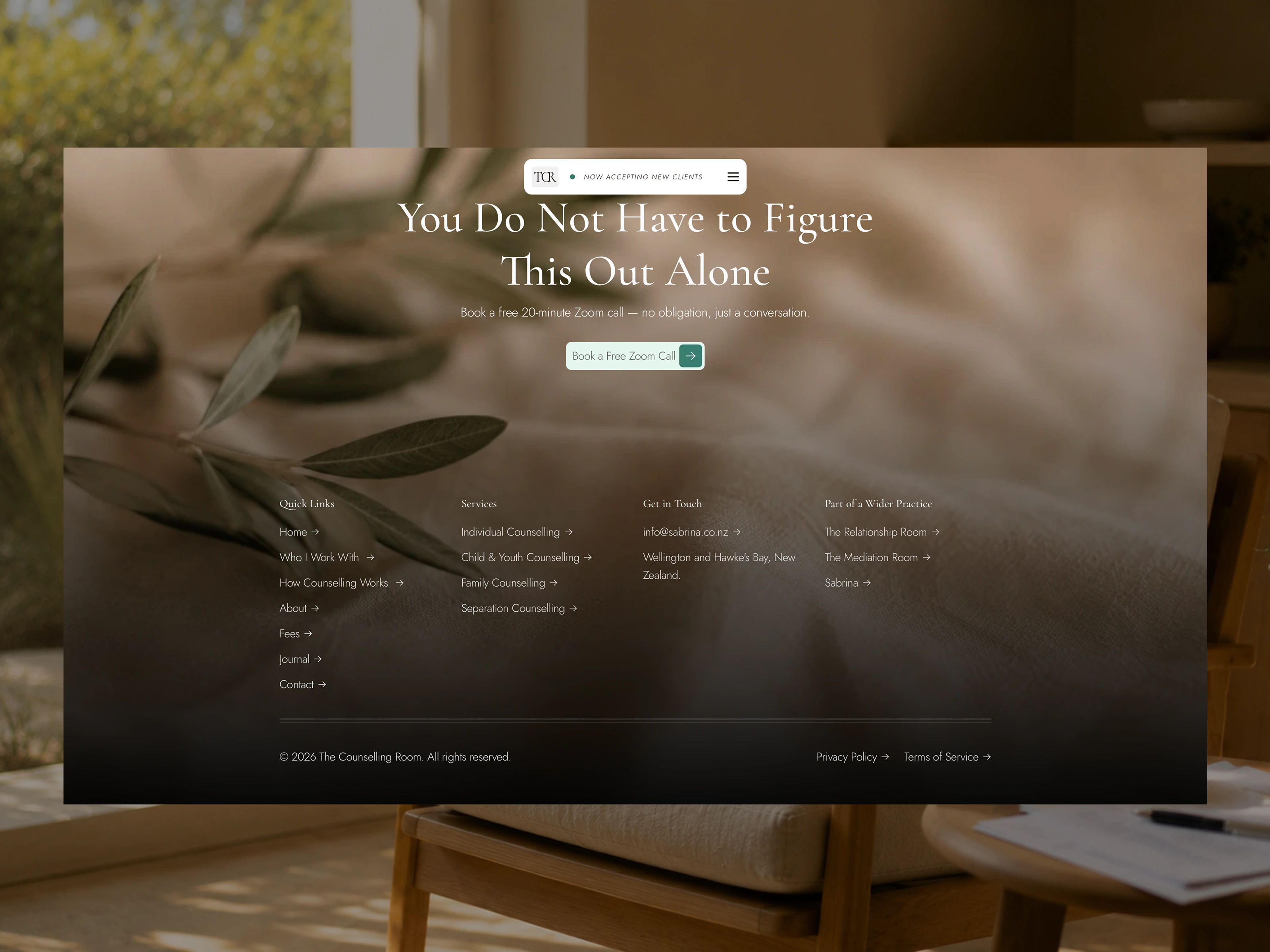
Building within an established ecosystem This site had to share design DNA with TheRelationshipRoom.nz (same animations, shared accent colours, same footer structure, same component logic) while having its own distinct identity — sage green rather than rose, a broader service range, a different emotional register.
Structuring four service subpages that didn't yet exist The original brief covered core pages only. Mid-build, the client added four fully developed service subpages (Individual Counselling, Child & Youth Counselling, Family Counselling, Separation Counselling), each requiring its own content architecture, pull quotes, cross-links, and SEO setup.
My Approach
Narrative-first information architecture The site is structured as an emotional journey, not a services menu. Home → Who I Work With → How Counselling Works → About → Fees → Contact. Each page answers the question the visitor is silently asking at that moment: "Is this for someone like me?" → "What does this actually look like?" → "Who is this person?" → "What will this cost?" → "How do I begin?"
A dedicated section for burnout and breakdown Rather than folding burnout into the services list, the homepage includes a standalone philosophical section between the pain point identification and the approach columns. Warm, direct, unhurried. Written in the voice of the site: "What we tend to call burnout or breakdown is rarely a sudden illness. It is, more often, the accumulated weight of feelings that were never properly tended to." This section targets high-volume search terms while serving the emotional reality of the visitor.
Age-sensitive service pages The Child & Youth Counselling subpage required particular care — addressing parents (the actual decision-makers) while centering the child's experience. It clearly separates how younger children (ages 6–12) are worked with from how adolescents and young adults (ages 13–25) are approached. A dedicated note for parents explains their role in the process without making the page feel like a parenting lecture.
Plain-English therapeutic language Every clinical term is spelled out in full on first use on every page — "Emotionally Focused Therapy (EFT)", "the International Centre for Excellence in Emotionally Focused Therapy, founded by the late Dr Sue Johnson" — and never shortened until the reader has been oriented. This is baked into the build checklist, not left to chance.
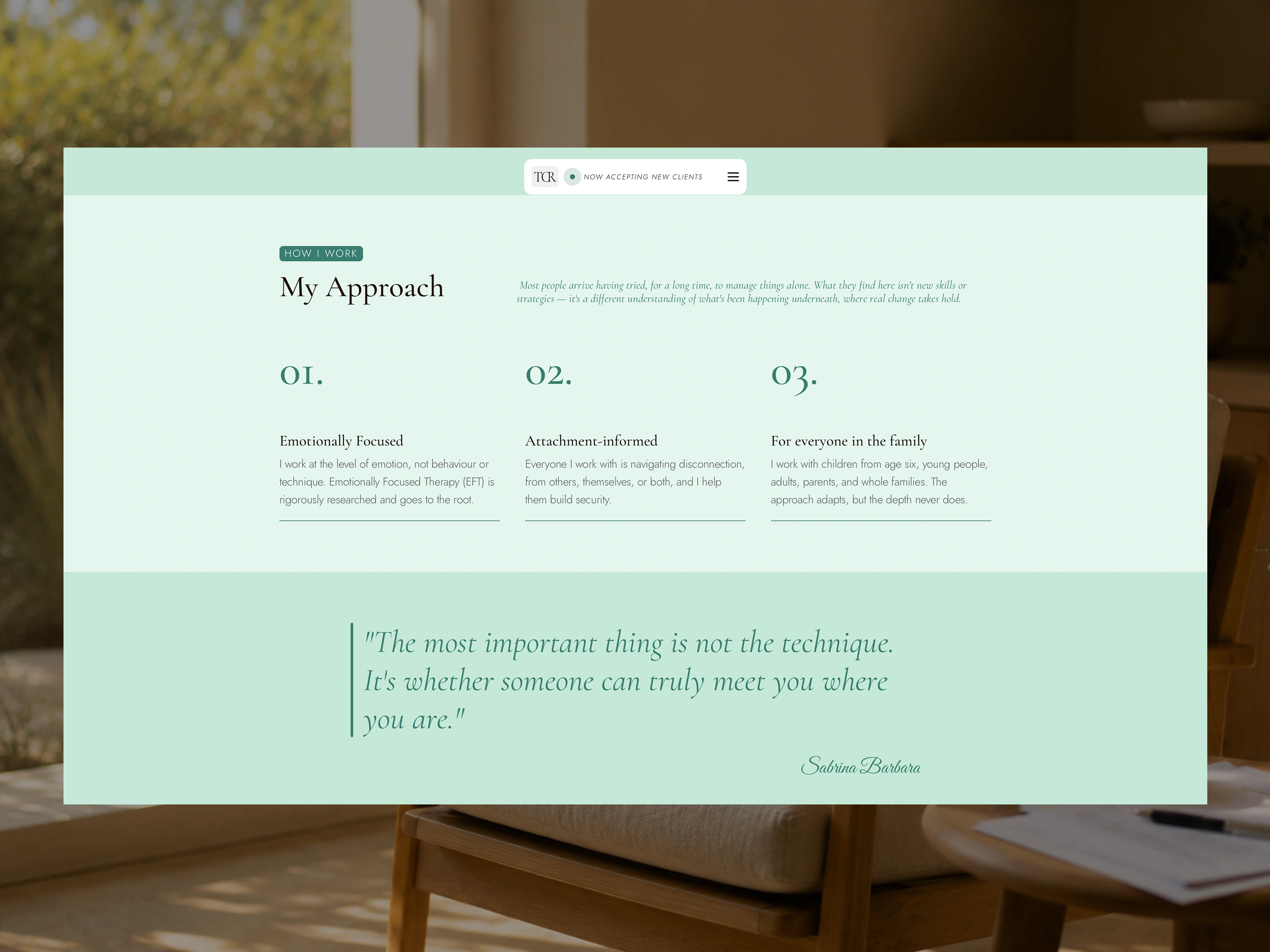
Shared design system, distinct site identity Light mint (
#A8D5B5) and caramel (#8B5E1A) carry across all four Sabrina sites for brand consistency. The Counselling Room uses sage (#4A7C6F) as its primary colour, deep sage (#2E5C52) for buttons and the footer, and near-white sage (#F2FAF6) as the page background — a palette that reads as calm, grounded, and trustworthy without being clinical.What Was Built
13-page fully responsive Framer website:
Home (hero, pain point section with image slideshow, burnout/breakdown section, three-column approach, service cards, about strip, testimonials placeholder, footer CTA)
Who I Work With (four alternating image/text sections: children & young people, adults, parents, families)
How Counselling Works (four-step visual timeline, what makes this different)
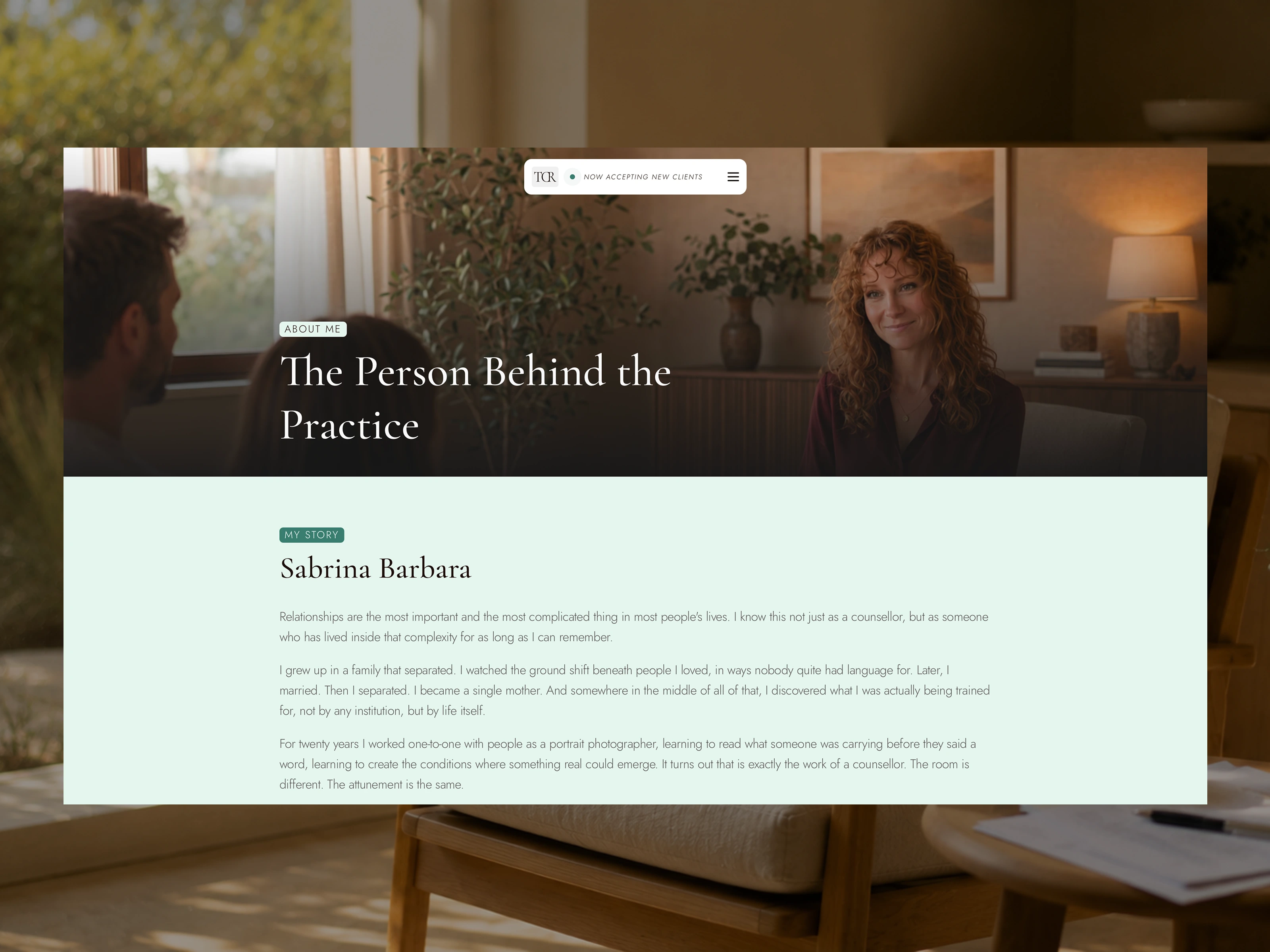
About (full bio including cultural competence note, credentials in small caps, logo strip, video reel placeholder)
Fees (six-row fee table with mint header, FAQ accordion with 10 questions and full answers)
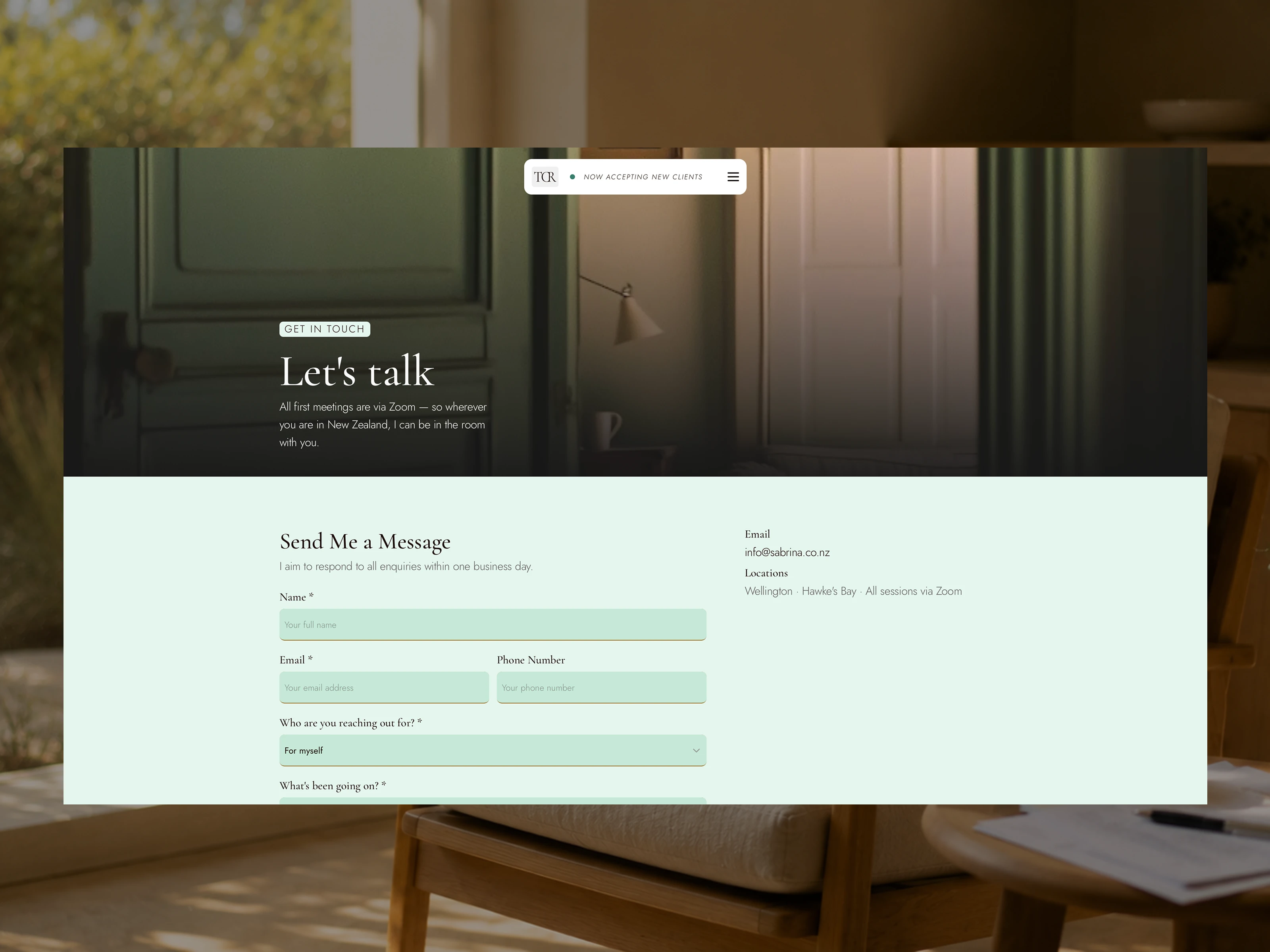
Contact (five-question intake form, consent checkbox, on-screen confirmation, after-form note)
Individual Counselling (subpage)
Child & Youth Counselling (subpage)
Family Counselling (subpage)
Separation Counselling (subpage)
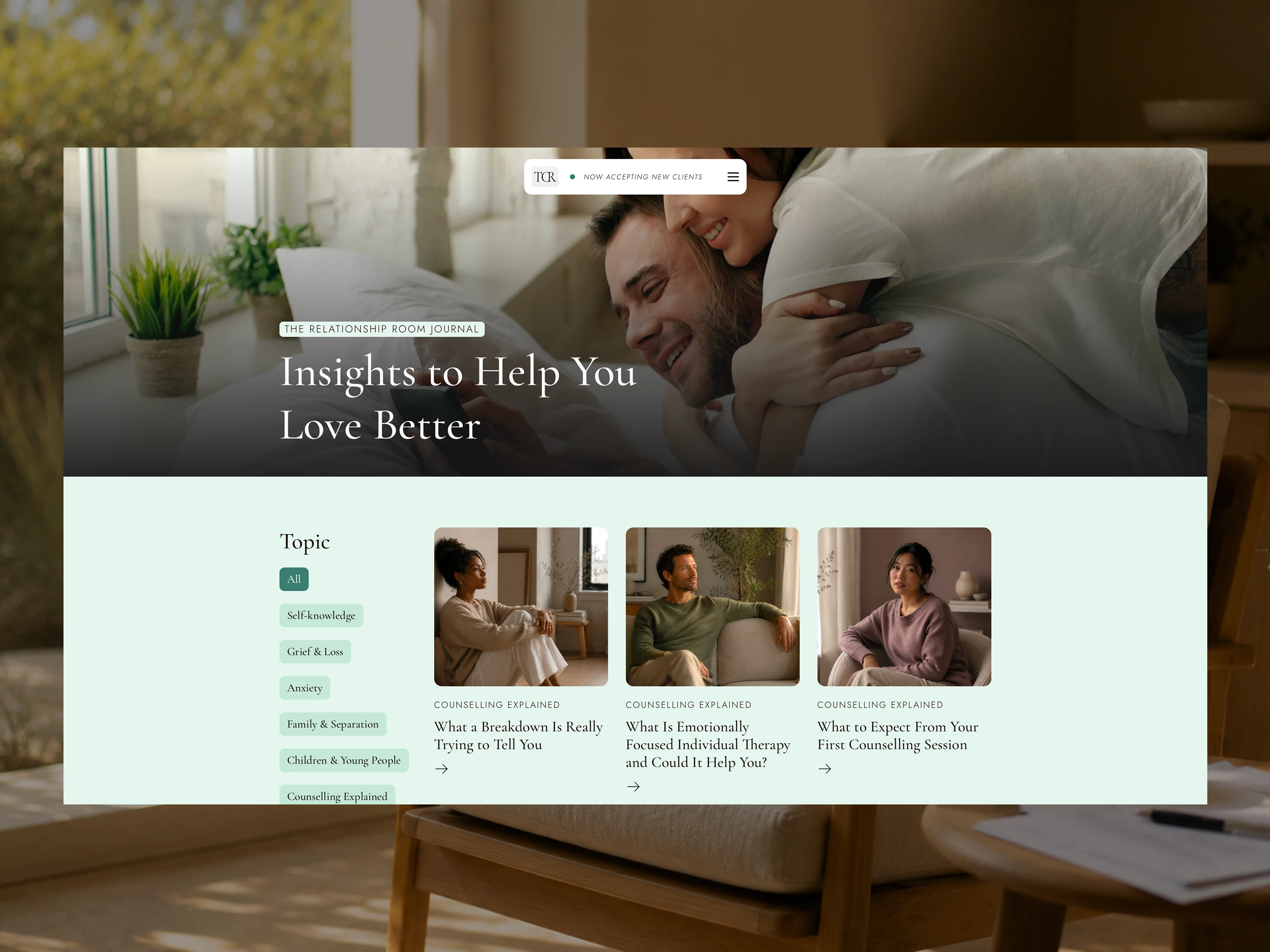
Journal (CMS index page)
Journal article template (CMS detail page)
404
12 fully written journal articles (CMS-driven):
All 12 entries written from scratch in Sabrina's clinical voice — warm, precise, philosophically grounded in the register of Alain de Botton's School of Life. Each entry includes an intro, three to four H3 subheadings, a "Note From Sabrina Barbara" section, and a closing italic line. Categories: Counselling Explained, Self-knowledge, Anxiety, Grief & Loss, Family & Separation, Children & Young People.
Key components and features:
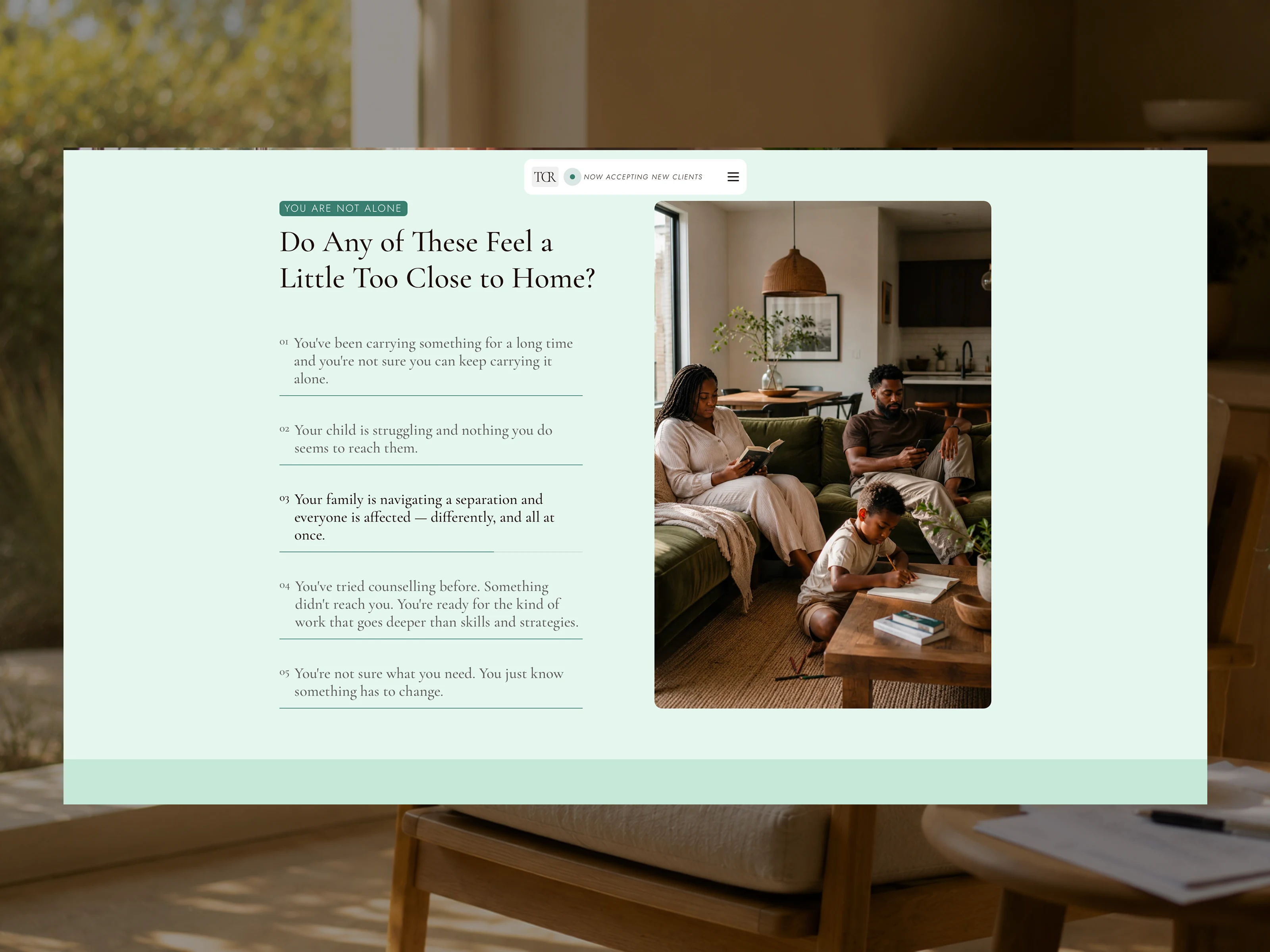
Five-image slideshow tied to the pain point section — one image per problem statement, sourced and alt-texted individually
Four-step visual timeline on How Counselling Works
Pull quote component with mint left border and animated entrance (border draws up, text fades in, attribution fades last)
Sticky floating nav (logo + Book a free call button) on scroll past hero
Framer native intake form with five questions, radio groups, conditional open text fields, and consent checkbox
On-screen form confirmation message replacing the form on submission
Fee table with mint header row and staggered scroll reveal
FAQ accordion with 10 questions and full clinical answers
Logo strip (NZAC, ICEEFT, NZCEFT, WhitireiaWeltec, Resolution Institute) — greyscale at rest, full colour on hover
Video reel placeholder block (frosted glass card, 16:9, About page only)
Google Reviews coming soon placeholder state
Footer ecosystem links to all three sister sites
Full SEO setup across all 17 pages (title tags, meta descriptions, OG images, canonical URLs, no-index off)
Global animations matching TheRelationshipRoom.nz: push buttons, card hover lift, scroll reveal, pull quote entrance, page transitions, nav hover underline, floating nav, image hover zoom
Key Features
Content written for emotional intelligence, not just SEO Every page was written with the visitor's emotional state in mind. The contact page opens with "Let's talk" and a single line: "All first meetings are via Zoom — so wherever you are in New Zealand, I can be in the room with you." The intake form asks "What's been going on?" with seven options that name real experiences — including burnout, family separation, and prior therapy that didn't reach them — rather than clinical categories.
A four-service subpage architecture built mid-project When the client added four fully developed service subpages mid-build, each needed its own hero image direction, section structure, pull quotes, cross-links to TheMediationRoom.nz, and footer CTAs — all consistent with the site's voice and design system. These weren't template pages with swapped text. Each one was written to the specific emotional reality of that audience.
The Separation Counselling page — a careful distinction This page explicitly distinguishes Sabrina's individual counselling work from the Ministry of Justice's free Parenting through Separation programme, and from the mediation and co-parenting work that lives at TheMediationRoom.nz. It also cross-references Discernment Counselling at TheRelationshipRoom.nz for visitors who aren't sure whether to separate at all. One page doing the work of a referral network.
Cultural competence baked into the About page The About page includes a dedicated paragraph on Sabrina's twenty-three years of whanau immersion within Ngapuhi and Fa'asamoa families, her grounded knowledge of tikanga Maori, whanaungatanga, manaakitanga, and te reo, and her commitment to the principles of Te Tiriti o Waitangi. Not an afterthought — a considered, specific, personal statement that signals genuine cultural competency to a New Zealand audience.
A name change applied across an entire live site Midway through the build, the client confirmed that "Sabrina Barbara Grabow" would become "Sabrina Barbara" in all site copy — with specific legal exceptions (footer copyright line, Privacy Policy, Terms of Service, consent checkbox, SEO metadata). This required a careful, page-by-page audit of every pull quote attribution, form confirmation message, after-form note, about strip, and journal byline — applied without touching the legal instances.
The Result
The Counselling Room launched as a complete digital presence for a counsellor whose work spans the full arc of human difficulty — from a six-year-old navigating their parents' separation to an adult who has been quietly burning out for years.
The site doesn't try to speak to everyone the same way. It speaks to each visitor from where they actually are — through pain point language that names real experiences, service pages that address specific life situations, and a voice throughout that is warm, unhurried, and clinically grounded.
It is the second of four sites built for Sabrina's practice. The component architecture, color system, animation logic, and content approach established here and in TheRelationshipRoom.nz now carry forward into TheMediationRoom.nz and Sabrina.co.nz — a four-site ecosystem built on a single shared foundation.
What This Means for You
If you're building a Framer site for a therapy, counselling, coaching, or specialist practice — one that needs to speak to multiple audience types, explain complex concepts in plain language, and convert visitors who are uncertain and often in distress — this is what's possible.
A site that earns trust before it asks for action. Content written for the emotional reality of the reader, not just the search algorithm. A design system that scales across multiple sites without starting from scratch each time.
Project Shots
Ready to build a website that carries the weight of your work? Let's talk about what's possible.
Like this project
What the client had to say
Second website with Blessing and my confidence in him has only grown. I'm a detail person (fonts, spacing, the exact shade of background wash) and he handles every last-minute tweak without complaint. Fast, calm, and consistently excellent

Sabrina Barbara
Jun 15, 2026, Client
Posted Jul 9, 2026
Framer website for a New Zealand counsellor serving children, adults, and families — 13 pages, CMS journal, and a native intake form.
Likes
1
Views
13
Timeline
Jun 11, 2026 - Jun 15, 2026