Designing a all-in-one platform for software payments

Dami Ojetunji

Designing a all-in-one platform for software payments
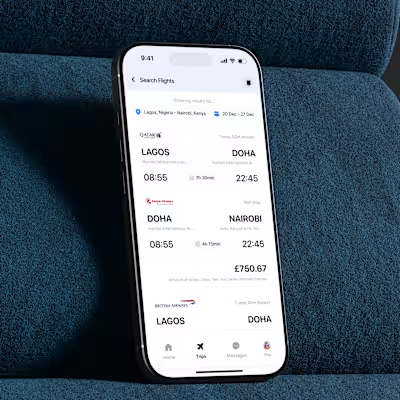
Mercurie is a web and mobile platform enabling businesses discover, pay for, and manage technology services and softwares easily, in their local currencies.
The launch of the Mercurie platform was timely, coinciding with a critical period when African businesses faced rising operational costs for dollar-based digital services. This was primarily driven by the CBN's restrictions on using Naira debit cards for international transactions. The team had previously launched Adpay in 2022 to address a specific part of this problem: enabling users to top up wallets and manage Google Ad campaigns in their local currency. Adpay was successful, but its model wasn't scalable. There were a number of factors that weren't considered that stemmed from pushing the platform to its limits, leading to compliance issues, user restrictions, and more. It was time to expand and fix said issues with a new product, Mercurie.
Role
Product Designer
Responsibilities
Product & Design Strategy, Product Design, UX Research, Usability Testing, Prototyping
Deliverables
Web Design, Mobile Web
Timeline
Q1 2024 - Present
Team
Dami / Product Designer
Michelle / Frontend Eng

Harry / Tech Lead & Frontend Eng

Sunday / Backend Eng

Elvis / Backend Eng
As the First Product Design Hire and solo designer at Mercurie, I was responsible for driving design priority and project scope.partnering closely with engineering, primary stakeholders, sales, and marketing to critique, scale, and deliver 0-1 user experiences. My focus ensured alignment across growth initiatives, design discovery, and final deliverable management.
Due to NDA restrictions, key company information, and business metrics have been omitted from this case study. However, the platform is live and serving businesses across Africa.
MVPing
In a fast-paced startup environment, the team's pursuit of a "perfect" MVP led to significant scope creep and delays. Our initial two-month launch window stretched to a year primarily caused by continuous scope changes and the desire to include all ideated features in the first release. This delay was discouraging as it prevented us from validating design decisions through valuable user testing and opened the door to frequent, unmoderated input from non-core stakeholders. This experience taught me critical lessons in standing firm on focused design choices, maintaining project scope, and communicating the importance of data to drive key decision-making.
Strategic Focus
Translating abstract concepts into tangible experiences required successfully bridging the gap between design vision, product strategy, and technical feasibility. The core project goal was simple: ensure users could discover, pay for, and track their technology services, with ease and pay in their local currency. This clear focus helped streamline design efforts and address technical feasibility early on. We also paid close attention to the unique African fintech context, ensuring payment methods were transparent, compliant, and familiar to users, avoiding any unnecessary complexity.
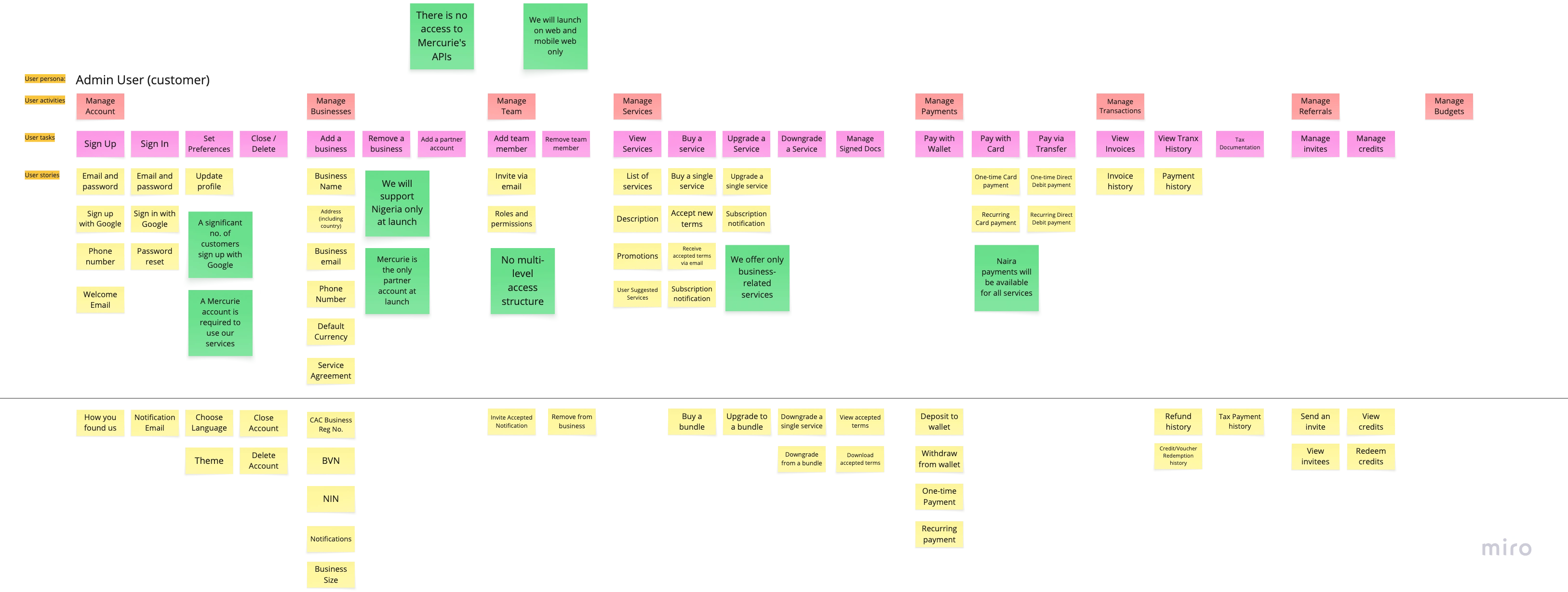
A very early snippet from the team's very first brainstorming session on the vision and direction of the Mercurie platform. As expected, a lot of this changed/evolved as time went on.
Research & Collaboration
Much of the early brainstorming was informed by user research conducted on the existing sister platform, Adpay. Although Adpay had a different product offering, its success with Mercurie's primary target users gave me critical foundational insights for design direction.
I also leveraged inspiration from previous wireframes and personal project explorations. The entire process was grounded in continuous critique and collaboration with the team, particularly with engineering. Understanding the technical constraints, requirements, and the inner workings of APIs was essential for ensuring an excellent and technically feasible user experience.
Explorations & Iterations
The first few iterations were 'straightforward' based on the understanding of the overall scope and user journeys and got better as I iterated and gained more clarity. One my biggest challenges was making the new platform not overwhelming and functional for customers coming over from the sister platform, Adpay. The main goal was to avoid user drop-off and boost adoption as much as possible for both old and new users.
Another unique challenge was the absence of a PRD or documentation, which is a common occurrence in startups. This meant diving into many engineering meetings (yaay collaboration) to understand how the APIs worked and key technical considerations that might influence design decisions. In turn, I was able to use the knowledge gained and technical documentation to draft all necessary user stories and flows to gain clarity and get the show on the road.
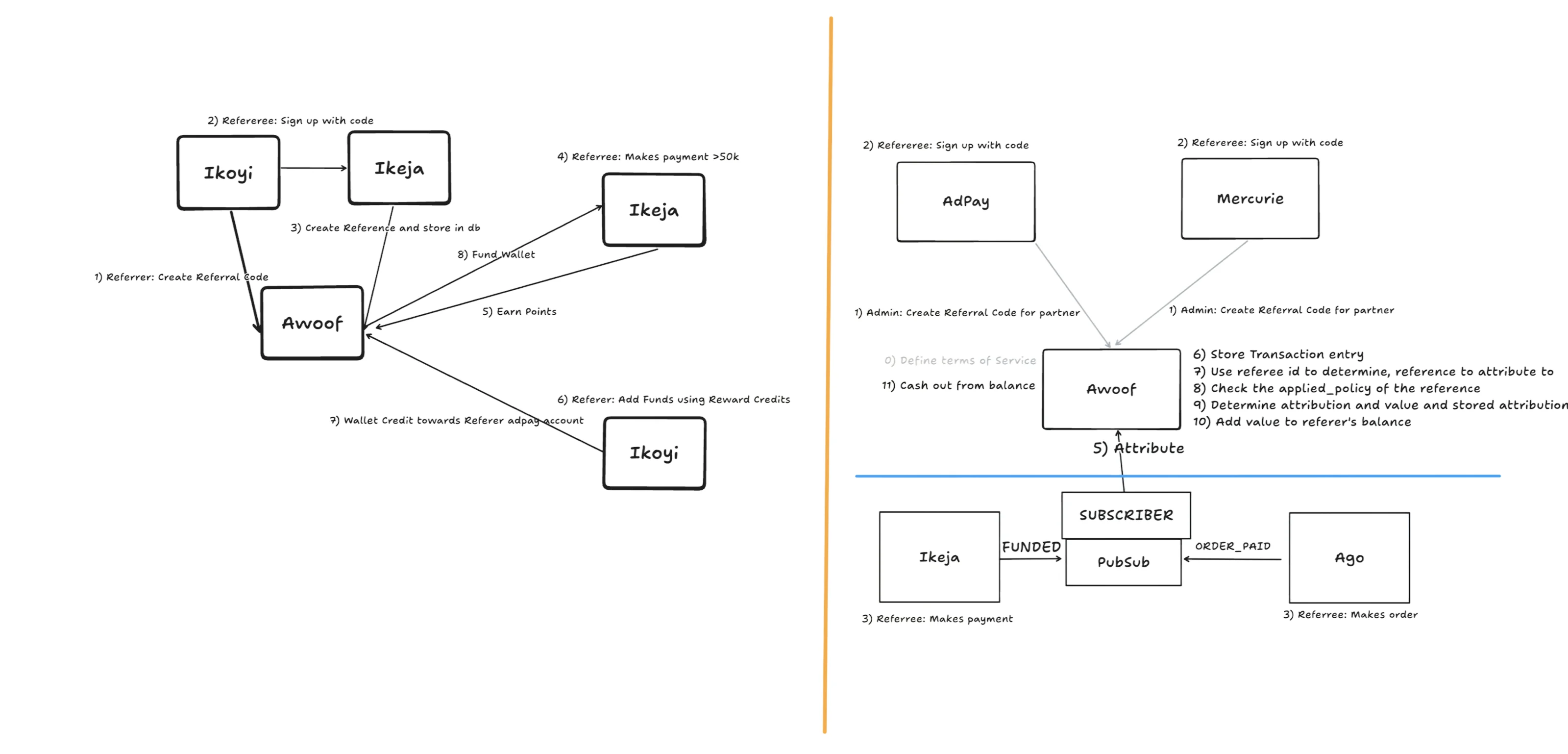
Referral Program API Flow. A sample flowchart created during one of our engineering meetings, illustrating the planned referral logic and how it interacts with different APIs across the system , from sign-up to earning rewards.
Design is never a straight line; it's a process of constant change and learning. Below, you can scroll through some key iterations and design variations of the Mercurie platform. These show how the design evolved over time as I and the team gained clarity on user needs, technical constraints, and the shifting scope of the project (Enjoy!)
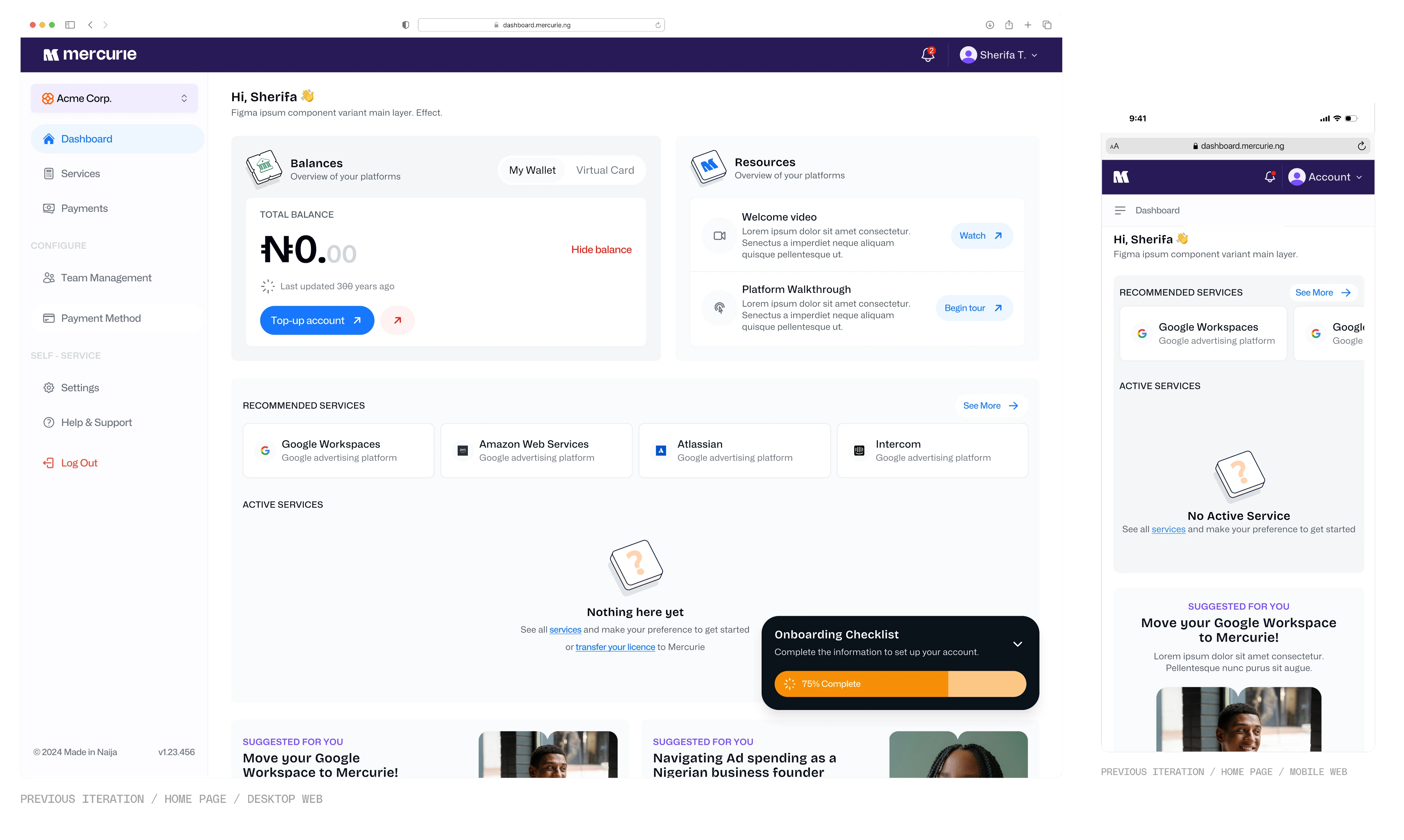
The objective for this version was to enable user exploration and discovery. The design focused on serving as a single entry point where users could take a guided tour, find available services, manage existing subscriptions, read relevant blog posts, access their wallet, and more.
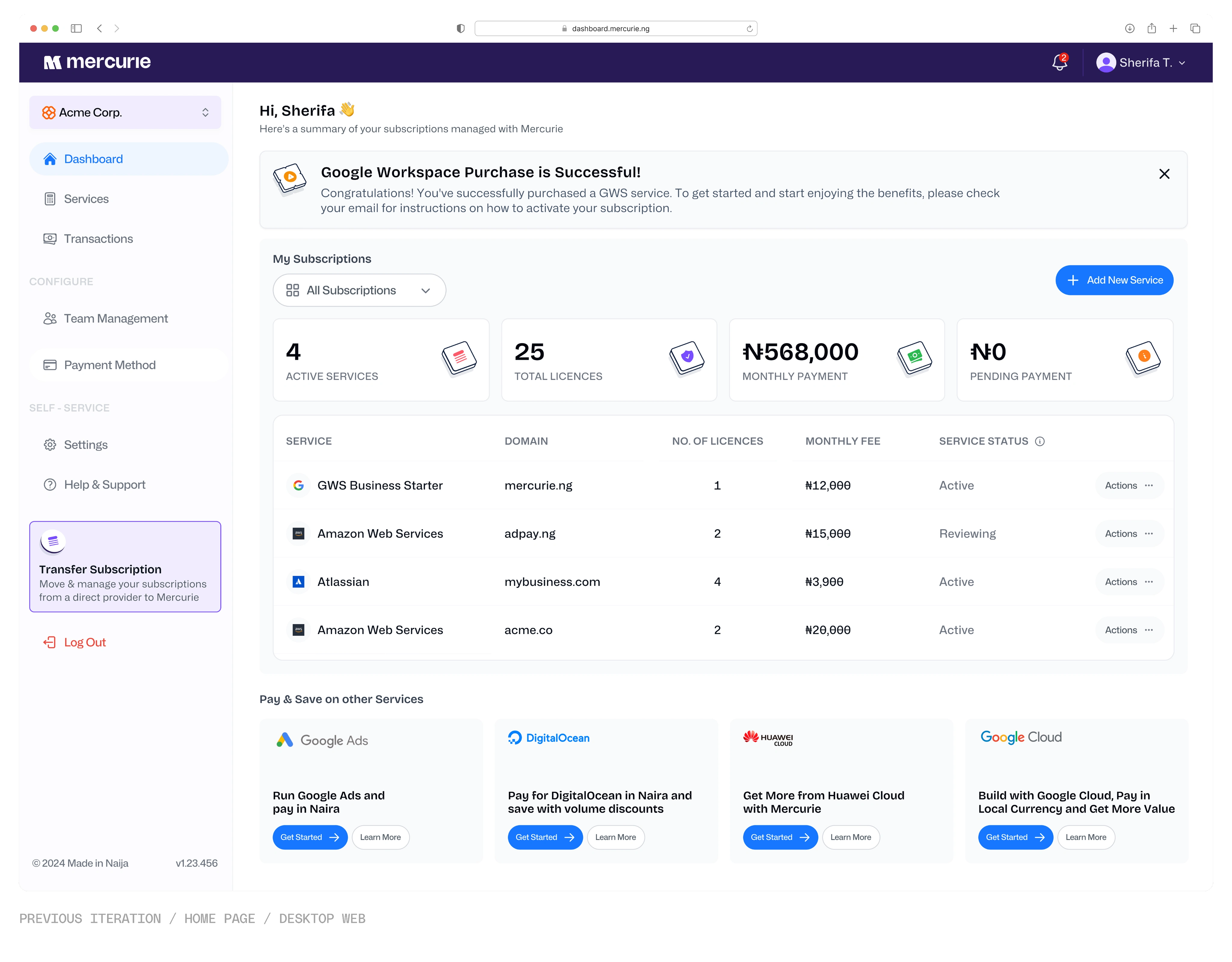
This version provided users with a quick, prioritised summary of their existing subscriptions, including active services, licenses, and payments for efficiency. the design fulfils our objective of user exploration and growth by prominently featuring a "Pay & Save on other Services" section to encourage the discovery and adoption of new services. clear visual feedbacks were introduced to build user trust.
Due to NDA restrictions this case study has been summarised! However, the most recent and iterated version of the platform is currently live and being used by over 100+ businesses across Africa. Happy to share a walkthrough, other explorations, ideas, and non-business impact of this project.
Reflections & Impact
Working on the Mercurie team, especially as part of the core team, was a great experience. It provided key insights into my skills as a designer and showed me what I would do differently if I could restart this project or any projects in the future.
This project was a huge opportunity to grow my communication and collaboration skills. I worked closely with a cross-functional team, including the engineering, sales, and marketing, wearing many hats. I was able to gain deep technical understanding by attending engineering discussions, which not only allowed me draft design documentations but contribute immensely to how projects were scoped and managed across the company.
If I could restart this project, I would suggest a much shorter timeline and a much 'simpler' MVP. The desire for a perfect, feature-packed product delayed our launch significantly. Strictly relying on stakeholder input instead of user testing led to a bulky MVP and a huge launch delay. This trade-off had immediate consequences: the platform required a lot more customer support, straining our support team. Also, because Engineering was stretched thin fixing post-launch bugs, critical time-saving 'features' like an FAQ section or Intercom integration (for automated support) couldn't be built. The core lesson here is clear: the simpler the initial scope, the better for the entire team.
Although I'd learned this on a previous team, it was nice to be reminded of how much joy I get from collaborating with my cross-functional peers. I had a blast jamming with the engineers while designing the UX. I loved digging into the technical constraints to come up with creative design strategies to make up for the constraints without sacrificing user experience.
I've also always found that engineers have great ideas but are too 'shy' to share them outside in larger forums
Like this project
Posted Mar 31, 2026
Web and mobile platform enabling African businesses to discover, pay for, and manage software in local currencies.
Likes
0
Views
0
Tags