Built with Framer
5U AI Landing Page Design Case Study

Cagatayhan Kurt


Designing the website for 5U AI, the AI workforce for freight teams
5U AI builds AI workers that take over the manual work in freight forwarding, quotes, bookings, tracking and customer emails, inside the inboxes teams already use. I designed their website to make that abstract product understandable in seconds and to turn operations leaders into demo calls.
Overview
5U AI is a Munich-based startup that builds AI workers for freight forwarding. Founded by Technical University of Munich graduates Yağız Abik and Fehmi Şener, it runs its AI workers inside the email and messaging channels logistics teams already use, where they handle quoting, bookings, shipment tracking, invoice reconciliation, data entry and routine correspondence across air, sea and road freight. [1] [2]
I designed the company’s marketing website through my studio, Beew: seven page templates for desktop and mobile, built in one month in 2025. The brief was simple to say and hard to do, make an abstract AI product instantly understandable to operations leaders at freight forwarders, brokers and 3PLs, and turn that understanding into demo calls.
The challenge
Freight operations people are busy and sceptical of “AI”. The first version of the story asked them to imagine what agents might do; it needed to show them which part of their day disappears.
Abstract value: “AI agents” meant little to an ops manager until they could see the tasks being done.
Complex workflows: documents, rate requests, customers and carriers had to fit into simple, scannable messaging.
Trust: the site had to feel premium and interactive, yet corporate enough for enterprise logistics buyers.
Scope: a structured multi-page site with consistent hierarchy, delivered in one month.
Goals
Say “AI workforce for freight” in the first screen, in the customer’s words.
Turn services into sections, use cases and diagrams people can scan in seconds.
Use interaction and motion to make the product feel tangible, not decorative.
Stay modern and premium without losing enterprise credibility.
Give every page a clear path to booking a demo.
Approach
1. Lead with the job, not the technology
Instead of explaining models and agents, every headline names a task freight teams already do by hand, answering rate requests, chasing status updates, re-typing PDFs, and shows it being done.
2. Show the workflow
The core of the product is a pipeline: an email arrives, data is extracted and validated, a person approves, the system learns. I turned that pipeline into diagrams and step-by-step sections, so the page explains itself even when it is skimmed.
3. Design for trust
Logistics buyers worry about errors reaching customers. The human-in-the-loop step, the AI drafts, a person approves, is visible throughout the site rather than buried in an FAQ.
4. Make every page a path to a demo
Navigation keeps “Book a demo” one tap away, use cases end with the next step, and the FAQ answers the objections that usually come up on the first call.
The solution
Homepage: the AI workforce in one sentence
The hero speaks to freight teams directly and puts proof, response time, coverage, scale, right under the headline. The scroll then tells the story in order: the problem, how the AI works, what changes for the team, and who already uses it.
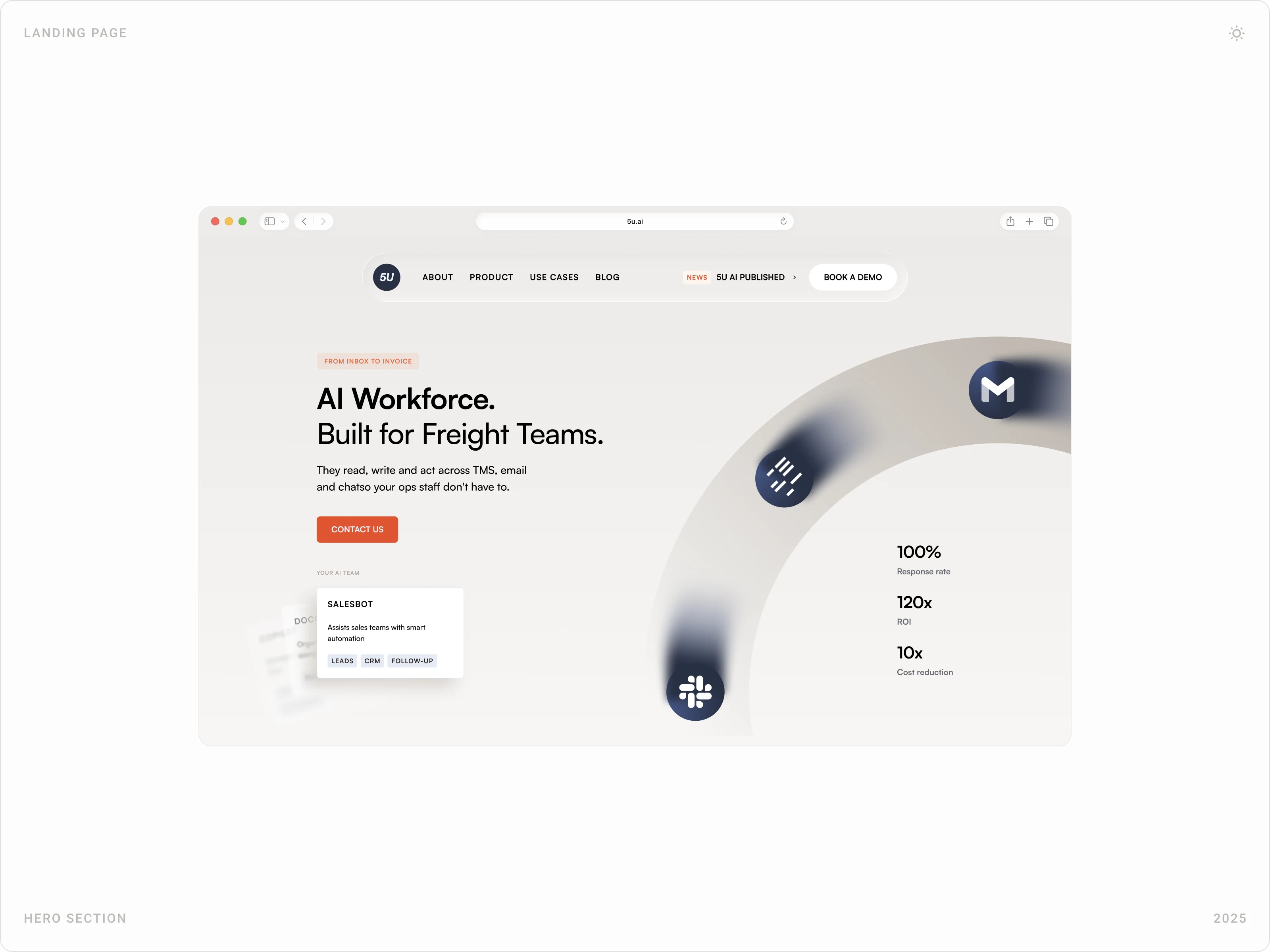
Desktop hero. The headline names the audience and the outcome; proof points sit right under it.
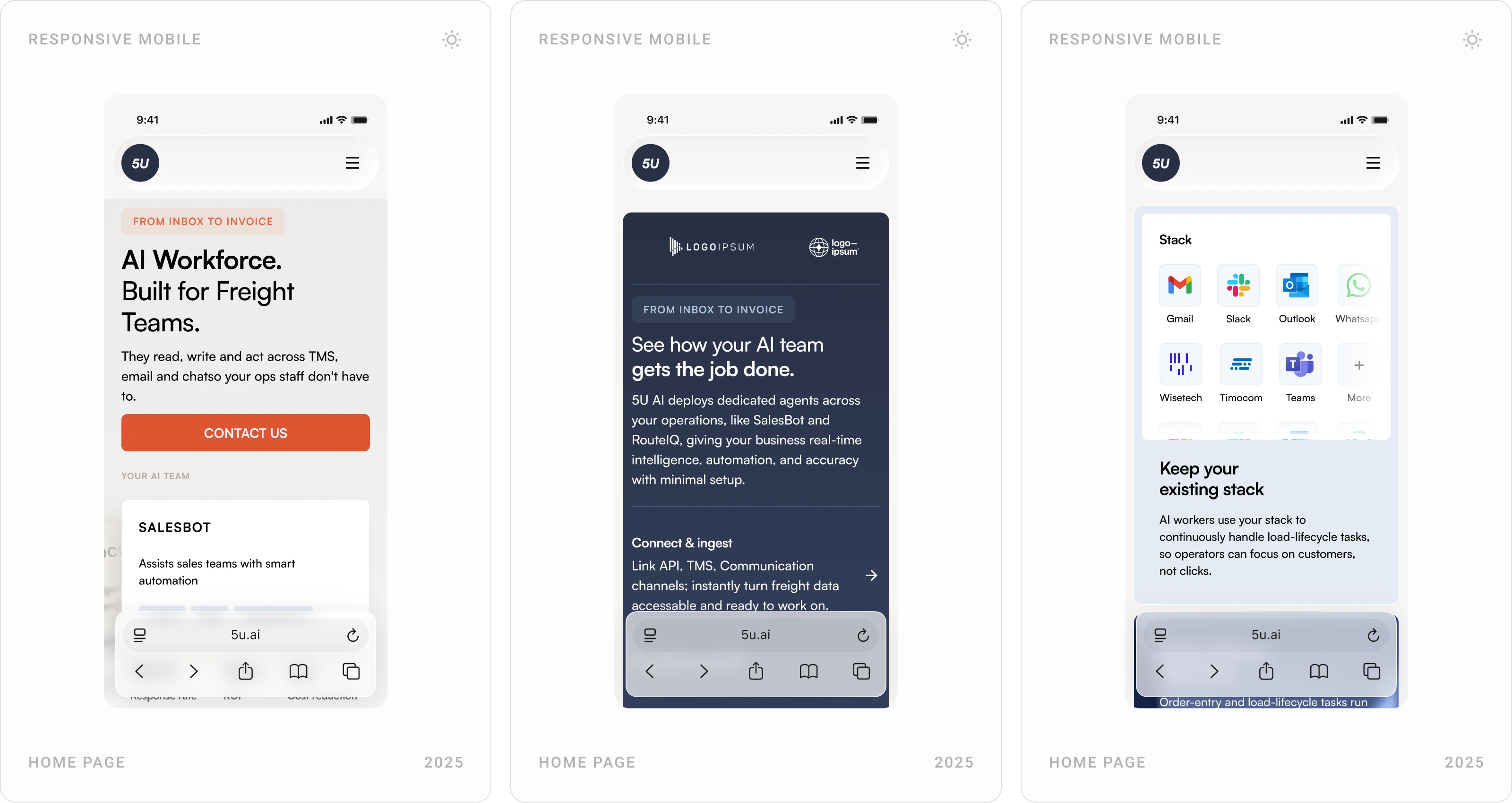
Mobile homepage: the same narrative, re-stacked for one-thumb reading.
From inbox to invoice: explaining how the AI works
The hardest thing to sell was the invisible part. A single diagram places the AI core between knowledge, data ingestion, validation and correction, and a step list, connect and ingest, AI worker on watch, human-in-the-loop, continuous learning, insight loop, expands into a live example built from a real-looking freight email.
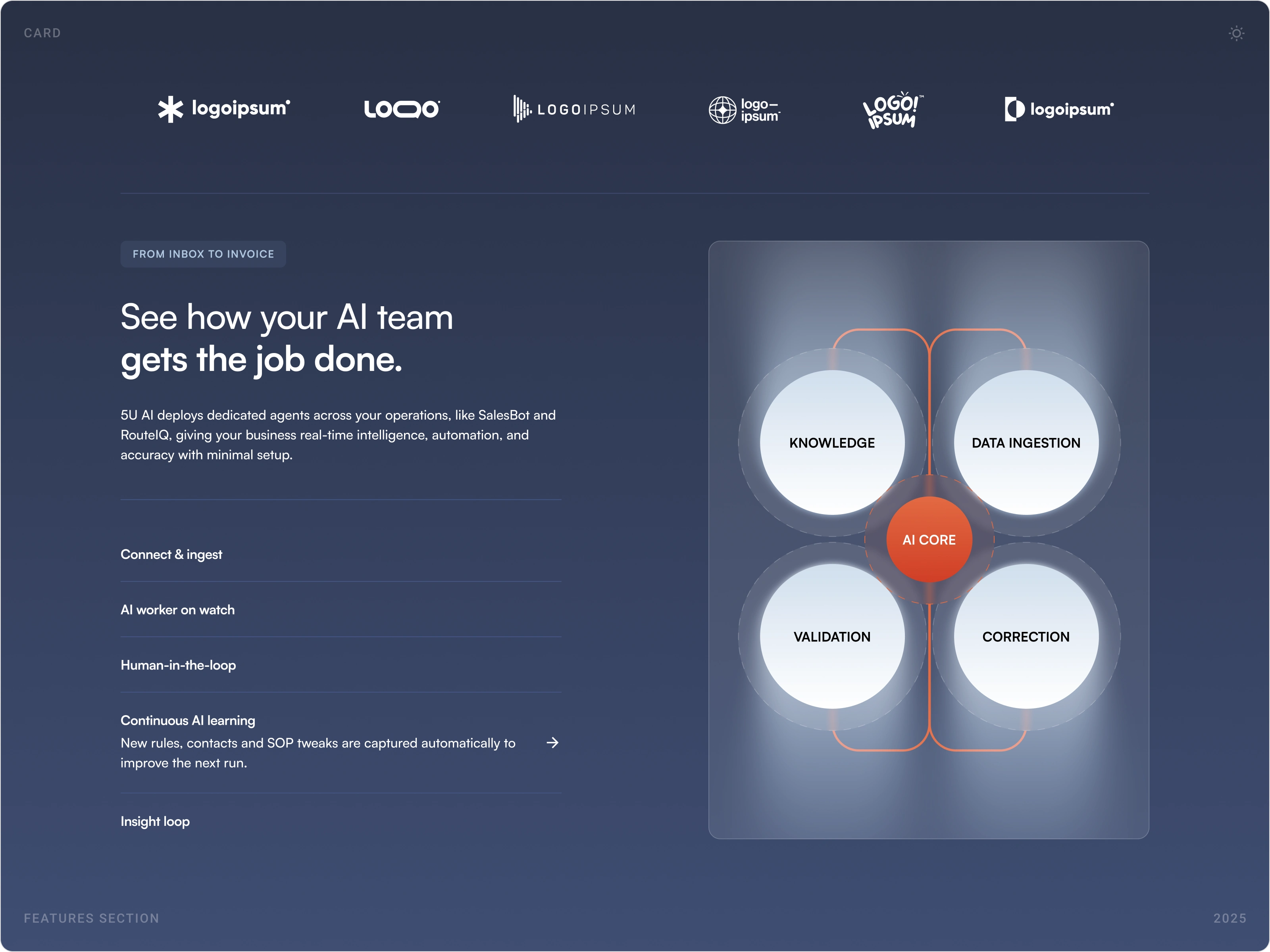
The “AI core” diagram: four capabilities around one engine, readable at a glance.
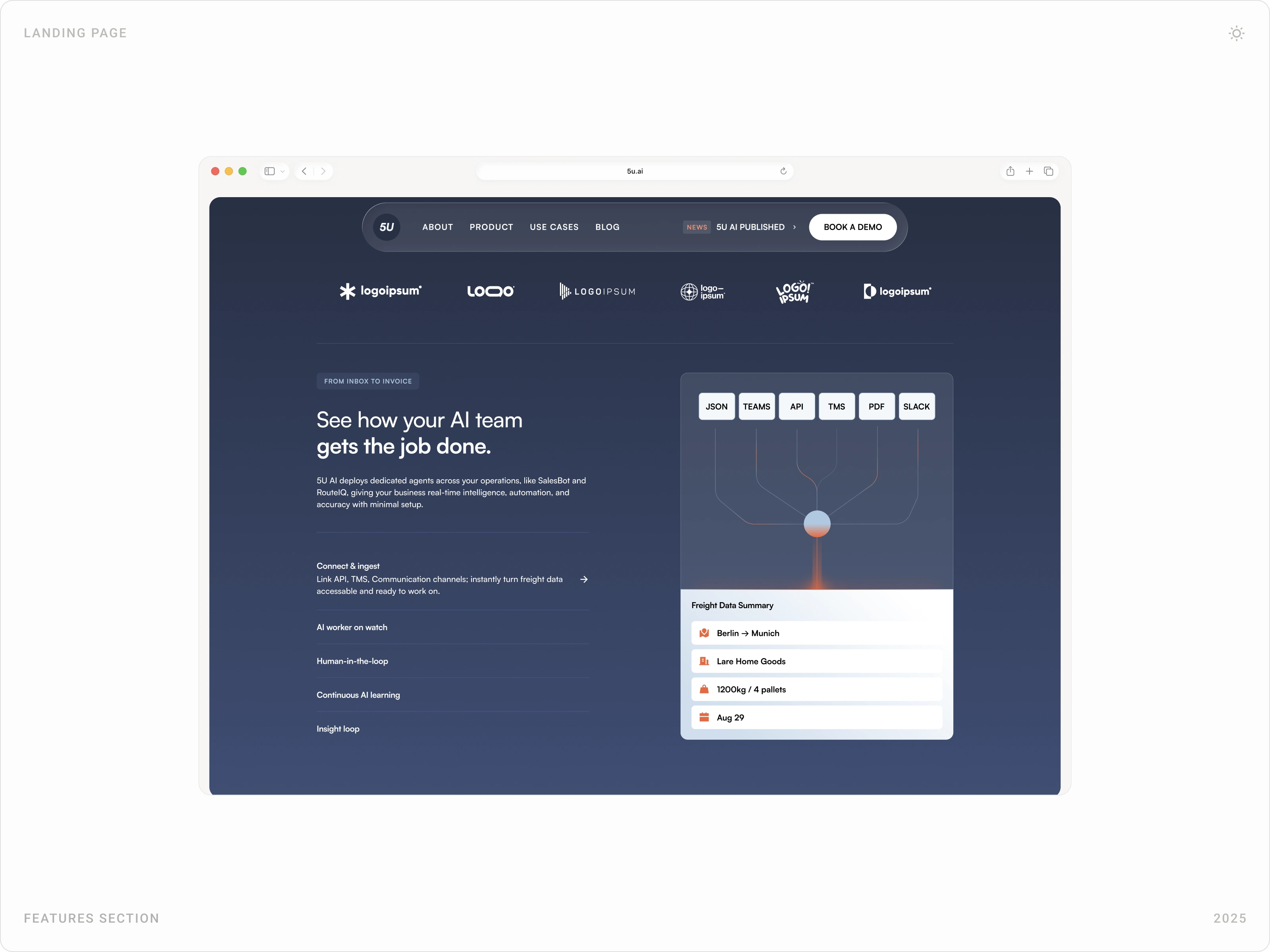
Each step expands with an example: a freight data summary (route, consignee, weight, date) built from a raw email.
Features written as outcomes
Rather than a feature list, the “Why 5U AI” section is a bento grid of outcomes an ops lead cares about: keep your existing stack, scale without new hires, always-on multimodal reps, and no more tribal knowledge. Each card animates on hover so the benefit feels like a product, not a promise.
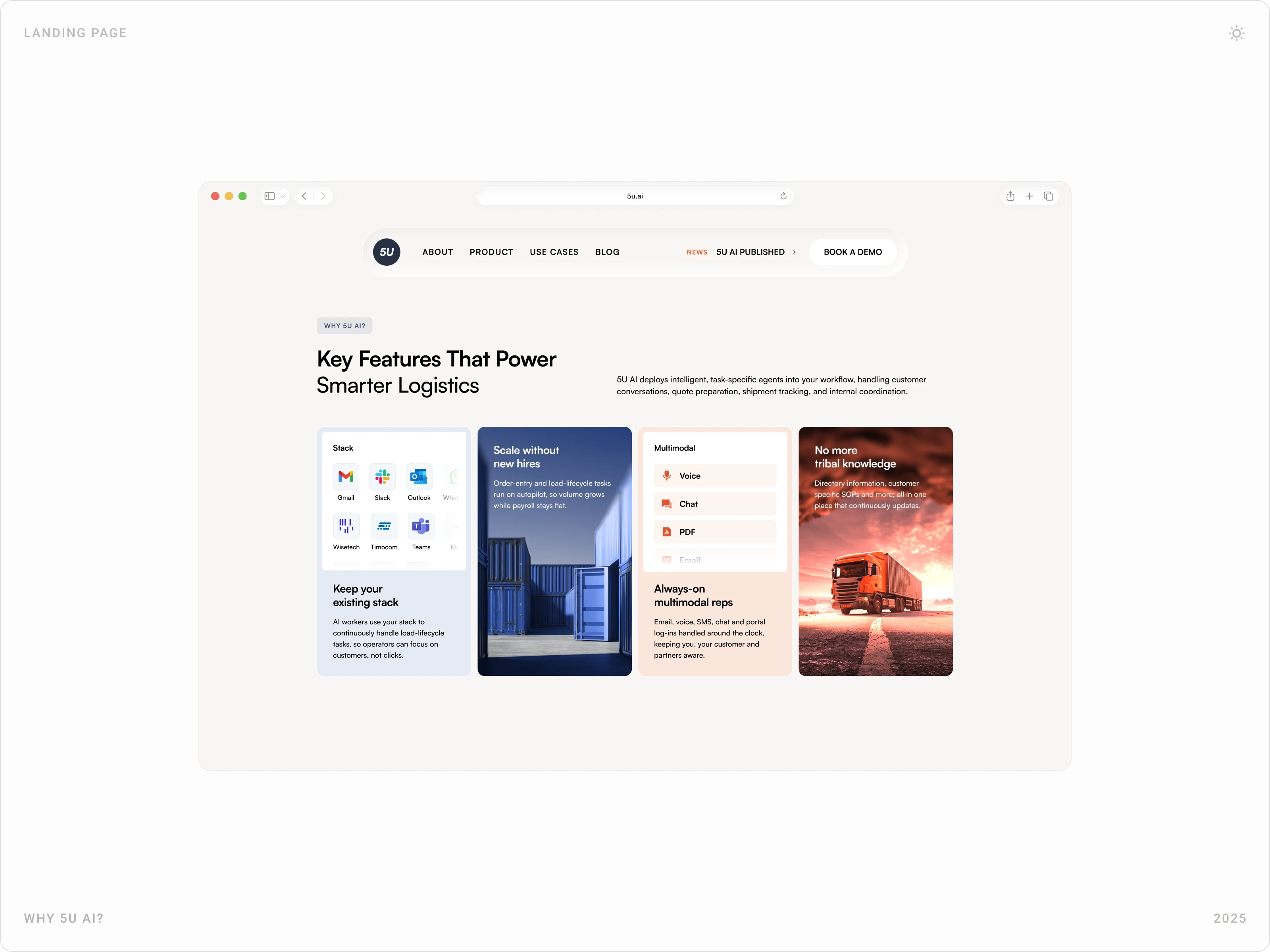
“Why 5U AI”: four benefits, each with its own visual language.
Bento cards come alive on hover.
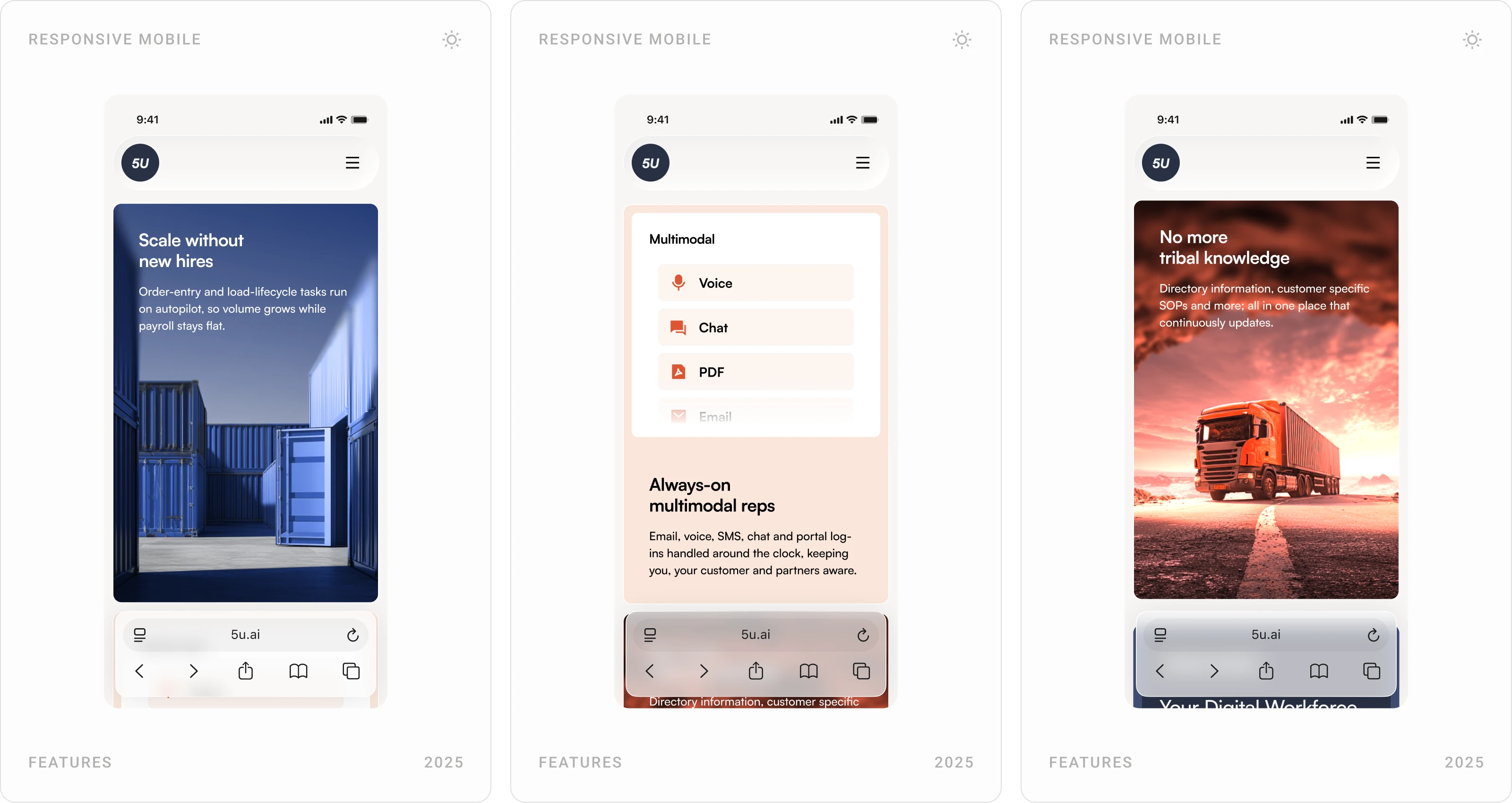
On mobile, each benefit becomes a full-screen card.
Human-in-the-loop, by design
Two sections make the safety net concrete: AI-led customer intake that asks follow-up questions and fills in shipment details, and an approval card where a person reviews the offer before it is sent. The product pages carry the same idea into use-case results, the insight loop and an agent builder.
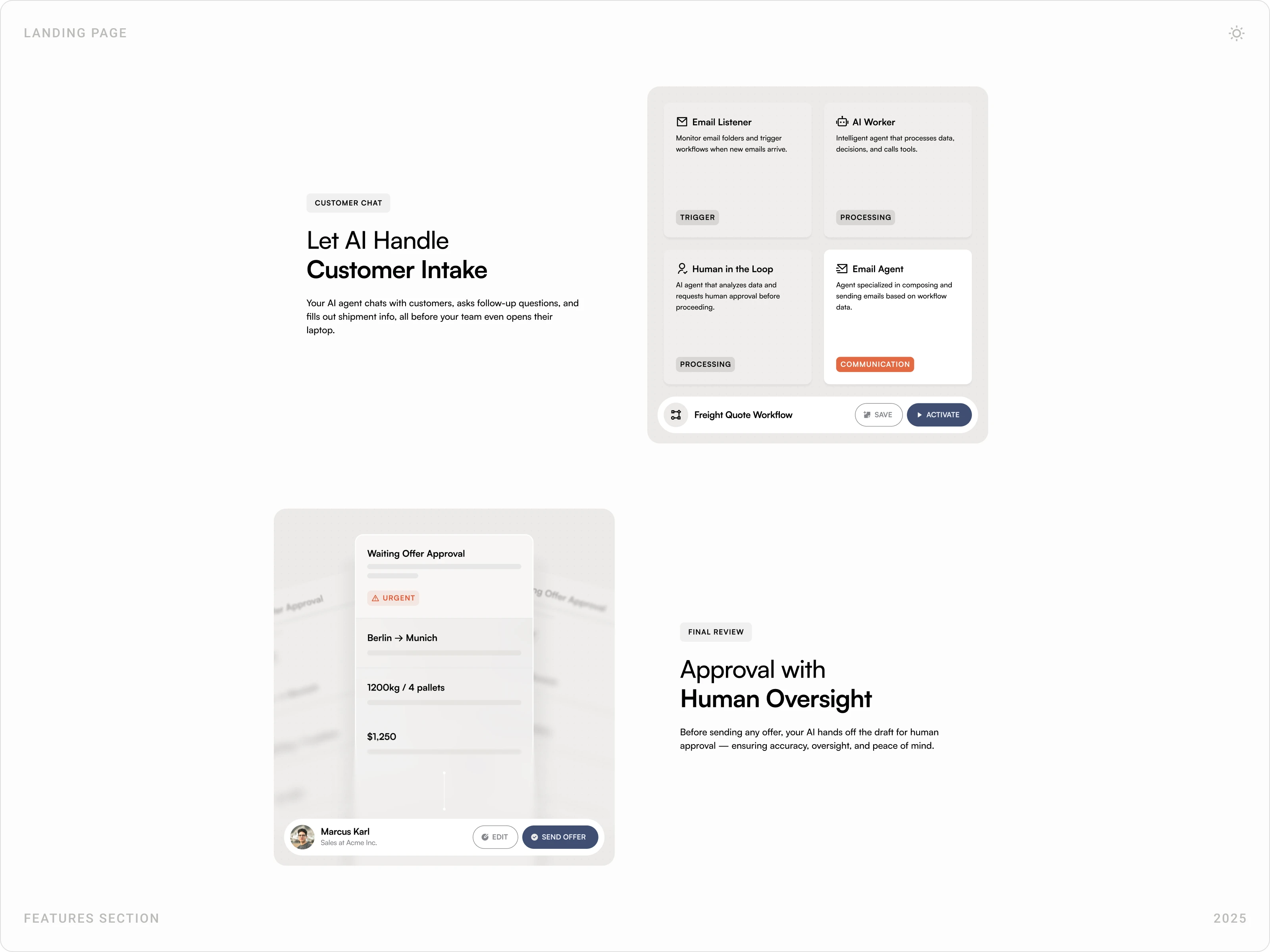
The AI drafts; a person approves before anything reaches the customer.
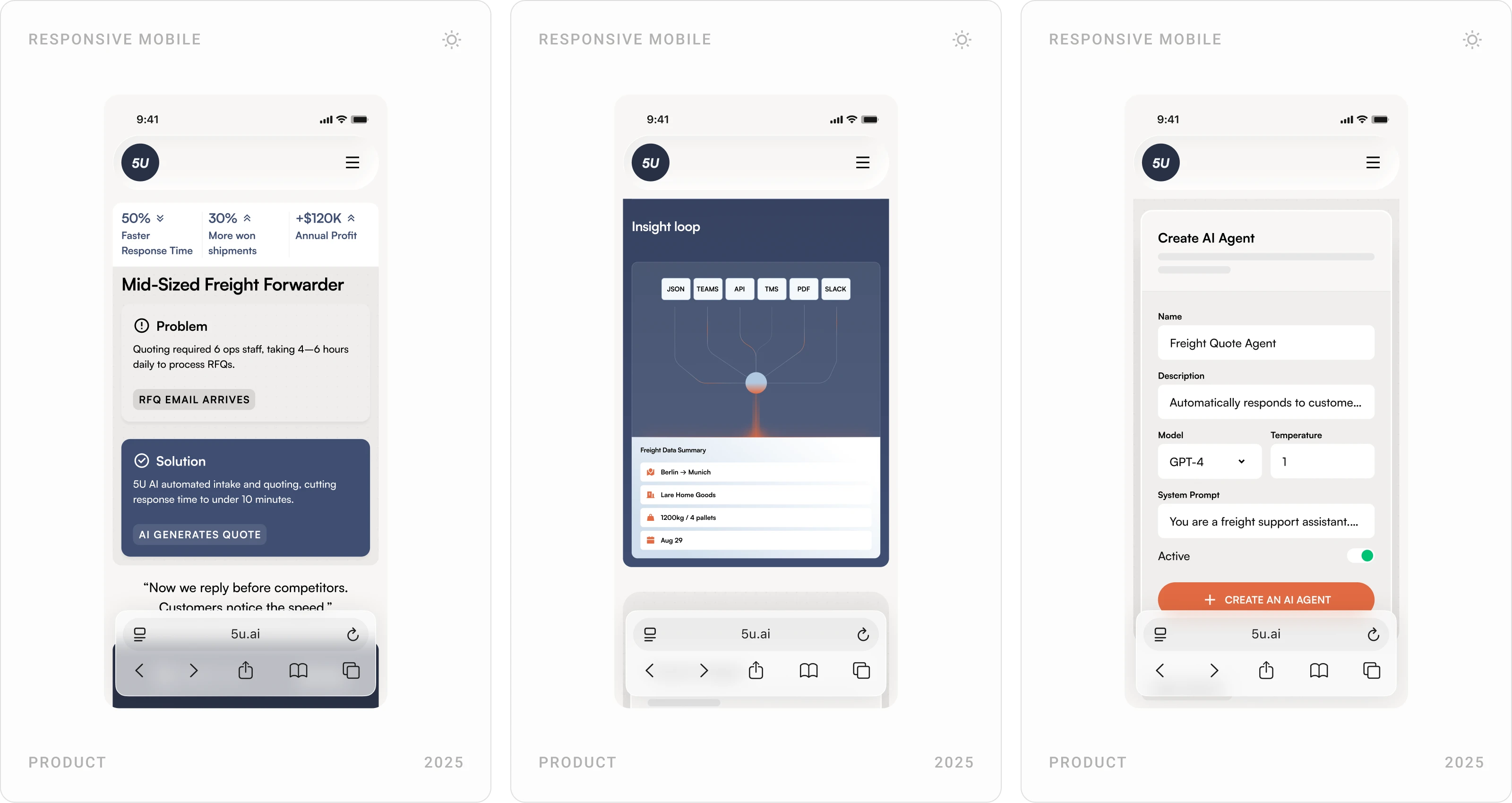
Product pages on mobile: results, the insight loop and creating an AI agent.
Use cases buyers recognise themselves in
Freight is not one market. The use-case section lets a visitor pick their company type, mid-sized forwarder, global carrier, local trucking company, customs broker, regional 3PL, and read their own problem, the solution and a short customer quote.
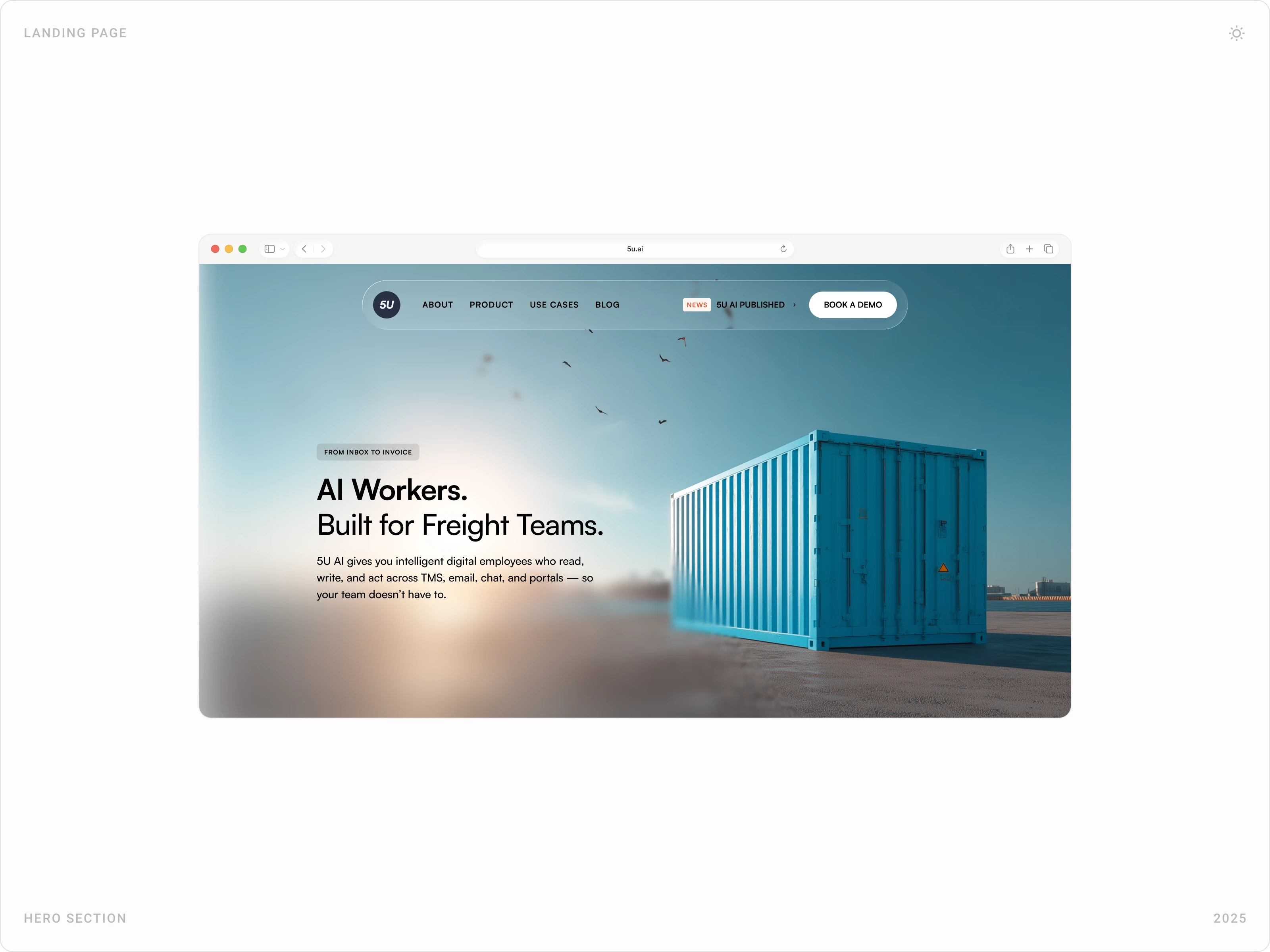
Product page hero.
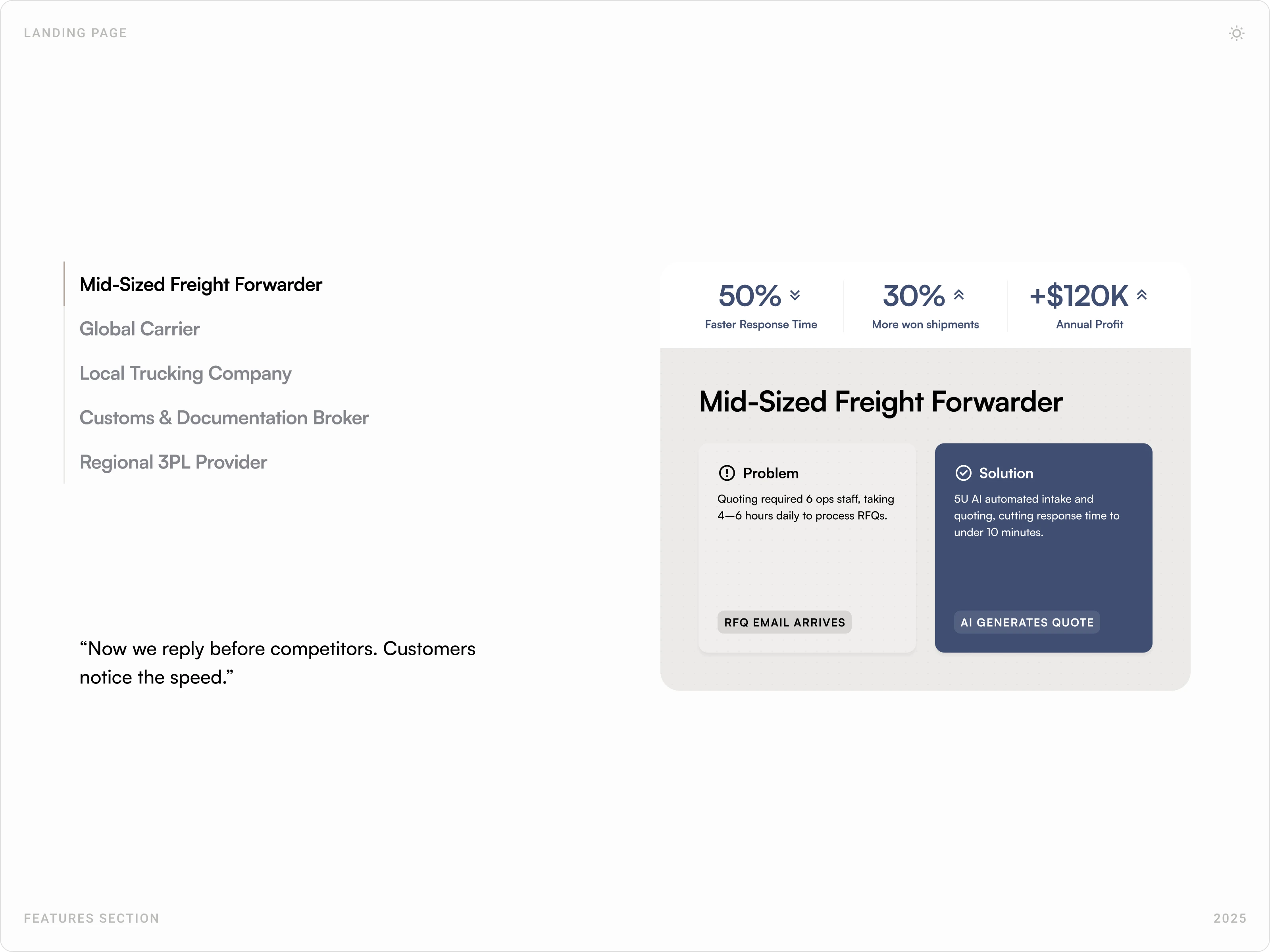
Use cases by company type, each told as problem → solution.
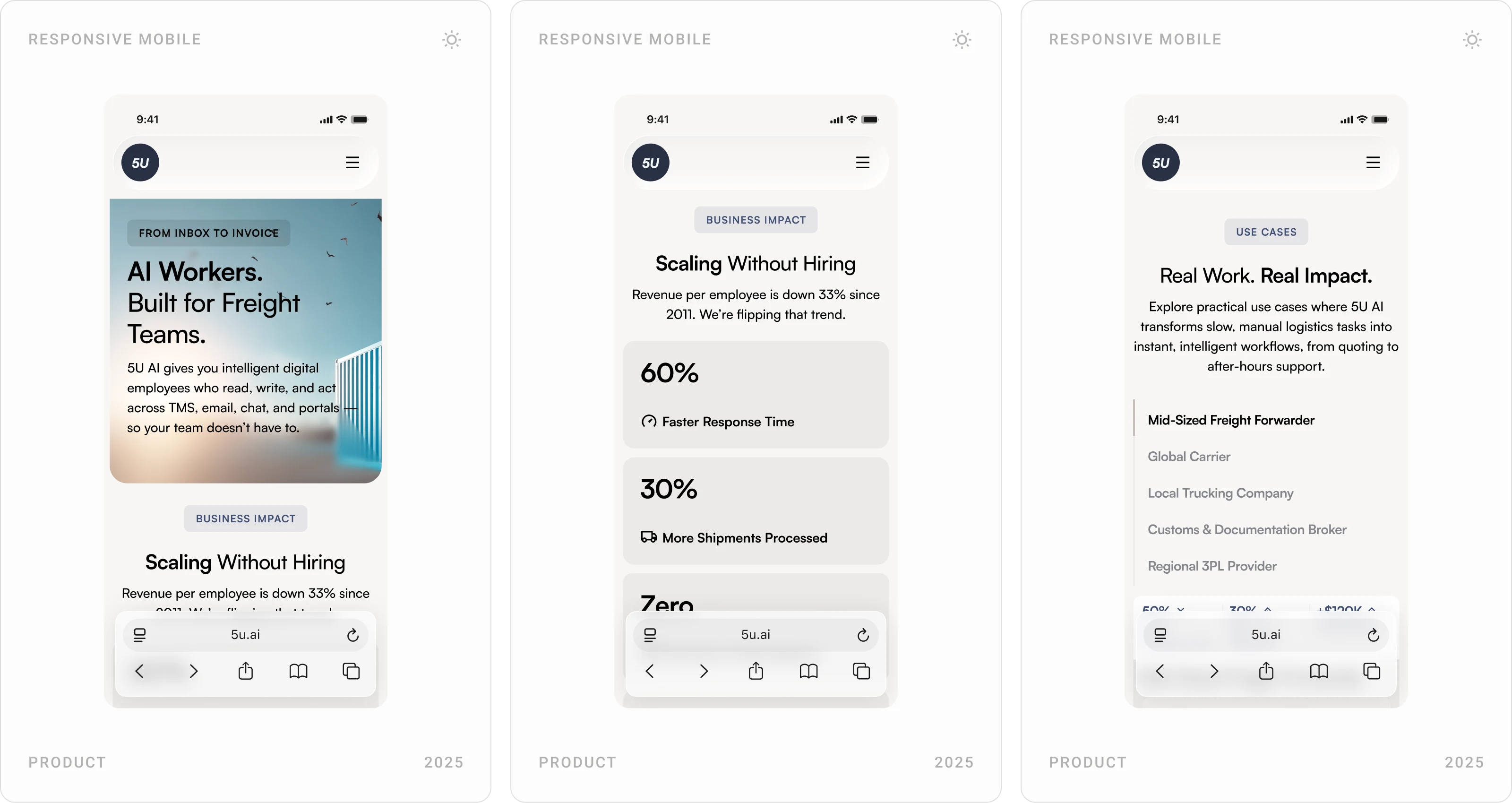
Product and use-case pages on mobile.
Conversion: every path ends in a demo
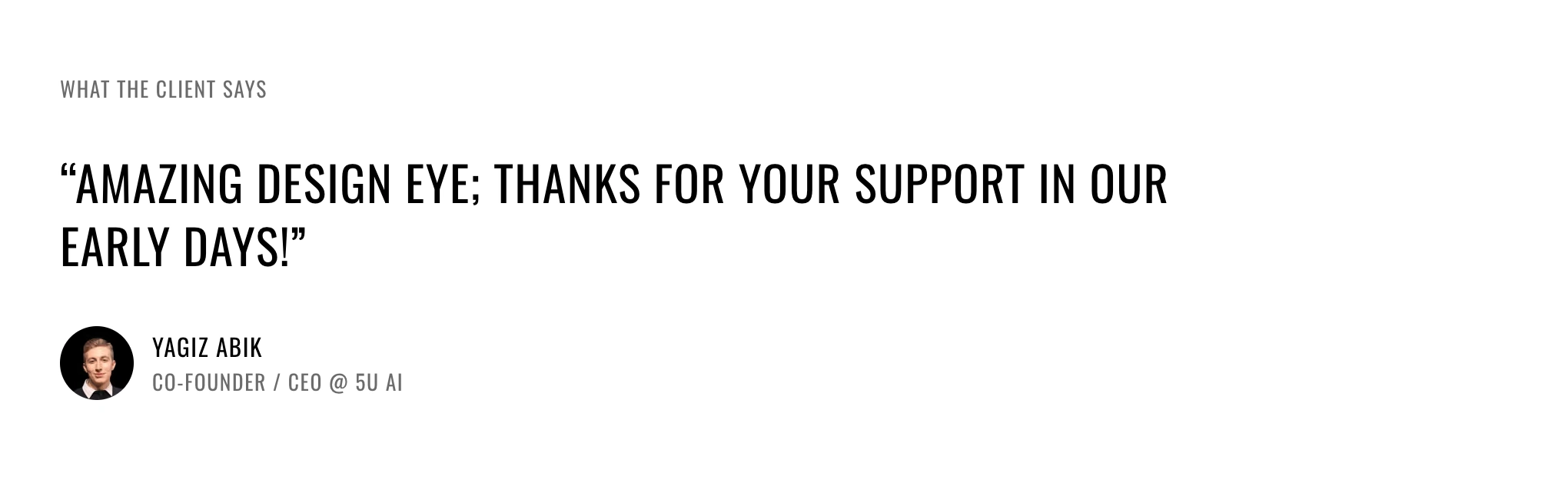
The demo request sits next to a customer testimonial, so the ask comes with reassurance. A topic-grouped FAQ, general, technical, agent capabilities, security and privacy, pricing, handles objections before the call, and a closing call to action repeats the one action that matters.
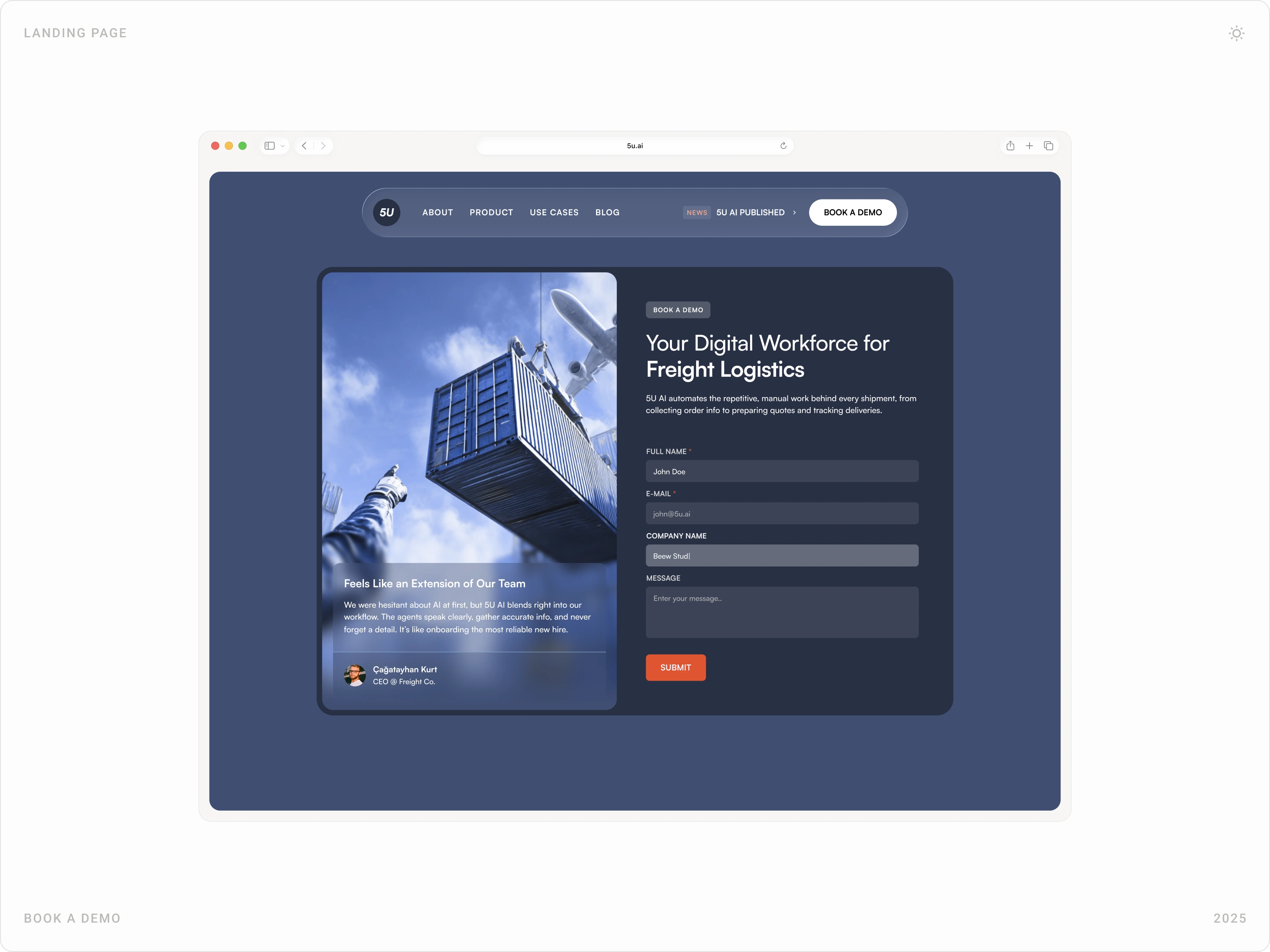
Book a demo: a short form beside a testimonial.
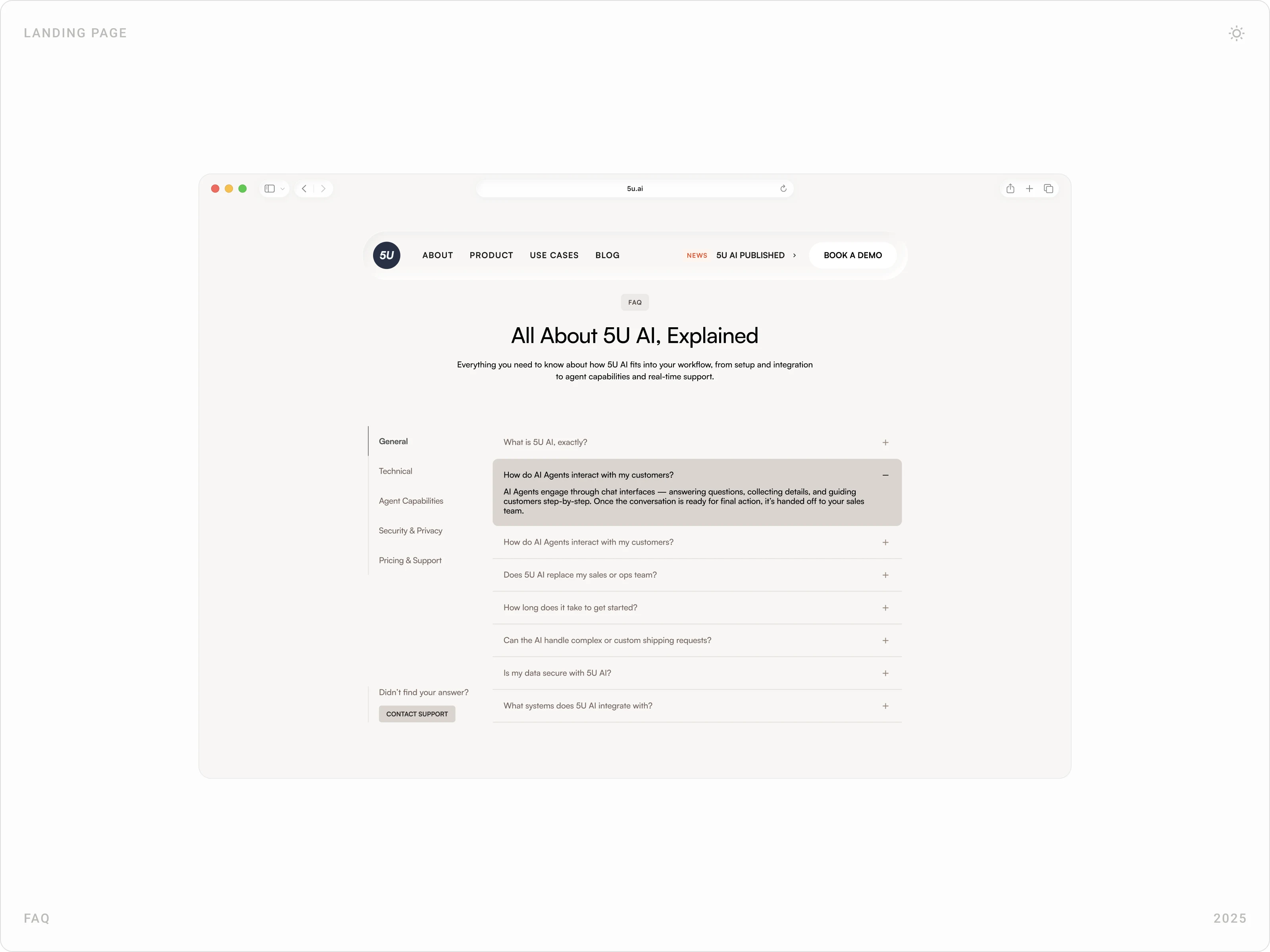
FAQ grouped by topic to answer objections before the first call.
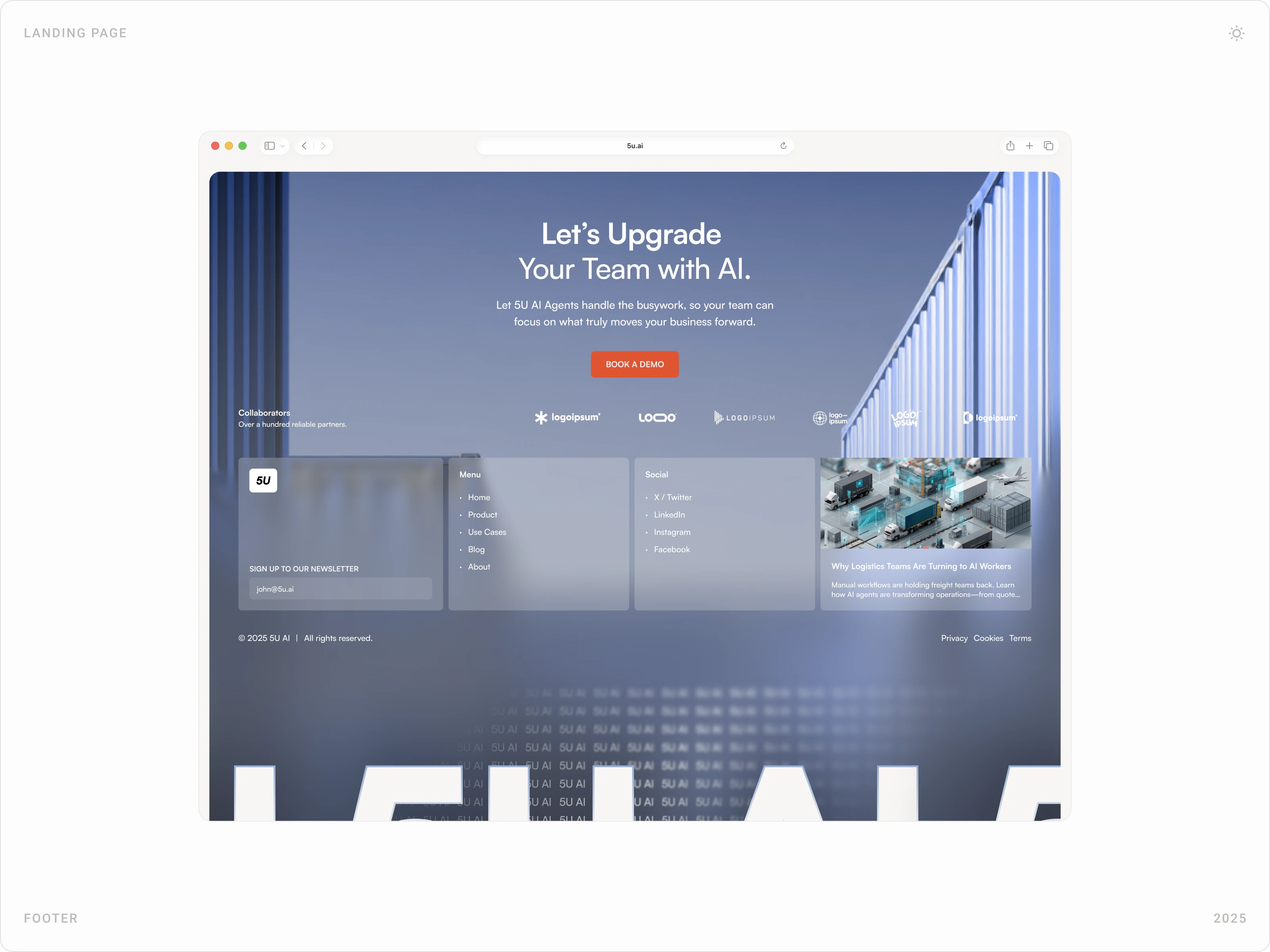
Closing call to action and footer.
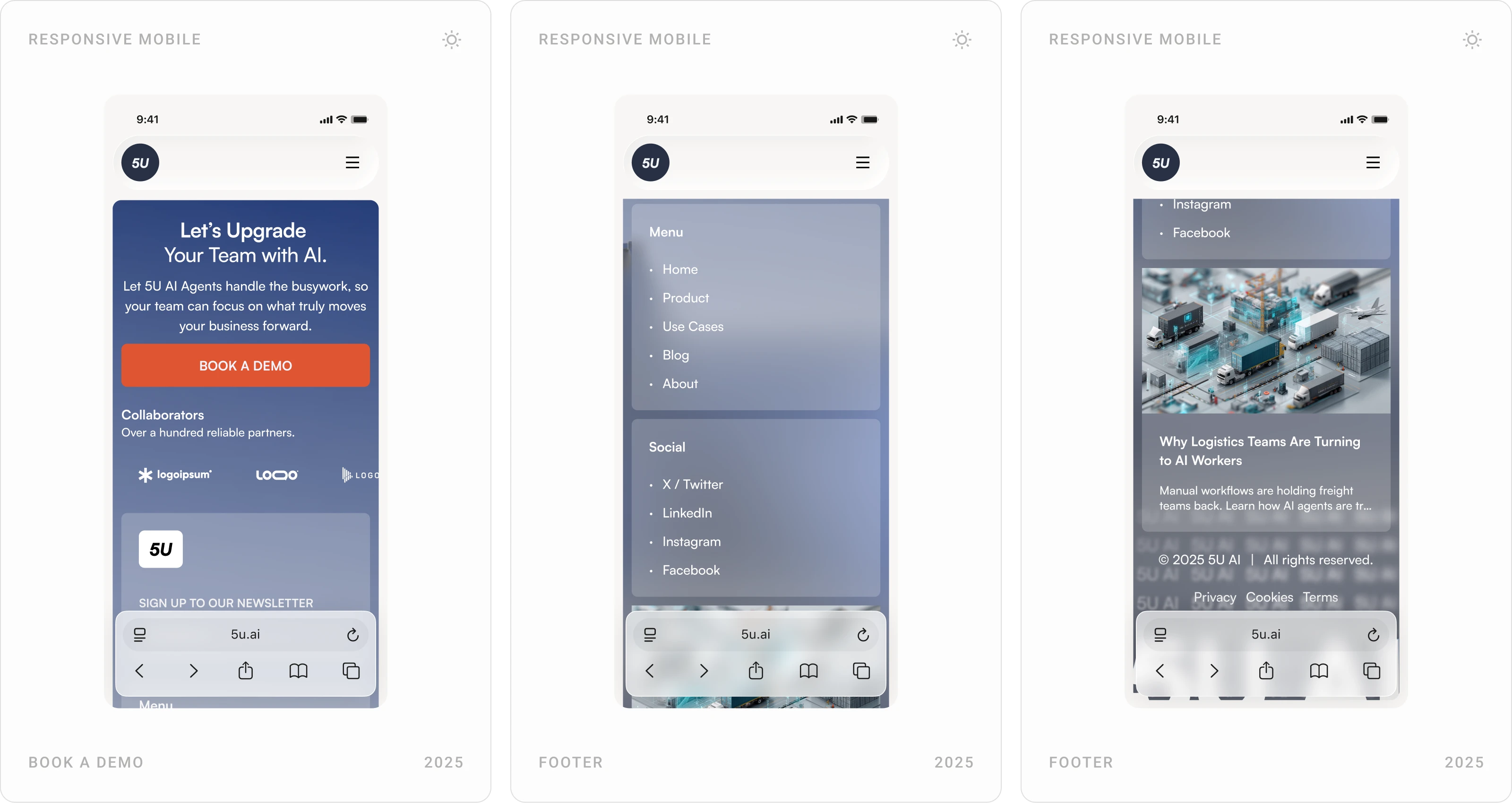
Demo call to action and footer on mobile.
About and blog: credibility and search
The about page introduces the mission, the numbers and the people behind the product. The blog gives the team a home for articles on AI in freight operations, content that builds trust with buyers and brings search traffic over time.
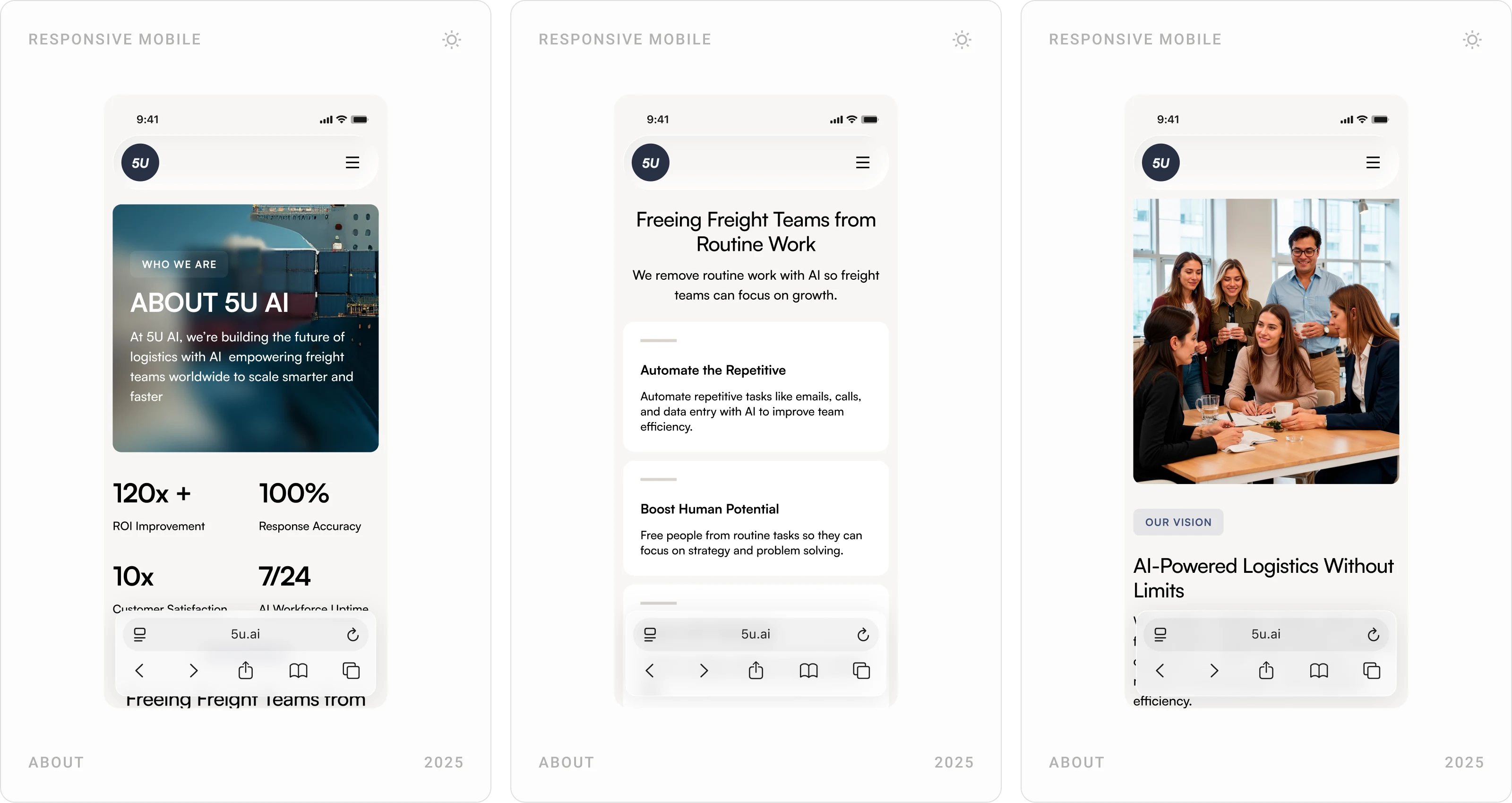
About page on mobile: mission, numbers and team.
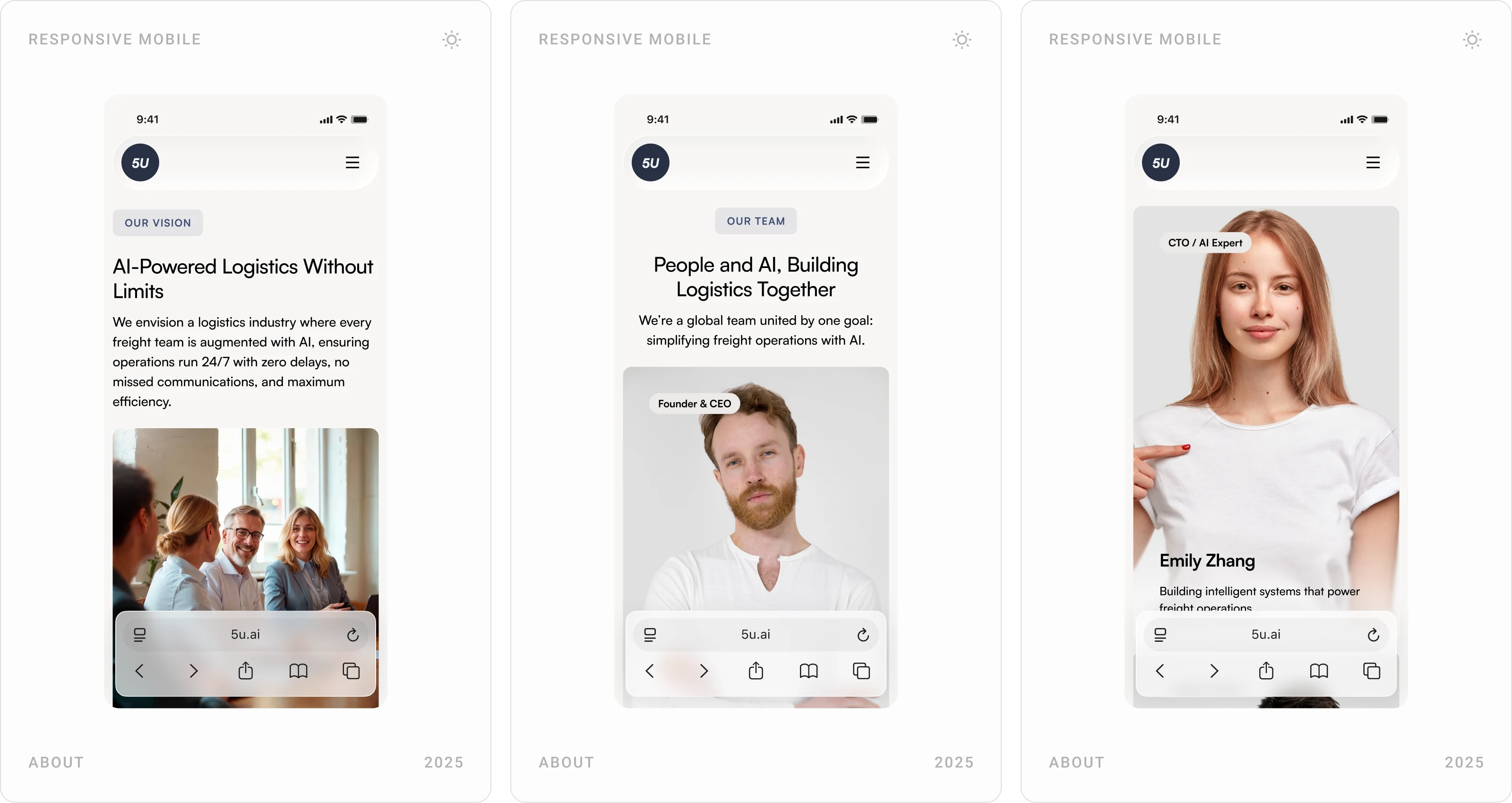
Vision and team.
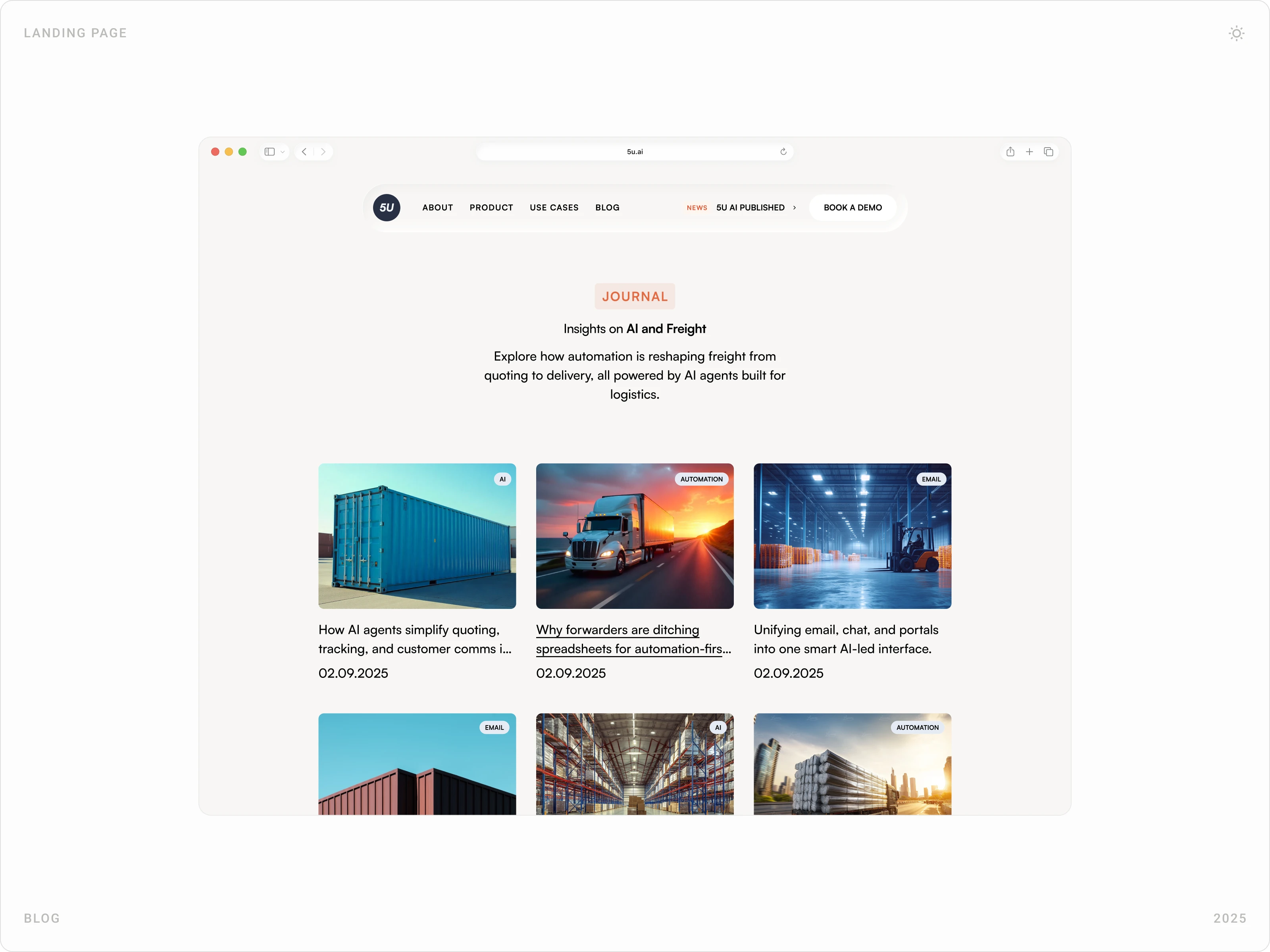
Blog index.
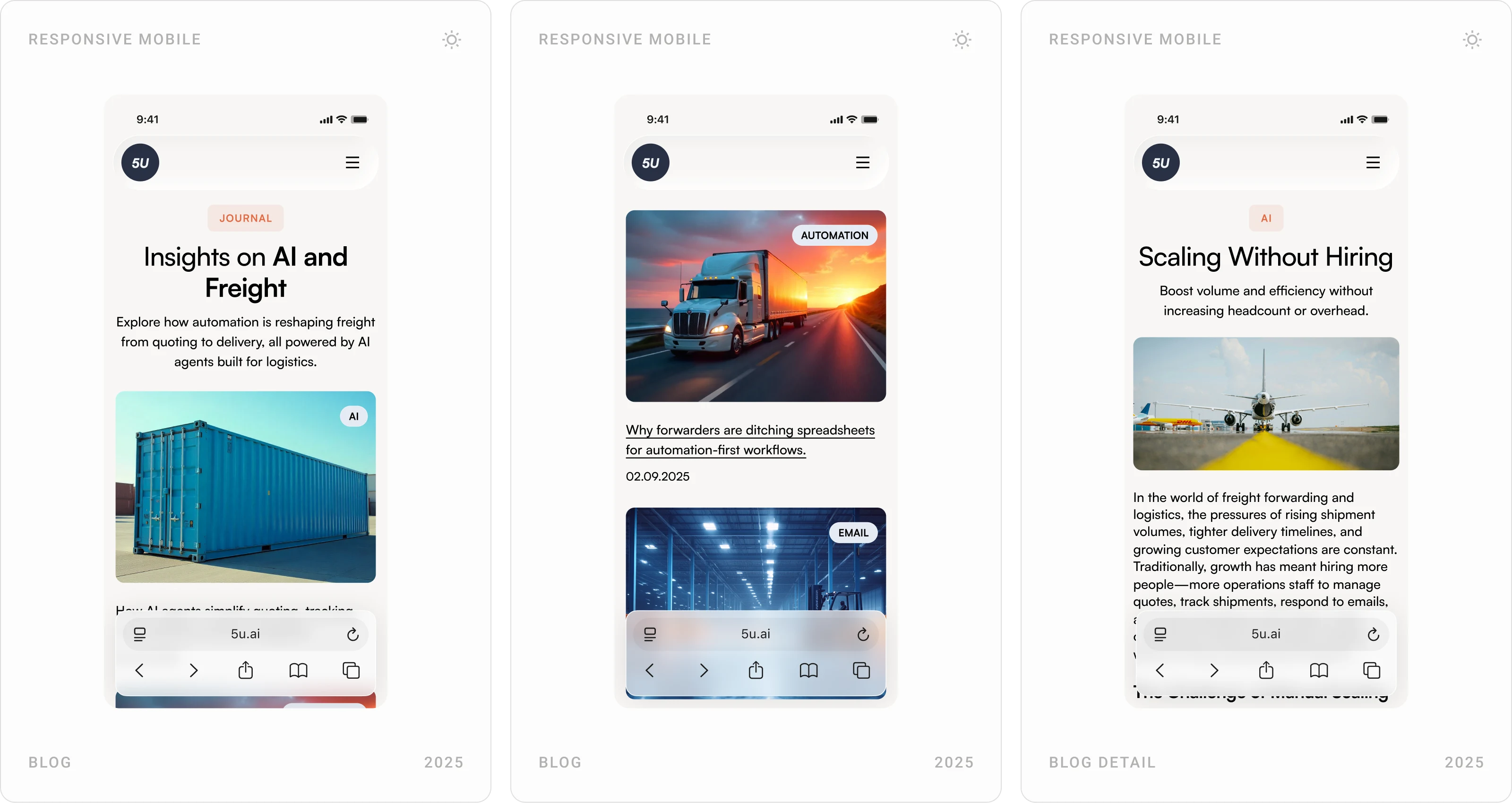
Blog on mobile.
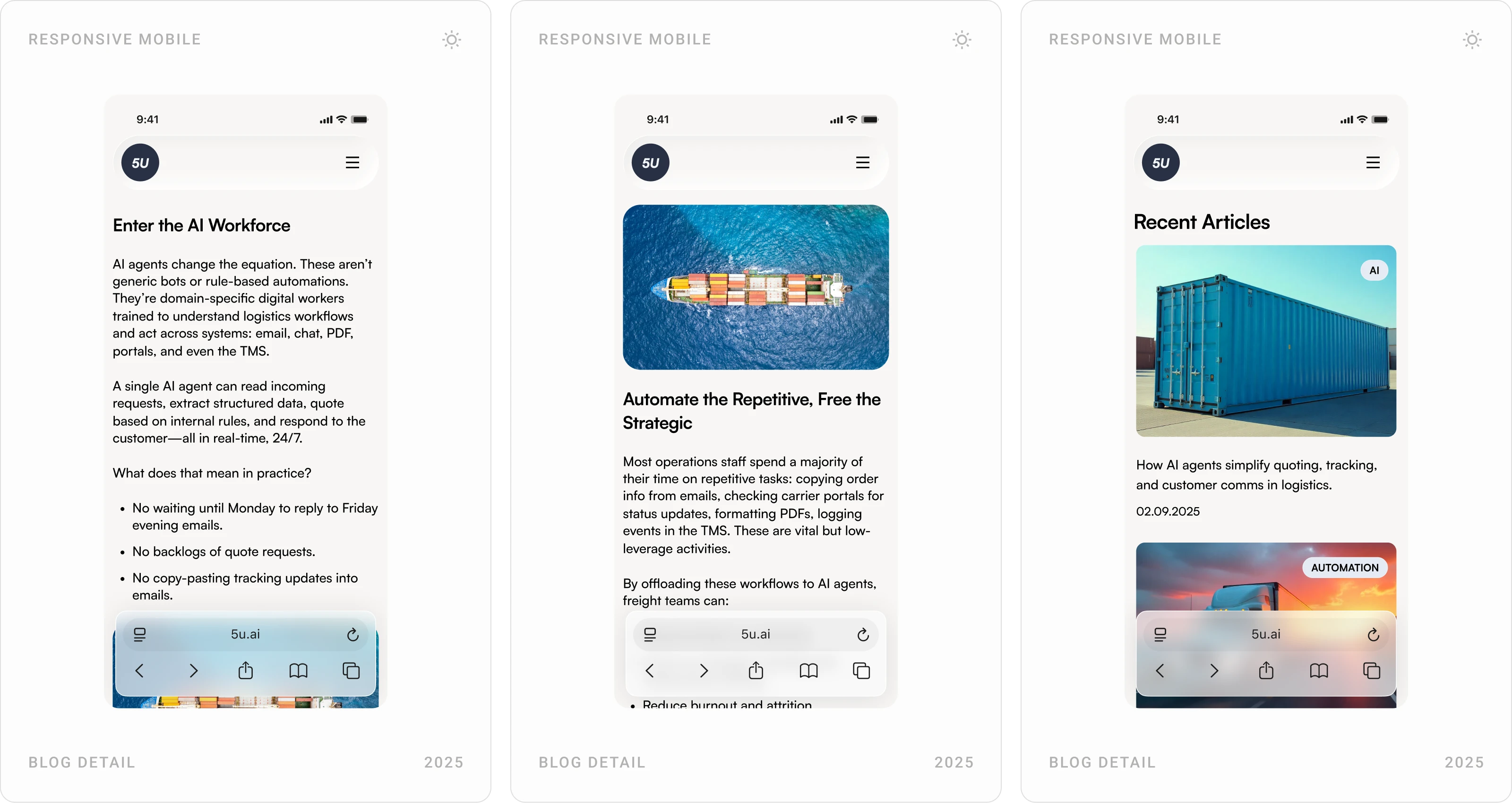
Article template: long-form reading with related posts.
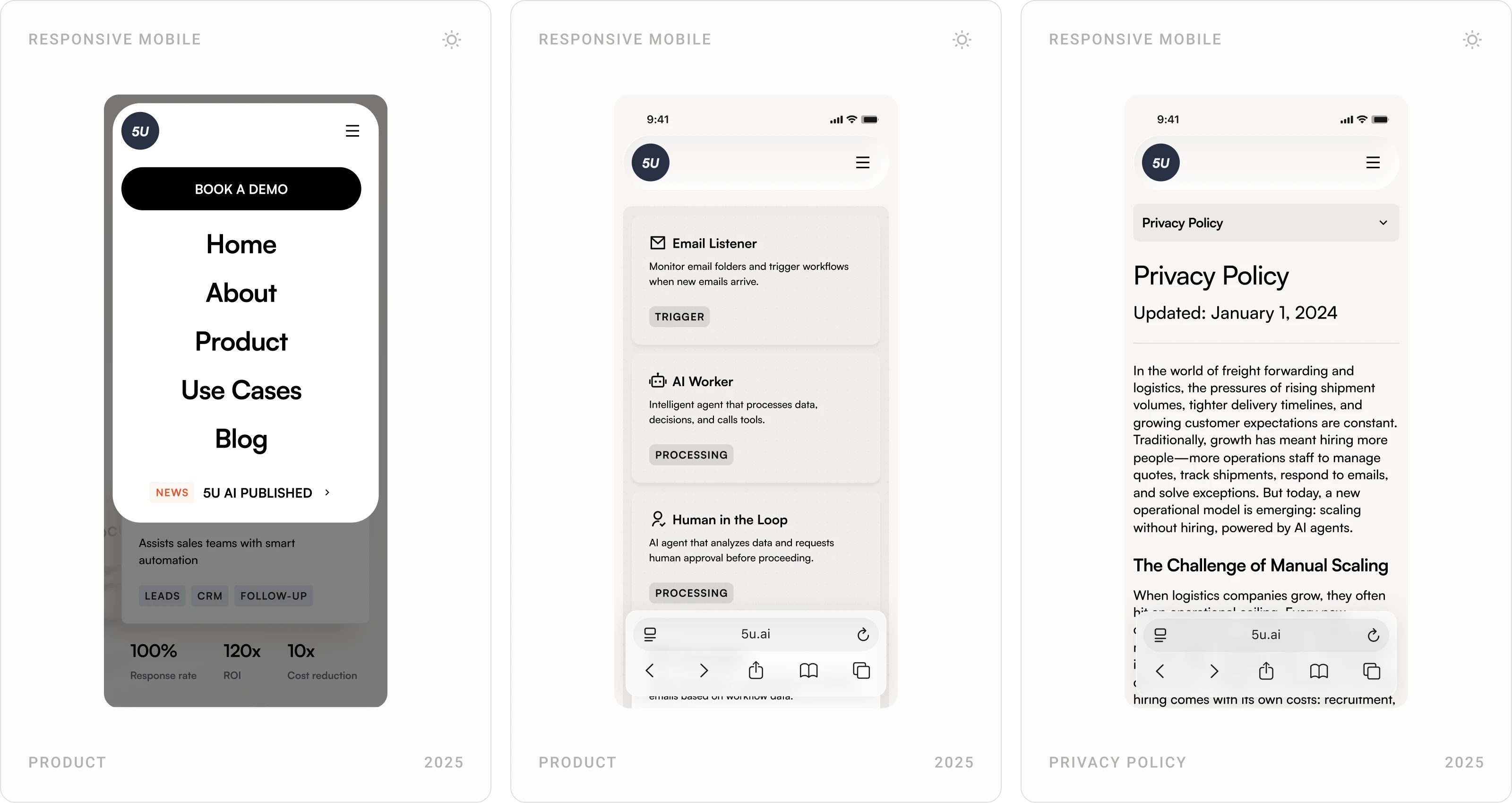
Navigation, workflow builder and legal pages complete the system.
Results
A premium, interactive website that explains 5U AI’s automation value in the first screen.
A clear problem → workflow → outcome story, carried by diagrams and motion instead of paragraphs.
An information architecture across seven templates that makes every page faster to understand and navigate.
A corporate-ready design that supports demo bookings and sales conversations.
In July 2026, 5U AI announced a US$3.2M pre-seed round led by London-based Emerge Capital, joined by angel investors who are former senior executives of DHL, GEODIS, DSV, Maersk and Ceva Logistics. [1] [2] The website is the company’s public face for that next stage of growth.
Key takeaways
Sell the task, not the model: name the work that disappears.
A good diagram beats three paragraphs when the product is invisible.
Trust is a feature: show the human approval step early.
Give every page exactly one next step.
Like this project
Posted Oct 27, 2026
Designed a website for 5U AI to simplify understanding and facilitate demo calls. They raised $3.2m recently.
Likes
0
Views
4
Timeline
Aug 6, 2025 - Aug 26, 2025
Clients
5U AI