Activity Gap Reconstruction System for ETS2 Tachograph

Arkadiusz Staniek


Activity Gap Reconstruction & Manual Entry System
Overview
Activity Gap Reconstruction is a data-editing and validation workflow developed as part of the ETS2 EU Digital Tachograph desktop application. It detects periods for which the tachograph has no reliable activity and allows the user to reconstruct the complete interval with audited manual segments.
Problem
Missing activity cannot safely be represented by a single default value. A gap may be created when a driver card is removed, telemetry is unavailable, or game time jumps forward. The missing interval may contain several kinds of activity, and the reconstructed data later affects counters, rest classification, reports, and violations.
The workflow therefore has to prevent:
uncovered minutes or overlapping segments;
segments outside the source gap;
zero-length or negative intervals;
unsupported manual activities such as driving;
edits to an abandoned game-time branch;
collisions with existing canonical history;
two conflicting resolutions of the same gap;
partial persistence that marks a gap resolved without saving its segments.
Solution
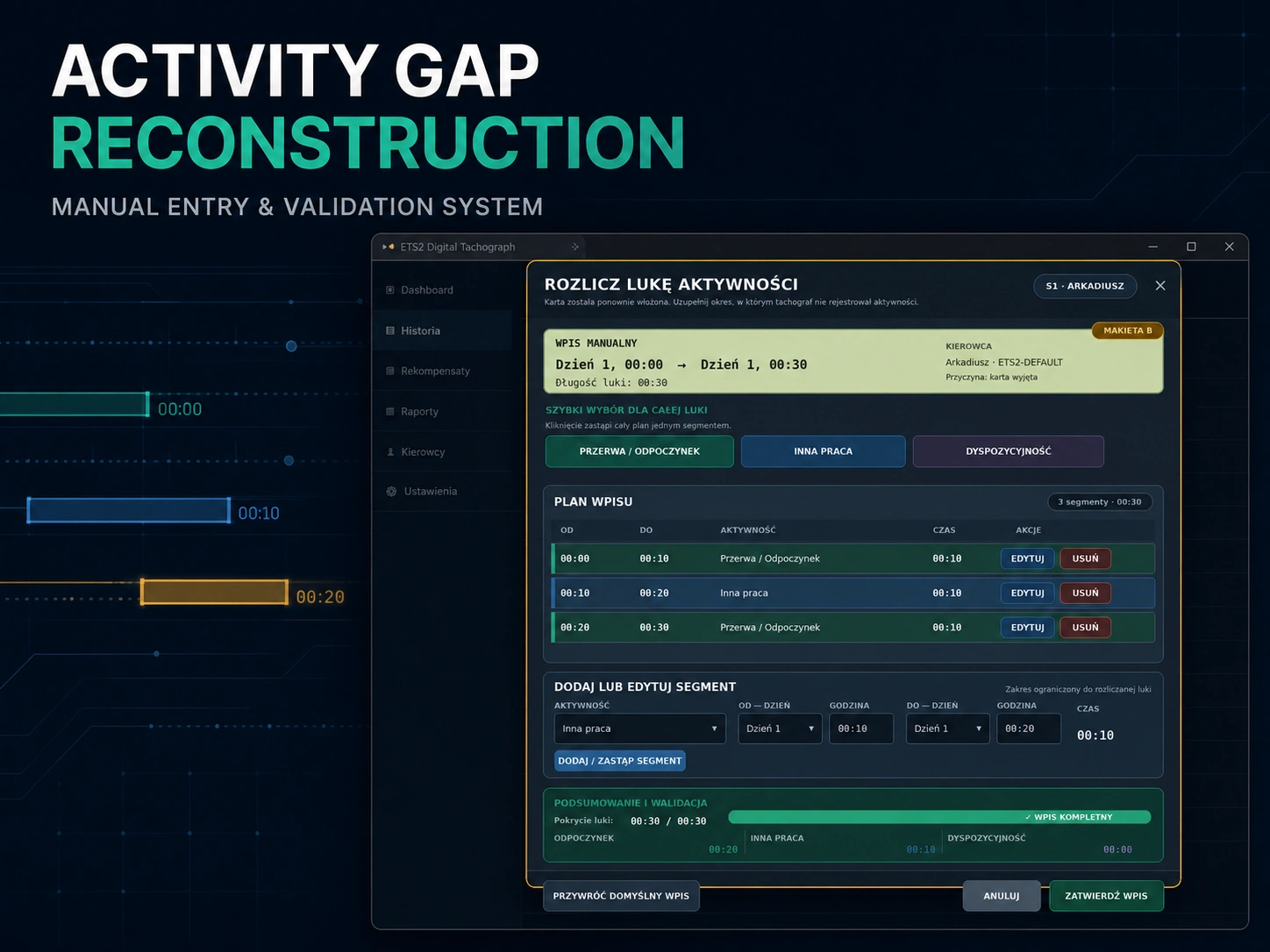
The application models a manual entry as an ordered plan of typed segments. The editor supports quick full-gap choices as well as precise add, replace, edit, split, and delete operations. A live coverage summary shows whether every minute has exactly one classification before the entry can be confirmed.
When the user confirms the plan, the application validates it again in the service layer, links every new record to the source gap, and writes the complete resolution in a database transaction. The canonical history is reloaded and the rule engine is evaluated again from the persisted result.
Key features
detection of unresolved card-removal and time-jump gaps;
quick classification of the entire gap;
multi-segment editing for rest, other work, and availability;
automatic range splitting and replacement in the editor;
complete-coverage, overlap, bounds, and duration validation;
canonical-branch and history-collision protection;
source provenance through
ManualEntry and SourceGapId;atomic SQLite persistence;
idempotent handling of repeated identical submissions;
explicit conflict handling for different second submissions;
rule recalculation after a successful resolution;
preservation of reconstructed provenance in history and reports.
Technical approach
Canonical history first
ETS2 game time can move backwards and create a new history branch. A raw stored gap may therefore no longer belong to the logical timeline. Before editing or saving, the repository resolves the gap against the canonical branch and tracks projection ancestry when a rollback clipped the original interval.
Defense-in-depth validation
The UI editor gives immediate feedback, but correctness does not depend on the UI.
ManualEntryValidator independently verifies the activity types, positive durations, exact coverage, ordering, overlap, bounds, and collisions immediately before persistence.Transactional and idempotent persistence
The resolution, generated activity records, source identifiers, and gap state are committed in one Entity Framework Core transaction. Repeating the same resolution returns an already-applied result; a different resolution returns a conflict. This protects data when a command is retried or triggered twice.
Traceable recalculation
Reconstructed records retain their source and gap identity. After the atomic write, the service reloads canonical history and recalculates the regulatory state, so daily resets and rest qualification occur at the reconstructed activity boundary rather than at the time the user clicked Save.
Verification
Tests cover gap creation, card removal, forward jumps, canonical projections, editor range operations, validation failures, idempotency, transactional persistence, restart behavior, and recalculation of the resulting rule state. These tests span Engine, Application, Infrastructure, RuleEngine, and Desktop boundaries.
Technologies
C# and .NET 9
WPF and MVVM
Entity Framework Core
SQLite transactions
domain validation and provenance modelling
xUnit
GitHub Actions
Result
The module converts uncertain missing intervals into complete, validated, and traceable activity history without hiding how the data was created. It demonstrates state management, non-trivial editing UX, defense-in-depth validation, transactional persistence, temporal-data modelling, and robust handling of retries and history branches.
Related project
Like this project
Posted Aug 10, 2026
Validated workflow for reconstructing missing driver activity with manual segments, coverage checks, SQLite transactions and rule recalculation.
Likes
0
Views
10
Timeline
Jul 27, 2026 - Jul 28, 2026