Creating SEO Content That Ranks and Converts

Zaib-un-Nisa Nawaz


How to Create SEO Content That Ranks, Converts, and Brings the Right Customers
A practical framework for writing content that gets found, earns trust, and guides the right readers toward action.
11 min read
·
Just now
--
Share
Press enter or click to view image in full size
Image designed by the author with AI assistance.
Introduction
Imagine a small business owner who publishes a blog post about her services. In this hypothetical scenario, the post eventually shows up on the first page of search results and starts getting a steady trickle of visitors.
Her inbox, though, stays quiet. No new inquiries, no new clients. Just visits that don’t turn into anything for the business.
That gap is worth paying attention to. A page can gain search visibility without producing any real business result. Learning how to create SEO content means learning to close that gap, not just getting a page onto page one.
This article walks through a process for doing that, organized around a framework I call the RICH Content Method. This is my own way of structuring the writing process. It isn’t an official Google framework, Google doesn’t endorse it, and following it doesn’t guarantee any ranking, traffic, or conversion result.
R — Research intent
I — Identify the right keyword cluster
C — Construct useful content
H — Hand the reader toward a relevant next step
Each part below addresses one piece of the problem described above.
Press enter or click to view image in full size
Image designed by the author with AI assistance.
Understand: What SEO Content Actually Means
SEO content writing is often reduced to “writing with keywords in it.” In practice, it’s writing that answers a real question in a way that’s genuinely useful to a reader and easy for a search engine to understand.
Content that tends to work well usually:
answers the reader’s actual question
matches the topic and the reader’s intent
stays accurate and easy to follow
makes it simple to find related information
offers an appropriate next step, when one makes sense
None of this guarantees a ranking. It describes what tends to make content useful, which is the foundation everything else in this article builds on.
A framework I use to think about this is what I call the Traffic Quality Triangle: Relevance, Intent match, and Trust. This is my own conceptual framework, not an official SEO term, and not a formula Google uses to calculate rankings. It’s a way to explain why a page can get visitors without getting results, when it’s missing one of the three:
Press enter or click to view image in full size
Image designed by the author with AI assistance.
Relevance — does the content match what the reader searched for?
Intent match — does it fit what the reader is trying to do?
Trust — does it give the reader a reason to believe the information and the source?
Google’s People-First Guidance
Google’s documentation on creating helpful, reliable, people-first content describes the qualities it wants human search quality raters to look for, often summarized as E-E-A-T: Experience, Expertise, Authoritativeness, and Trustworthiness. Of these four, Google specifically says trust is the most important, and the other three mainly matter because of how they contribute to it.
It’s worth being precise here. Quality raters use E-E-A-T concepts to evaluate search results as part of testing how well Google’s ranking systems are working, but raters don’t set individual page rankings themselves, and rater feedback is used to assess system performance rather than to score individual pages. Google’s own SEO Starter Guide directly addresses a common misconception on this point, stating plainly that E-E-A-T is not a ranking factor. It’s better understood as a quality concept behind the kind of content Google’s systems are designed to favor, not something a writer can simply add to a page.
The same general approach applies to AI Overviews, the AI-generated summaries that appear above regular results for some searches. Google’s documentation on AI features in Search states there are no special requirements or extra optimizations needed to appear in them. The guidance is to keep following standard SEO fundamentals and creating helpful, reliable content, rather than chase a specific technique meant to guarantee inclusion.
Research: Search Intent and Keyword Selection
Understand Search Intent Before You Write
Press enter or click to view image in full size
Image designed by the author with AI assistance.
Search intent is what someone is trying to accomplish when they type a phrase into a search engine. Three practical categories, used for this article, can help:
Learning — the reader wants to understand something
Comparing — the reader is weighing options
Deciding or buying — the reader is close to taking action
These aren’t official Google classifications, and not every search fits neatly into one. Some sit somewhere in between, and looking at the actual search results for a phrase is a practical way to get a read on which one applies.
Three questions can help before you write anything:
What type of pages currently show up for this search?
What information would actually satisfy this reader?
What is the reader likely trying to accomplish next?
For a hypothetical example used throughout this article, picture a small bookkeeping business. This business doesn’t exist. It’s used only to make the process easier to follow.
Example search phrase Likely stage Note how does bookkeeping work Learning Often suggests someone researching the topic generally bookkeeping vs. accounting Comparing May indicate someone weighing two related options bookkeeping services for small business Deciding Can be more closely aligned with someone evaluating a service to hire
This table reflects reasoning about the phrasing of each search, not actual keyword research data. No real search volume, competition, or difficulty figures were checked for these examples.
Keyword Research With a Purpose
Keyword research means identifying words and phrases people actually use to search for something related to your business. A workable process includes:
A seed keyword — a broad starting topic, such as “small business bookkeeping”
Related keywords — other phrases connected to that topic
Keyword clusters — grouping related keywords by what the searcher is trying to do, not just by shared words
Relevance to the business — checking that a keyword connects to something you can actually offer
In the table above, “bookkeeping services for small business” has a clearer commercial intent in this example, meaning the phrasing itself suggests someone closer to hiring a service. That’s a difference in likely intent, not a claim about which keyword has higher search volume or lower competition.
Plan: Build a Simple SEO Content Brief
Before writing, it helps to put the plan on one page. This isn’t a Google requirement. It’s a practical habit that settles decisions before the draft begins instead of during it.
Press enter or click to view image in full size
Image designed by the author with AI assistance.
A simple brief can include:
Primary keyword — the main phrase this page is built around
Supporting keywords — two or three related phrases
Search intent — learning, comparing, or deciding
Target reader — who they are and what situation brought them here
Competing pages — a few pages currently ranking for the topic
Content gap or opportunity — something those pages don’t cover well
Unique angle — what this page will do differently
Approximate scope — based on what similar pages currently cover
Conversion goal — what you want the reader to do next
Filling this out before writing keeps the piece focused on one topic and forces an early decision about where the content is meant to lead.
Write: Structure and Substance That Help the Reader
Structure that Helps Readers Scan:
Clear, descriptive headings that reflect what each section covers
The main point of a section answered early
Short paragraphs, since long blocks of text are harder to skim
Consistent formatting throughout the page
Substance that Actually Helps:
Specific explanations. Instead of a vague statement like “bookkeeping saves time,” explain which tasks it typically replaces. Use a real example or a verified figure rather than a number that sounds reasonable but hasn’t been checked.
Answering related questions. If a heading answers “what,” it can help to touch on “how” or “how much” nearby. Covering related questions is part of what’s sometimes called topical authority: a page or site becoming known for covering a subject thoroughly. This is a content strategy concept, not a single confirmed ranking factor, and publishing a certain number of articles doesn’t automatically create it.
Avoiding keyword stuffing. Use your target keyword and its natural variations where they genuinely fit. If a phrase feels forced, rewrite the sentence.
Google’s SEO Starter Guide is direct about one common myth here: content length alone doesn’t affect ranking, and there’s no minimum or maximum word count to aim for. The better goal is covering what the reader needs to know, without adding filler just to make a page longer than a competitor’s.
Optimize: On-Page SEO Without Overcomplicating It
On-page SEO covers the small elements that help both readers and search engines understand a page. None of it replaces the content itself.
Title. According to Google’s documentation on influencing title links, the title link shown in search results is generated automatically, using a combination of sources such as the page’s
<title> element and other prominent content on the page. That means the exact text you write won't always appear unchanged in search results, and putting a keyword in the title doesn't by itself guarantee a ranking. Writing a title that's unique, clear, concise, and accurate to the page's content is the most reliable way to influence it.Meta description. Google’s documentation on writing meta descriptions explains that Google may use the description you provide, or generate a different snippet from the page content instead. Meta descriptions are not a direct ranking factor. A clear, accurate one can still help a searcher decide whether to click your result, though it isn’t guaranteed to appear as written or to increase clicks in every case.
Headings. Descriptive H2s and H3s help readers understand what each section covers at a glance.
Internal links. Linking to other relevant pages on your site helps readers navigate and gives search engines more context about how your content connects. Google recommends descriptive, concise anchor text so both users and search engines understand what a linked page contains. This is a useful practice, not a guaranteed ranking shortcut.
Image alt text. Alt text is a short, descriptive piece of text that explains the relationship between an image and the surrounding content, primarily to help search engines and assistive technology understand the image. It shouldn’t be stuffed with keywords, and it doesn’t automatically improve rankings on its own.
Convert: Give the Reader a Relevant Next Step
A common gap in SEO content is getting someone to the page and then giving them nothing to do once they’re there.
I use a framework for this called One Reader, One Next Step, my own practical approach rather than a formal SEO term. The idea is that each page should offer one main action that fits where the reader likely is in their decision process.
Early-stage readers might be offered something low-commitment: a related guide, a checklist, a newsletter, or a simple template.
Later-stage readers might be offered something more direct: a consultation, a quote request, a demo, or a way to make contact.
In the bookkeeping example, an early-stage post might link to a free expense-tracking checklist partway through, while a pricing-focused post might end with an invitation to book a consultation. This doesn’t guarantee a higher conversion rate. It’s a way to make the path from reading to taking action feel more logical for the reader.
Attract the Right Customers, Not Just More Visitors
More traffic isn’t automatically a good outcome. There’s a real difference between traffic quantity and traffic relevance.
A broad keyword can bring in visitors who are simply curious or looking for something the business doesn’t offer. A more specific, intent-matched keyword can sometimes bring fewer visitors, with a higher share who could plausibly become customers. This isn’t a universal rule, and it doesn’t mean long-tail or commercial-sounding keywords always convert better. The outcome depends on the specific query, the audience, the business, and how closely the search relates to what’s being offered.
A useful question when choosing a keyword: does this topic relate closely to what the business offers, and would someone searching it plausibly be somewhere in the decision process for that offer? If the honest answer is rarely, that keyword may generate visits without moving the business forward.
Hypothetical Example: Improving a Basic Bookkeeping Article
The bookkeeping business used here is entirely invented, along with the “before” and “after” article below. No real ranking, traffic, or conversion data is involved, and no pricing shown is meant to reflect actual market rates.
Before: “Benefits of Bookkeeping”
Broad, general topic with no clear intent match
No specific keyword focus
General information that could appear on many similar pages
No next step offered to the reader
After: “How Much Does Bookkeeping Cost for a Small Business?”
Aimed at a more deciding-stage type of search
Built around a more specific, intent-matched keyword
Includes direct information about pricing structure instead of vague reassurance
Ends with a clear next step, such as booking a consultation
This doesn’t mean the second version would definitely rank higher or convert better. It illustrates a clearer intent match and a clearer path for the reader, nothing more. What changed, and why it matters conceptually:
Search intent — from a general topic to a more specific question
Topic focus — from a broad subject to a narrower, more commercially relevant one
Heading structure — from a vague label to a heading that reflects an actual question
Useful information — from general statements to specific detail
Trust and transparency — from avoiding pricing to addressing it directly
Next step — from no call to action to one clear option
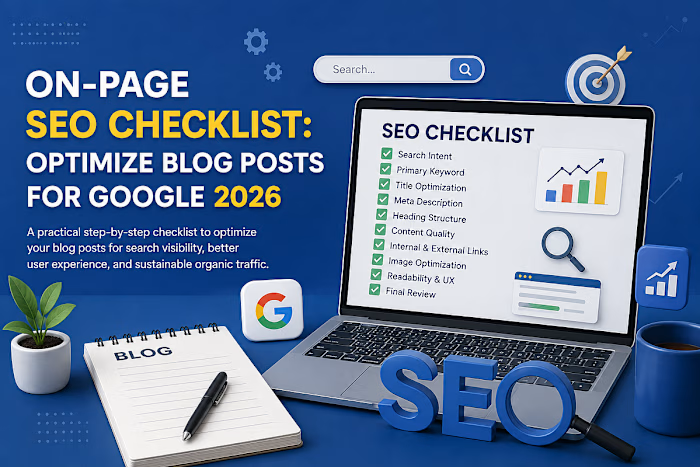
Final SEO + Conversion Checklist
[ ] Search intent identified
[ ] Primary keyword selected
[ ] Supporting keywords selected
[ ] Target reader defined
[ ] Content brief created
[ ] Headings reflect reader questions
[ ] Information is specific and useful
[ ] Claims are verified
[ ] Title written clearly
[ ] Meta description written clearly
[ ] Internal links planned
[ ] Image alt text added where appropriate
[ ] CTA matches the reader’s stage
[ ] No keyword stuffing
[ ] No unsupported ranking or conversion claims
Press enter or click to view image in full size
Image designed by the author with AI assistance.
Conclusion
SEO content isn’t just about inserting keywords or chasing a position in search results. It’s about helping the right person find useful, accurate information and, when it makes sense, guiding them toward a relevant next step.
The RICH Content Method is one way to keep that order straight: research the intent behind a search, identify the right keywords, construct content that’s genuinely useful, and hand the reader toward a next step that fits where they are. It doesn’t promise a ranking, a set amount of traffic, or a certain number of leads or sales. What it offers is a clearer, more deliberate way to approach content that has a real reason to exist.
If you’re working through this process for your own business, or you’d rather have someone build the strategy and write the content for you, that’s the kind of work I do. I help businesses with SEO content writing, content strategy, keyword research, search intent, and conversion-focused content. Feel free to reach out if you’d like a second opinion on your current content or a plan built from the ground up.
Sources
Google Search Central — “Creating Helpful, Reliable, People-First Content”
Google Search Central — “SEO Starter Guide: The Basics”
Google Search Central — “AI Features and Your Website”
Google Search Central — “Influencing Title Links in Google Search”
Google Search Central — “How to Write Meta Descriptions”
Like this project
Posted Sep 3, 2026
Created an article for Medium explaining a framework for effective SEO content.