Ghostwriting a 4,000-Word Economics Chapter

Victor T Tam Yan

The Brief
A published author with a 100+ book background in economics (Austrian, Chicago, and Public Choice schools) needed a ghostwriter for Chapter 2 of his book on human action and civilization. The chapter had to cover 20 interconnected economic concepts, from scarcity and trade-offs to market topology and civilizational renewal.
The catch: this wasn't a "write it up" job. The Author expected a co-author who could think like an economist, expand his ideas with academic precision, add technical vocabulary, cross-disciplinary parallels, and new synthesis. His exact instruction: "Use an LLM to get the exact language physicists or economists use."
Budget: $1,000 | Duration: 20 hours | Deliverable: 4,000-word chapter + full concept library
The Process: From Scattered Notes to Symphonic Architecture
Phase 1: Concept Extraction
The Author's raw material was fragmented: outline notes, Zoom recordings, follow-up messages, and later additions on property rights and market topology. None of it was in publishable form.
I extracted 20 distinct concept clusters from his notes and calls, each representing a causal link in the chain of human action:
Human Condition and Emergent Laws
Scarcity
Trade-Offs and Double Choice
Inducement to Act
Wealth Creation
Private Property and Incentives
Market as Coordination Mechanism
Topology and Geometric Growth
Competition and Capital Accumulation
Time Preference and Intertemporal Choice
Comparative and Absolute Advantage
Demonstration Effect and Knowledge Spillover
Division of Labour
Government and Property Rights
Market Topology and Relational Dynamics
Exponential vs Linear Growth
Limits to Growth and Entropy
Adaptation and Resilience
Evolution of Institutions and Cultural Memory
Civilization Cycles and Renewal
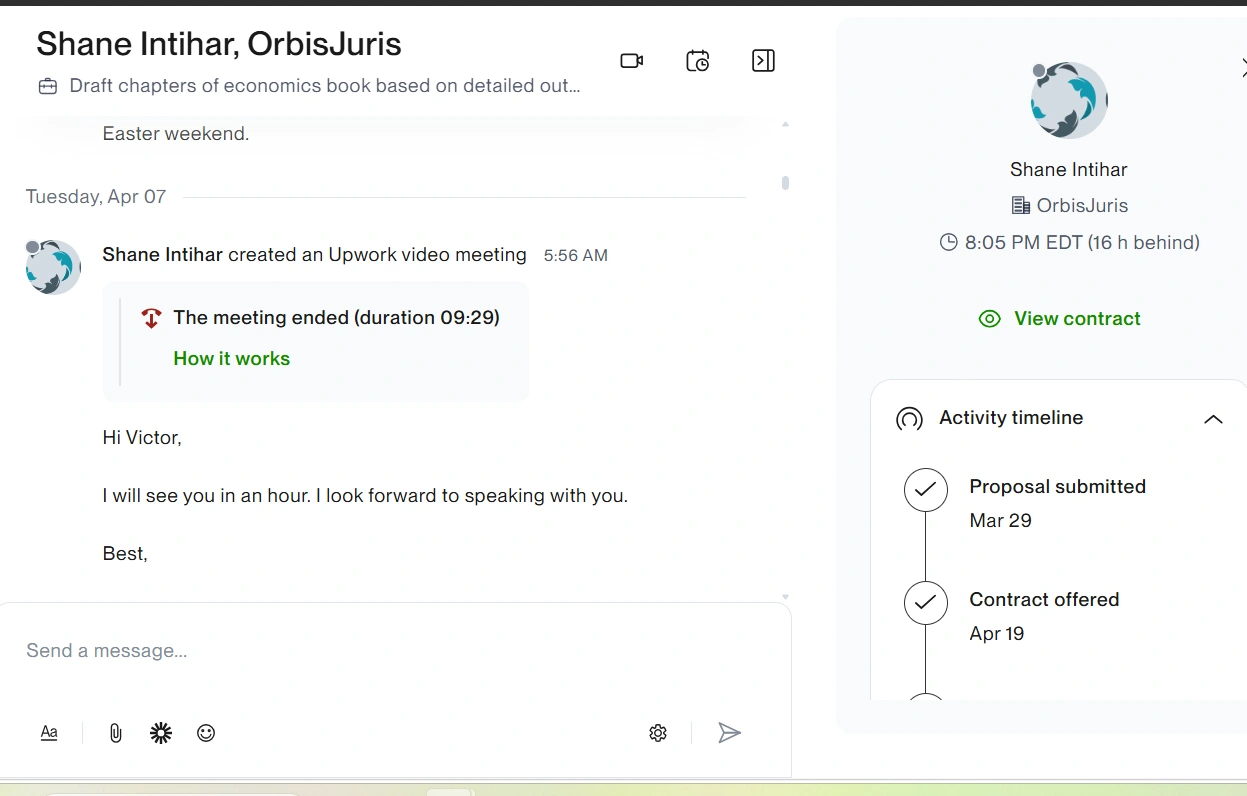
Collaboration session with the Author
Phase 2: Academic Research and Synthesis
For each of the 20 clusters, I built a structured research tile containing:
Academic anchors (Mises, Hayek, Böhm-Bawerk, Ricardo, Schumpeter, Douglass North, Buchanan, and others)
Technical vocabulary (praxeology, opportunity cost, roundabout production, incentive compatibility, endogenous growth)
Cross-disciplinary parallels (thermodynamics, neural networks, evolutionary biology, information theory)
"Wow" synthesis lines designed to make the reader think "I've never seen this explained this way before"
Vignettes and examples grounded in tight academic language
Causal bridges connecting each cluster to the next
This wasn't rewriting. It was intellectual co-authorship: understanding the economics, expanding it, and adding the precision the Author's 100-book background demanded.
Working outline and structural planning
Phase 3: Architectural Design
With 20 clusters built, the risk was obvious: marching through them sequentially would create repetition, not narrative. So I designed a role-based architecture where each cluster served a specific narrative function:
Expository clusters (Property Rights, Wealth, Market Topology) got full academic treatment
Reflective clusters (Human Condition, Entropy, Civilization Cycles) became philosophical pauses
Bridge clusters (Competition to Time Preference, Adaptation to Institutions) acted as transitional connective tissue
Illustrative clusters used concrete vignettes to humanize abstract ideas
Integrative clusters merged overlapping concepts into coherent sections
These were then grouped into 4 macro-sections, each functioning like a movement in a symphony:
Foundations of Action and Value (Breath → Depth → Motion)
Market Geometry and Coordination (Depth → Breath → Motion → Depth)
Systemic Dynamics and Boundaries (Depth → Breath → Motion)
Institutional Memory and Civilizational Renewal (Depth → Breath → Reflective Coda)
The chapter's causal spine: Human Action → Choice → Wealth → Competition → Coordination → Growth → Entropy → Adaptation → Memory → Renewal
Phase 4: Psychological Copywriting at the Academic Level
The writing itself applied the same PAS and AIDA principles I use in commercial copy, but calibrated for an academic audience:
Each section opened by naming a conceptual tension (Problem)
Intensified it with cross-disciplinary evidence (Agitation)
Resolved it with the Author's framework, now expressed with technical precision (Solution)
The rhythm alternated between Depth (dense academic exposition), Breath (philosophical reflection), and Motion (bridges and transitions), preventing reader fatigue across 4,000 words.
The Deliverable
Two artifacts delivered:
1. The Chapter (4,000 words)
4 macro-sections (H2), each with 3 to 7 subsections (H3)
20 economic concepts integrated into a single causal argument
Academic anchors from Mises, Hayek, Smith, Ricardo, Schumpeter, North, Buchanan, and others
Cross-disciplinary parallels from physics, biology, information theory, and complexity science
Every idea preserved from the Author's original notes; no philosophy inserted, no ideology introduced
2. The Concept Library (working framework document)
All 20 clusters with full research tiles
Academic phrasing, technical terms, examples, and synthesis lines
Readable reference document the Author can use for future chapters
The Result
The Author gave the project a 5-star review.
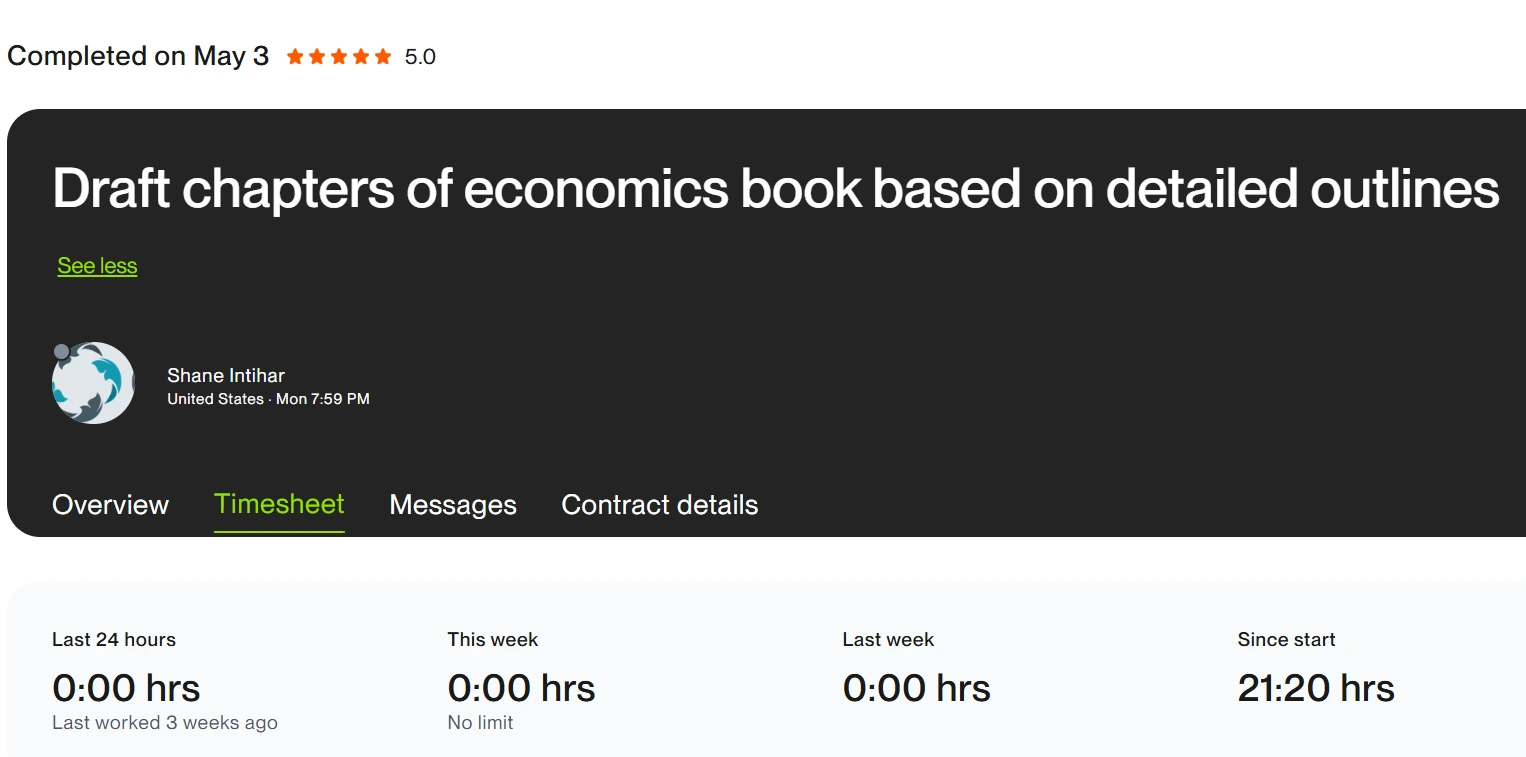
5-star review from the Author
The chapter was accepted as submission-ready. The concept library became a reusable framework for subsequent chapters.
Why This Matters
This project produced something beyond a single chapter: a reusable ghostwriting methodology for complex, research-heavy long-form content.
The framework (concept extraction → academic research → role-based architecture → rhythm-driven writing) works for any subject where scattered expert knowledge needs to become coherent, publishable prose. It's the difference between transcribing someone's ideas and thinking alongside them.
Like this project
Posted May 19, 2026
$1,000 ghostwriting project: 4,000-word economics chapter built from 20 concept clusters, academic research across 6 economic schools, and a 4-movement architectural framework. 5-star review.