Scroll Motion Prototype for UMG

Tone Segurado


Scroll Motion Prototype for UMG
The Project
Universal Music Group launched Bridge, a global SaaS royalty reporting platform serving managers, financial teams, and creators across labels like Capitol, Interscope, Republic, Island, Decca, Geffen, Polydor, and Def Jam. The platform needed to communicate financial transparency, trust, and clarity while feeling like it belonged to the world's largest music company.
Before any front-end development began, the team needed a way to visualize how the landing page would feel in motion. Not a static mockup. Not a written spec. A video someone could watch and say "yes, build that."
The Brief
Isadora Digital Agency brought me in to translate static Figma designs into a scroll-based motion prototype: a 30-60 second video demonstrating every microinteraction, scroll animation, hover state, and transition on the page. The audience was internal: UMG decision-makers and the development team who would build it.
The goal was alignment. One video that answers "what does this page feel like when someone scrolls through it?" before anyone commits to implementation.
The Deliverables
Scroll-Based Motion Design Video
A single video file showcasing the full-page scroll experience with:
Scroll-triggered section animations and reveals
Hover state behaviors for interactive elements
Transition timing and easing between content blocks
Microinteraction details for UI components
Full narrative flow from hero to final CTA
Built from static Figma designs provided by the team. I interpreted the layouts, created the storyboard, then the animatic, then designed all motion effects, aligning with the creative direction and layout intent.
One delivery with two round of revisions.
The Team
Client: Universal Music Group
Agency: Isadora Digital Agency
Product Designer: Cyn Márquez, Product Designer, Isadora Digital Agency
Creative Director: Isadora Marlow-Morgan, President, Isadora Digital Agency
Sr. Manager, Digital Production: Carina Lora, Isadora Digital Agency
Motion Designer: Tone Segurado (Tonemaki™)
Process
The timeline was tight by design: kickoff on Wednesday, initial delivery by Thursday EOD, client feedback by Friday, final delivery Monday. Four working days, start to finish.
I worked from the Figma layouts and interpreted where motion should live. The static designs told me what was on the page; my job was to define how it behaved. Which elements ease in on scroll? How fast? What happens on hover? How do sections hand off to each other?
Then, the motion prototype became the single source of truth for the development team. Instead of written specs or annotated screenshots trying to describe timing and easing, they had a video they could scrub frame-by-frame.
Why This Matters
Motion prototypes like this eliminate the most expensive kind of revision: the one that happens after code is written. When developers can see exactly what "scroll-triggered fade-in with a 200ms ease-out" looks like before they build it, the implementation matches the intent on the first pass.
This prototype directly informed the Lottie animations I later built for the production site (documented in a separate case study).
The Outcome
The motion prototype was delivered on deadline and approved by UMG stakeholders. It became the reference document for all front-end animation development on the Bridge landing page.
The Final Website link
Motion Breakdown: Behind the Scenes
This section delves into the individual scroll animations and microinteractions extracted from the complete prototype.
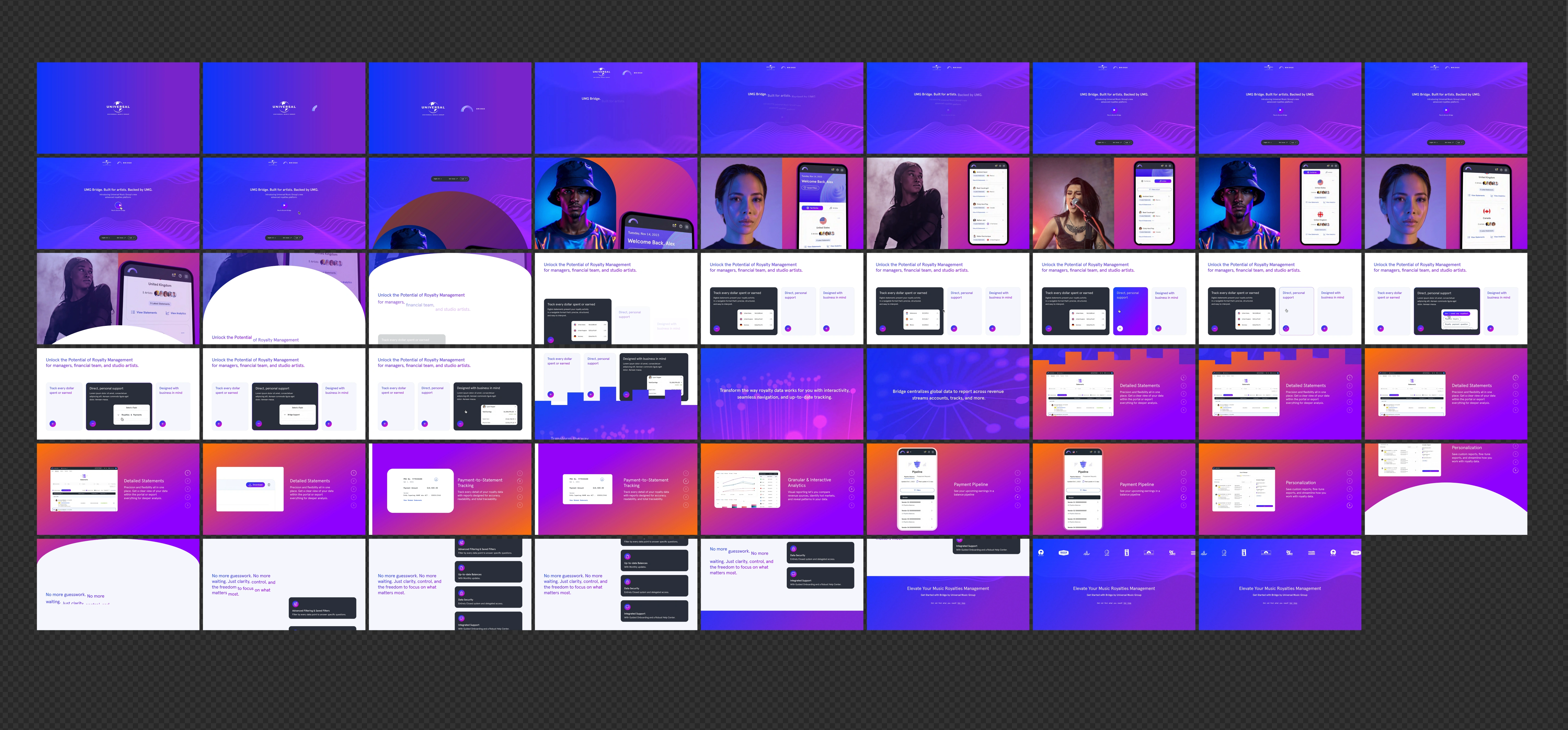
Storyboard
Animatic
Intro
Navbar Animation
Microvideo A
Microvideo B
Microvideo C
Microvideo D
Microvideo E
Microvideo F
Microvideo G
Microvideo H
Microvideo I
After-Effects Animation Breakdown
Final Delivery
The complete 90-second scroll motion prototype as delivered to UMG.
Final Video
Do you like what you see?
Let's talk.
Freelancer: tonesegurado.com
Agency: tonemaki.com
Book a Call: cal.com/tonemaki
Like this project
Posted Aug 3, 2026
Prototyped a scroll-based motion design video for Universal Music Group’s Bridge landing page, including microinteractions, scroll animations, and hover states.
Likes
1
Views
18
Timeline
Mar 26, 2025 - Mar 31, 2025
Clients
Universal Music Group