
💡How Desire Forms: DARES™ Framework for DTC Conversion Storytelling
➡️A buyer psychology framework for ecommerce ads, PDP copy, landing pages, and product messaging.
➡️Project Type: DTC Conversion Strategy, Ecommerce Copywriting, Buyer Psychology, Product Messaging
➡️Services: Paid Social Ad Copy, Landing Page Copywriting, PDP Messaging, Brand Positioning, Conversion Storytelling
➡️Methods: Desire Formation, Buyer Psychology, Hook Strategy, Emotional Messaging, Conversion Copywriting
➡️The Problem: Most Brands Confuse Attention With Desire
Most DTC brands try to create desire instantly.
A stronger hook.
A better offer.
A more polished ad.
A bigger product claim.
A cleaner product page.
💡But attention is not the same as desire.
💡A buyer can stop scrolling and still not care.
💡They can like the product and still not imagine owning it.
💡They can understand the benefit and still feel no emotional pull toward choosing it.
That is where many ecommerce brands lose momentum.
They explain the product.
They list the benefits.
They show the offer.
But they do not guide the buyer through the emotional progression that turns interest into want.
➡️QUASAR Signal built DARES™ around one core idea:
➡️Desire does not happen in one moment. It builds through a sequence inside the buyer’s mind.
💡The Insight: Desire Is a Psychological Progression
Most ecommerce copy is built around the final decision.
“Buy now.”
“Shop today.”
“Limited offer.”
“Try it risk-free.”
But the buyer does not arrive at that decision instantly.
Before they choose, they move through a quieter internal journey.
They notice something.
They feel something.
They imagine themselves with it.
They connect it to identity.
They justify the decision.
Then they act.
💡That journey is what DARES™ maps.
It helps turn product messaging into a desire-building system — not just a collection of hooks, captions, or product benefits.
💡The DARES™ Framework
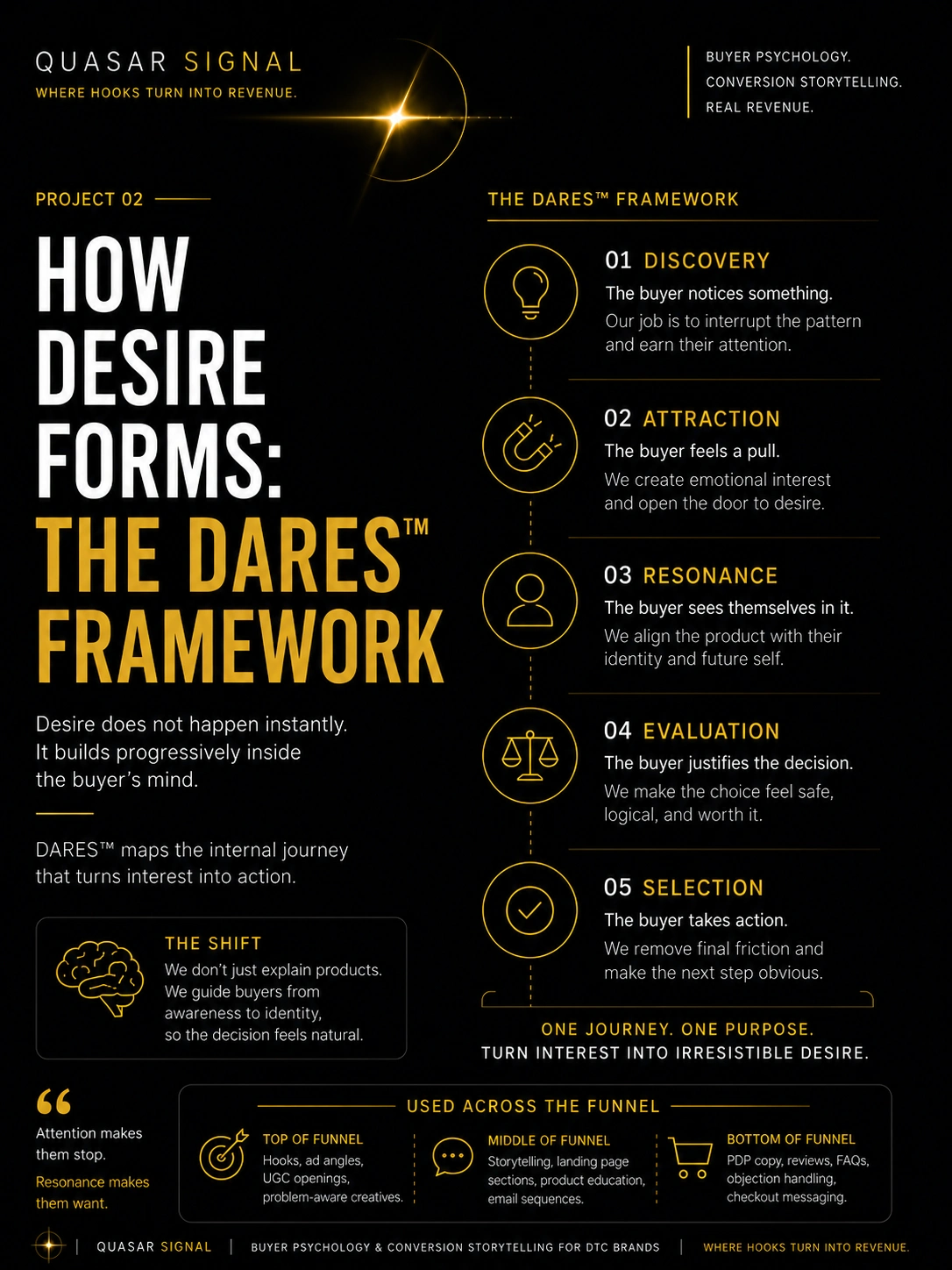
DARES™ stands for:
➡️Discovery → Attraction → Resonance → Evaluation → Selection
Each stage represents a different psychological movement in the buyer’s mind.
➡️1. Discovery
This is where the buyer first notices the product, message, or idea.
At this stage, the goal is not to explain everything.
The goal is to interrupt the buyer’s current thought pattern with something relevant enough to earn attention.
The buyer thinks:
“This is interesting.”
“This feels relevant.”
“I should look at this for a second.”
For DTC brands, Discovery is created through strong hooks, visual contrast, product angles, and problem-aware messaging.
But Discovery alone is not enough.
Attention only opens the door.
It does not create desire by itself.
➡️2. Attraction
This is where the buyer starts to feel a pull.
The product is no longer just visible.
It starts to feel emotionally interesting.
The buyer thinks:
“This looks good.”
“I like the feeling of this.”
“This might be something I want.”
Attraction is built through emotion, aesthetic, benefit clarity, social cues, and the first sense of reward.
For ecommerce copywriting, this is where product features need to become emotionally meaningful.
Not just:
“Soft fabric.”
But:
“The kind of comfort you look forward to after a long day.”
Not just:
“Brightening serum.”
But:
“Skin that looks rested before you even say a word.”
Attraction begins when the product stops being information and starts becoming a feeling.
➡️3. Resonance
This is the strongest stage.
Resonance happens when the buyer starts seeing themselves in the product, outcome, or story.
The buyer does not just think:
“This is nice.”
They think:
“This feels like me.”
“This fits the version of myself I want.”
“This solves something I actually recognize.”
This is where most DTC messaging is either won or lost.
A brand can have attention.
It can have benefits.
It can have a strong offer.
But if the buyer does not see themselves in the story, desire stays shallow.
Resonance turns product interest into personal relevance.
It makes the message feel less like a pitch and more like recognition.
➡️4. Evaluation
This is where the buyer starts justifying the desire.
Once they want the product, the logical mind enters.
The buyer asks:
“Is this worth it?”
“Can I trust it?”
“Will it work for me?”
“Is now the right time?”
“What makes this different?”
Evaluation is where product proof, reviews, mechanisms, guarantees, comparisons, and clear explanations matter.
But they only work well after desire has already been built.
If a brand leads with too much logic too early, the buyer may understand the product without wanting it.
Evaluation should support desire, not replace it.
➡️5. Selection
This is the moment of choice.
The buyer has noticed the product.
Felt the emotional pull.
Seen themselves in the outcome.
Justified the decision.
Now the product feels like the right choice.
Selection is where the message should reduce final friction and make the next step feel natural.
This can happen through:
Clear CTAs.
Strong product page copy.
Risk reversal.
Checkout reassurance.
Offer clarity.
Simple decision language.
At this stage, the buyer should not feel pushed.
They should feel ready.
➡️DARES™ in Action: Performance Running Shoes
💡Discovery
“You are halfway through your hardest route — and your feet still feel light.”
This earns attention because it places the buyer inside a specific moment.
Not a product claim.
A lived scenario.
💡Attraction
“The stride feels smoother. The pace feels easier. The run starts feeling less like effort and more like momentum.”
Now the product is connected to a feeling.
Not just performance.
The feeling of ease, control, and forward motion.
💡Resonance
“For the runner who does not just want to finish the route, but wants to feel capable while doing it.”
This is where identity enters.
The buyer sees themselves as someone committed, capable, and performance driven.
The shoe becomes connected to that identity.
💡Evaluation
“Built with responsive cushioning and energy-return support, the shoe helps reduce impact while keeping each stride efficient.”
Now the logic supports the desire.
The buyer has a reason to believe the feeling.
💡Selection
“Choose the shoe that helps your body keep up with the runner you are becoming.”
The product is no longer just footwear.
It becomes part of the buyer’s self-image and performance ritual.
➡️Why This Matters for DTC Brands
Most ecommerce brands build messaging around what the product is.
DARES™ helps build messaging around what the buyer is becoming.
That shift matters.
Because buyers do not only purchase products.
They purchase relief.
Confidence.
Comfort.
Status.
Control.
Identity.
A better version of a moment they already live through.
💡When messaging moves through DARES™, the buyer is not forced from attention straight into action.
💡They are guided from noticing to feeling, from feeling to personal relevance, from relevance to justification, and from justification to choice.
That is how desire becomes stronger.
And stronger desire makes conversion easier.
➡️Funnel Applications
➡️Top of Funnel
DARES™ can be used to build paid social hooks, Meta ad angles, TikTok concepts, UGC openings, and scroll-stopping product stories.
At this stage, the focus is Discovery and Attraction.
The goal is to make the buyer stop and feel something quickly.
➡️Middle of Funnel
DARES™ can shape advertorials, landing page sections, product education, email copy, and brand storytelling.
At this stage, the focus is Resonance.
The goal is to make the buyer see themselves in the product and outcome.
➡️Bottom of Funnel
DARES™ can support PDP copy, comparison sections, trust-building blocks, guarantees, FAQs, and final decision messaging.
At this stage, the focus is Evaluation and Selection.
The goal is to help the buyer justify the purchase and feel safe enough to choose.
➡️Built For👇
DTC brands
Ecommerce product pages
Paid social ads
Landing pages
UGC scripts
Product messaging
Performance products
Beauty and skincare brands
Wellness brands
Fashion and lifestyle brands
Founder-led ecommerce brands
Brands with strong products but weak emotional conversion layers
💡What This Project Shows
➡️This project demonstrates how QUASAR Signal builds conversion storytelling around the internal progression of buyer desire.
The goal is not to write louder hooks.
The goal is to understand how the buyer moves from awareness to emotional relevance to action.
DARES™ gives that process a structure.
Discovery gets attention.
Attraction creates emotional pull.
Resonance makes the product personally relevant.
Evaluation gives the buyer permission to justify the desire.
Selection turns that desire into action.
Together, these stages help brands create messaging that does more than explain the product.
It helps the buyer want it for reasons that feel personal.
➡️Client Takeaway
Strong ecommerce copy does not only tell the buyer what the product does.
It helps the buyer understand why the product matters to them.
That is the difference between attention and desire.
Attention makes someone stop.
Resonance makes them care.
Evaluation makes them believe.
Selection makes them act.
➡️QUASAR Signal uses DARES™ to turn product messaging into a desire-building system for ads, PDPs, landing pages, and DTC conversion storytelling.
Because the strongest brands do not just sell products.
They help buyers recognize the version of themselves they are trying to move toward.
QUASAR Signal
Buyer Psychology & Conversion Storytelling for DTC Brands.
Where hooks turn into revenue.
0 likes · 2 views · Jul 8, 2026
💡How Desire Forms: DARES™ Framework for DTC Conversion Storytelling ➡️A buyer psychology framework for ecommerce ads, PDP copy, landing pages, and product m...


