Real Estate Data Scraping Workflows for 2026

Shishir Sutradhar


The 7 Most Impactful Use Cases for Real Estate Data Scraping in 2026
The 7 Most Impactful Use Cases for Real Estate Data Scraping in 2026
7 real estate scraping workflows for 2026: price monitoring, rental dedup, valuation comps, change detection with schemas and pipeline architecture.
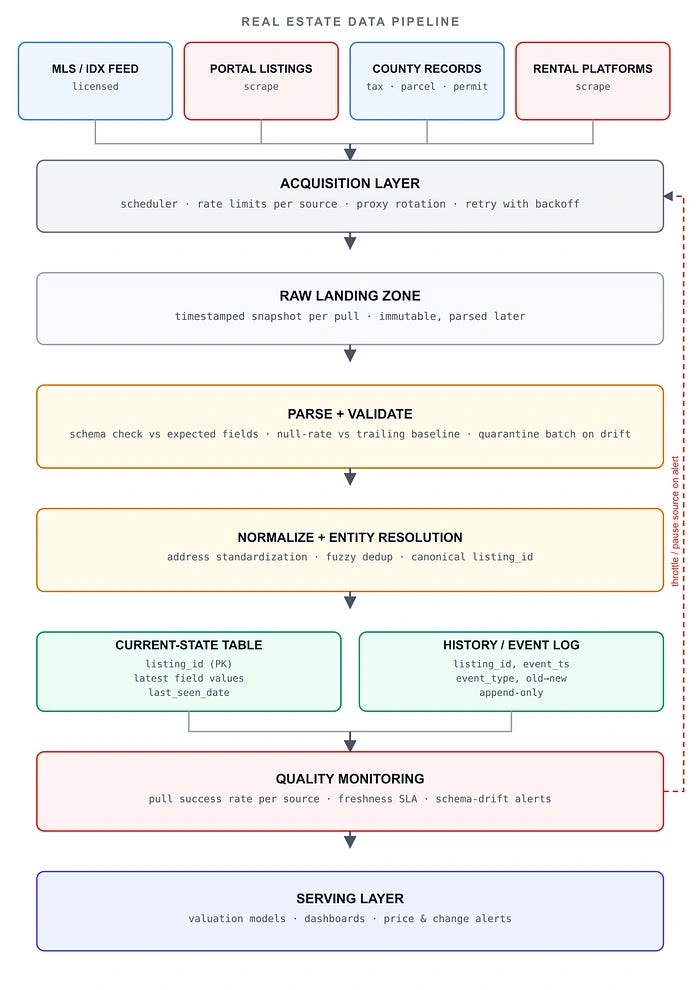
Figure 1: Real estate data pipeline
Figure 1: Real estate data pipeline
Figure 1: the shared backbone every workflow below sits on, from source to serving layer.
Real estate data is fragmented by design. List prices live on portals. Tax assessments live in county systems. Permits live in municipal records. Rents scatter across a dozen regional sites. None of these systems share a primary key, and none were built to talk to each other. Pulling them into something coherent is the actual engineering problem, and scraping is one mechanism for doing that not the only one, and not always the right one.
For active MLS listings, the correct access path is an IDX feed, a VOW agreement, or a direct data partnership. Routing around those through a portal scrape doesn’t solve the underlying licensing question; it just adds the portal’s own terms on top of it. For portal-only fields proprietary estimate models, certain rental aggregator inventory a licensed API or paid data partnership is the first call.
Where no API exists and a portal’s terms genuinely permit automated access for a specific use, scraping becomes viable, but “check the terms” means the terms document, not just
robots.txt. County tax, parcel, and permit records are different again: many counties publish open-data portals or bulk files, and those are the correct starting point before deciding to scrape. Rental listings on niche or regional platforms sites with no feed to license and no public API to call are where most legitimate scraping work actually happens in practice.What’s actually different in 2026
Three things changed in the last two years that matter to anyone building real estate data pipelines.
Zillow’s public API was wound down in stages after 2021 and was effectively closed to general developers by 2024. What remains is partner-only, reserved for Premier Agent partners and MLS members through Bridge Interactive. That pushed most teams that need portal-scale data toward scraping by default, not as a workaround for an edge case but as the only practical option.
The anti-bot infrastructure at the major portals escalated well past what an HTTP client and a proxy pool can handle. Zillow now pairs Imperva (formerly PerimeterX) with Cloudflare, both routinely rated “hard” by independent scraping benchmarks. Realtor.com uses Cloudflare with a custom WAF. A production scraping pipeline in 2026 needs full browser automation, residential proxies, and fingerprint management at minimum. That’s real infrastructure cost that simply didn’t exist at this scale a few years ago.
NAR also rolled out an 18-point overhaul of the MLS Handbook effective January 2026, shifting meaningful governance, service areas, membership requirements, several listing-display rules from one national standard down to each local MLS’s discretion. Paired with the “Multiple Listing Options for Sellers” policy in effect since late 2025, which lets sellers instruct their agents to delay public syndication for a locally-determined window, a growing share of inventory simply won’t appear in an IDX feed or a portal scrape for some period after listing. That’s not a bug in a pipeline. It’s a structural coverage gap that now varies MLS by MLS instead of being one predictable rule everywhere.
7 workflows
Each one below starts with a specific decision someone needs to make, covers the data that feeds it, and then gets into how to build the pipeline reliably enough to trust.
1. Price Monitoring and Market Analysis
The decision is whether a submarket is moving and how a specific listing is priced relative to where the market actually sits.
The fields that matter here are narrower than they look: list price, original list price, status, property type, beds/baths, square footage, zip or neighborhood, list date, sale date, sale price, and a stable listing ID.
Most of the analytical value comes from how those fields are tracked over time, not from collecting more of them.List prices don’t move minute to minute the way rental availability does. A daily pull per tracked geography is usually enough; only fast-moving luxury or investor-heavy segments warrant twice-daily checks. The place teams consistently get this wrong is storage. Overwriting a listing’s record in place on every pull destroys the ability to reconstruct a trend later. The fix is an append-only snapshot table:
Price history:
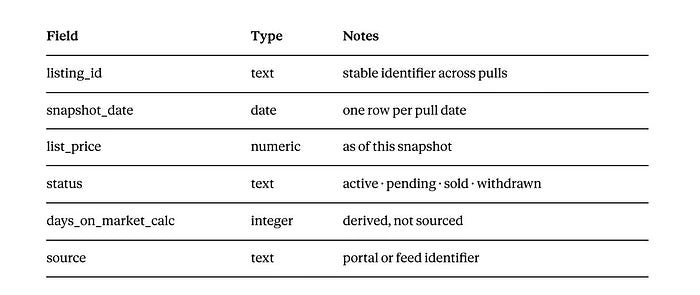
Price history
Trend lines are then a rolling weekly median of
list_price grouped by zip, property type, and bed count. List-to-sale ratiosale_price / original_list_pricegets computed only on closed records, never on active listings, since an active list price hasn't produced a market outcome yet.A practical alert threshold: flag a bucket when its four-week rolling median moves more than 3% week-over-week, or when list-to-sale drops under 97%. That second signal usually surfaces a turning market earlier than the median does.
2. Rental Market Intelligence
The decision here is where to set rent on a specific unit and whether a submarket is quietly oversupplied. The engineering problem isn’t collection it’s deduplication.
The same unit gets posted across multiple platforms, pulled down after a prospect falls through, then reposted days later. Without a dedup pass, a market analysis double-counts the same apartment as three separate units.
A workable canonical
unit_id is built from normalized address plus unit number plus bed/bath count plus square footage within a 5% tolerance. If two listings match on address and unit number but differ on bed/bath count, treat them as different units rather than forcing a merge the alternative makes quiet errors that are hard to audit after the fact. Each occurrence keeps its own first_seen_date and last_seen_date; the canonical unit_id ties them together across sources.Daily re-pulls are sufficient cadence. Mark a listing stale after two consecutive missed pulls before treating it as removed. A single missed pull is more often a parsing hiccup than a real status change.
One thing worth stating plainly: listing duration and relist frequency are a proxy for vacancy, not a measurement of it. A unit can sit listed for weeks because of bad photos, an unresponsive leasing office, or a price that’s $50 too high none of which means it’s vacant. Report “median days listed” rather than “occupancy rate” unless actual vacancy data is available to validate against, because the labeling is the kind of thing clients notice and data teams get blamed for.
3. Property Valuation and Comparable Analysis
The decision is a defensible market-value estimate for a subject property the kind that supports an offer price or an appraisal review. Comp selection is a search problem before it’s a modeling problem.
A workable default radius is 0.5 miles for dense urban markets and 1 to 1.5 miles for suburban ones, filtered to the same property type, beds/baths within ±1, square footage within ±15%, and a sale within the trailing 180 days. If that returns fewer than five or six comps, widen the recency window before widening the geographic radius a six-month-old sale half a mile away is usually a better comp than a same-week sale two miles out in a different price band.
Feature importance for valuation is fairly consistent: square footage, bed/bath count, lot size, year built, and condition, roughly in that order. Condition is the genuinely hard one, because it lives in free-text descriptions and photos rather than a structured field. That’s a real gap in most automated comp sets, not something solved by pulling from more sources.
Missing or inconsistent attributes need to be visible, not silently patched. If square footage is missing on 8% of records in a market, carry a
data_quality_flag or is_imputed boolean alongside any imputed value. Anything downstream a model, a report, a person reviewing an offer needs to know which numbers to trust less.Volume is also not quality. A comp set that doubles its coverage by pulling a second portal without a dedup pass is more likely to count the same property twice than to add genuinely new comparables. And a comp set over weighted toward investor-flip relistings skews estimates high in ways that are easy to miss until someone audits the inputs. More data makes a valuation model more confidently wrong when the additional data is noisy or duplicated.
4. Competitor Analysis
The decision is where a brokerage is gaining or losing share, and how its pricing positions relative to the segments it’s competing in. Attribution is the hard part before any of the analysis can happen.
MLS-originated data usually carries a clean
listing_office_id. Portal-only data often doesn't, and free-text brokerage names need normalization strip suffix variance like "Realty," "Group," and "& Associates," then fuzzy-match the remainder into a canonical brokerage_id. For the handful of brokerages that actually matter in a given market, the fuzzy match is worth a manual review pass before trusting it. Misattributing market share to the wrong firm isn't a small rounding error; it makes the analysis answer the wrong question.Market share once attribution is clean is a simple ratio: listing count for a given brokerage over total listings in a segment over a period, tracked week-over-week to surface movement rather than a static snapshot. Days-on-market benchmarked against the segment median tells a different story whose listings convert faster and in which property types and is more actionable than volume alone.
On description and amenity analysis: start with keyword and phrase matching against a manually curated taxonomy (“in-unit laundry,” “granite counters,” “pet friendly”) rather than defaulting immediately to embeddings or an NLP classifier. Keyword matching is cheap, fast, and auditable when it gets something wrong. Escalate to NLP only for the long tail of phrasing that a keyword taxonomy genuinely doesn’t cover, which is usually less of the text than it initially appears.
5. Lead Generation and Prospect Enrichment
This is the use case that requires the most care, because it’s the most likely to involve identifiable personal data. That changes the constraints before anything else does.
In the EU, UK, and Switzerland, resolving a workflow down to an identifiable owner or landlord requires a lawful basis under GDPR-equivalent law, even when every underlying data point originated from a public record. Legitimate interest is the basis most commonly cited for B2B prospecting, but it requires an actual documented balancing test not an assumption that it applies because the data was already public. In the US, there’s no single federal framework. California’s CCPA/CPRA is the most developed state-level regime, and a growing number of other states now have comparable ones, so the relevant question is which states’ residents the workflow touches, not where the company is incorporated.
The practical mitigation is data minimization at the workflow design stage: flag a property as a candidate using property-level signals only, then resolve to an identifiable contact only for the properties where an actual outreach decision has been made. Enriching every flagged property with personal data by default before any decision to contact anyone expands the privacy exposure for no real operational benefit.
On the signal quality question: a single price reduction is a weak flag. Most one-time price cuts are routine repricing, not distress. A more reliable distressed-asset signal combines indicators with an AND rather than an OR two or more price reductions within 60 days plus days-on-market exceeding 1.5x the neighborhood’s rolling median is a much tighter filter than either condition alone. Where historical outcomes exist, backtest the flag: did flagged properties actually sell below original list, or get withdrawn? Set the threshold against data rather than feel, and revisit it periodically.
6. Public Record and Assessment Research
Public records are a genuinely rich source: parcel data, tax assessments, deed histories, permits. The caution is specific. Publicly accessible is not the same as freely reusable.
A county recorder or assessor can publish parcel data on a public-facing lookup portal while maintaining separate terms that restrict bulk redistribution or commercial resale of the same data. Some counties require a paid bulk license for systematic access even though individual record lookups are free to anyone. This varies by county and by state. Finding data on a
.gov page doesn't answer whether scraping it at scale and incorporating it into a commercial product is permitted that requires checking the specific office's terms or asking directly.There’s a second issue less commonly noticed: compiling individually public records into a queryable profile tied to a specific person is a meaningful act in its own right, separate from any single underlying record being public. California and several other states have data broker registration requirements that can apply to exactly this kind of aggregation even when no individual record was restricted at the source.
The technical work is simple by comparison. Ownership history is a deed chain matched on
parcel_id. Tax trends are a time series keyed on (parcel_id, assessment_year). Neither is difficult once the data is in a clean, consistently structured form getting there from the raw county output is usually where the engineering time actually goes.7. Listing Change Detection and Tracking
This is where the engineering does the most work, because the value is almost entirely in the delta, not the snapshot. A property that drops price three times in two weeks tells a more useful story than any single price point. A rental unit that disappears and reappears repeatedly says something about tenant churn or pricing misalignment that a static record will never surface.
The mechanism is content hashing. On every pull, compute a hash over a normalized field set price, status, description, photo count and compare it to the last stored hash for that
listing_id. If the hash matches, nothing changed: update last_seen_date and move on. If it doesn't, write a new row to an append-only event log and overwrite a separate current-state table: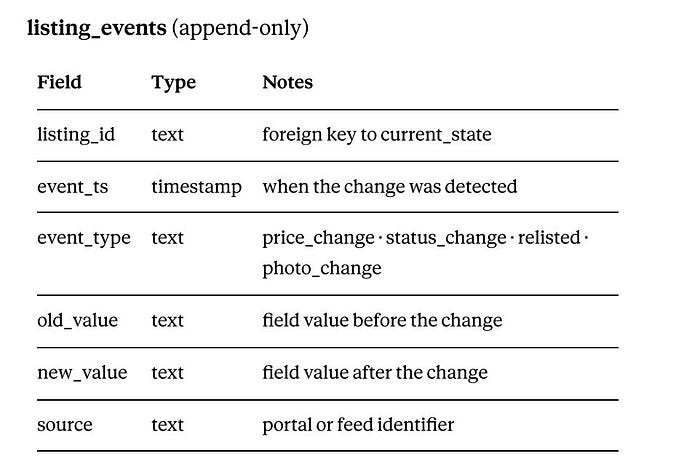
listing events
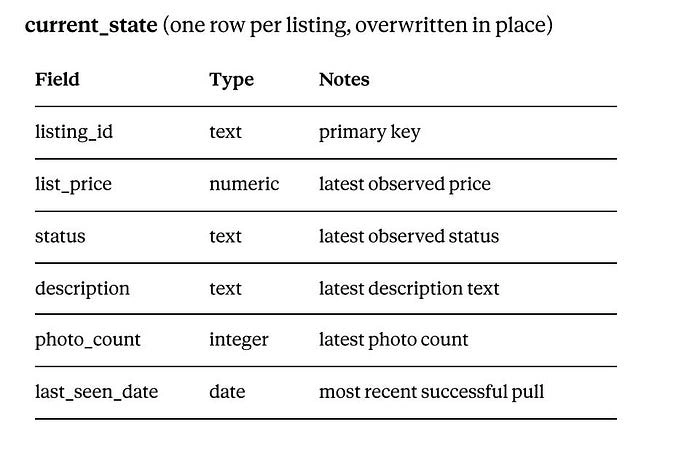
current state
Both tables exist because they answer different questions. “What changed and when” needs the event log. “What does this listing look like right now” needs the current-state table. Trying to serve both from a single overwritten-in-place record loses history, trying to serve both from a full snapshot on every pull wastes storage and turns any “what changed” question into a join-and-diff operation every time someone asks it.
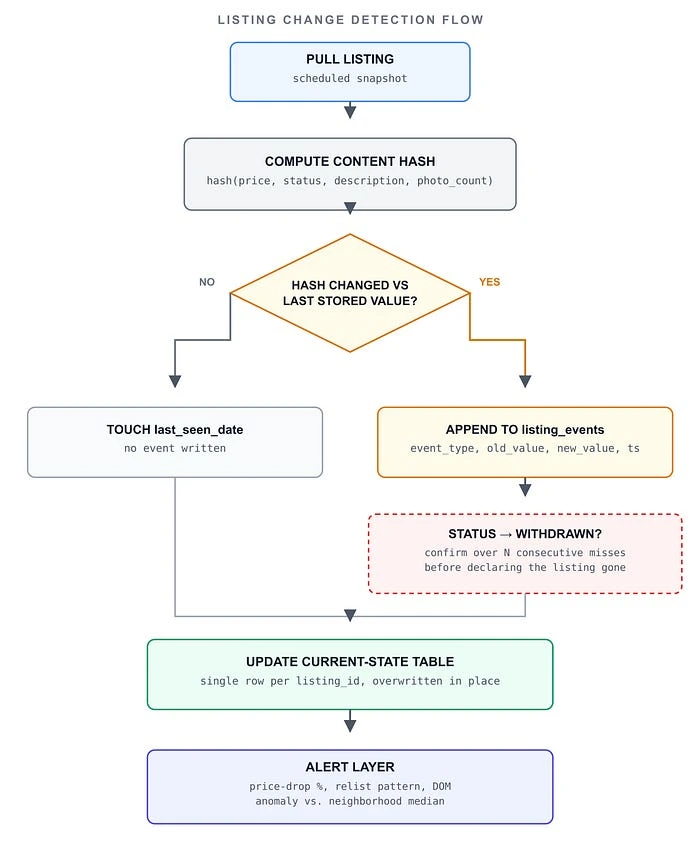
Figure 2: listing change detection flow
Figure 2: the decision logic behind a single pull, including the grace window described below.
Stable architecture here is a specific checklist, not an aspiration. Retries with backoff on transient failures, so a blocked or timed-out request doesn’t get logged as a status change. Idempotent writes, so rerunning a pull for the same
listing_id and timestamp never creates a duplicate event.Pull success rate monitored per source, with an alert below 90% over a rolling window a sustained drop almost always means the source changed its markup or tightened bot defenses, not that the market went quiet. Null-rate drift detection on parsed output, checked against a trailing baseline before a batch gets written, if a normally well-populated field like price comes back mostly null in one run, quarantine the batch and investigate rather than inserting it. And a grace window before declaring a listing withdrawn, meaning several consecutive missed or failed pulls, not one.
That last rule I learned the hard way. On an early version of a listing tracker, a source changed its page markup overnight, just a renamed CSS class the parser depended on for the status field. The parser didn’t throw an error. It returned an empty string for every status on every pull during that window, and the pipeline had been written to treat an empty status field as a probable withdrawal. By the next pull cycle it had written withdrawal events for several thousand active listings, and a client’s sourcing dashboard quietly showed a market that had stopped existing overnight. The fix wasn’t a smarter parser. It was treating “I successfully fetched this page” and “this listing’s status is X” as two separate claims, each requiring its own validation and refusing to write any status change unless the parse step passed a basic sanity check: required fields present, price in a plausible range, listing ID matching what was requested.
Alerting on top of a clean event log is the easy part: price-drop velocity, relist patterns, and days-on-market anomalies relative to the neighborhood median are queries against
listing_events, not engineering problems.Access rights and the legal framework
Every use case above is commercially legitimate. How the data gets collected determines whether it stays that way.
A portal’s own terms of service are the relevant document not just
robots.txt, and not just a general sense of what "public" means. Zillow's terms, for example, explicitly prohibit using "any robot, spider, scraper or other automated means" to access the service without written permission (Zillow Terms of Use). Most major portals carry some version of that clause. Enforceability varies by jurisdiction and legal theory in the US, Computer Fraud and Abuse Act claims have been read differently across federal circuits, so "they probably won't sue" is a different question from "this is permitted," and treating them as the same question is how compliance problems start.MLS data carries its own licensing layer, separate from any individual portal’s terms. Listing content originating from an MLS is governed by NAR’s Handbook on Multiple Listing Policy, primarily through the IDX policy and the VOW policy. As of the January 2026 MLS Handbook update, governance over many display and access rules moved from one national standard to each local MLS’s discretion, so the authorized pathway for MLS-adjacent data can now differ from one MLS to the next. Authorized pathways IDX licensing, a VOW agreement, or a direct data partnership are the right route for any MLS-adjacent product. Routing around them through a portal scrape doesn’t avoid the underlying licensing question.
NAR’s Multiple Listing Options for Sellers policy, in effect since late 2025, adds a structural coverage gap worth understanding: sellers can now instruct their agents to delay public syndication through IDX for a locally-determined window. During that period a listing exists in the MLS but won’t appear in an IDX feed, a VOW, or most portal scraped data. That gap is built into the policy, not a failure of the data collection pipeline.
On content and copyright: the underlying facts in a listing price, square footage generally aren’t copyrightable in the US under Feist Publications v. Rural Telephone Service Co., 499 U.S. 340 (1991), but a creatively written description or a photograph is a different category. The EU and UK separately recognize a database right over compiled datasets under the EU Database Directive 96/9/EC, with no direct US equivalent. Treating a whole listing page as freely reusable because the price on it is a fact is a common mistake with real legal exposure.
Once a workflow resolves to an identifiable individual an owner, landlord, agent, or tenant privacy law applies regardless of where the data came from. For operations touching the EU, UK, or Switzerland, that means GDPR-equivalent obligations (UK ICO guidance, EU GDPR text). For US-based operations, it depends on which states’ residents are involved California’s regime under CCPA/CPRA is the most developed but no longer the only one. None of these treat “sourced from a public record” as an automatic exemption.
The intent of the use matters as much as the access method. Data collected for internal analysis sits in a different position from the same data collected for commercial resale, outreach campaigns, or profile building even when the collection pipeline never changes. Establish the intended use before building the pipeline, not after it’s running.
Where this leaves you
None of these seven workflows get solved by collecting more data faster. They get solved by getting the architecture right: append-only history where an overwrite would quietly erase the signal, a grace window before a parsing failure gets reported as a market event, a dedup pass before a comp set gets trusted, and a clear answer on which access path is actually licensed before any of it gets built.
Most failure modes in this space aren’t legal they’re quiet data-quality problems that look like market signals until someone checks the inputs. Build for that, and the data holds up.
I’m Shishir Sutradhar. I work at the intersection of data strategy and real estate technology. If any of this connects to something you’re building, I’d welcome the conversation.
Like this project
Posted Jun 26, 2026
Shishir Sutradhar discusses data strategies for real estate scraping, covering seven impactful workflows for 2026.