When Context Meets Nature - LLM Context Engineering Course

Doug Silkstone



The Fleeting Life of a Context Window
A case study in designing with natural systems.
Developer / Designer / Art Direction: Doug Silkstone
React. Next.js. React Three Fibre. 2DCanvas. Tailwind.
The Brief
Build the interface for an 8-week course on context engineering, the practice of optimizing how AI systems use their limited memory. The content is technical: token budgets, prompt architecture, retrieval patterns.
The challenge: how do you make optimization feel like something?
Context windows are living systems.
They open empty. Words accumulate. Patterns form. Understanding crystallizes. Then the window closes. Everything created from nothing, returning to nothing.
It's a lifecycle. Birth, growth, stagnation, renewal. The same rhythm that governs every natural system.
Conway's Game of Life operates on four rules. Three neighbors: birth. Two or three neighbors: survival. Anything else: death. From these minimal constraints, infinite complexity emerges - gliders traversing the grid, oscillators pulsing, still lifes persisting.
The parallels are immediate.
But standard Game of Life shows life and death. It doesn't show optimization.
So I extended the rules but bring together this design language for a project of mine.
The system watches.
When a cluster of cells remains unchanged for eight consecutive generations, it's flagged. These are patterns that have stopped contributing - stable, yes, but static. In context terms: redundancy. Information taking up space but producing nothing new.
Stagnation triggers renewal. An explosion radiates outward from the center of the static cluster - not destroying randomly, but clearing intentionally. Cells touched by the blast turn green, marked as refreshed.
This is what good context engineering does. It identifies what's no longer serving the conversation and creates space for new understanding to emerge.
Green spreads. A cell stays green if it's surrounded by more green than grey. Optimization cascades through the system, each renewed cell influencing its neighbors. Ties favor green - when it's ambiguous whether to preserve or refresh, the system chooses renewal.
Natural systems follow simple rules that generate complex behavior. The designer's job isn't to prescribe every outcome - it's to set the initial conditions and let the system breathe.
This means:
Emergence over prescription. I don't control what patterns form on the grid. Conway's rules do. The gliders, the oscillators, the explosions - they emerge. Users witness something alive, not something performed.
Decay over persistence. Everything fades. Particles live for 600 milliseconds. Explosions dissipate in 400. Flash intensity drops faster than the blast radius expands. This is the rhythm of organic systems, intensity followed by gradual release.
Response over control. The system watches and reacts. Stagnation triggers renewal. Interaction creates ripples. The grid evolves on its own timeline. Users participate in something already living.
When a cell has equal green and grey neighbors, it stays green. Optimization wins in ambiguity. This small rule creates momentum - once renewal begins, it tends to continue.
As a result, visitors land on a page with a living background. They don't know they're watching a philosophy, they just feel that something is alive.
Cells flicker. Patterns form and dissolve. Occasionally, a cluster stagnates too long and erupts in green, the color cascading outward through the grid.
They haven't read a word about context engineering. But they've already absorbed the lesson: stagnation is the enemy, and renewal is always possible.
The background becomes it's own curriculum. Or something like that.
The Larger Principle
This project is one expression of a broader design philosophy: natural systems as interface primitives.
Every interface is a bounded space where patterns emerge. Every user interaction is an input that ripples through a system. Every session has a lifecycle. Opening, filling, closing.
If you need a build that grows with rhythm and meaning instead of against them, let's create an experience that feels inevitable rather than imposed.
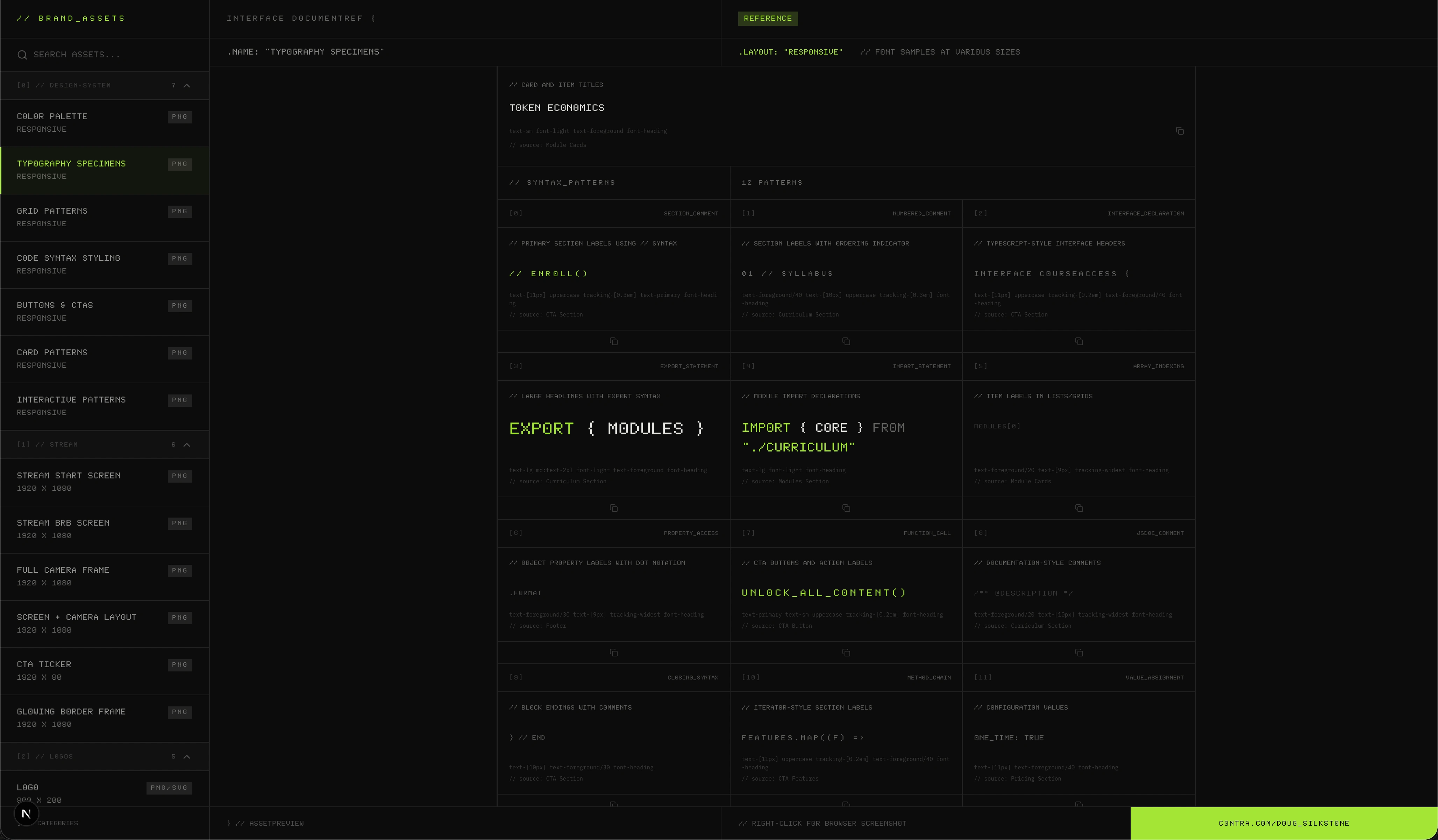
Context Engineering Course Concept. Doug Silkstone — hello@withseismic.com
Like this project
Posted Nov 28, 2025
Inspired by Conway's Game Of Life, designed an interface for an 8-week course on context engineering.
Likes
3
Views
16
Timeline
Nov 29, 2025 - Ongoing
Clients
Withseismic