If I Didn’t Snap and Post It – Was I Really There?

Romy Todd

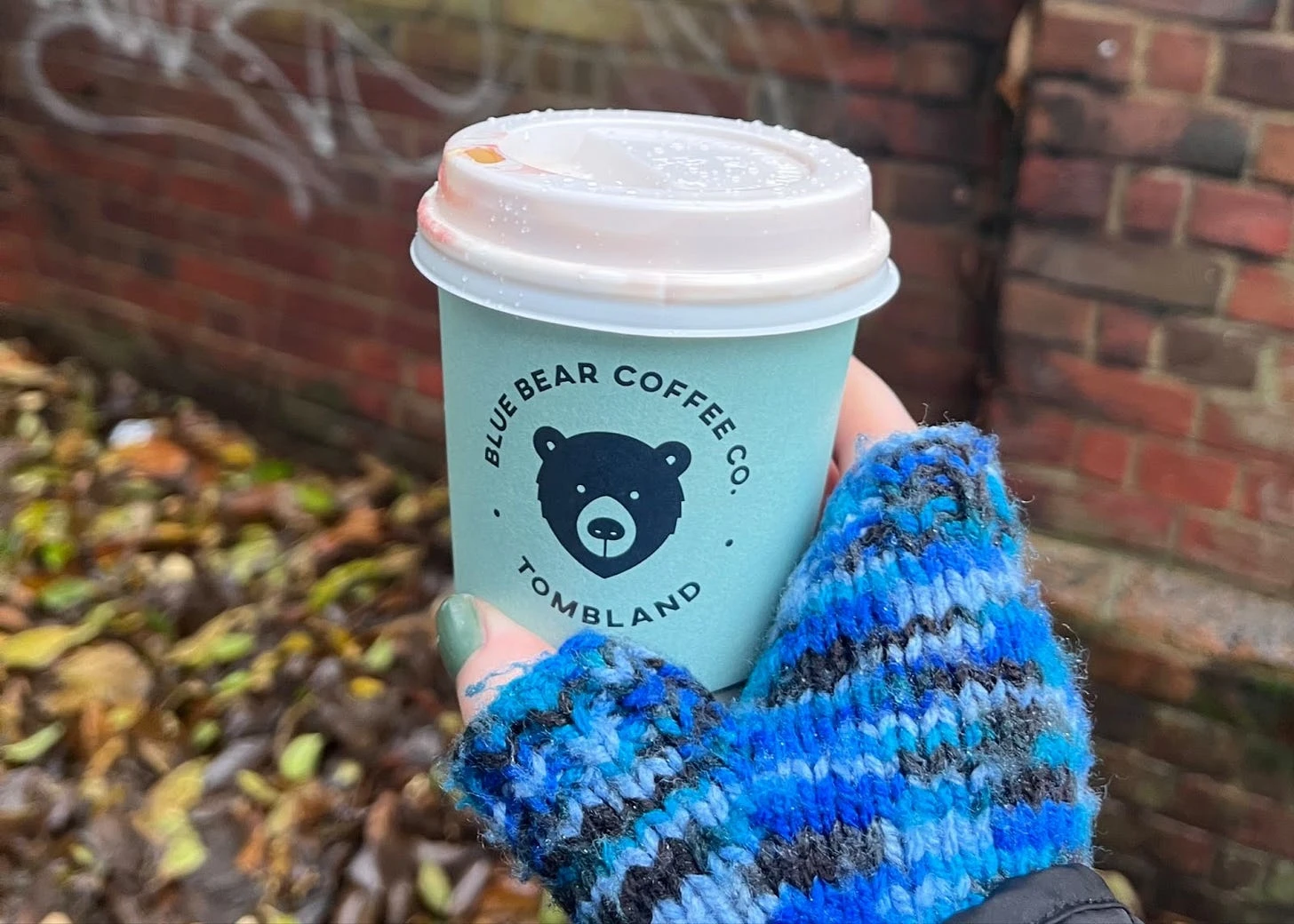
It was just a coffee. A pale blue takeaway cup from a local café in Norwich, held against the backdrop of a rain-darkened wall and a scatter of fallen leaves. I had paused on my walk to photograph it, adjusting the angle to frame the brand’s logo, the texture of my wool gloves, the damp gleam of the pavement. I posted it before taking a sip.
There was nothing especially remarkable about the image. It was not about the drink, but something adjacent to it – an aesthetic fragment, a gesture. Yet later, seeing it return to me on my feed through likes and brief replies, it felt curiously amplified. As though the act of uploading had transformed a minor personal moment into something legible, even significant.
Thanks for reading Media, Machines & Meaning! Subscribe for free to receive new posts and support my work.
Susan Sontag, in On Photography, called this “a way of refusing [experience] – by converting experience into an image, a souvenir.” The photograph, in this sense, does not simply preserve the real. It mediates it, sometimes even replaces it. What was once a means of archiving the ephemeral has become a mechanism for certification. Not just a memory, but proof.
Perhaps that is why so many of our images now orbit joy – the shared meal, the landscape at golden hour, the hand clutching a coffee cup on a grey day. In an attention economy where presence is tethered to visibility, the photograph becomes a receipt. A claim not only to beauty or experience, but to having truly lived.
If the image now functions as proof, it is also increasingly a kind of performance. What we choose to photograph, and how we choose to present it, becomes part of a broader choreography of self. We do not simply record experience; we rehearse it, stylise it, and offer it up for view. Even the most casual post carries traces of intention: a curated angle, a caption, a timing calibrated to attract attention. The image becomes both archive and advertisement.
John Berger once observed that “every image embodies a way of seeing.” Even a photograph, he argued, is never neutral. It reflects not only the object being shown, but the perspective, desire, and context of the person behind the lens. In a digital environment where images are endlessly reproduced, cropped, filtered, and recirculated, that perspective becomes even more pronounced. We are not just seeing, but being seen, and often seeing ourselves through imagined eyes.
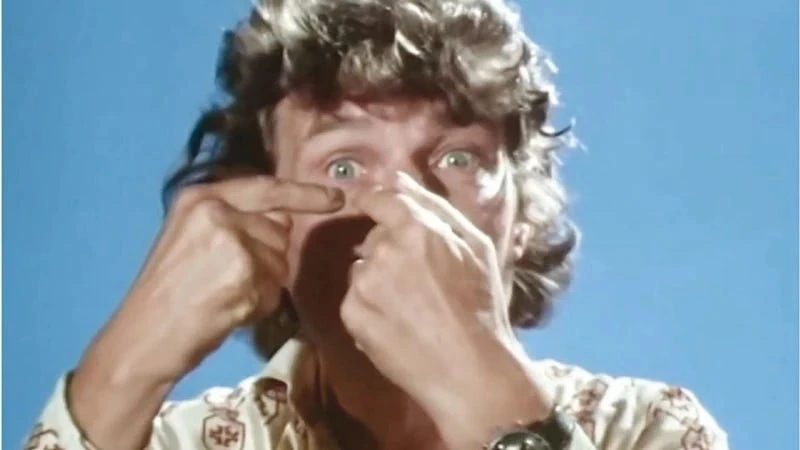
John Berger in BBC's Ways of Seeing (1972). Still courtesy of the BBC.
Social media collapses the distance between audience and self. A holiday becomes a series of posts. A meal becomes a mood. What begins as a moment of pleasure is swiftly reframed as an aesthetic proposition, designed to be consumed, validated, and archived by others. The premise persists: visibility stands in for reality. To be seen is, increasingly, to be.
We do not need to be influencers to perform. More and more, the feed shapes how we see ourselves.
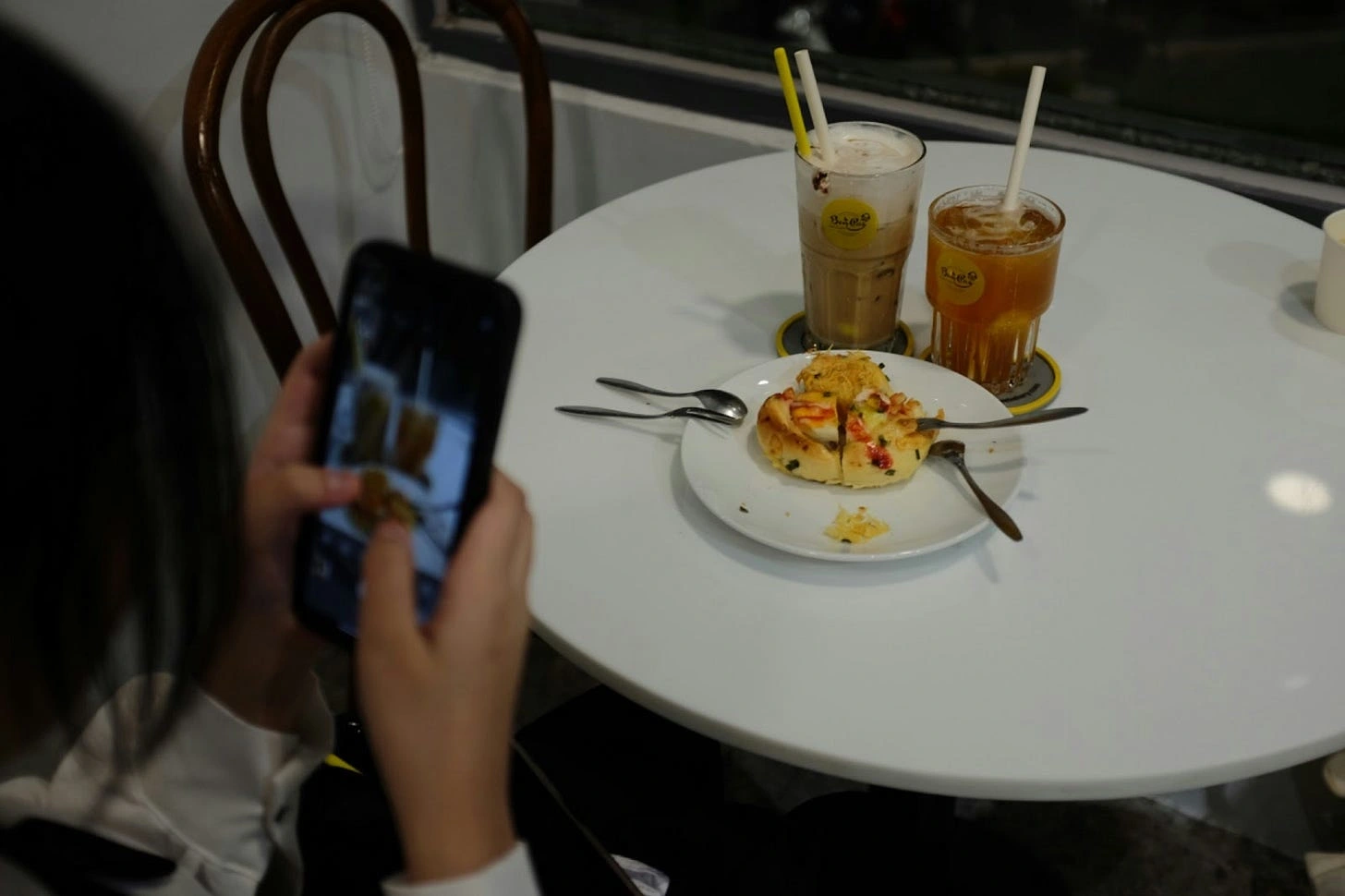
The ritual before the bite. Photo by Lê Chí Quốc on Unsplash
We no longer post solely to remember. Increasingly, we post to affirm that the moment occurred. As media theorist José van Dijck writes, personal memory is becoming “platform-dependent,” structured by the systems we use to document, store, and retrieve the past. What we recall is often shaped less by the experience itself than by what we chose to record, and by what we believed might resonate.
Even platforms that claim to resist aestheticisation, such as BeReal, simply offer a shift in style. Their enforced spontaneity gestures toward authenticity, but the performance remains. Spontaneity, too, is curated, only more discreetly. The premise persists: visibility now stands in for reality. To be seen is, increasingly, to be.
Long before the advent of social media, sociologist Erving Goffman described identity as a series of performances, adapted for different audiences. What distinguishes the digital self is the absence of a backstage. Social media collapses boundaries between public and private, casual and deliberate. The result is a seamless loop of observation and expression, where the line between living and displaying becomes difficult to locate. We are always preparing for the gaze, even when no one is explicitly watching.
This has emotional consequences. In a culture where memory is indexed through imagery, unshared experiences can feel strangely insubstantial. I have felt it on days when I forgot to post. A beautiful view, a perfect meal, a moment of unexpected joy, all fully lived, yet oddly ephemeral. Without documentation, the memory seems to drift faster, as if it lacks anchorage. It is not that the pleasure is lost, but that it becomes harder to recall, harder to re-enter. Without the image, the moment risks slipping into invisibility.
And yet, there are exceptions. I remember once walking along the river in early spring, my phone buried in my coat pocket. Blossom petals floated in the water. A boy stood nearby, playing music from a speaker with tinny determination. The light shifted. I said nothing. I kept walking. There is no photo, no caption, no trace in my camera roll. But I remember it, not as content, but as presence.
Further Reading
Susan Sontag, On Photography (1977)
John Berger, Ways of Seeing (1972)
José van Dijck, Mediated Memories in the Digital Age (2007)
Erving Goffman, The Presentation of Self in Everyday Life (1956)
Nan Goldin, The Ballad of Sexual Dependency (1986)
Like this project
Posted May 18, 2025
On the emotional logic of documenting joy in the digital age
Likes
0
Views
7