Git Conflict Management System for AI-Human Integration

Crispin Courtenay


1. The Challenge: The Rise of the Synthetic Workforce
In modern high-velocity environments, the definition of a "developer" has shifted. We are no longer just managing humans; we are managing AI Agents.
Tools like Google Jules, AI Studio, and Antigravity are not passive assistants; they are active, 24/7 contributors. An agent like Jules can work overnight, simultaneously refactoring 15–20 functions, running linting, hardening security, and debugging iteratively. By the time the human lead has their first coffee, these agents may have created a pile of iterations, first passes or enhancements. Using traditional manual review for this work takes hours to days...always falling more and more behind the curve.
The Bottleneck:
While AI has solved the speed of writing code, it has broken the speed of integrating it. Standard Git tools (Regex/diff3) fail catastrophically at this volume.
The "Morning Gridlock": Developers wake up to a queue of conflicting Agent PRs.
Semantic Collisions: Two agents optimizing related functions might create code that passes individual tests but fails when merged.
Wasted ROI: The efficiency gains of the AI agents are lost because senior engineers spend their expensive hours acting as "Git Janitors" instead of reviewing architecture.
2. The Solution: Git Conflict Management
To solve this, I architected Git Conflict Management, an industrial-grade Git Merge Driver designed to manage a hybrid human-synthetic workforce.
This system replaces standard text merging with an intelligent Supervisor Agent powered by Google Gemini 3 Flash. It treats the conflict resolution process as an autonomous governance layer.
Intercepts the Conflict: Catches merge failures at the driver level, before humans are alerted.
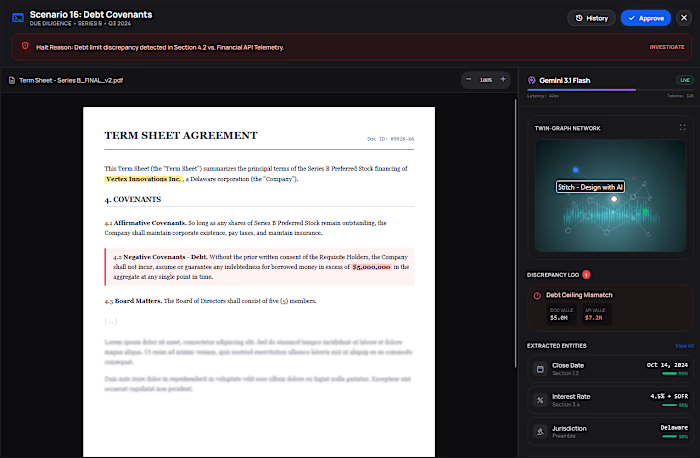
Semantic Understanding: Parses the Abstract Syntax Tree (AST) to understand the intent of the 20,000+ changes, not just their text location.
Golden Path Enforcement: Queries a RAG knowledge base to ensure Agent-generated code (which can vary in style) strictly adheres to project architectural standards.
Safety Verification: Validates output to prevent hallucinated logic before committing.
3. The Strategy: Velocity Protection
Git Conflict Management is built on a single premise: Keep the pipeline moving.
For a team using autonomous agents, the bottleneck is integration. This tool acts as an automated lane-assist, resolving the friction between multiple high-speed AI inputs (and human overrides) in the background. It ensures that the overnight work of the "Synthetic Workforce" is ready for high-level review by morning, rather than stuck in conflict limbo.
4. Technologies & Architecture
Core Engine: Google Gemini 3 Flash (High token throughput, low latency).
Logic Layer: Python with AST parsing for deep syntax validation.
Infrastructure: Dockerized "Supervisor Agent" deployed via GitHub Actions.
Knowledge Base: RAG-based "Golden Path" store for architectural rule enforcement.
5. Strategic Impact & ROI
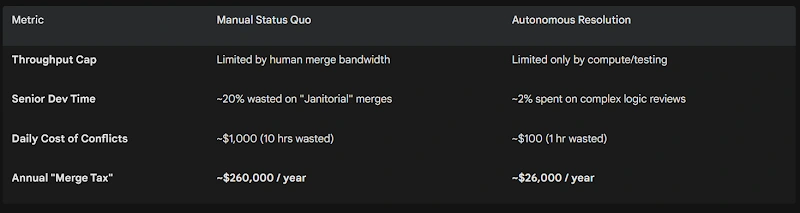
The "Merge Tax" Analysis
Modeling a midsize team (10 Developers) heavily augmented by AI Agents, with a blended hourly rate of $100 (range $50–$200).
Qualitative Outcomes
90% Autonomy: Achieved a 90% success rate on resolving semantic conflicts without human intervention.
Governance as a Side Effect: The system actively refactors Agent code during the merge to match the "Golden Path," ensuring technical debt decreases with every PR.
Burnout Reduction: Eliminates the cognitive load of "context switching" for human leads, allowing them to focus on high-value architecture while the AI handles the scut work.
Like this project
Posted Jan 30, 2026
Developed Git Conflict Management to manage hybrid AI-human workforce integration.