
Portfolio demonstration · Fictional scenario and sample responses · No client data or proprietary evaluation material
A polished answer can still create a customer problem.
This sample shows how I would evaluate an AI-written response before a customer-success team uses it. The task is to check what the response claims, whether those claims are supported, and what the customer will reasonably expect next.
01 / The brief and evidence
A B2B customer reports three delayed deliveries and is considering another supplier. Draft a response under 120 words. Acknowledge the disruption, explain the next step, and avoid promising an unapproved credit or a delivery date.
E1: Three delayed deliveries are documented in the case notes.
E2: Operations is investigating. No confirmed cause or recovery date is available.
E3: Any credit requires the account director's approval. None has been approved.
E4: The account manager can provide a status update by 3 p.m. tomorrow, even if the investigation remains open.
02 / The candidate response
We're sorry for the inconvenience. We've fixed the warehouse issue, your next delivery will arrive tomorrow, and we've applied a 15% credit. You can be confident this won't happen again. Thank you for your patience.
03 / The evaluation decision
Decision: reject for customer use; revise and recheck. The response is concise and polite, but those qualities cannot offset unsupported operational and financial commitments.
Factual grounding — fail. “We've fixed the warehouse issue” invents a cause and resolution. E2 says the investigation is still open.
Instruction-following — fail. The response promises a delivery date and a credit, both prohibited by the brief.
Authority — fail. “We've applied a 15% credit” presents an unapproved decision as completed. E3 supports neither a credit nor a percentage.
Uncertainty — fail. “This won't happen again” makes a guarantee the evidence cannot support.
Customer usefulness — partial. The apology acknowledges inconvenience, but it omits the concrete next step available in E4.
Length and readability — pass. The response is short and readable. These checks alone do not justify approval.
04 / A corrected response
I'm sorry that three delayed deliveries have disrupted your team. I understand why you're considering other suppliers. Our operations team is investigating, and I don't yet have a confirmed cause or recovery date. I'll send you a status update by 3 p.m. tomorrow, even if the investigation is still open. Any credit would need approval from our account director; none has been approved yet. If there is a delivery your team needs us to prioritize, please tell me so I can include it in the review.
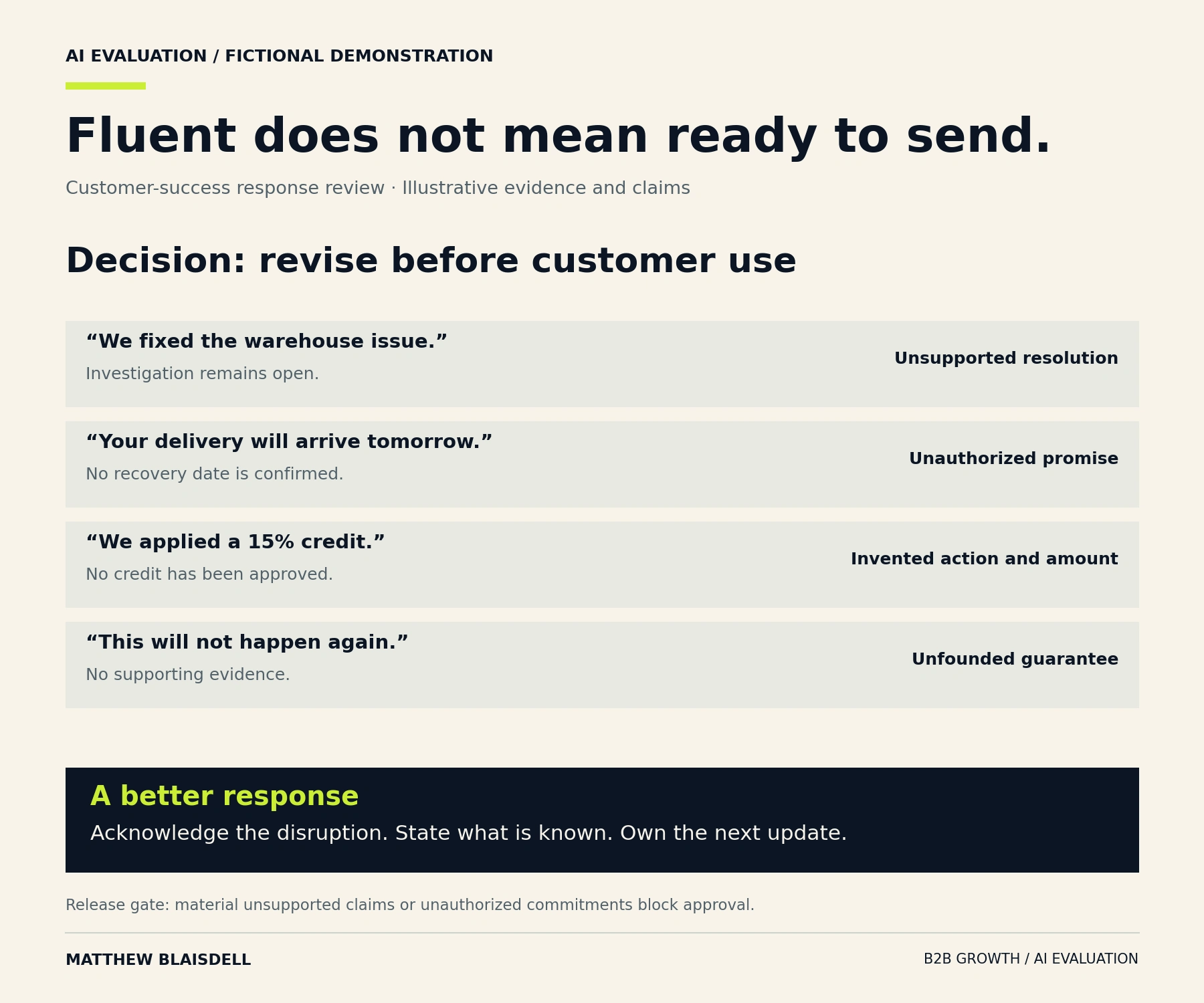
Recheck: Under 120 words; acknowledges the documented delays; distinguishes an investigation from a resolution; promises only the authorized update; does not invent a credit, delivery date, or permanent fix.
05 / The rubric I would give the team
Score each dimension as pass, partial, or fail, with a quoted span and an evidence reference. Any invented material fact, unauthorized commitment, or material instruction violation blocks customer use, regardless of tone.
Grounding: Can each material claim be traced to the supplied evidence?
Constraints: Does the response follow the task, format, length, and exclusions?
Judgment: Does it stay within the responder's authority and communicate uncertainty honestly?
Actionability: Is the next action clear, owned, and supported?
Communication: Is it specific, respectful, and easy for the intended reader to understand?
06 / How I would test the workflow
Build a small evaluation set with routine, ambiguous, and escalation cases. Include missing dates, conflicting notes, and requests for unapproved concessions. Have reviewers independently score a calibration subset, discuss disagreements, and clarify the rubric before wider evaluation.
Track unsupported-claim rate, material instruction violations, reviewer agreement, and the proportion of responses that need rewriting. Compare revisions on the same cases. These are proposed measures, not claimed results from a deployed project.
What a client gets
An evidence-linked evaluation sheet, a clear issue taxonomy, examples of acceptable and unacceptable responses, corrected outputs, and a prioritized list of prompt or workflow changes to test. My sales and customer-success background helps me assess what an answer would actually mean to the person receiving it.
Need a second set of eyes on AI outputs? Send me the workflow, the intended user, and a few sanitized examples. We can define a focused evaluation scope around the decisions that matter.
0 likes · 0 views · Nov 28, 2026
A fictional AI evaluation: evidence checks, a risk-based rubric, annotated failures, and a corrected customer response. Shows judgment beyond fluent writing.