
The story: sending a parcel with a stranger sounds like a terrible idea — until the product makes it feel safer than the post office. Sendr matches people who need to send packages with travelers already heading to that destination. The whole business runs on trust between three people who will never meet: the sender, the traveler carrying the parcel, and the receiver waiting at the other end. And when I started, too many senders were giving up before their first package was ever booked — the drop-off problem this redesign had to solve.
What Sendr is: a four-portal courier platform — Sender, Traveler, Receiver and Admin — designed end-to-end as one product: 450+ screens, one design system. Here is the story of the two portals that carry the business.
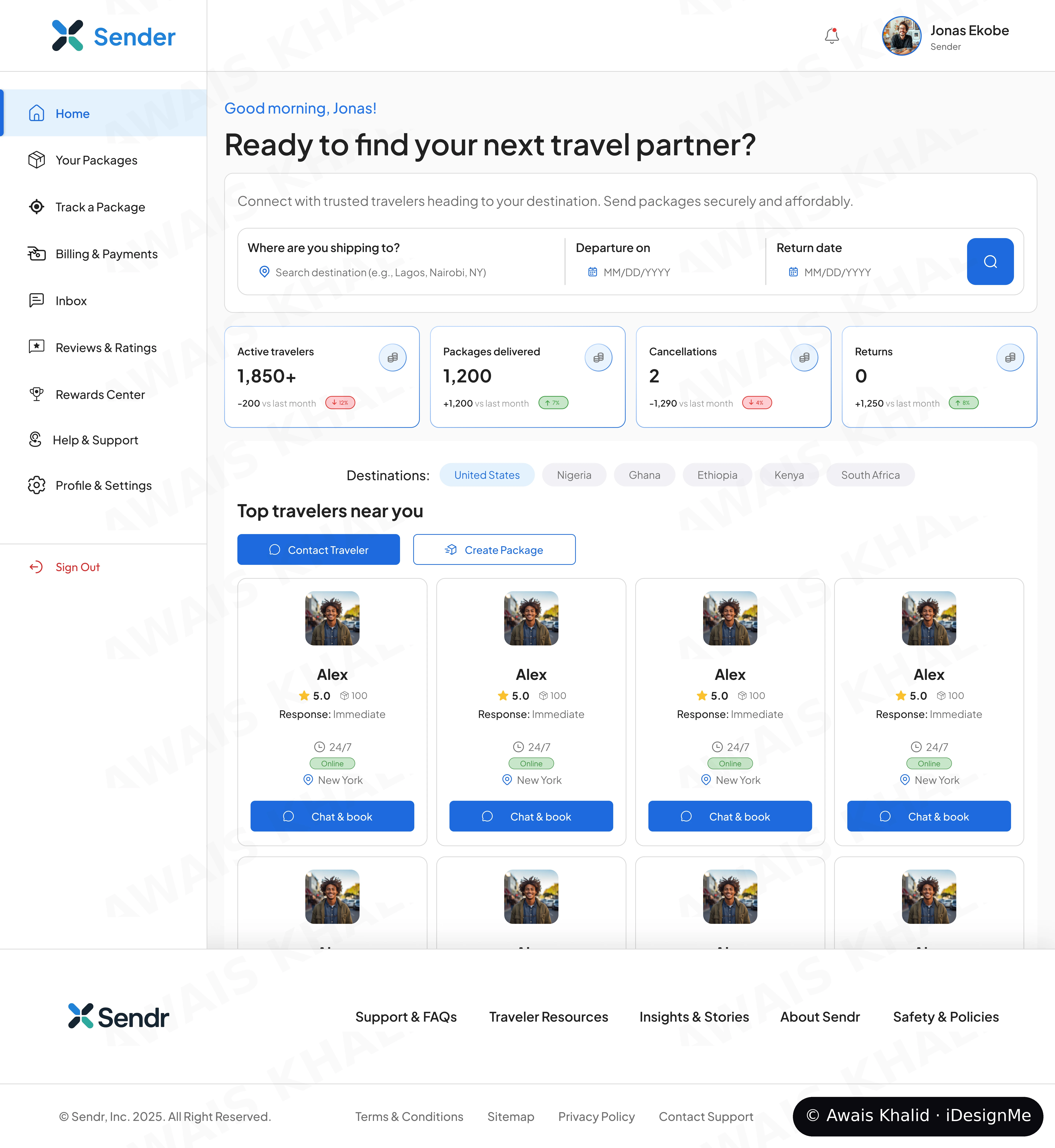
01 — Sender Portal · Trust is the interface. The sender's home opens with one question — "Ready to find your next travel partner?" — and a search built the way senders actually think: where is it going, when does the traveler leave, when do they return. Below it, every traveler card does the trust work before a single message is sent: photo, 5.0 rating, "Response: Immediate", online status, city — and one clear action, Chat & book. Design decision: nobody hands a parcel to a stranger because of a logo. They do it because every cue on the card answers the fear they're actually feeling. The funnel work behind this home — clearer first steps, fewer dead ends — is where onboarding drop-off was cut by 35%.
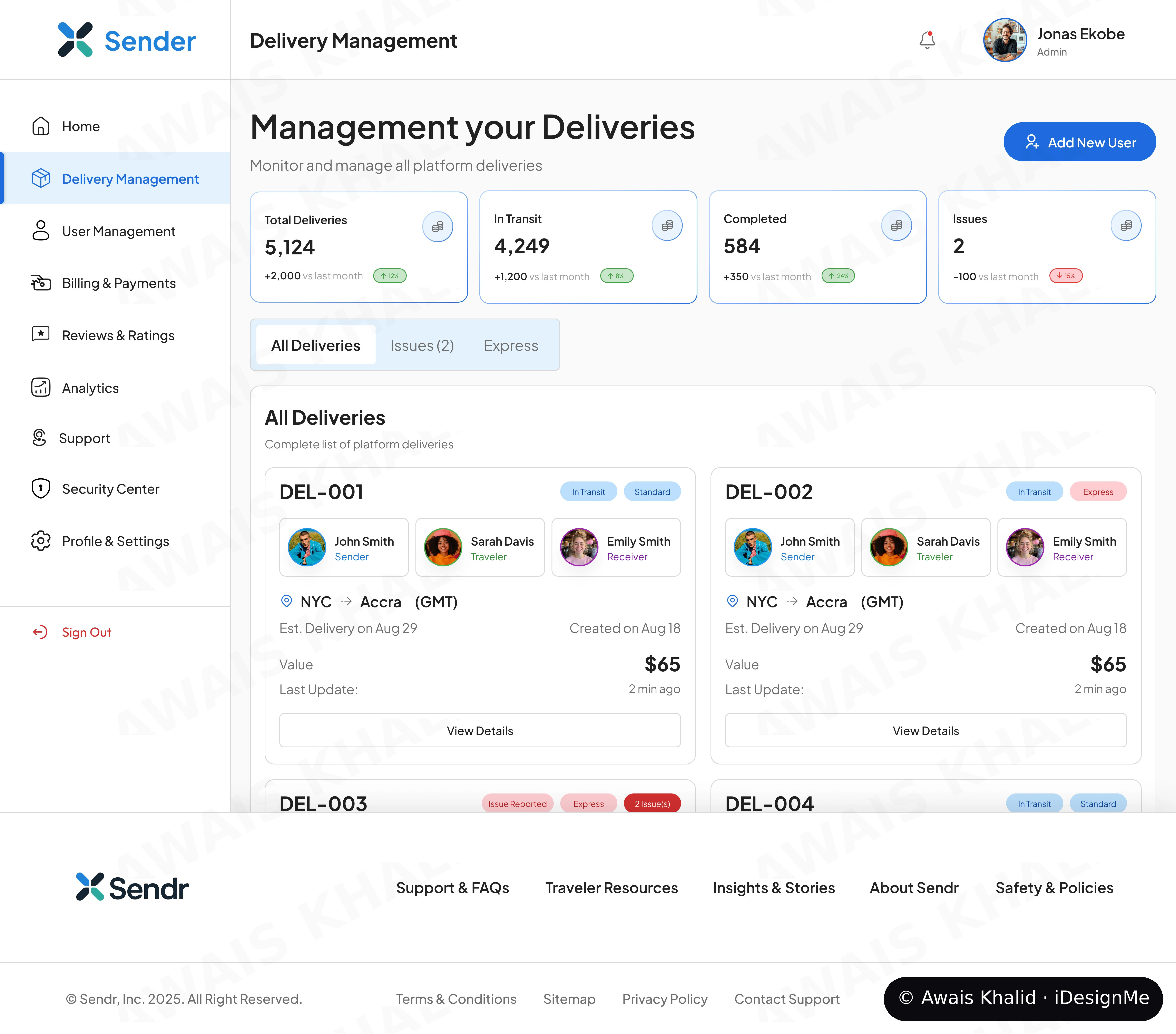
02 — Admin Portal · One delivery, three people, zero detective work. Operations sees the whole platform as deliveries: 5,124 total, 4,249 in transit, 584 completed — and just 2 issues, surfaced as their own tab instead of hiding in the list. Each delivery card shows the complete chain at a glance: Sender, Traveler and Receiver with faces and roles, the route (NYC → Accra), status and service chips (In Transit, Express, Issue Reported), value and last update. Design decision: in a three-sided marketplace, the unit of truth is the delivery, not the user account — so the card is built around the handoff, and an exception reads in one second flat.
The system underneath: 450+ screens across four portals, and a sender, a traveler and an admin can move between completely different jobs without ever re-learning the product — same patterns, same components, same language. That consistency is not decoration; it is what lets a platform this size stay usable, and what lets a small team keep shipping without the design debt compounding.
The outcome: onboarding drop-off cut 35%, on a platform whose entire model depends on strangers trusting each other. I designed Sendr end-to-end in Figma — four portals, 450+ screens, one design system, developer-ready handoff. Building a multi-role platform where different users have to trust the same product? Let's talk.
0 likes · 2 views · Nov 8, 2026
Unified courier platform for Admin, Sender, Receiver and Traveler — one design system, 450+ screens, onboarding and tracking flows in Figma.
