TheDevPort: Bounty Payment System & Developer Job Portal

Pratik Patil


The problem
Hiring often rests on resumes, not on real work. Developers, especially beginners, need a way to prove their skills on real projects and get paid while they learn.
What I built
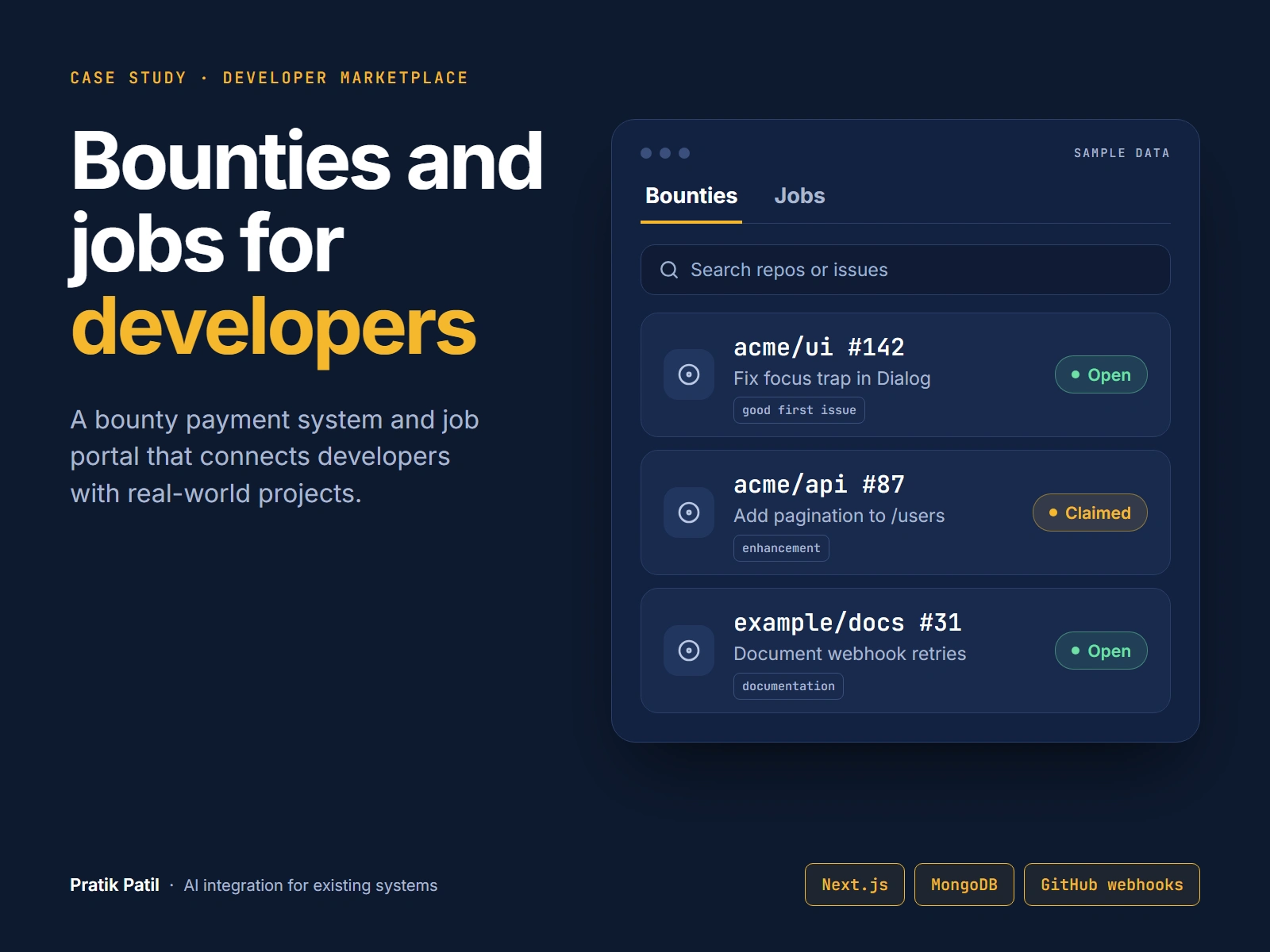
A bounty system: developers earn money by completing bounties on open-source projects
A job portal with project-based hiring, so employers review profiles and real contributions instead of resumes
GitHub integration: developers connect repositories, and webhooks update contributions and bounty completions in real time
Skill validation through completed projects and bounties, with badges and a leaderboard
Practice projects for beginners
Payments with Stripe and Razorpay
A MongoDB data model for user profiles, projects and bounties
Reusable components and design tokens, so the interface stays consistent across different project types
Tech stack
Next.js (front end and back end), MongoDB, GitHub API webhooks, Stripe and Razorpay.
My role
Software engineer. I built the front end and back end, the MongoDB data model, the reusable components, and the secure GitHub webhook endpoints that keep contributions and bounties in sync.
Links
Live demo: thedevport.vercel.app (the site is labelled a demo environment).
Like this project
Posted Oct 26, 2026
A platform where developers earn bounties on open-source work and employers hire based on real project contributions. Next.js and MongoDB, GitHub webhooks for live contribution updates, and Stripe and Razorpay payments.