Evoke Dholavira: A Cultural Gateway to the Indus Valley

Sumit Joshi


The brief in one image — a landscape so vast it makes the building look optional.
Evoke Dholavira — Selling Silence to People Who've Never Experienced It
Most luxury resorts sell you something to look at. Evoke Dholavira had to sell you something to not look at — silence, scale, and emptiness, in a location most travelers had never heard of, next to ruins most travelers couldn't place on a map.
That's a strange thing to put a price tag on. It's an even stranger thing to put on a website.
The Challenge
Dholavira is one of the most significant excavated cities of the Indus Valley Civilization — and almost nobody outside archaeology circles knows that. The people this resort needed to reach were international, culturally curious, slow-travel guests who expect a seamless digital booking experience. The place they were being asked to travel to has minimal infrastructure and some of the weakest connectivity in the region.
That's the contradiction at the center of this project: a digital-first audience, built for a destination that is deliberately, almost defiantly, offline.
Add to that an active archaeological zone with real sensitivity constraints, and a harsh desert climate that shapes literally everything — this wasn't a "make it look luxurious" brief. It was a "make remoteness itself feel like the luxury" brief.
[Image slot: exterior architecture shot showing horizontal lines / earth-toned material against the desert]
Caption: The building borrows its language from the ruins next door — horizontal, low, deliberately quiet.
Why "Luxury" Had to Mean Something Different Here
Every reference point in this category — Wadi Rum, the Petra-region camps, the Morocco desert retreats — sells isolation as an amenity. But most of those properties still let you forget where you are once you're inside a beautifully lit room.
Evoke couldn't do that, and didn't want to. The strategic bet was that restraint itself was the differentiator — that if the brand tried to compete on resort-scale spectacle, it would lose to properties with more infrastructure and easier access, and it would also betray the one thing that made Dholavira worth visiting in the first place: a 5,000-year-old city that didn't need decoration to matter.
So instead of leading with amenities, the narrative had to lead with place — geometry, water systems, ancient urban planning — and trust that the right traveler would recognize depth over indulgence.
The Approach
Brand and story first, rooms second. The name itself — Evoke — was chosen to point at memory and reflection rather than comfort. Every brand pillar (ancient intelligence, geometry as metaphor, silence as a premium experience) had to survive translation into a digital layout before a single room description got written.
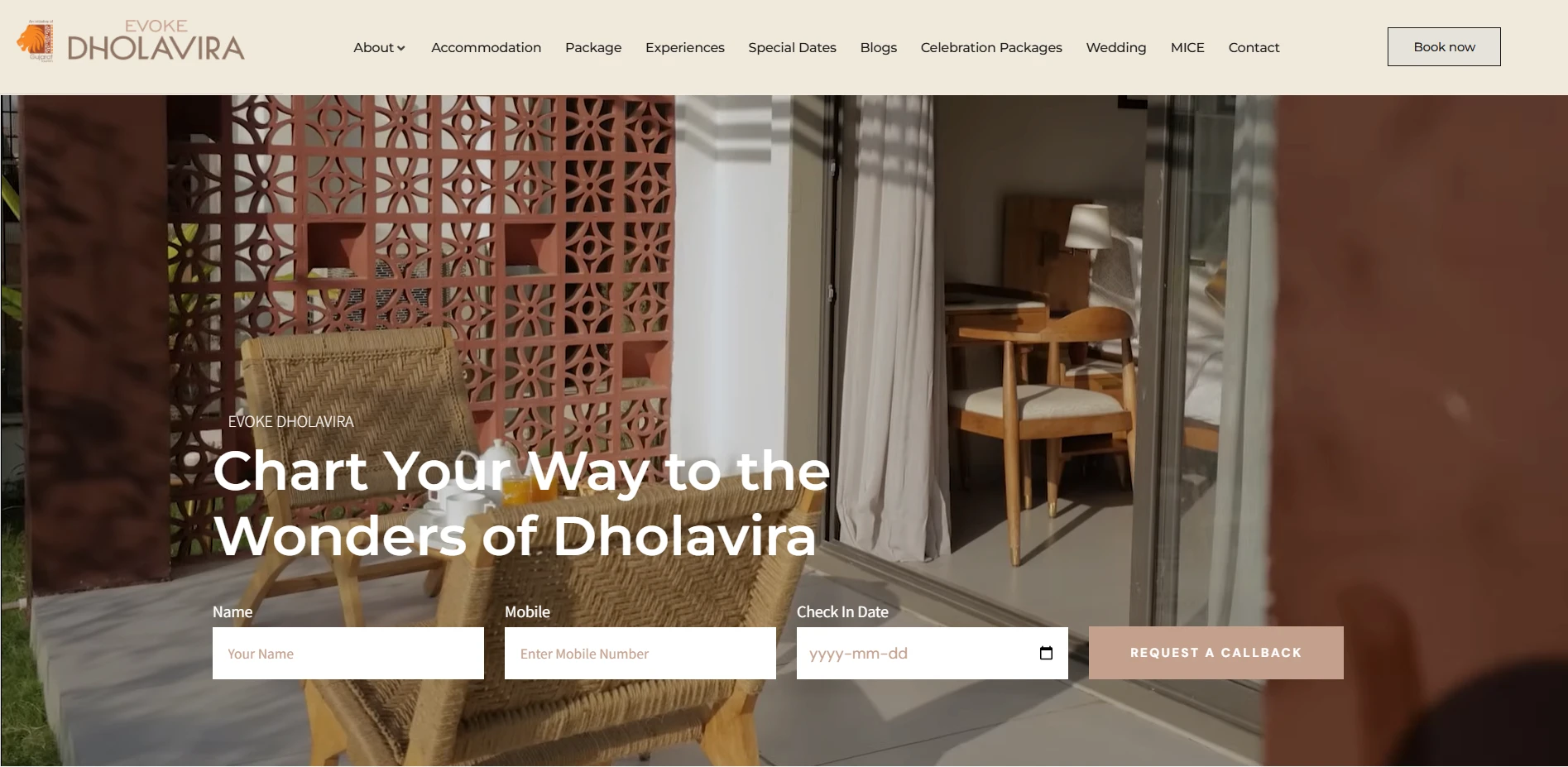
[Image slot: the existing site screenshot — editorial-style layout / hero page]
Caption: An editorial, magazine-style layout replaces the typical hotel template — image-led, with restrained typography that doesn't compete with the landscape.
Experience-led navigation, not room-led navigation. Most hotel sites are structured around what you can book. This one had to be structured around what you'd feel — guided walks through the excavation site, stargazing in a zero-light-pollution sky, storytelling around Harappan engineering — so a browsing visitor understands the why before they ever hit a room rate.
Built lightweight, on purpose. With international travelers arriving to genuinely weak connectivity, and a guest experience where slow, unhurried loading actually reinforces the brand's own message about slowing down, the site was engineered for low-bandwidth performance rather than heavy, image-saturated pages that would undercut the story before a visitor even arrived.
Inquiry over automation. Booking flows were deliberately kept minimal — human interaction was prioritized over aggressive self-serve automation, matching a brand built on depth rather than convenience.
The Result
Evoke Dholavira now occupies a genuinely rare position — not competing with mainstream resorts, but sitting alongside the world's best heritage and slow-travel destinations, while staying rooted in a UNESCO site most of its own audience had never heard of before finding the brand.
The deeper proof point: guests aren't booking a room with a nice view. They're booking a relationship with a place that's over five thousand years old — and the digital experience had to be quiet enough, and confident enough, to let that be the whole pitch.
Restraint is hard to sell. It's even harder to sell well. Evoke Dholavira is proof that when the story is strong enough, the least decorated version of it is usually the most convincing one.
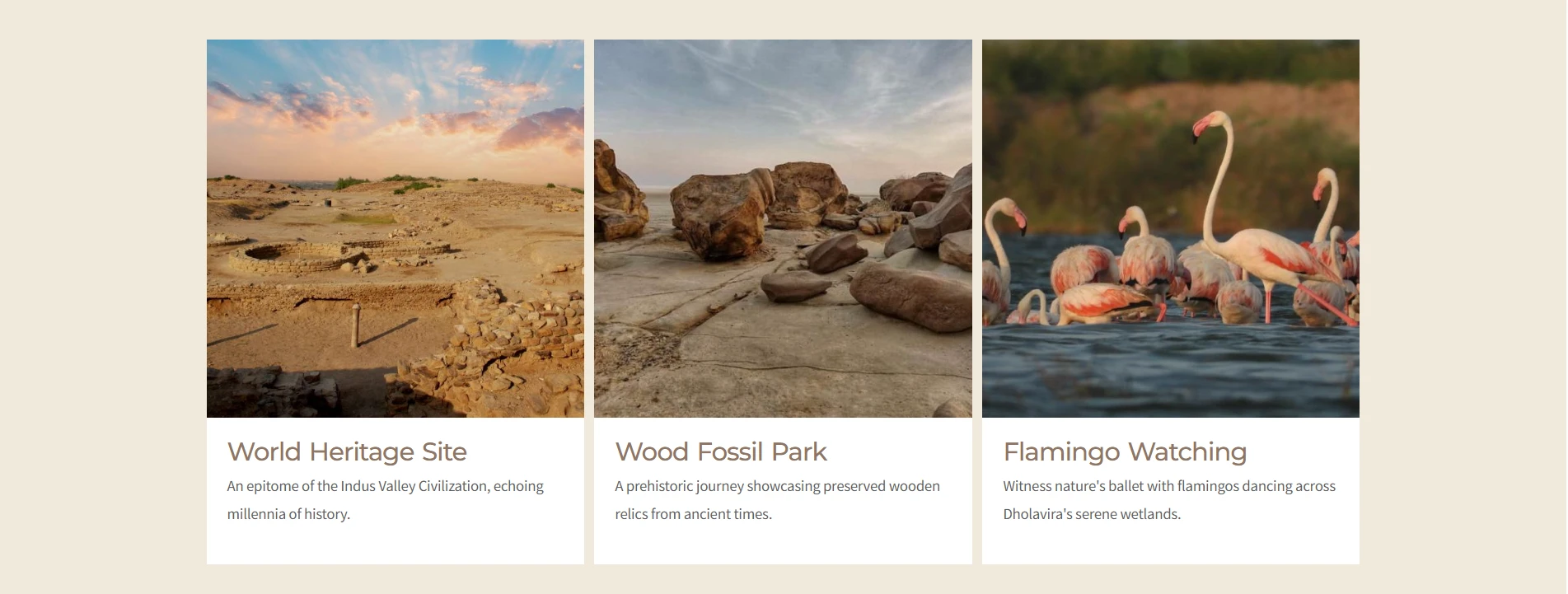
The sights of Dholavira
Like this project
Posted Jan 24, 2026
Developed Evoke Dholavira resort as a cultural gateway near the UNESCO site of Dholavira for people to visit, discover and experience.