Smart Inventory – Stock Management and Analytics

Nitu Alam


InvenTrack — Smart Inventory and Supply Chain Tracker
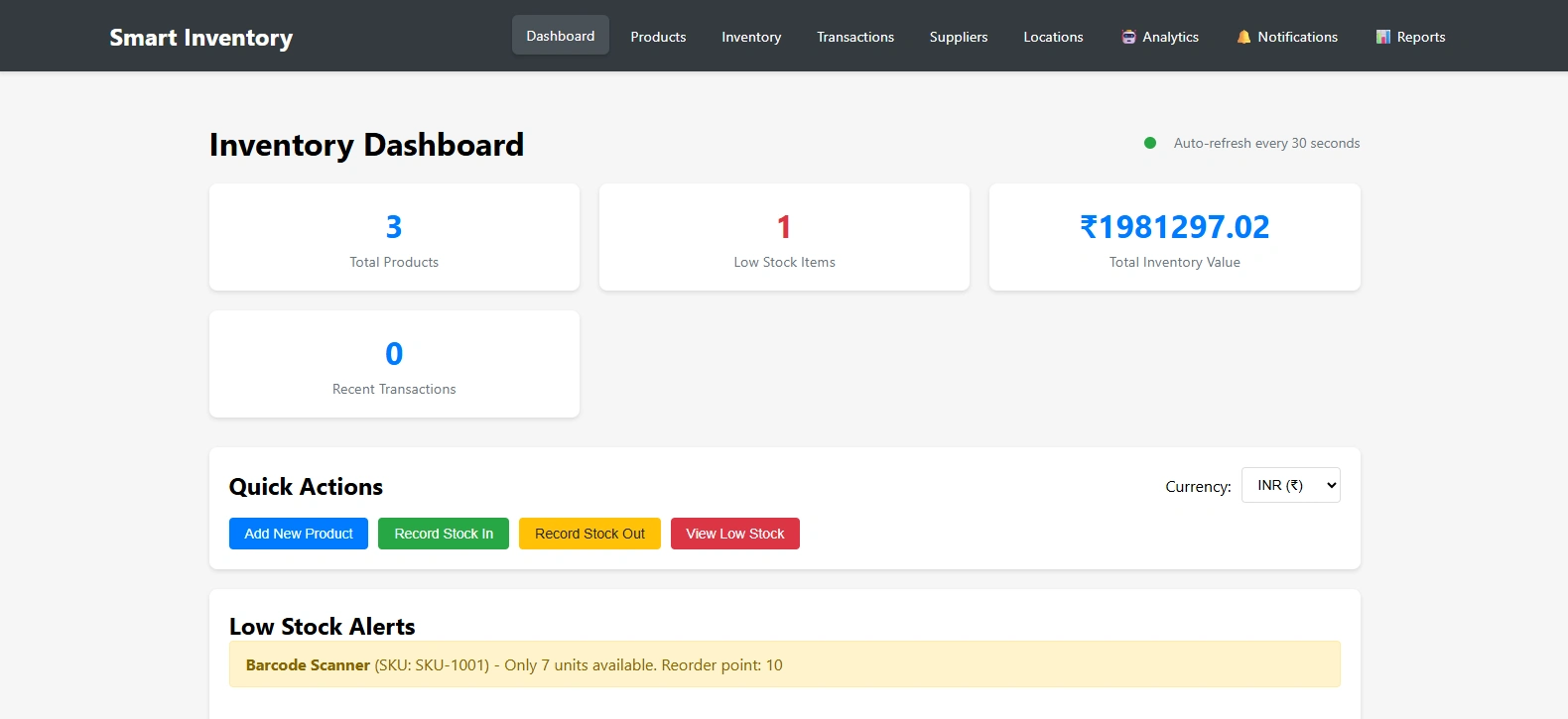
InvenTrack is a full-stack inventory management application built to help small and growing businesses track stock, manage suppliers, monitor inventory movements, and identify products that may require reordering.
The project combines a Django REST API with a React interface and adds real-time updates, barcode scanning, operational reports, notifications, and experimental demand forecasting.
Business problem
Inventory records are often distributed across spreadsheets and manually updated systems. This can make it difficult to answer basic operational questions:
What stock is currently available?
Which products are approaching their reorder point?
Where and why did inventory quantities change?
Which supplier is associated with a product?
Which products may run out based on recent demand?
InvenTrack brings these workflows into one application with searchable records, transaction history, reports, and automated alerts.
Features
Product, category, supplier, and location management
Current stock and available-quantity tracking
Inbound and outbound stock transaction history
Barcode and QR-code scanning from a mobile-friendly interface
Low-stock and critical-stock notifications
Email and optional Twilio SMS alerts
Real-time updates using Django Channels and WebSockets
PDF and Excel report generation
Demand forecasting using historical stock movements
Estimated stockout dates and reorder recommendations
React dashboard with Bootstrap and Chart.js visualisations
Tech Stack
Backend
Python
Django 5.2.5
Django REST Framework
Frontend
React 18
Bootstrap 5
Chart.js
Real-time communication
Django Channels
WebSockets
Background processing
Celery
Data and forecasting
pandas, NumPy, scikit-learn
Development database
SQLite
Notifications
Gmail SMTP, Twilio
Barcode scanning
QuaggaJS
Forecasting approach
The demand-prediction service converts outbound stock transactions into a daily demand series. Calendar attributes such as day of week, day of month, month, and weekend status are used as features for a Random Forest regressor.
The application also estimates stockout dates from recent average consumption. These predictions are experimental decision-support features; they are not a replacement for human purchasing decisions or a production forecasting system.
Local setup
1. Clone the Repository
2. Backend Setup
3. Frontend Setup
4. Configuration
Copy
config.example.py to config.pyFill in your email and SMS credentials
For Gmail, enable 2FA and use App Password
5. Run the Application
Configuration
Email Setup (Gmail)
Enable 2-Factor Authentication
Generate App Password
Update
config.py with App PasswordSMS Setup (Twilio)
Create Twilio account
Get Account SID and Auth Token
Purchase phone number
Update
config.py with credentialsProject Structure
API Endpoints
/api/products/ - Product management/api/inventory/ - Inventory tracking/api/notifications/ - Notification settings/api/analytics/ - Analytics and predictions/api/reports/ - Report generationDevelopment
Running Tests
Database Migrations
Frontend Development
Production Deployment
Set environment variables for sensitive data
Use PostgreSQL for production database
Configure proper SMTP settings
Set up Redis for Celery
Use nginx and gunicorn for serving
Contributing
Fork the repository
Create feature branch
Commit changes
Push to branch
Create Pull Request
Screenshots
Current status and limitations
This is a portfolio application and is not currently presented as production-ready software. Before production deployment, it needs stronger automated test coverage, environment-based security configuration, PostgreSQL and Redis configuration, forecasting validation, and deployment monitoring.
Author
Developed by CoderNitu.
Like this project
Posted Sep 13, 2026
Built a Django inventory system with stock tracking, supplier metrics, low-stock alerts, automated orders, analytics and exportable reports.
Likes
1
Views
1
Timeline
Aug 15, 2025 - Aug 20, 2025