

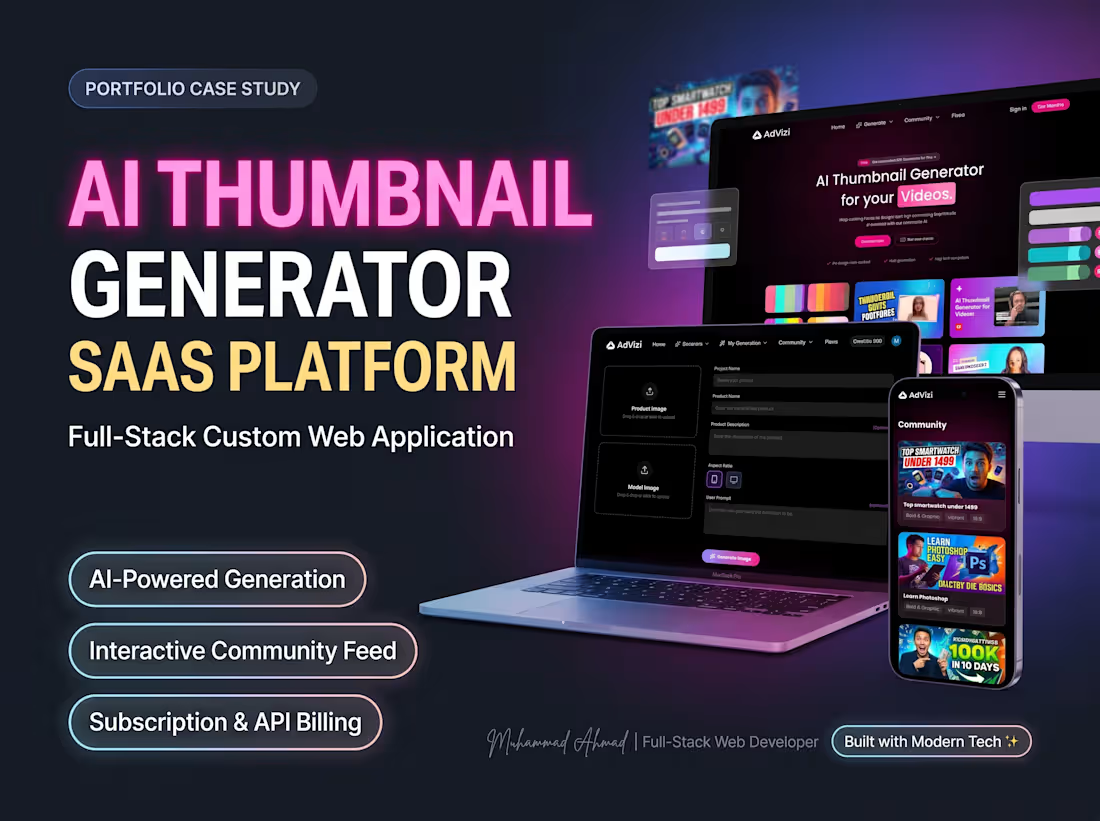
Advizi AI — AI Thumbnail & Video Generator SaaS
Project Overview
Advizi AI is a personal SaaS project I built to help content creators generate visual content for YouTube and other platforms using AI. The platform brings thumbnail and video generation into one application, with user accounts, a credit-based usage system, and subscription billing.
The idea was to build more than a simple AI generation interface. I wanted to create a full-stack application where users could access generation features, use credits, and choose a plan that fits their needs.
What I Built
AI Thumbnail Generation
Implemented AI-powered thumbnail generation for YouTube and other platforms, allowing users to create visual content and save or download their generated results.
AI Video Generation
Built working video generation functionality alongside thumbnail creation, bringing two content generation workflows into one platform.
User Authentication
Integrated Clerk to handle user authentication and access to the application.
Credit-Based Usage System
Implemented a credit system with three plans:
Free: 20 credits
Pro: 80 credits
Premium: 240 credits
Subscription Billing
Integrated Stripe for subscription and payment workflows connected to the platform's plans.
Media Handling and Error Monitoring
Integrated Cloudinary for media handling and Sentry for error monitoring.
My Role:
I developed Advizi AI as a personal full-stack project, working across the frontend, backend, database, authentication, AI integration, and billing functionality.
The project involved bringing multiple services together into a single application, with React and TypeScript on the frontend and Node.js with Express.js on the backend.
Technology Stack
Frontend: React, TypeScript, Vite
Backend: Node.js, Express.js
Database: MongoDB
AI integration: Gemini API
Authentication: Clerk
Payments: Stripe
Media handling: Cloudinary
Error monitoring: Sentry
The Result
Advizi AI is a working AI content-generation application that combines thumbnail and video generation with authentication, usage credits, and subscription billing. It demonstrates my ability to develop a full-stack SaaS product and integrate AI services with the supporting systems needed for a user-facing application.
1
5
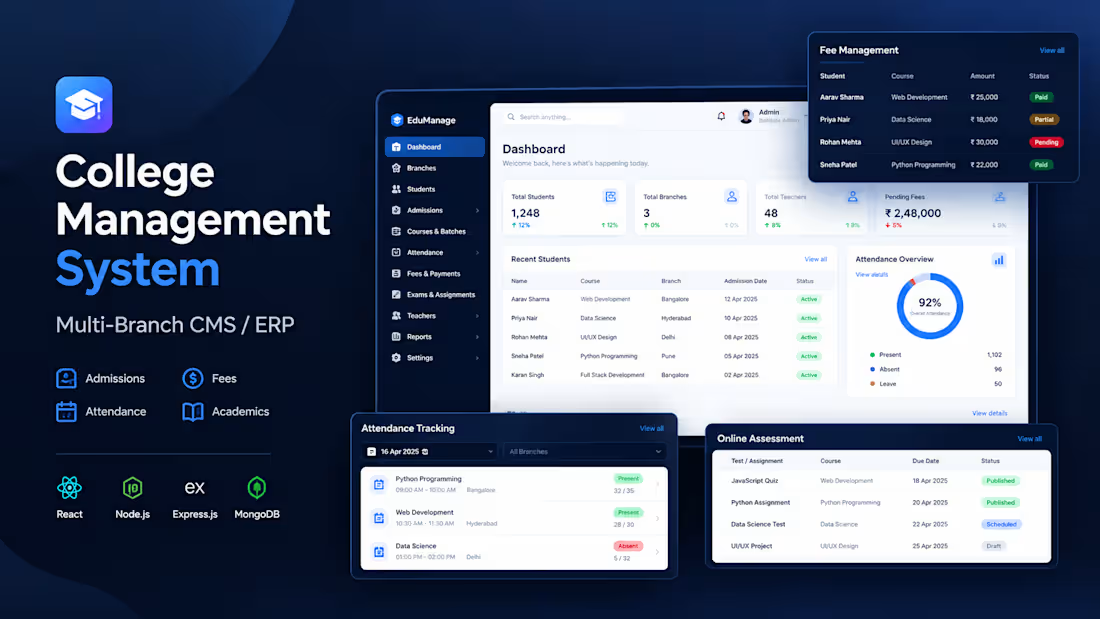
Project Title
Multi-Branch College Management System (CMS/ERP)
I built a full-stack College Management System to help computer colleges and training institutes manage their daily operations across multiple branches from one central platform.
Managing several branches involves more than keeping student records. Institutes need to track admissions, course enrollments, batches, fee payments, attendance, teachers, and assessments while making sure each user can access the information relevant to their role. I built this system to bring these operations together in one place, with separate branch access and role-based permissions.
What the System Includes
Multi-Branch Management: Manage multiple branches from one admin panel, with separate branch data and settings.
Student Admissions and Records: Manage student information, admissions, courses, bundles, and batch assignments.
Fee and Installment Management: Track fee payments, full payments, installment plans, payment dates, and installment records to help staff follow each student's fee status.
Attendance Management: Manage student attendance and let branch managers review attendance records and attendance rates.
Live Class Attendance: Integrated Zoom live classes with webhook-based attendance tracking to record participation and support attendance monitoring.
Assignments, Exams and Quizzes: Support academic assessment workflows, including assignments, online tests, quizzes, and marks management.
Separate User Portals: Provide role-based access for institute administrators, branch managers and front-desk staff, teachers, students, and parents.
Reports and Dashboards: Bring key academic and administrative information together to help staff monitor daily operations.
My Role and Technology
I designed and developed both the frontend and backend of the system. My work covered the user interface, backend APIs, database structure, access permissions, and the workflows connecting different modules.
The main challenge was making these connected operations work within one system without mixing branch data or giving every user the same level of access. Fee tracking and installment records also needed to show not just how much a student owed, but how payments were organized and recorded. For online classes, I integrated Zoom webhooks to support attendance tracking.
The system is deployed with restricted access and is ready for demonstration.
I built this project to solve practical management problems faced by educational institutes and to bring their everyday administrative and academic work into one organized platform.
1
14
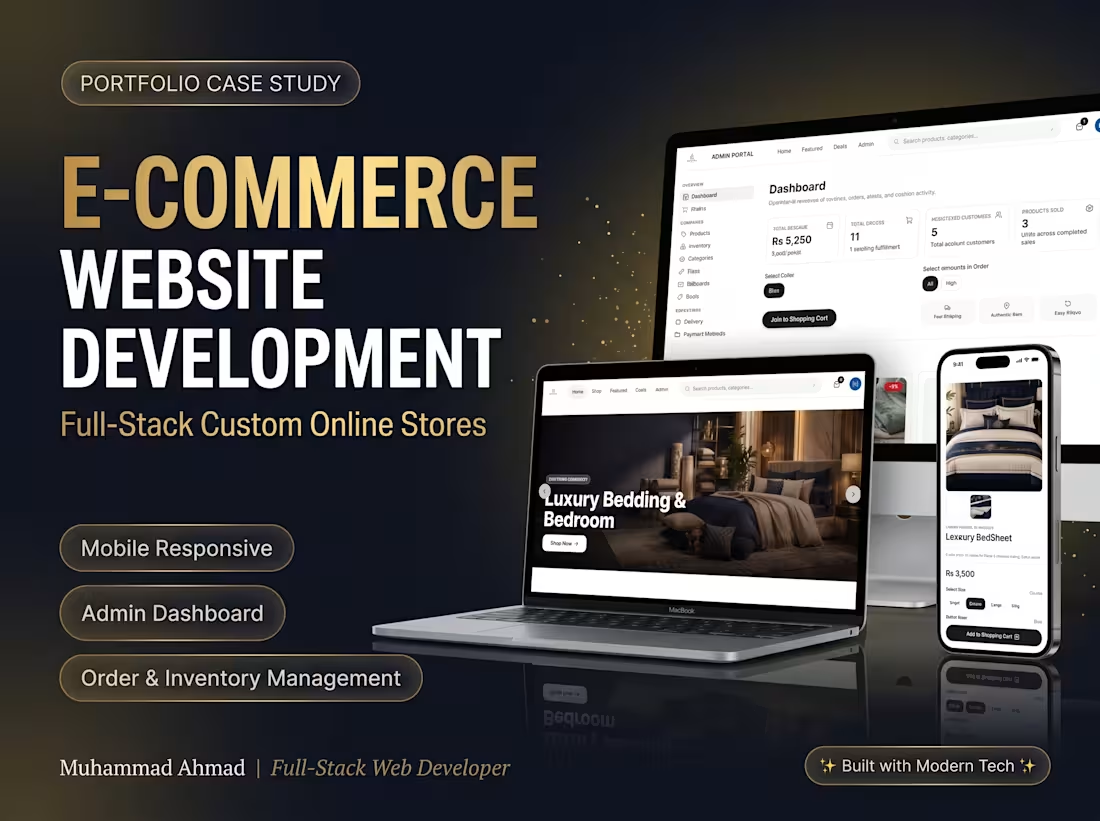
Dreamora Collections | Custom E-commerce Website
Built a custom e-commerce website for selling clothing, bedsheets, and other products, with an admin dashboard for managing product categories, pricing, variants, inventory, orders, payment details, and location-based delivery charges.
About the project
Dreamora Collections is a custom online store built to sell different types of products, including clothing, bedsheets, and other retail items. The store needed a flexible way to manage a growing product catalog, handle different product variations, accept local payment methods, and calculate delivery charges according to the order and delivery location.
I built the website with a dedicated admin dashboard so the store owner could manage day-to-day store operations without needing to make code changes for routine updates.
Rather than using one fixed setup for every product, the system supports configurable product categories, variants, prices, stock levels, payment instructions, and delivery charges. This gives the store owner control over how products are listed, sold, and delivered.
Business problem :
An online store selling different types of products needs more than product listings and a shopping cart. Product variations, stock availability, payment instructions, and delivery costs can differ from one order to another.
For example, delivery charges for a 1 kg parcel going to Lahore may differ from those for an order going to Islamabad. Product prices and stock can also vary by color or other available options.
The store needed a way to manage these details from one place while providing customers with a straight forward shopping and ordering experience.
The solution
I developed a custom e-commerce mobile Friendly application with a customer-facing storefront and an admin dashboard.
The storefront allows customers to browse products, explore featured items and deals, view product details, manage varient, manage their cart, enter delivery addresses, and place orders.
The admin dashboard gives the store owner control over product information, categories, variants, pricing, inventory, payment details, order status, and delivery-charge settings.
I also implemented delivery-charge configuration based on factors such as parcel weight, destination, and courier-specific rates, rather than relying on one flat delivery fee for every order.
Key features
1. Product catalog and product management
Product categories for clothing, bedsheets, and other retail products.
Admin-managed product listings and product details.
Product variants with different colors and prices.
Stock and inventory management.
Featured products and deals pages.
Search, filtering, and sorting to help customers find products.
2. Shopping cart and checkout
Shopping cart for reviewing selected products.
Checkout flow for collecting order and delivery information.
Address entry for customer deliveries.
Product and order details available through the shopping process.
3. Local payment options
The checkout and payment setup supports local payment methods suited to the store's market:
JazzCash
Easypaisa
Cash on Delivery (COD)
The admin dashboard allows the store owner to manage payment instructions and details, including relevant payment numbers and QR codes.
4. Delivery charges based on weight and location
Instead of applying the same delivery fee to every order, I implemented configurable delivery-charge handling based on:
Parcel weight.
Delivery destination.
Courier company and its applicable rates.
Admin-managed delivery pricing rules.
For example, a 1 kg parcel going to Lahore can have a different delivery charge from a parcel going to Islamabad.
This setup allows the store owner to manage delivery costs according to the business's shipping arrangements. It should not be confused with automatic live courier-rate retrieval unless a live courier API is separately integrated and verified.
5. Order and customer management
Order management through the admin dashboard.
Order-status handling.
Customer order history.
Access to relevant order and delivery information for managing purchases.
6. Store administration
The admin dashboard brings important store-management tasks together, including:
Adding and managing product categories.
Creating and updating product listings.
Managing product variants, prices, and stock.
Updating payment instructions and QR codes.
Managing delivery-charge settings.
Managing orders and their statuses.
Controlling featured products and deals.
7. Customer-facing pages
The website includes dedicated pages and flows for:
Homepage and product catalog.
Product details.
Featured products.
Deals.
Shopping cart.
Checkout and delivery address.
Customer registration and login, including OTP functionality.
Customer order status and order history.
Refund policy.
The website also has a responsive layout intended to support customers browsing and shopping on mobile devices as well as desktop screens.
My role and contribution
I worked on the full-stack development of Dreamora Collections, covering the customer-facing shopping experience and the store-management functionality.
My work included implementing the storefront, product browsing, product details, cart and checkout flows, customer authentication, order handling, payment-method configuration, inventory management, product variants, and configurable delivery-charge logic.
I also developed the admin-management workflows that allow the store owner to maintain product information, update pricing and stock, manage payment details, and handle orders from one place.
The focus was on building a store that could accommodate different products and practical retail requirements without depending on fixed product options or a single delivery charge for every order.
Technology
Primary framework: Next.js
The application is a custom full-stack web project. The specific supporting libraries, database, authentication implementation, and deployment configuration should be listed separately only after confirming the exact technologies used in the codebase.
Project outcome
The result is a live e-commerce website with a customer shopping experience and an admin-managed system for handling products, variants, inventory, orders, local payment options, and configurable delivery charges.
The project demonstrates my ability to build custom e-commerce functionality around practical business requirements, including product-level variations, local payment instructions, and shipping rules that account for parcel weight and delivery destination.
Live website: https://dreamoracollection.vercel.app
Looking for a similar solution?
If you run a retail business and need an online store with custom product management, local payment options, inventory controls, order management, or delivery pricing based on your shipping requirements, I can help build an e-commerce solution around your business workflow.
Need a custom online store? Let's discuss what your business needs.
1
36
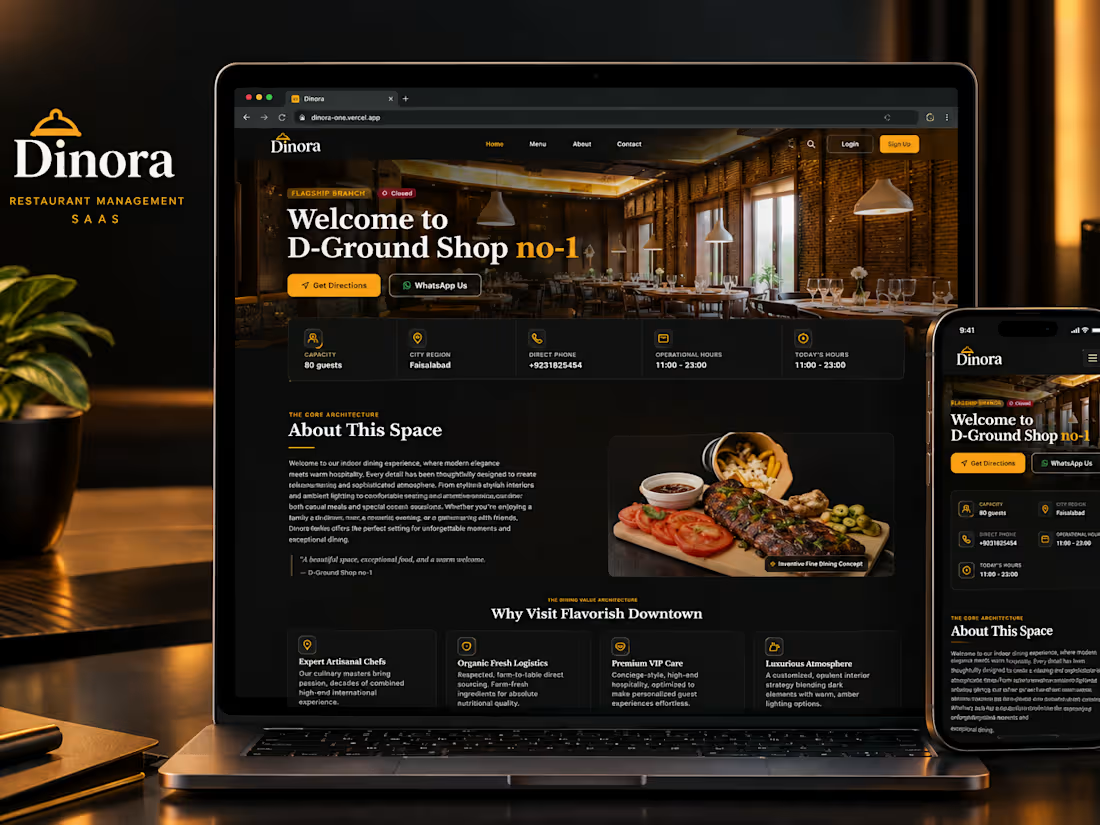
Dinora is a full-stack, multi-branch restaurant management and ordering system built to bring customer ordering and restaurant operations into one connected platform.
Restaurants with multiple locations often manage online orders, table bookings, kitchen activity, delivery, staff attendance, payroll, inventory, menus, and branch reporting through separate tools or manual records. That can create delays, inconsistent data between branches, stock-control issues, and limited visibility for owners or managers.
I built Dinora as an independent product case study to demonstrate how these workflows can be managed through one custom web application. The system includes a customer-facing restaurant experience as well as an internal admin platform for managing day-to-day operations across multiple branches.
On the customer side:
Users can browse the menu, view deals, select the nearest branch, place online orders, choose takeaway options, book a table, and sign in with email or Google. The platform is designed to make ordering and booking clear for customers while routing relevant activity to the restaurant’s operational team.
On the admin side:
Dinora gives restaurant management control over branches, menu content, deals, stock, staff, attendance, payroll, bookings, orders, kitchen activity, deliveries, and reporting. Different operational roles can access the workflows relevant to their work, including administrators, chefs, waiters, delivery staff, and other restaurant employees.
The system includes:
A kitchen-management workflow for receiving and managing incoming orders
A dedicated kitchen interface for chefs to handle on-site orders and preparation activity
Waiter access for creating and managing restaurant orders through the admin panel
A delivery workflow for handling and completing online orders
Booking management for reviewing and organizing table reservations
Menu, deals, branch-location, and customer-facing content management
Inventory management helps track stock usage and movement across branches. The reporting area is designed to give management visibility into branch-wise revenue, stock status, stock usage, delivery activity, staff performance, and kitchen order progress and preparation activity. This makes it easier to review operations and create accountability around stock additions, stock usage, and order fulfillment.
Dinora also includes staff management, attendance tracking, and payroll management. Payroll deductions can be managed using attendance information and additional staff-related dues, such as damaged equipment or restaurant items.
I built Dinora from frontend to backend using the MERN stack:
React |Node.js | Express.js | MongoDB | Tailwind CSS | Framer Motion | JWT-based authentication | Google sign-in with Firebase Authentication | Stripe payment integration | Cloudinary for image uploads and media handling | REST APIs | deployment .
Need a restaurant ordering system, multi-branch operations dashboard, kitchen workflow, inventory platform, or custom management software? Send me your current process and the features your team needs, and I can help define a practical full-stack solution.
1
97