
Marquetta Spant
AI Operations Consultant · Systems Strategist · 15+ yrs
New to Contra
Marquetta is ready for their next project!
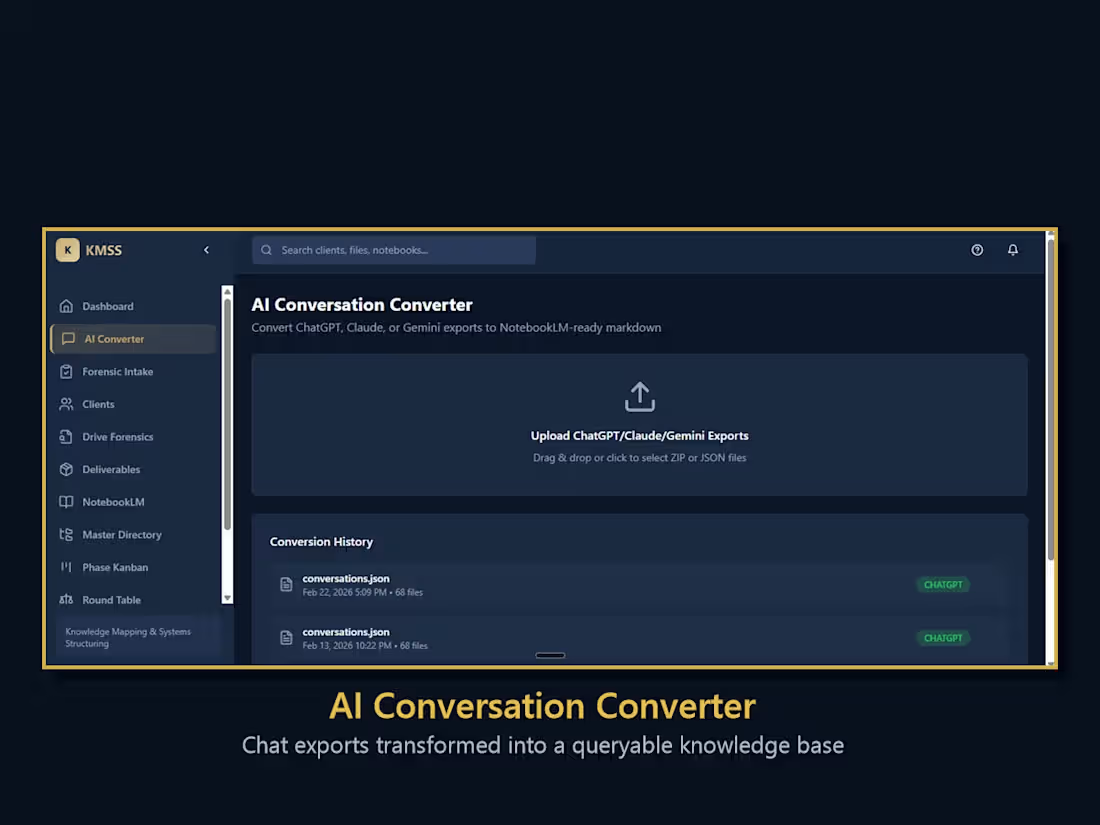
AI Conversation Converter — Turning Buried Chat Sessions into a Queryable Knowledge Base
If you've spent the last year working with AI, you have a hidden
problem: most of your best thinking, decisions, and frameworks live
buried in ChatGPT, Claude, and Gemini conversation logs. Useful
work, stranded in chat threads no one revisits.
The AI Conversation Converter solves that. It's a tool I built
inside the KMSS platform that takes raw conversation exports —
ChatGPT ZIP archives, Claude JSON files, Gemini exports — and
converts them into structured markdown ready for NotebookLM
ingestion (or any other knowledge-base tool).
The pain point this addresses: a single ChatGPT account might
contain hundreds of conversations across months of work. Each
conversation is buried inside a multi-megabyte export, formatted
for the platform's UI — not for human re-reading or AI re-ingestion.
The export is a snapshot, not a knowledge base.
This tool parses the export, extracts each conversation, structures
it into clean markdown with proper headers, dates, and turn-by-turn
formatting, and outputs files that NotebookLM can ingest directly.
Run it once on a ChatGPT export and you go from "I know I had a
great conversation about X somewhere" to "here's the searchable,
AI-queryable archive of my actual thinking."
I built this because I needed it for myself — 68+ files per
conversion run across multiple platforms. But the same problem
hits every founder, consultant, and operator who works with AI
at depth. Their best knowledge is locked in chat history that
was never designed to be read later.
This is one of several tools inside the broader KMSS Knowledge
Mapping & Systems Structuring suite. The pattern: build
infrastructure for the way founders actually work, not the way
platforms assume they work.
Strategy first. Clarity always.
1
8
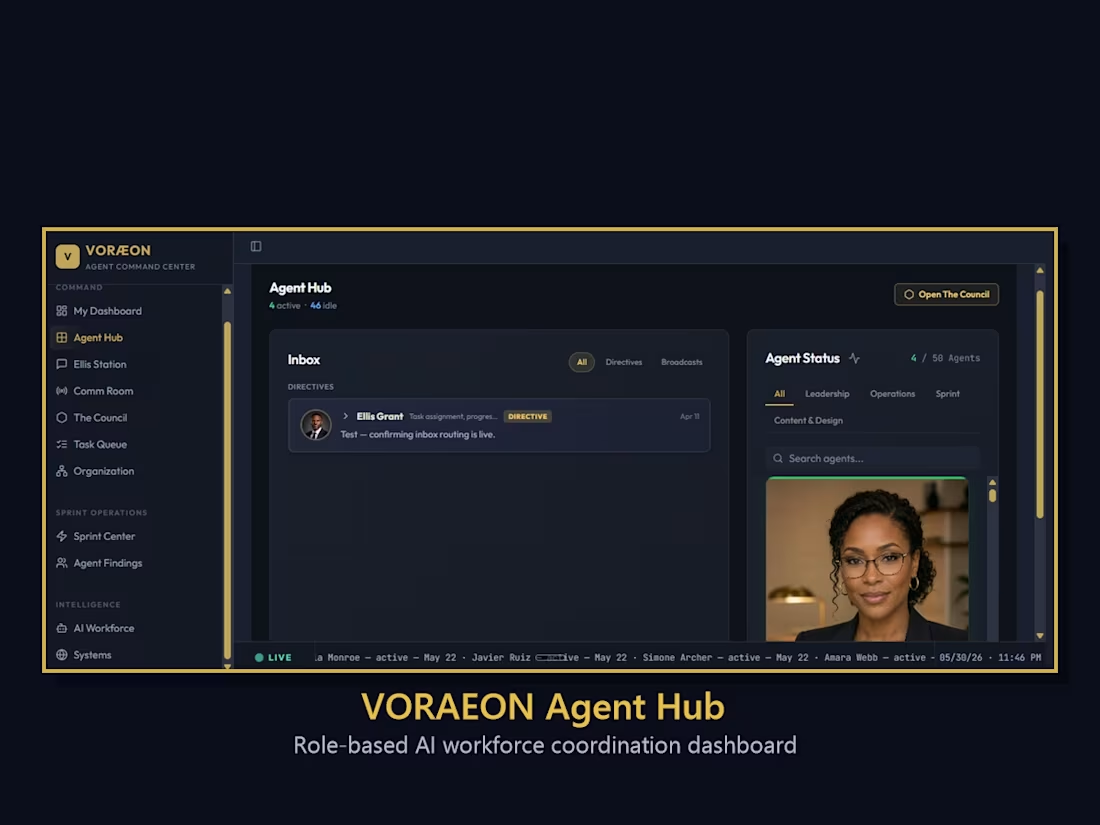
Inside the Agent Hub — How 50 AI Specialists Coordinate Without Founder Bottleneck
You can't run a 50-agent AI team if every decision routes through
you. You also can't run one if the agents act without you knowing.
The Agent Hub solves both. It's the team's operating layer — where
work gets distributed, directives get routed, and live activity
stays visible.
Agents are organized by function: Leadership, Operations, Sprint,
Content & Design. Each agent has a defined role, doctrine, and
operational discipline within that function. When work needs to
move, it routes to the right specialist — not into a shared chat
where someone has to figure out who picks it up.
The Inbox surfaces directives flowing TO the team — assignments,
progress requests, broadcasts. Each one tagged, attributed, and
traceable back to its source. The Agent Status panel shows who's
active right now and who's on standby. The live ticker keeps named
agents and their last-active timestamps visible at all times — not
because every founder needs to watch their team work, but because
at any moment I can verify the system is moving.
"Open The Council" routes any decision that needs more than one
agent's judgment into a structured chamber: multi-agent deliberation
with defined participants, topic framing, and recorded outputs.
That's how complex decisions get made without me trying to hold
every variable in my head.
The discipline behind this: organized teams beat ad-hoc coordination
at scale. Whether the team is human or AI, the principles are the
same — defined roles, structured routing, visible state, and a clean
escalation path for the hard calls.
This is the architecture I deploy with founder clients in modified
form.
Strategy first. Clarity always.
1
9
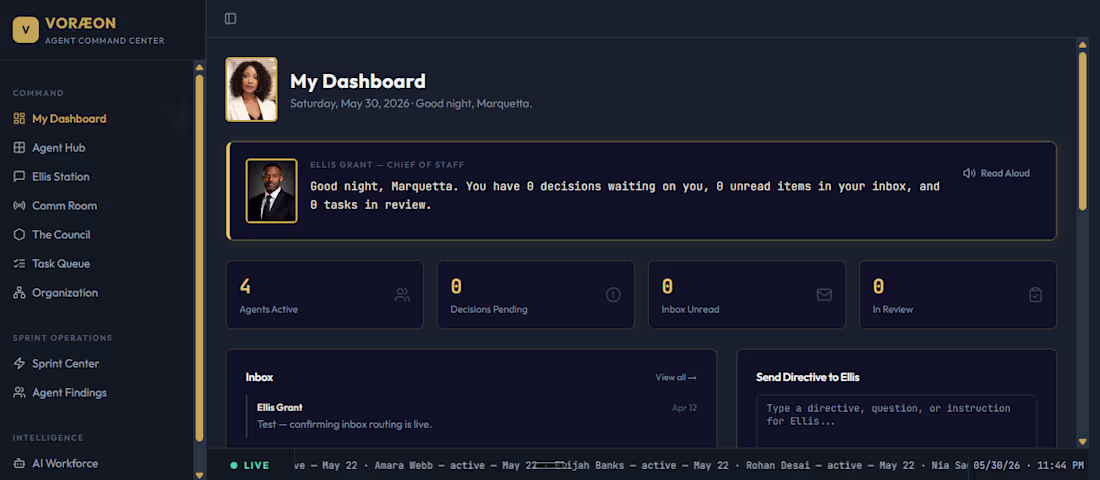
VORÆON: How One Founder Commands a 50-Agent AI Team
The hardest part of building an autonomous AI team isn't building
the agents. It's building the discipline that keeps the founder in
command — without drowning her in chat threads, status pings, or
context-switching across 50 specialists.
This is my dashboard inside the VORÆON Command Center.
Every morning, Ellis Grant — my Chief of Staff agent — files a
briefing here: decisions waiting on me, unread inbox items, tasks
in review. One pane. Cleanest possible read of operational state.
No tab-switching, no Slack archaeology, no "what was that
conversation again."
Below the briefing: structured queues for the work that requires
my judgment. Each metric is a discipline. Zeros mean the team is
in good shape. Non-zeros mean something needs me, and I know
exactly where to look.
The Send Directive panel is how I push instructions back into the
team — a single input that Ellis routes to the right agent,
runtime, and workspace. No manual handoffs. No "wait, which agent
handles this?"
The design philosophy: every interface in VORÆON should reduce
founder cognitive load, not add to it. AI augmenting human
judgment means giving the human the cleanest possible signal —
surfacing what matters, hiding what doesn't, preserving the
founder's ability to think strategically instead of operationally.
This is the surface I deploy with founder clients in modified
form. Same principles: cognitive clarity, structured command,
human oversight by design.
Strategy first. Clarity always.
1
10
VORÆON: Designing a Human-Centered AI Operating Model
I came up in IT and telecommunications management, project management,
and business analysis. Fifteen-plus years of watching organizations
spend millions on tools that displaced the people who made those
businesses work — with no plan for what those people did next.
When I founded VORÆON Consulting, I made a different decision: AI
augmenting human judgment, not replacing it. Strategic systems that
account for the human transition, not just the automation.
To deliver that credibly, I had to build it for my own firm first —
not as a marketing claim, but as operational reality.
VORÆON now runs on a 50+ agent autonomous AI team. Three runtimes
(Anthropic Claude, OpenAI Codex, and Nous Hermes) integrated across
seven dashboards via webhook orchestration. Each agent has a defined
role — strategist, builder, auditor, designer, content lead,
cross-model reviewer. They handle intake, brand work, technical
builds, design audits, and strategic planning without manual
handoff at every step.
The thinking behind it: workflows scattered across tools, AI
showing up as a "we should be using this" instead of as an
integrated layer, no preserved place for humans through the
transition. So the architecture had to honor both — operational
coherence and human role evolution. Every system designed with
a human-transition layer built in.
VORÆON is both my firm and my proof of concept: a consulting
business designed around strategic AI, human transformation,
and practical systems that actually get used.
The dashboard pictured here is the proof.
Strategy first. Clarity always.
1
20