Malaz Aroub's Work | Contra
Work by Malaz Aroub
Sign Up
Post a job
Sign Up
Log In
Malaz Aroub
CTO & Co-Founder of InfiniteUp
Message
Follow
Profile in progress
Malaz is building their profile!
Followed by
InfiniteUp A
,
Studio Kelcy
, and
Andranik T
Amsterdam, Netherlands
Work
Posts
About
Amsterdam, Netherlands
Created
Collaborated
1
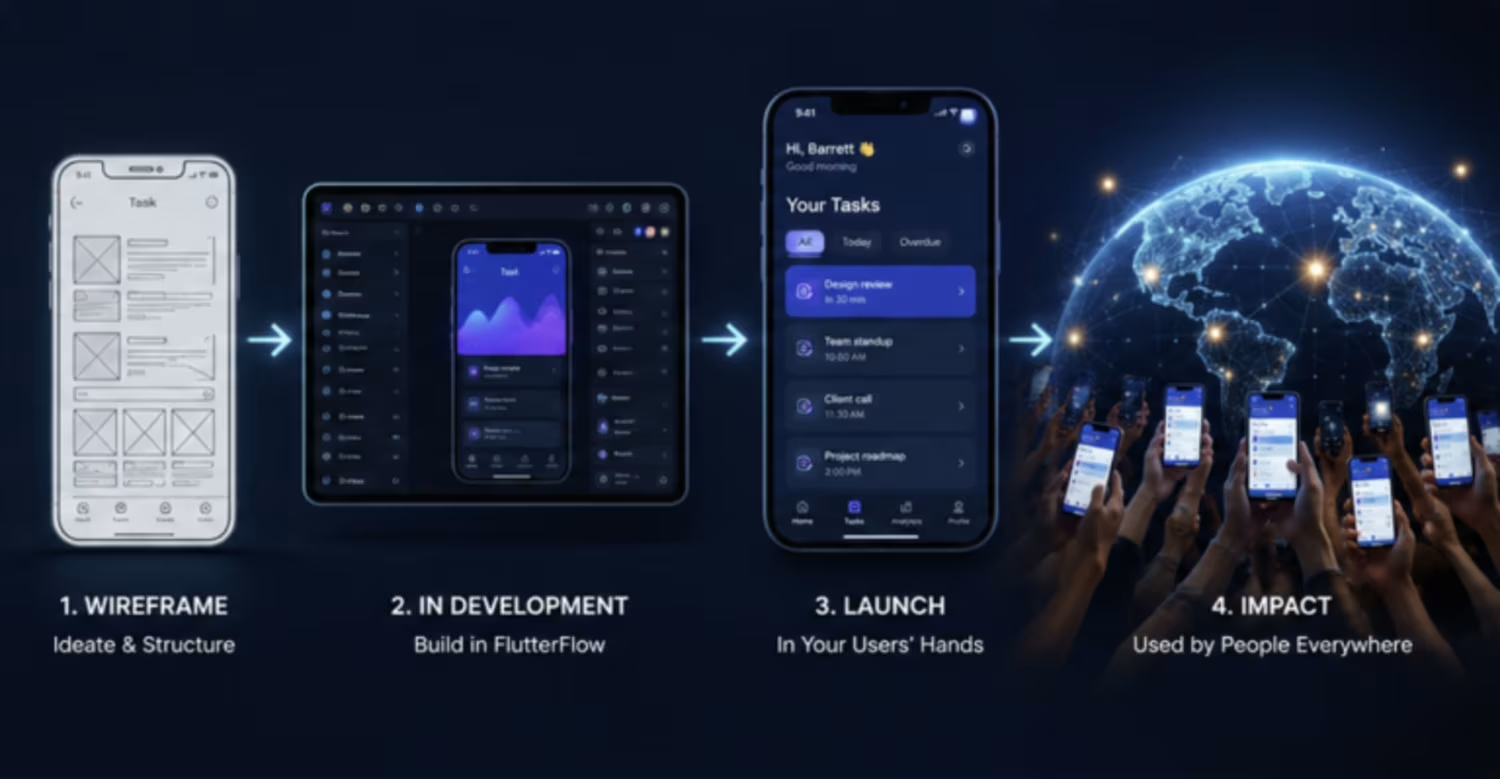
The InfiniteUp Stack: Building Invisible AI By Malaz Aroub, CTO & Co-Founder At InfiniteUp, people often ask how our small, remote team ships complex AI platforms so quickly. The secret isn't a massive engineering department—it's a ruthlessly efficient, model-agnostic tech stack. Here is a look under the hood. Frontend: FlutterFlow & Native Code We use FlutterFlow as our visual IDE. To us, it’s an accelerator that outputs clean, scalable Flutter/Dart code, allowing us to deploy highly responsive, cross-platform UIs (iOS, Android, Web) in weeks. When a project requires deep hardware access, we seamlessly merge in custom native Swift and Kotlin via GitHub. Backend: Firebase & Supabase Our serverless infrastructure is built on two pillars. We rely on Google Firebase for lightning-fast NoSQL data sync, robust Auth, and Cloud Functions (Node.js). When projects require complex relational data or custom Edge Functions (Deno/TypeScript), we deploy Supabase (PostgreSQL). The Intelligence Layer: Our "API Tapestry" We refuse to lock into a single foundation model. Instead, we orchestrate the best tools for the job: - OpenAI (GPT-4o-mini) for blazing-fast logical reasoning, structuring tasks, and generating strict JSON. - Google Gemini for its massive context window, image recognition, and real-time audio. - Anthropic Claude for synthesizing high-density transcripts and deep data parsing. Monetization & Infrastructure We tie the ecosystem together with RevenueCat and Stripe to handle seamless cross-platform subscriptions and payments. Our development philosophy is simple: spend less time fighting boilerplate architecture, and more time building "Invisible AI" that gets out of the user's way. We build the car, not the engine.
1
108