
Lebogang Mohau
Healthcare Excel Specialist |Data Cleaning| Dashboards
New to Contra
Lebogang is ready for their next project!

Interactive Clinical Risks Insights Dashboard
0
17
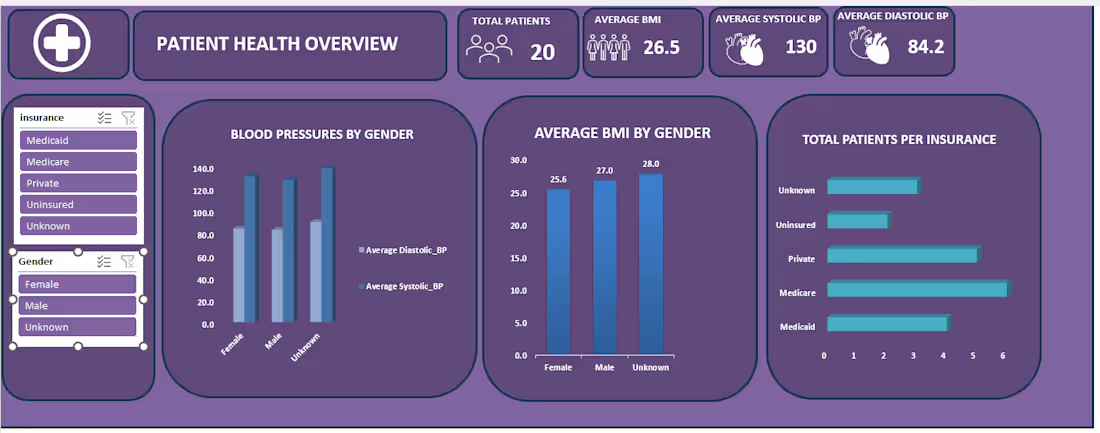
Project Summary: Patient Health Overview Dashboard Interpretation
This report evaluates a cohort of 20 patient records, examining relationships between demographics, physical health indicators (BMI and Blood Pressure), and insurance distribution.
Key Metrics & Cohort Breakdown
Cohort Overview: 20 total patients analyzed across demographic categories.
Core Health Benchmarks: Average BMI stands at 26.5, average systolic blood pressure is 130 mmHg, and average diastolic blood pressure is 84.2 mmHg.
Insurance Coverage: Medicare covers the largest share with 6 patients, followed by Private insurance (5), Medicaid (4), Unknown records (3), and Uninsured patients (2).
Demographic & Vital Trends
BMI Progression: Average BMI increases progressively across demographics, from 25.6 (Female) to 27.0 (Male) and 28.0 (Unknown gender).
Blood Pressure Dynamics: Both systolic and diastolic readings remain consistently elevated across all gender subgroups, indicating systemic hypertension risk.
Actionable Recommendations
Risk Stratification: Initiate clinical monitoring for patients presenting with systolic readings at or above 130 mmHg.
Revenue Cycle Audit: Resolve the 3 Unknown insurance files to eliminate unbilled services and billing errors.
Health Programs: Launch targeted wellness initiatives focused on weight management to reduce overall cohort BMI.
0
24
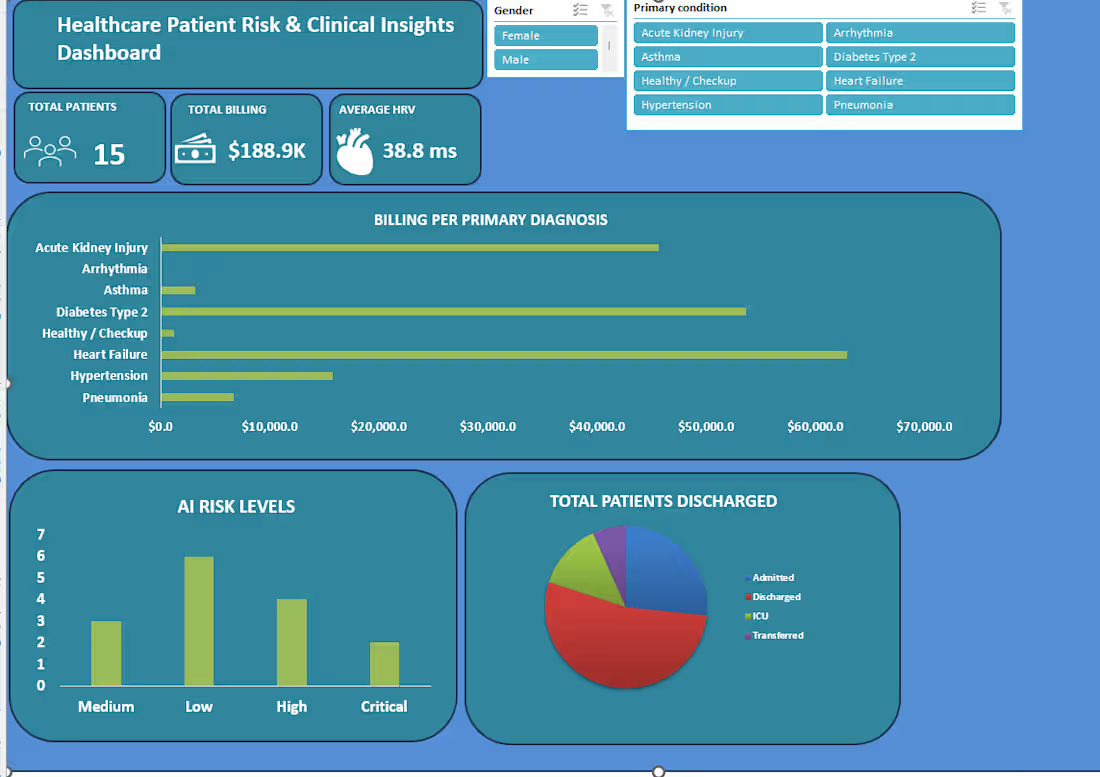
Project Summary: Healthcare Patient Risk & Telemetry Insights
This analysis covers a dataset of 15 patient admissions, evaluating the links between clinical primary conditions, financial billing, AI risk stratification, and wearable IoT device sync performance.
Key Financial & Operational Highlights
Total Billed Revenue: $188,852.00 across all recorded patient admissions.
Average Cost Per Admission: $12,590.13 across all 15 cases (or $15,737.67 when excluding pending or unbilled accounts).
Unbilled / Pending Accounts: 3 out of 15 records (20%) show $0 billed amounts due to pending claims or missing telemetry data audits (Patients P-1005, P-1010, and P-1015).
Highest Revenue Drivers: Heart Failure ($62,900.00 total across 2 patients) and Diabetes Type 2 ($53,600.00 total across 3 patients) account for 61.7% of total revenue. A single Acute Kidney Injury case represents the highest individual charge at $45,600.75.
Primary Condition & Revenue Breakdown
Hypertension: 4 Patients | $15,751.00 Total Revenue | $3,937.75 Average | Low Risk (75%)
Diabetes Type 2: 3 Patients | $53,600.00 Total Revenue | $17,866.67 Average | High / Medium Risk
Heart Failure: 2 Patients | $62,900.00 Total Revenue | $31,450.00 Average | Critical Risk (100%)
Asthma: 2 Patients | $3,100.25 Total Revenue | $1,550.13 Average | Low / Medium Risk
Acute Kidney Injury: 1 Patient | $45,600.75 Total Revenue | $45,600.75 Average | High Risk (Sepsis Protocol)
Arrhythmia: 1 Patient | $0.00 Total Revenue (Pending) | $0.00 Average | High Risk (Cardiac Event)
Pneumonia: 1 Patient | $6,700.00 Total Revenue | $6,700.00 Average | Medium Risk
Healthy Checkup: 1 Patient | $1,200.00 Total Revenue | $1,200.00 Average | Low Risk
AI Risk Stratification & Clinical Alerts
Low Risk: 6 Patients (40.0%) | Standard hypertension, routine asthma, and checkup cases.
Medium Risk: 3 Patients (20.0%) | Stable monitoring for pneumonia and managed conditions.
High Risk: 4 Patients (26.7%) | Directly tied to urgent clinical triggers including Anomalous Spike (P-1002), Sepsis Protocol (P-1006), and Cardiac Event (P-1015).
Critical Risk: 2 Patients (13.3%) | Heart failure cases (P-1003 and P-1011) requiring immediate ICU transfer and continuous cardiology telemetry.
Wearable Tech / Telemetry Performance
Sync Success Rate: 13 out of 15 devices (86.7%) successfully synced Heart Rate Variability (HRV) and sleep efficiency scores.
Device Failures: 2 devices (13.3%) faced connection issues. Patient P-1002 experienced a Partial Sync that hid metrics during an AI spike flag, while Patient P-1005 was completely Offline.
Actionable Recommendations for the Team
Standardize ICU Alerts: Establish immediate transfer protocols for heart failure patients presenting with HRV levels under 20ms.
Resolve Pending Claims: Audit the 3 zero-dollar/pending accounts to prevent revenue leakage.
Telemetry Checkpoints: Implement a pre-discharge checklist ensuring wearable sync verification before sending high-risk cardiovascular or diabetic patients home.
0
72
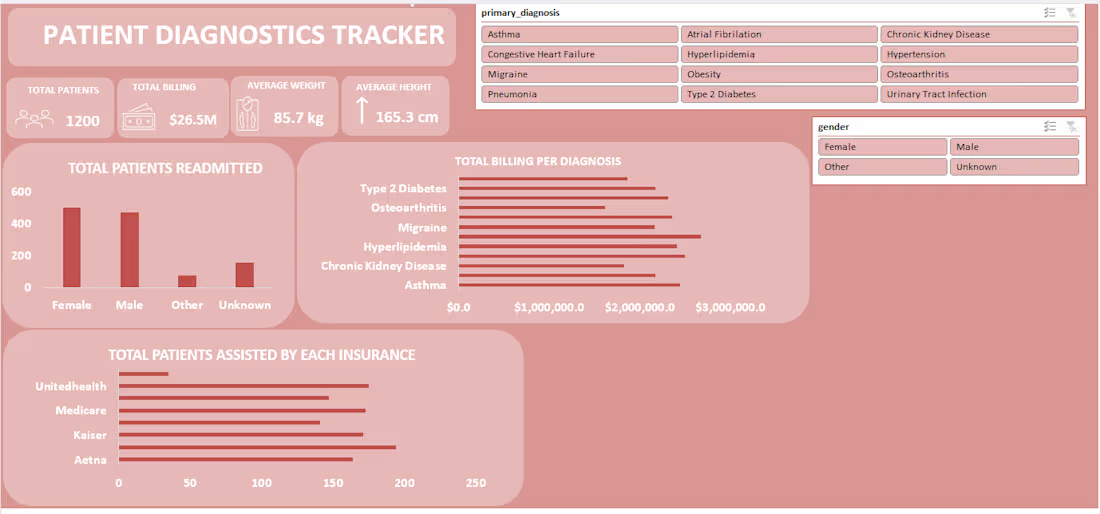
Project Summary: Patient Diagnostics Tracker Dashboard Interpretation
This analysis covers a large cohort of 1,200 patient records, evaluating primary clinical diagnoses, total billing allocations, readmission patterns, physical metrics, and insurance distribution.
Key Metrics & Financial Overview
Cohort Scale: 1,200 total patients tracked across multiple diagnosis and gender groups.
Revenue Breakdown: Total billed charges reach $26.5M, averaging approximately $22.08k per admission.
Physical Averages: Average patient weight is 85.7 kg and average height is 165.3 cm across all demographics.
Readmission & Clinical Trends
Readmission Distribution: Readmissions are heavily concentrated among Female (approx. 500 patients) and Male (approx. 470 patients) groups, with minor counts in Other and Unknown categories.
Financial Revenue Drivers: High-cost diagnoses including Hypertension, Congestive Heart Failure, Type 2 Diabetes, and Hyperlipidemia generate the largest share of overall billing, each approaching or exceeding $2.0M to $2.5M.
Insurance Coverage Insights
Top Payers: Coverage is distributed across major providers, led by top-volume payers (approaching 200 patients) down to specialized plans, ensuring multi-payer revenue streams.
Actionable Recommendations
Readmission Reduction: Focus post-discharge care programs on high-volume male and female cardiovascular cohorts.
High-Cost Care Management: Implement chronic disease protocols for top billing drivers like Heart Failure and Diabetes.
Revenue Optimization: Audit smaller insurance payer contracts to ensure full billing recovery across all patient segments.
0
55