
Laura Olachi
Ghostwriter/ LinkedIn, Articles,Essay writing for busy pros
- 1
- Followers


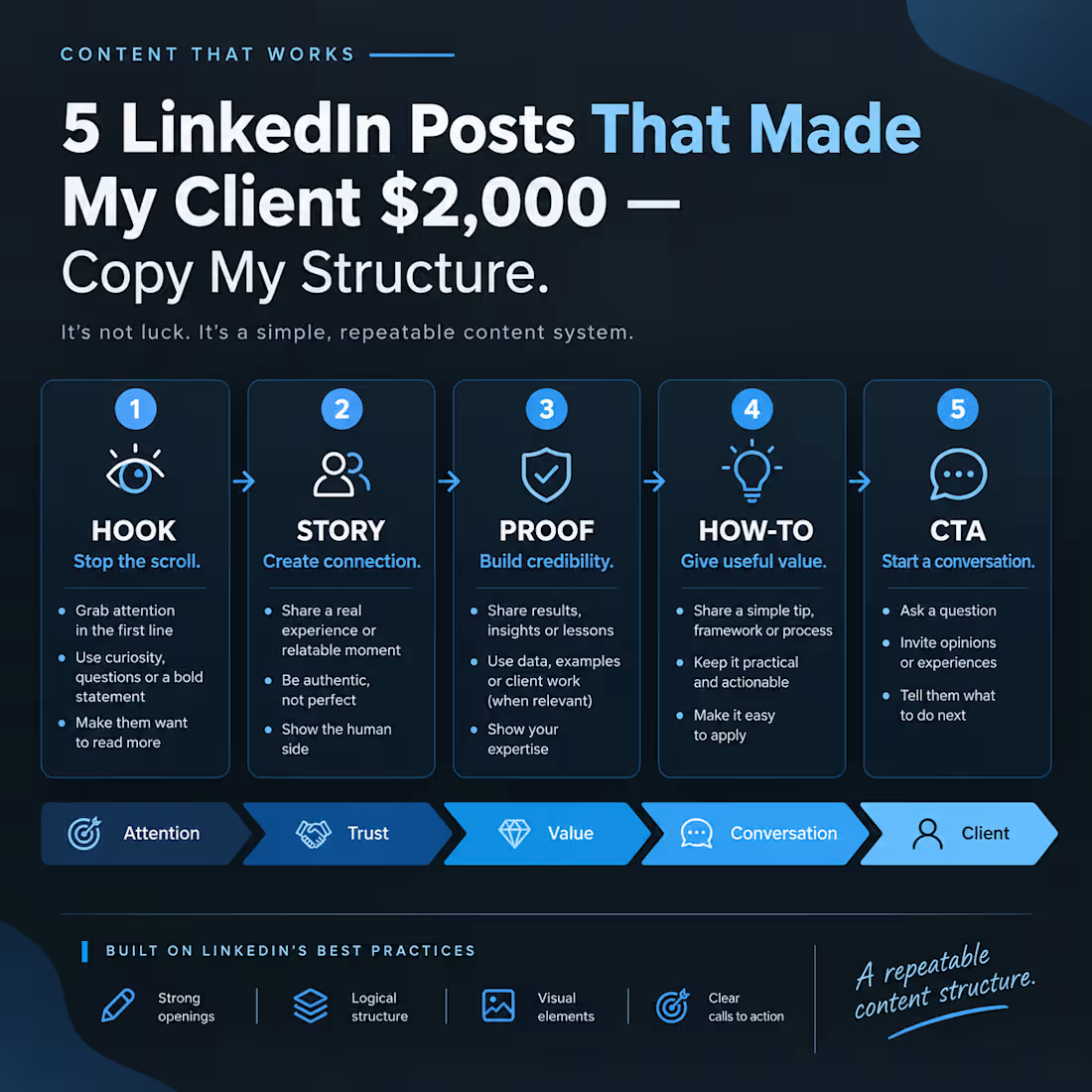
5 LinkedIn Posts That Made My Client $2,000 — Copy My Structure
Most people think LinkedIn content is about posting consistently.
It isn't.
It's about posting with a purpose.
A post can get thousands of views and still bring you zero clients.
Meanwhile, a simple post with the right message, structure, and call-to-action can start a conversation that turns into a paying client.
Here are 5 types of LinkedIn posts I would use to build that kind of content system.
The Hook Post — Stop the Scroll
Your first sentence has one job:
Make someone want to read the second sentence.
Instead of:
«"Here are some tips for growing your business."»
Try:
«"Your content isn't failing because you're inconsistent. It's failing because nobody knows what you're selling."»
A strong hook creates curiosity, identifies a problem, or challenges something your audience believes.
Goal: Get attention.
The Story Post — Create Connection
People don't connect with perfect brands.
They connect with experiences.
Share a mistake you made, a lesson you learned, a difficult moment, or a transformation.
A simple structure:
Problem → Experience → Lesson → Takeaway
For example:
"I spent months trying to sound like an expert.
The result?
My posts sounded polished—but nobody remembered them.
Then I started writing like I was talking to one person instead of an audience.
Engagement changed.
More importantly, conversations started.
The lesson: clarity beats complexity."
Goal: Build connection and trust.
The Proof Post — Build Credibility
Don't just tell people you're good at something.
Show them.
You can share:
A result you achieved
A client transformation
A before-and-after
A lesson from a project
A useful number or insight
A mistake you helped someone avoid
The important part is context.
Don't simply say:
"My client made $2,000."
Explain what happened, what you changed, and what others can learn from it.
That turns a result into a valuable piece of content.
Goal: Demonstrate expertise.
The How-To Post — Give Away Something Useful
One of the easiest ways to build authority is to teach.
Give people something they can actually use.
For example:
How to turn one idea into five LinkedIn posts:
Turn the idea into a personal story.
Turn it into a list of mistakes.
Create a step-by-step tutorial.
Share a surprising lesson.
End with a question that encourages discussion.
Don't worry about "giving away too much."
Useful content gives people a reason to remember you.
Goal: Provide value.
The CTA Post — Start the Conversation
Your content shouldn't always end with:
"What do you think?"
Give people a clear next step.
You could ask them to:
Comment with a specific word
Share their experience
Send you a message
Download something
Book a call
Follow you for more content
For example:
«"If you're struggling to turn your expertise into LinkedIn content, send me a message. I'll show you the structure I'd use."»
A good CTA doesn't pressure people.
It simply makes the next step obvious.
Goal: Turn attention into conversations.
The Real Strategy
These five posts work best together.
Hook → Story → Proof → How-To → CTA
You're not just posting randomly.
You're taking someone through a journey:
Attention → Connection → Trust → Value → Conversation
And that's where content becomes more than content.
It becomes a client-acquisition system.
The biggest lesson?
You don't need to post more.
You need to post with more intention.
Create content that makes people stop.
Give them a reason to trust you.
Teach them something useful.
Then make it easy for the right person to start a conversation.
That's the structure I'd copy.
1
61
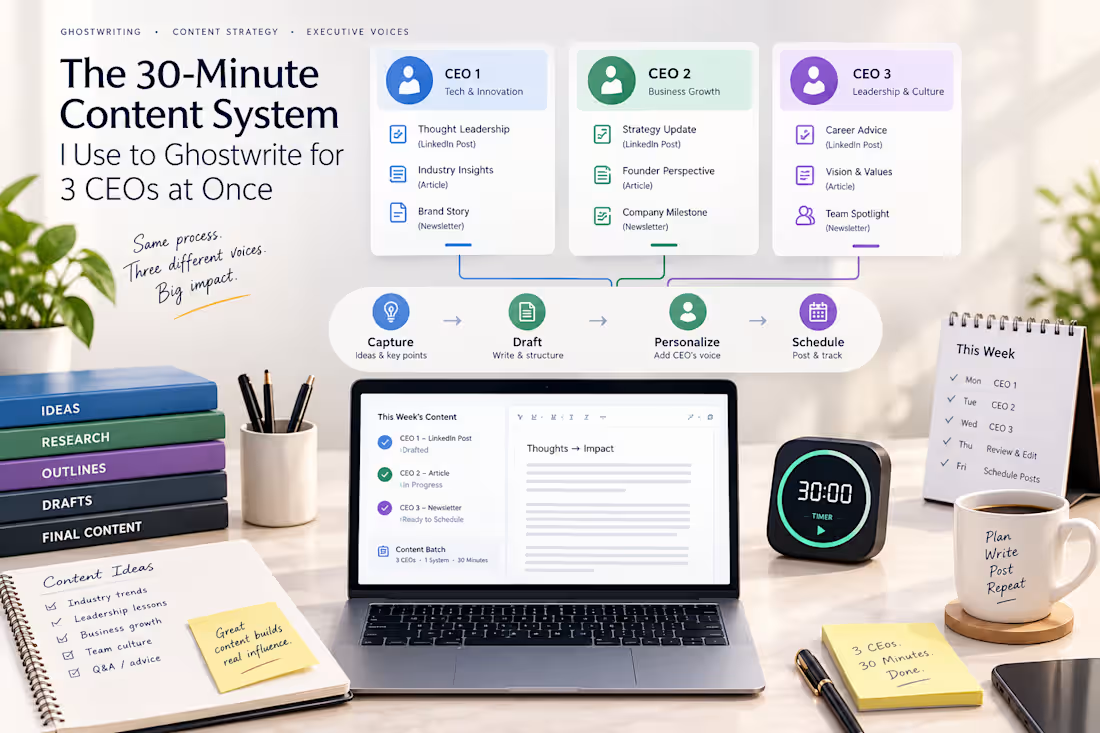
The 30-Minute Content System I Use to Ghostwrite for 3 CEOs at Once
Ghostwriting for one busy CEO requires organization.
Ghostwriting for three CEOs at the same time requires a system.
The biggest mistake a ghostwriter can make is treating every piece of content like a brand-new project. If you start from scratch every time, you spend more time wondering what to write than actually writing.
Instead, I use a simple 30-minute content system that helps me move from ideas to publishable content quickly — without making every CEO sound the same.
Step 1: Capture the ideas
I start by collecting ideas from conversations, voice notes, interviews, company updates, industry news, and things the CEO has recently said.
I don't try to write the entire post immediately.
I simply capture the idea, opinion, story, or lesson.
That gives me a bank of raw material to work with.
Step 2: Create the draft
Next, I turn those ideas into a basic structure.
For example:
Hook → Problem → Personal insight → Lesson → Takeaway
The goal at this stage isn't perfection.
It's momentum.
Once the structure is clear, writing becomes much faster.
Step 3: Add the CEO's voice
This is where ghostwriting becomes more than simply "writing a good post."
CEO #1 might be direct and analytical.
CEO #2 might be conversational and story-driven.
CEO #3 might be motivational and focused on leadership.
The subject can be similar, but the voice, perspective, vocabulary, and personality need to feel completely different.
A good ghostwriter doesn't just write for the client.
They write as the client.
Step 4: Schedule and track
Once the content is edited and approved, I organize everything into a simple content calendar.
I track:
What's drafted
What's being reviewed
What's approved
What's scheduled
What has already been published
This prevents content from becoming a pile of unfinished documents.
The secret isn't writing faster
It's building a repeatable process.
When the system is clear, 30 focused minutes can go a surprisingly long way.
Instead of asking:
"What should I write today?"
I can ask:
"Which idea belongs to which CEO, what is their perspective, and where is it in the workflow?"
That's the difference between simply being a writer and becoming a content partner.
My 30-minute workflow:
Capture → Draft → Personalize → Schedule → Repeat.
Three CEOs.
Three different voices.
One organized system.
And most importantly, content that still sounds like the person behind the name.
1
60
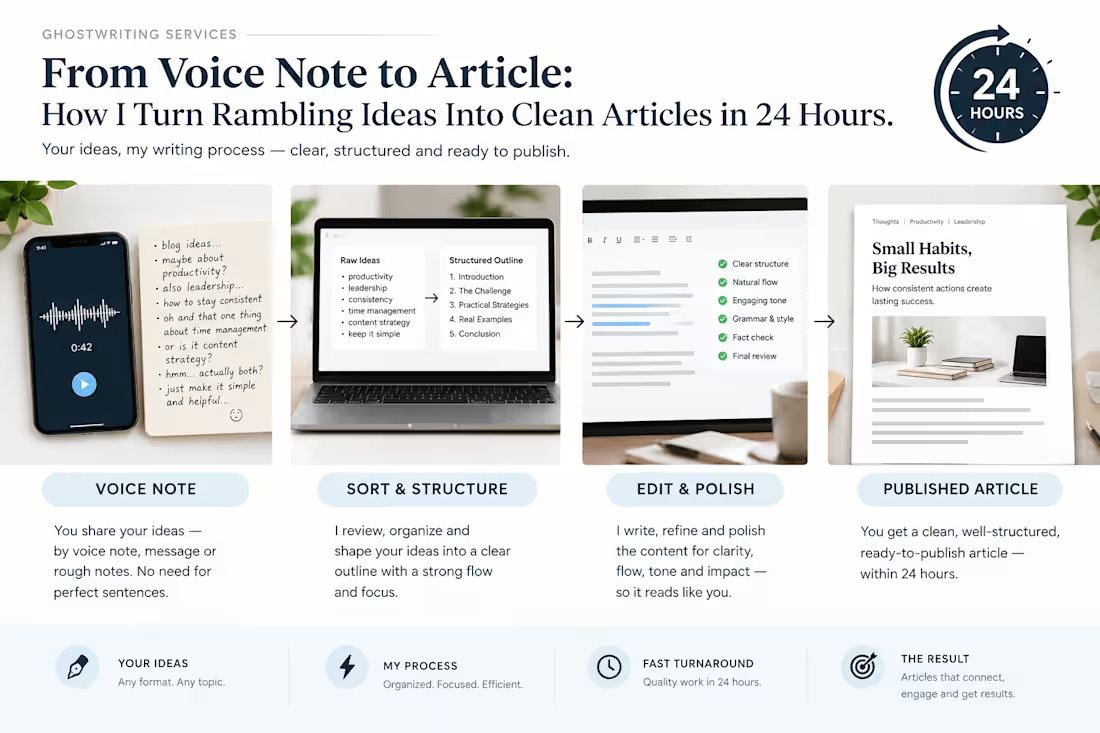
From Voice Note to Article: How I Turn Rambling Ideas Into Clean Articles in 24 Hours
You don’t need to be a great writer to have great ideas.
Sometimes, the best ideas come while you’re driving, walking, working, or simply thinking out loud. You record a quick voice note, send a few messages, or write down a messy collection of thoughts.
The problem?
Turning those thoughts into a clear, engaging article can take hours.
That’s where ghostwriting comes in.
You Send Me the Raw Ideas
You don’t need a perfect outline.
You can send me a voice note, rough notes, bullet points, messages, or even a simple explanation of what you want to say.
Your ideas can be messy.
That’s okay.
My job is to understand the message behind them.
I Find the Story and Structure
Once I have your ideas, I organize them.
I identify the main message, remove unnecessary repetition, connect related thoughts, and create a structure that makes sense to the reader.
Instead of having ten scattered ideas, we turn them into one clear story.
I Write It in Your Voice
Good ghostwriting shouldn't make you sound like someone else.
The goal is to take what you already think and express it in a way that is clear, natural, and engaging.
I focus on:
Clear language
Strong openings
Smooth transitions
A natural tone
Easy-to-follow structure
A conclusion that leaves an impression
The finished article should feel like something you could genuinely say — just more polished.
I Edit and Polish the Final Draft
Before the article is ready, I go through it again.
I remove awkward sentences, tighten the writing, improve the flow, and make sure every section contributes to the main idea.
The result isn't just grammatically correct writing.
It's content that is easier to read, understand, and remember.
From Rambling Thoughts to Publish-Ready Content
What started as a 5-minute voice note can become a complete article.
You don't have to spend your evening staring at a blank document trying to figure out how to organize your thoughts.
You bring the ideas.
I turn them into words.
And when you need consistent content, this process can become a simple system: share your thoughts, let me shape them, review the draft, and publish.
Your ideas don't need to be perfectly written.
They just need to exist.
That's where I come in.
If you have a voice note, rough idea, or half-written thought sitting in your phone right now, it could be the beginning of your next article.
3
150

How Busy CEOs Post Every Day Without Writing a Single Word
You see a CEO posting on LinkedIn every morning.
A thoughtful lesson from a recent meeting.
A story about a business mistake.
An opinion about leadership.
A useful lesson for other entrepreneurs.
And you might wonder:
When do they actually have time to write all of this?
The answer is simple: many of them don't.
They have something better—a system.
CEOs Don't Need More Time. They Need a Better Content System.
Running a company already takes up most of a CEO's day.
There are meetings, emails, employees, customers, strategy sessions, presentations, partnerships, and countless decisions.
Finding another two hours every day to sit down and write a polished LinkedIn post isn't realistic for most busy executives.
But here's the thing:
CEOs already have the content.
Their experiences are content.
Their conversations are content.
Their mistakes are content.
Their opinions are content.
Their lessons are content.
The real challenge is turning those ideas into something their audience can read and engage with.
That's where a content system—and often a ghostwriter—comes in.
1. They Capture Ideas Instead of Writing Posts
A CEO doesn't need to stop everything and write a 500-word article whenever an idea comes to mind.
They can simply record a quick voice note.
For example:
"I had a conversation with a client today, and it reminded me why we shouldn't confuse growth with progress..."
That's enough.
A ghostwriter can take that raw thought, understand the message behind it, and turn it into a polished post that still sounds like the CEO.
The CEO provides the expertise.
The writer provides the structure.
2. They Turn Everyday Experiences Into Content
Some of the best content doesn't come from sitting at a desk trying to "think of something to post."
It comes from real life.
A difficult conversation with an employee can become a leadership lesson.
A failed product launch can become a story about learning from mistakes.
A customer complaint can become a lesson about business.
A successful project can become a breakdown of what worked.
CEOs are constantly experiencing things worth sharing.
They simply need a way to capture those experiences before they disappear into the next meeting.
3. They Repurpose What They've Already Created
One idea can become multiple pieces of content.
A podcast interview can become several LinkedIn posts.
A presentation can become an article.
An email to a team can become a leadership lesson.
A conference speech can become a series of short posts.
A single conversation can even produce several different perspectives.
This is one of the biggest advantages of having a content system:
You don't always need more ideas. You need to use your existing ideas better.
4. They Don't Try to Sound Like Everyone Else
Good ghostwriting isn't about making every CEO sound like a professional writer.
In fact, it should be the opposite.
The goal is to make the content sound like them.
Their vocabulary.
Their opinions.
Their experiences.
Their sense of humor.
Their way of explaining things.
A good ghostwriter studies the client's voice and turns rough thoughts into clear writing without removing the personality behind them.
The finished post shouldn't feel like a stranger wrote it.
It should feel like the CEO finally had time to say what they were already thinking.
5. They Separate Expertise From Execution
This is perhaps the biggest reason busy executives use ghostwriters.
The CEO doesn't need to become a full-time content creator.
They need to remain a CEO.
Their job is to lead the company, make decisions, build relationships, and use their expertise.
The writer handles the process of turning that expertise into content.
Idea → Draft → Edit → Publish.
The CEO may only need to provide the first step.
The Real Secret Behind Consistent CEO Content
Consistent posting isn't necessarily about having unlimited time.
It's about having a repeatable process.
A simple system might look like this:
Capture → Organize → Write → Edit → Publish → Repurpose
The CEO shares ideas whenever they naturally occur.
Those ideas are collected and organized.
A writer turns them into content.
The CEO reviews the finished pieces.
Then the content is published and reused across different platforms.
Suddenly, posting every day doesn't require the CEO to spend every day writing.
Great Ideas Don't Need Hours of Writing
The next time you see a busy CEO posting consistently, remember that you may not be seeing the hours of work behind the post.
You may be seeing a system.
Behind one polished post could be a five-minute voice note recorded between meetings.
Behind another could be a lesson from a conversation that happened weeks ago.
And behind several posts could be one podcast interview that was repurposed into an entire content series.
That's the power of a good content system.
And that's the power of ghostwriting.
The CEO brings the knowledge.
The ghostwriter brings the words.
The audience gets the value.
Because sometimes, the best way for a busy CEO to say more isn't to write more.
It's to have the right person turn their ideas into words.
1
67