Línea de Sangre
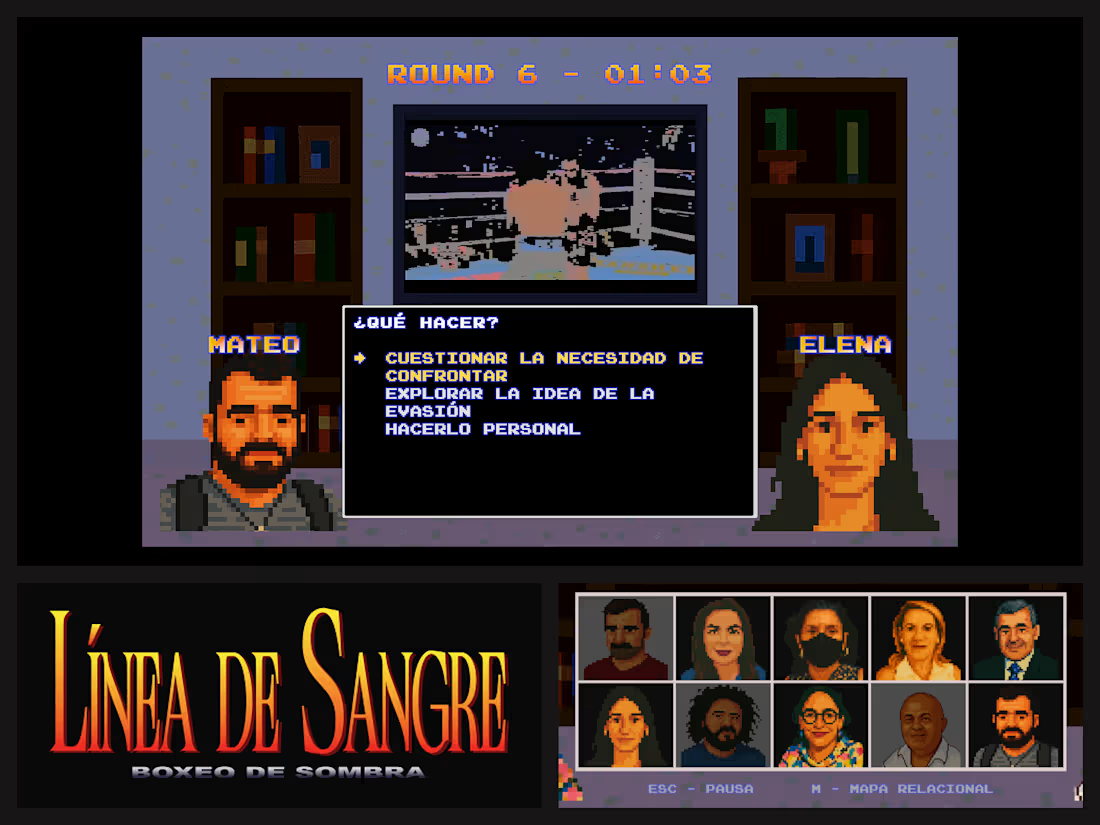
Línea de Sangre — Boxeo de Sombra is a narrative interactive game that uses the videogame format to explore confrontation as a form of bonding. Set during the night of December 8, 2012—coinciding with the fourth fight between Juan Manuel Márquez and Manny Pacquiao—the game transposes the tension of the boxing ring into a domestic setting, where conflict unfolds through language rather than physical blows.
Players inhabit different family members and engage in conversational encounters that function as moments of combat, revealing how power, affection, and inheritance circulate within the family space. For this project, the game was developed using AI-driven systems to handle the logic of conversations and confrontations, allowing dialogue to operate as both narrative progression and combat mechanic. Rather than representing violence directly, Línea de Sangre proposes inhabiting conflict through words, understanding confrontation not as rupture, but as a mode of recognition.
→ Download the game for Mac (in Spanish) (https://www.dropbox.com/scl/fo/459bte117v806dzo6ookt/AGT3BAdiT7UQqpmiQ8tV_40?rlkey=l2aq2k4nc4rhxstynh99hk78r&dl=0)
→ Download the game for PC (in Spanish) (https://www.dropbox.com/scl/fi/tux2nnaetwpjm51zjqja6/Linea_de_Sangre_v0.1_fixed.zip?rlkey=nvoi9n7e7dp64n1u94s66m9fi&e=1&dl=0)
0
10
Vestigia Futura
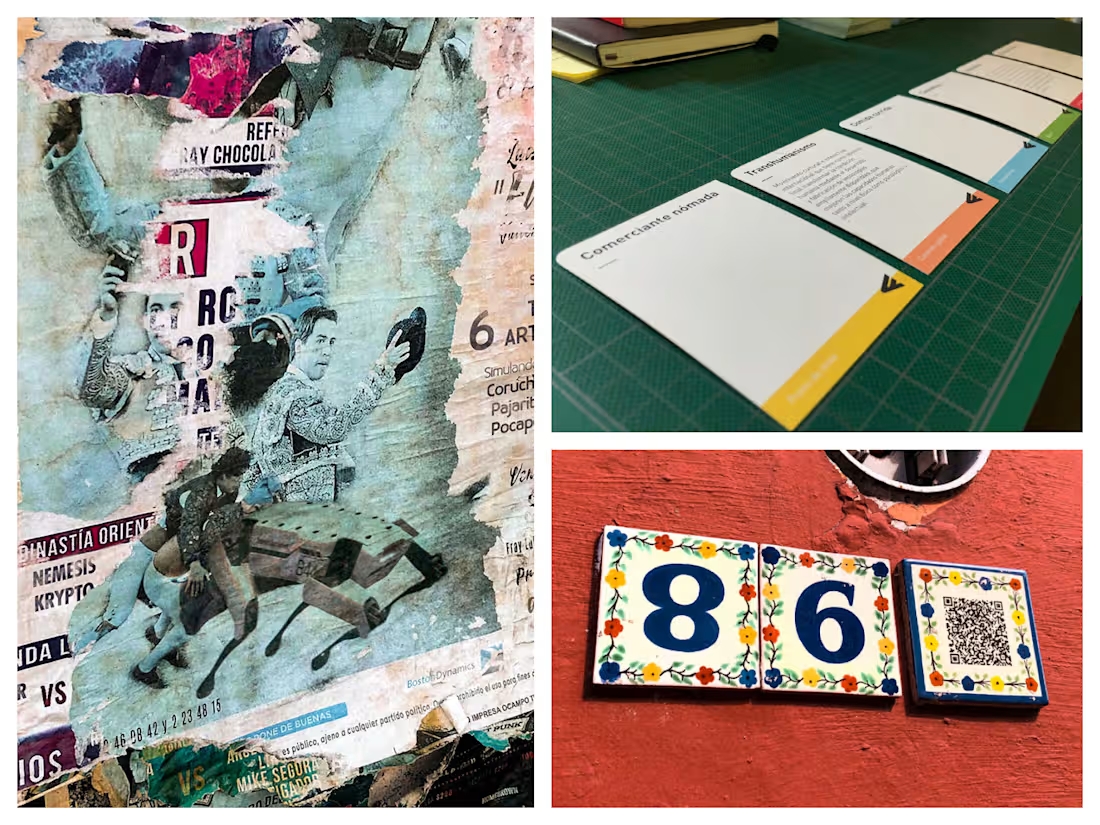
Vestigia Futura is a transdisciplinary speculative project that seeks to materialize glimpses of possible futures for Mexico, both physically and digitally.
Its goal is to tell stories about the implications of technological development on our decision-making capabilities, which in turn shape our political, social, and cultural lives.
It is at the same time a workshop series and a laboratory where people create fictional narratives and artifacts that serve as materialized critique, visualizing consequences of contemporary issues mediated by technology.
The narratives and artifacts also act as provocations or discussion catalysts, fostering the creation of new ways of being that challenge our notions of the present and the future.
For this project I developed a toolkit that guides the formulation of different future scenarios in order to create tangible artefacts. The toolkit is composed by a deck of cards that participants use to negotiate their views about the future, and a set of worksheets that orient and track their narratives.
0
14
Lo único que nos queda es el futuro
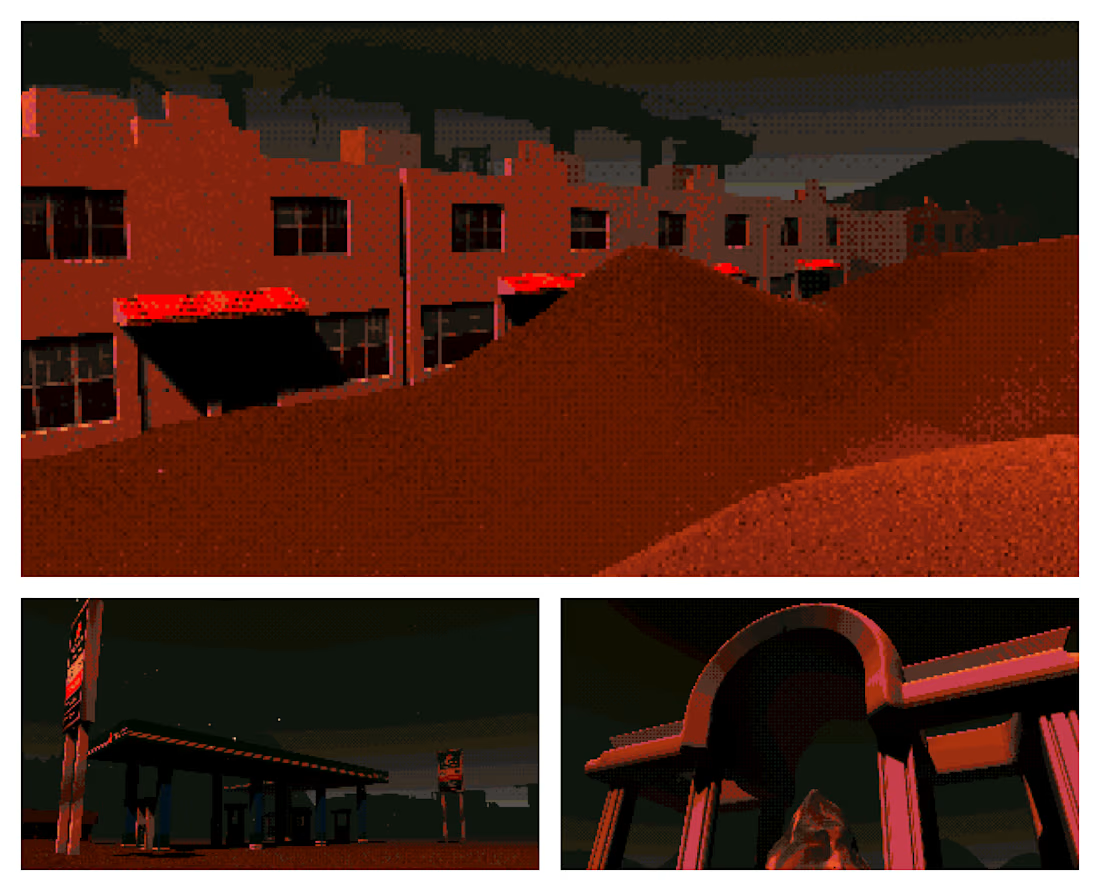
A co-creation project focused on producing (post)post-apocalyptic narratives and artifacts that question how deeply rooted apocalyptic imaginaries shape our capacity to envision the future.
Through a workshop and a walking simulator built from participants’ stories, the project invites participants to encounter, question, and collectively dismantle visions of the end of the world, reframing the future as something actively constructed through critical hope rather than despondency.
The first version of the game was developed during the Agential Worldbuilding class taught by Viktor Timofeev and Blake Andrews at the School for Poetic Computation.
0
28
Cultivating social imaginaries toward flourishing peace
In the 2020s, peacekeeping was transformed into a predictive and preventative endeavor through widespread datafication. In the span of a few years, machine learning flattened the world into a supposed comprehensive codex for future prediction. By 2027, peacebuilding was preached on the contention of conflicts by algorithmically considering all past data points of human interaction. The assumption was that stability and the absence of friction, policed by quantification and automation, would inescapably lead to peace.
However, new dimensions for conflict were instead opened. Predictive peacekeeping transformed citizens into objects onto which conflict suppression machines were deployed. Conflict erasure became future erasure as common histories were reduced to data points. By the 2030s, multilateral peacebuilding institutions could not ignore the deafening murmurs of citizens deprived of past and future imaginaries any longer.
Murmur Community was born as a reaction to decades of solution-based approaches that conceived peace as a homeostatic end state. Instead, Murmur seeks to reimagine peaceful futures as dynamic and reflexive processes. Peacebuilding involves recovering and unfolding a plurality of voices to articulate social tensions, conflicts, limitations, and failures. Murmur Community activates the global citizenry, especially the historically excluded, oppressed, and marginalized, as the primary actors of peacebuilding in an effort to create imaginaries of belonging that reframe and surpass current cultural and national understandings.
This project was selected by the Innovation Cell of the UN Department of Political and Peacebuilding Affairs (DPPA) (https://dppa.un.org/en) and Design Futures Initiative (DFI) (https://www.futures.design/) as part of the Futuring Peace initiative (https://www.futures.design/futuring-peace) celebrating the 75th Anniversary of the United Nations.
0
21
¿Está sufriendo de encanto?
An interactive performance exploring the oscillating nature of enchantment and disenchantment, power dynamics, and the forms of disillusionment associated with contemporary creative practices.
For this project, I developed a web app that allowed audience members to actively participate in the performance by sending messages from their mobile devices. These messages appeared live within the visual system, responding to prompts and questions about their own disenchantment with artistic production. By integrating audience input into the visuals, the performance sought to blur the boundaries between spectatorship and participation, turning personal expressions of disillusionment into a collective, visible layer of the event.
0
25
Map of Geneva for Autonomous Vehicles
When investigating “what if” scenarios around automated driving and the implications for urban policy, it is easy to skip over uncomfortable details in favor of the “big picture”. We created a physical map for a city as might be given out to the public to generate debates about the challenges that would be faced, the failures that might occur, the brand names of services, new kinds of signage, etcetera. It particularly shows how:
Urban traffic may be reconfigured and redefine what is acceptable on certain streets (pedestrian movements, presence of non-autonomous vehicles)
The energy infrastructure needed for this technology to happen
The map acts as a tangible future for a group of people with conflicting opinions to debate about the uses of Autonomous Vehicles and their implications. It was commissioned to the Near future Laboratory by Département de la Mobilité de l’Etat de Genève.