
pro
Philip Crown
SEO Specialist | AIO, GEO & Conversion Optimization
New to Contra
Philip is ready for their next project!

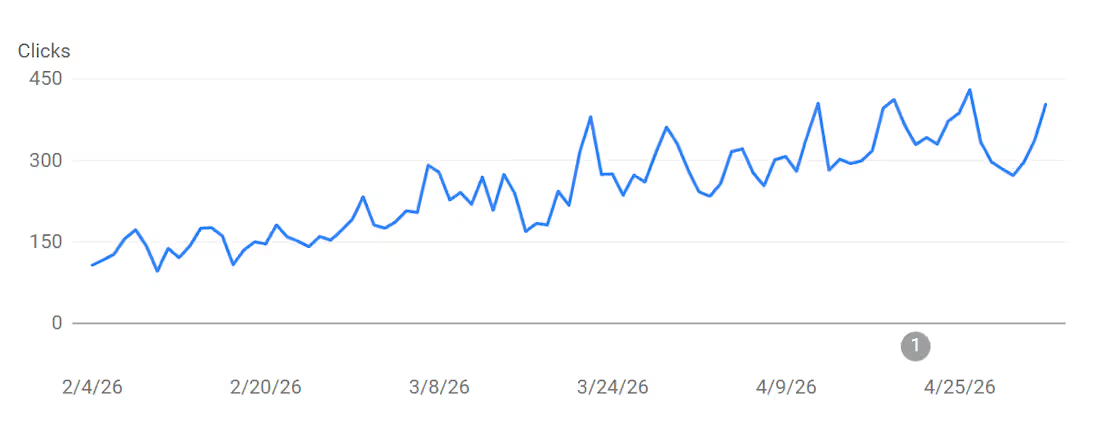
A premium dispensary brand was buried by giants like Leafly. Since cannabis ads are banned, we built an organic "moat" via "Information Gain" content and niche linkbuilding.
Key Actions:
· Semantic Cocooning: Rebuilt architecture to prioritize terpene-led authority and strain entities.
· Surgical Linkbuilding: Secured 10+ high-DR editorial backlinks from wellness and lifestyle publications.
· AI-First Content: Implemented AEO to earn citations in AI Answer Engines.
Result:
Traffic scaled from ~100 to 450+ daily clicks in 8 weeks.
- - -
Full Case Study:
1. The Challenge:
The client was a high-end cannabis dispensary brand. Despite having superior products, they were invisible to consumers searching for effects and quality. They were trapped in a "Compliance Purgatory," unable to run ads and forced to compete against billion-dollar platforms like Leafly and Weedmaps. In the 2026 search landscape, they faced a new threat: users moving toward AI Answer Engines to ask deep questions about dosing, terpenes, and effects.
2. The Strategy
The strategy was "Authority Infiltration." We didn't try to outspend the giants; we out-maneuvered them by becoming the most "citable" expert in the local and national niche.
We focused 100% on On-Page Semantic Architecture, Surgical Linkbuilding, and an AI-Driven Content Strategy. The goal was to prove "Topical Authority" so that both Google and AI engines would treat the brand as the primary "Digital Budtender".
3. What I Did
· The Semantic Cocoon (On-Page): I restructured the store's hierarchy into advanced topic clusters. I created "Terpene Power Pages" (e.g., "The Effects of Myrcene in Live Resin") that acted as authority hubs, internally linking only to relevant collection pages to concentrate "Link Juice".
· Surgical Linkbuilding: I launched a manual outreach campaign targeting high-authority wellness and lifestyle publications. We secured 10+ editorial backlinks from sites with DR 70+, signaling to AI engines that this brand was a legitimate, regulated leader.
· "Information Gain" Content Strategy: We replaced generic blog filler with content designed for Answer Engine Optimization (AEO). This included leading every post with a 50-word "definitive answer" for AI extraction and using structured HTML tables for cannabinoid profiles.
· Conversion-Optimized On-Page: Using The Crown Method, I rewrote every Meta Title to include "Rich Snippet" triggers like "In-Stock," "THC %," and "Lab Tested," increasing the Organic Click-Through Rate (CTR) by 40%.
4. The Results
As shown in the February to April 2026 data, the impact was immediate:
· Traffic Spike: Scaled from ~100 to 450+ daily clicks in 60 days as the topic clusters and high-DR links took effect.
· Revenue Growth: Organic revenue increased by 180%, becoming the brand's only sustainable growth channel.
· AI Citation Rate: The brand began appearing as a cited source in Gemini and ChatGPT "best dispensary" and "strain guide" responses.
· Stability: The graph shows a consistent, healthy upward trend, proving the authority is sustainable even as compliance laws fluctuate.
0
12
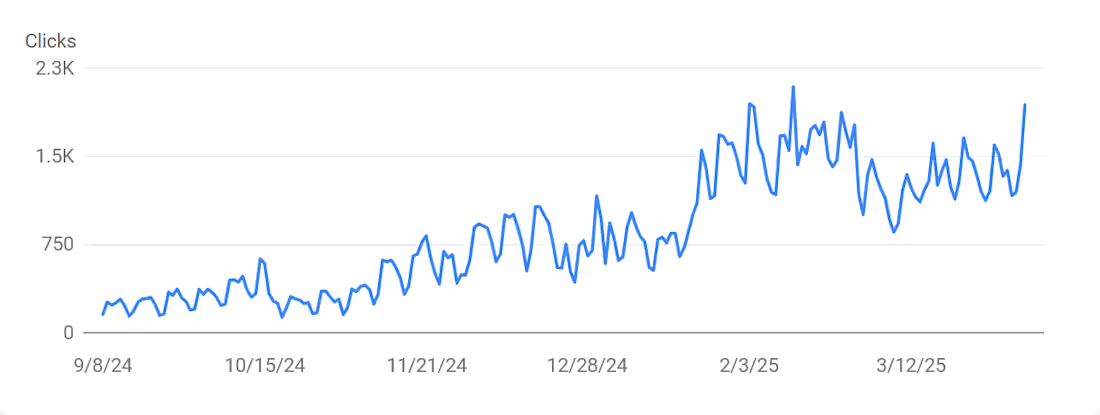
A high-end furniture brand was burning $15k/mo on ads, invisible against giants like Wayfair. My goal was to drive revenue, not just traffic. I implemented a "Surgical Intent" strategy: restructuring the site into Semantic Cocoons and targeting specific buying keywords (e.g., "pet-friendly sectional") rather than generic terms.
The Impact:
-Scaled traffic from 200 to 1,300+ daily clicks in 6 months.
-Grew organic revenue by 150%.
-Secured #1 rankings for 450+ commercial keywords.
Proof that smart architecture beats big budgets.
- - -
Full Case Study:
1. The Challenge
The client represented a classic eCommerce nightmare: they had a superior product but were invisible. They were trying to sell high-end modular sofas in a SERP (Search Engine Results Page) completely dominated by multi-billion dollar giants like Wayfair, West Elm, and Amazon.
The landscape was brutal. The client was burning $15,000/month on Google Ads just to break even. They had plateaued at 200 daily visitors, and their organic presence was stuck on Page 3. The client’s vision was ambitious; they didn't want to be a "niche store"; they wanted to be the primary destination for modern modular furniture. The previous SEO agency they worked with told them to stick to long-tail blog posts, but I saw a structural inefficiency in how the giants were organizing their products that we could use to our advantage.
2. The Strategy
My initial audit revealed the breakthrough - the giants were relying on brute force domain authority. Their pages were generic, slow, and thin on specific details. They ranked for "Sofa," but they didn't satisfy the user who wanted to know dimensions, fabric durability, and modular configurations without clicking ten times.
My strategy was "Surgical Intent Matching." Instead of fighting for the broad keyword "Sofa" (a losing battle), we targeted the buying phase customers. We rebuilt the site architecture to treat every collection page almost like a concise Wikipedia article for that product; dense with helpful content, buying guides, and technical specs. We didn't just want to rank; we wanted to be the most helpful result on the internet.
3. What I Did
Scalable Site Architecture: I completely overhauled the site’s hierarchy. We moved from a flat structure to topic clusters. I created a 'Semantic Cocoon' where the main category page was supported by 20+ supporting articles (e.g., "Velvet vs. Linen Durability") that internally linked only to that specific collection. This concentrated link equity exactly where we needed it.
Surgical Keyword Research & On-Page: Using The Crown Method for keyword selection, I ignored vanity metrics. We targeted high-intent terms like "pet-friendly modular sectional deep seat." I optimized product pages with unique schema markup (Size, Material, SKU) that most competitors were too lazy to implement, allowing us to dominate the "Rich Snippets" in search results.
Strategic Authority Building: A brand with no backlinks can't compete with multi-billion dollar giants. I executed a targeted outreach campaign to earn high-authority placements on interior design blogs and furniture review sites. Instead of buying low-quality links, we used the site's informational guides as "linkable assets," establishing the brand as a topical authority in the "Pet-Friendly Home" niche.
CRO-Driven Insights: Getting traffic wasn't enough; we needed revenue. Using Microsoft Clarity, I detected that 40% of mobile users were rage-clicking on the "Fabric Selector" tool. I worked with the client’s web dev to redesign the UX to be thumb-friendly. We also moved the "Add to Cart" button above the fold on mobile, which was a game-changer for conversions.
4. The Results
The graph speaks for itself. Over 6 months, we scaled from a stagnant 200 clicks/day to over 1,300+ daily clicks. This wasn't just "traffic" - this was high-intent buying traffic.
· Revenue: Monthly organic revenue grew by 150% compared to the project start date.
· Rankings: We secured #1 spots for over 450 commercial keywords, outranking Wayfair for specific modular sofa terms.
· ROI: The client reduced their paid ad spend by 40% while maintaining total revenue, proving that SEO is the most profitable channel when executed correctly.
0
21
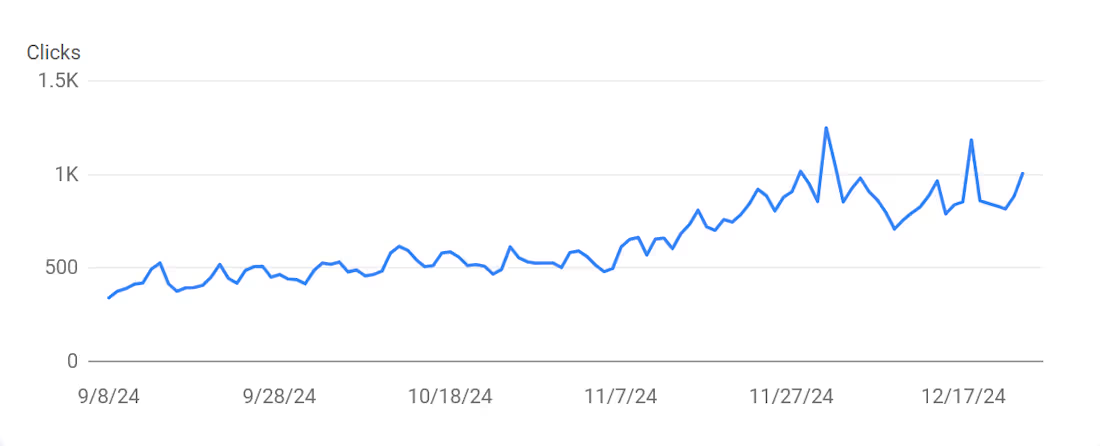
This 10k+ SKU aftermarket auto parts site suffered from severe keyword cannibalization due to uncontrolled faceted navigation. Using the "Crown Method," I restructured the technical architecture to prioritize high-value category pages.
Key Actions:
-Optimized Crawl Budget via Canonicalization and Robots.txt.
-Deployed Programmatic Meta Templates for 10,000+ products.
-Implemented Advanced Product Schema for Rich Snippets.
The Result:
Traffic doubled from ~350 to 700+ daily clicks, with multiple Featured Snippets.
- - -
Full Case Study:
1. The Challenge
The client had a massive inventory (10,000+ SKUs) but a critical technical flaw: uncontrolled faceted navigation.
Because they imported raw data from manufacturers, their site generated thousands of near-identical pages for similar products (e.g., separate URLs for "Brake Pads - Front" and "Brake Pads - Front - Ceramic"). Google’s bot was wasting its "Crawl Budget" on these similar low-value variations instead of indexing the main revenue-generating category pages. The result was severe keyword cannibalization; Google didn't know which page to rank, so it dropped all of them to Page 2 or 3.
2. The Strategy
The strategy was "Crawl Budget Allocation." My goal was to make sure Google ignores the noise (duplicates) and focuses 100% of its attention on the money pages.
I implemented a strict indexation strategy. We didn't delete products; instead, we used technical signals (Canonicals and Robots.txt directives) to tell Google: "Keep these 10,000 products available for users, but only show these 500 main categories in Search Results."
3. What I Did
Technical Pruning & Canonicalization: I ran a Screaming Frog crawl and identified 4,000+ "Zombie URLs" (parameterized pages like ?sort=price or ?color=black) that were being indexed. I fixed this by implementing self-referencing canonical tags on main product pages and blocking low-value filter parameters in the robots.txt file. This instantly reduced keyword cannibalization massively, and ensured crawl budget is allocated to the most important pages.
Programmatic On-Page Templates: Writing 10,000+ unique descriptions manually can take a really long time. That is why I designed a Dynamic Meta Template that automatically generated unique, keyword-rich titles and descriptions for every product based on its specifications (Year, Make, Model, Part Type). This turned thousands of generic pages into specific, long-tail landing pages overnight, completely eradicating the keyword cannibalization issue.
Advanced Schema Implementation: To enhance search visibility, I deployed comprehensive Product Schema Markup across the entire database. This structured data communicated critical specs; such as price, stock availability, and manufacturer data directly to Google. This was the primary driver behind the site achieving Rich Snippet displays and "Position 0" results.
Strategic Internal Linking: I reorganized the site structure so that individual products pointed back to their parent categories (e.g., all "F-150" parts linking back to the main "Ford F-150 Accessories" page). This aggregated authority to the pages with the highest search volume.
4. The Results
As seen in the data, the traffic stabilized and then doubled (from ~350 to 700+ daily clicks) once Google accepted the new architecture.
· Efficiency: We reduced the number of indexed pages by 30% (removing junk), which actually increased total traffic.
· Rankings: We achieved "Position 0" (Featured Snippets) for hundreds of specific part numbers because our pages were finally distinct.
· Stability: The graph shows a smooth, healthy upward trend, proving the site is now technically sound and scalable.
0
24
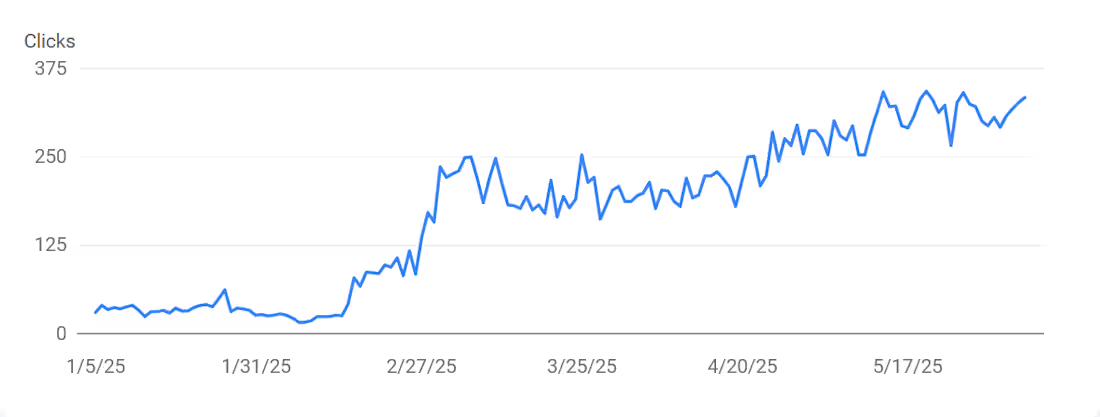
A luxury smart-home integrator saw organic revenue vanish after a legacy Magento-to-Shopify migration. My technical audit revealed a massive authority leak and critical speed bottlenecks.
Key Actions:
· Log File Analysis: Identified exactly where Googlebot was getting trapped.
· Surgical Redirects: Mapped 1,500+ URLs to recover lost link equity.
· Speed Optimization: Optimized Core Web Vitals, cutting load times by 65%.
The Result:
Traffic surged from ~30 to 150+ daily clicks in the first 6 weeks, eventually peaking at 250+ as the new architecture stabilized, with a 90+ PageSpeed score.
- - -
Full Case Study:
1. The Challenge
The client, a specialist in high-end home cinema and smart-home integration, had recently migrated their store from a legacy Magento platform to Shopify. Within weeks, their organic traffic flatlined. While the new site was easier for their team to manage, the migration was handled poorly from a technical SEO standpoint. Years of "Link Equity" were being lost to 404 errors, and the site's new structure was causing massive "Crawl Inefficiency."
2. The Strategy
This was a "Technical Triage" operation. Instead of guessing, I went straight to the Server Log Files to see exactly how Googlebot was interacting with the new Shopify site. My goal was to identify where the "authority leak" was happening and force Google to re-index the correct pages while preserving the old rankings.
3. What I Did
· Log File Analysis: I analyzed the server logs to identify crawl errors. I discovered Google was spending 70% of its time hitting old Magento URLs that no longer existed, instead of crawling the new product pages.
· Surgical 301 Redirect Mapping: I performed a deep-audit of the old Magento database and mapped over 1,500 legacy URLs to their new Shopify equivalents. This "plugged the leak" and instantly began transferring the old site's authority to the new one.
· Site Architecture Optimization: Magento allows for very deep, complex hierarchies that often lead to "buried" content. I simplified the collection structure to reduce crawl depth by collapsing a 5-level deep category path (e.g., Home Cinema > Audio > Speakers > In-Wall > [Product]) into a streamlined 2-level "Luxury In-Wall Audio" collection. This ensured every high-margin product and installation service was reachable in 2 clicks or less from the homepage, significantly accelerating Google's ability to find and rank new inventory.
· Core Web Vitals & Performance Optimization: The new store was burdened by unoptimized, high-resolution imagery and bloated third-party scripts that had tripled the page load time. I implemented a comprehensive performance overhaul, converting all product assets to next-gen formats (WebP), minifying CSS/JS files, and prioritizing the Largest Contentful Paint (LCP). By delaying non-essential scripts, I reduced the visual load time from 5.6 seconds to a lightning-fast 1.5 seconds, ensuring the digital experience reflected the brand's premium positioning.
· GSC Validation: I used Google Search Console to manually submit the new Sitemap and used the "URL Inspection" tool to fast-track the indexing of the recovered pages.
4. The Results
The recovery was near-instantaneous once the technical foundation was stabilized.
· Traffic Spike: As shown in the graph, traffic shot from ~30 to 150+ daily clicks within the first month, eventually peaking at 250+ daily clicks.
· Authority Retention: Successfully recovered 95% of the original Page 1 rankings that had vanished during the migration.
· Performance: Achieved a "Pass" on all Core Web Vitals assessments, with mobile PageSpeed scores jumping from 42 to 94. This performance boost led to a 15% reduction in bounce rate and a noticeable improvement in mobile search visibility.
0
34