Freelancers using PyTorchFreelancers using PyTorch
Senior Software & ML Engineer | Zero to One Product Builder
6x
Hired
5.0
Rating
60
Followers
Senior Software & ML Engineer | Zero to One Product Builder
AI & ML Engineer|Real-Time Computer Vision & Edge AI Expert
New to Contra
AI & ML Engineer|Real-Time Computer Vision & Edge AI Expert
Iโ€™m an AI & Machine Learning engineer with expertise in deve
Cover image for What your attention heatmap isn't
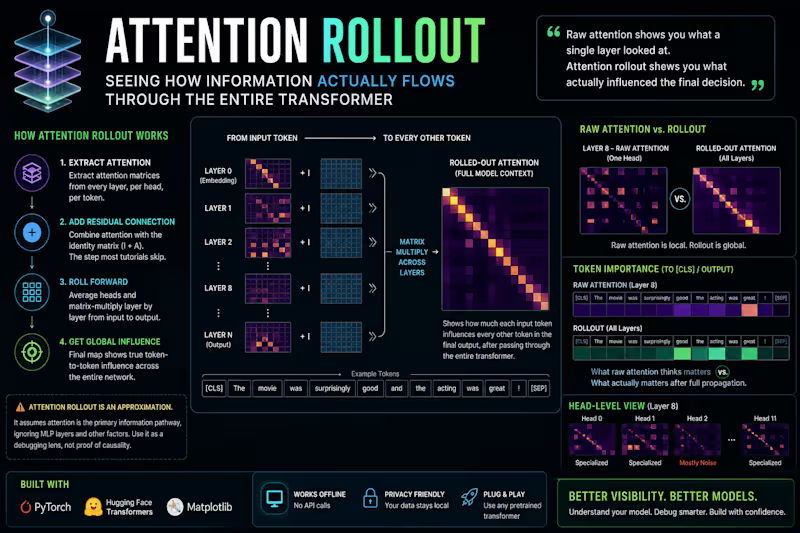
What your attention heatmap isn't telling you Everyone's staring at attention heatmaps and calling it "interpretability." Almost nobody's asking whether a single attention map actually tells you what the model used to make its decision. It doesn't. Not on its own. A raw attention map from layer 8 shows you what layer 8 attended to. It says nothing about how that signal got mixed, diluted, or overwritten by every layer before and after it. Attention rollout fixes this โ€” and I built a walkthrough to show why it matters. Here's what makes it more than a "pretty heatmap" demo: Instead of visualizing one layer's attention, I traced how information actually flows through the full transformer stack. โ†’ Every layer's attention matrix is extracted, per head, per token โ†’ Multi-head attention is averaged, then combined with the residual connection (identity + attention) โ€” this is the step most tutorials skip, and it's the one that actually matters โ†’ The combined matrices are matrix-multiplied layer by layer, rolling attention forward from input to output โ†’ The result: a single map showing genuine token-to-token influence across the entire network, not just one layer's snapshot The overlay shows you everything: โ†’ Per-layer attention vs. rolled-out attention, side by side โ†’ Token importance scores overlaid directly on the input text โ†’ A comparison view: which tokens raw attention says "matter" vs. which ones rollout says actually matter โ†’ Head-level breakdown so you can see which heads specialize vs. which are noise No black box. No "trust me, the model looked here." Just linear algebra, applied honestly across every layer instead of cherry-picking one. Built with PyTorch + HuggingFace Transformers + Matplotlib. Runs on any pretrained transformer, fully offline. โš ๏ธ Important: attention rollout is an approximation, not ground truth. It assumes attention is the primary information pathway, which ignores MLP layers and can still mislead for very deep models. Treat it as a debugging lens, not proof of causality.
0
141
Cover image for Everyone's talking about quantum computing.
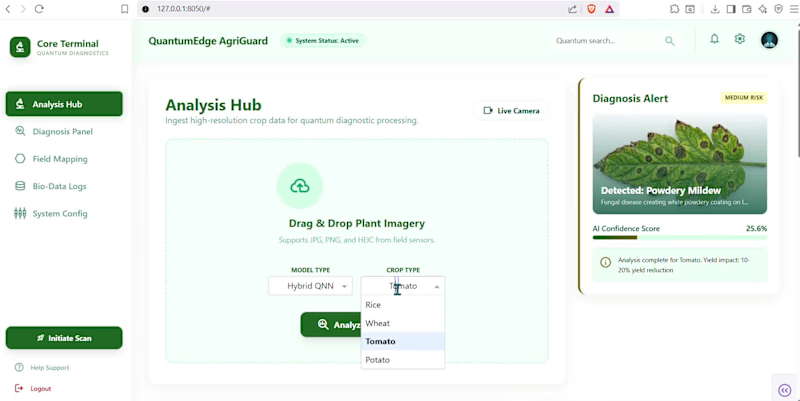
Everyone's talking about quantum computing. Nobody's using it to feed farmers. India loses 20โ€“30% of its crop yield every year to diseases and pests. Not because farmers don't care โ€” but because early detection is hard, expensive, and inaccessible to the people who need it most. The existing solutions? Either a basic image classifier trained on lab-perfect photos that fail in real field conditions, or an agronomist visit that costs time and money most small farmers don't have. So I built QuantumEdge AgriGuard โ€” a hybrid Quantum Neural Network app where a farmer can photograph a diseased leaf on their phone and get an instant diagnosis in under 5 seconds. Here's what makes it different from just another plant disease detector: Instead of a pure classical CNN, I built a hybrid architecture โ€” a ResNet/EfficientNet backbone extracts visual features, then passes them into a Variational Quantum Circuit (VQC) for the final classification. The quantum layer uses angle embedding + StronglyEntanglingLayers, which gives it a measurable edge on small, noisy datasets โ€” exactly the kind of data you get from Indian field conditions. The app doesn't just tell you what disease it is. It gives you: โ†’ Confidence score โ†’ Organic + chemical remedies (India-specific) โ†’ Yield impact estimate โ†’ A live classical vs quantum accuracy comparison so you can see the difference yourself I tested the quantum advantage claim honestly โ€” ran both models on the same downsampled PlantVillage dataset and tracked accuracy, F1-score, and inference time side by side. The results are on the dashboard. No hand-waving. Built with PennyLane + PyTorch + Plotly Dash. Designed to run on simulators today and on QpiAI-Indus 25-qubit hardware tomorrow.
1
0
133
AI/ML Engineer crafting intelligent systems & AI solutions.
11
Followers
AI/ML Engineer crafting intelligent systems & AI solutions.

Founder & AI Systems Architect
New to Contra
Founder & AI Systems Architect
Cover image for Horse Health AI is a
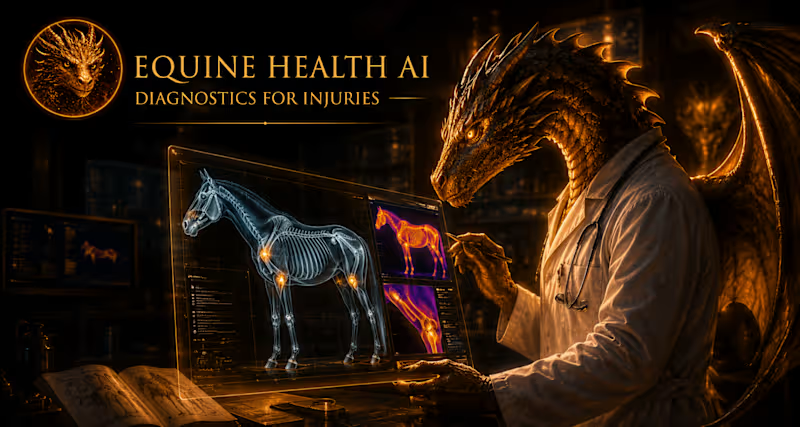
Horse Health AI is a Golden Dragon AI DeepTech project for portable, non-invasive, multimodal animal health screening and longitudinal health intelligence. I designed the system around a compact multimodal sensor architecture combining RGB Computer Vision, multi-wavelength NIR, radiometric thermal imaging, structured/polarized optical sensing, and motion and geometry data. Rather than analyzing each signal independently, the AI architecture is designed to fuse complementary modalities and evaluate visible anatomy, gait and behavior, thermal patterns, vascular and perfusion-related features, tissue-related optical signals, movement, and individual history. A key part of the architecture is the Individual Digital Baseline. Each animal can become its own longitudinal reference, allowing new scans to be compared not only with validated population-level knowledge but also with that animal's historical normal patterns. The software architecture includes synchronized acquisition, calibration, multimodal registration, per-modality AI models, longitudinal baseline modeling, multimodal embeddings and fusion, veterinary knowledge/RAG, explainable anomaly localization, confidence and uncertainty assessment, and mobile and research interfaces. The project is designed as a screening and decision-support system, not as a replacement for veterinary diagnosis. Veterinary expertise, clinically confirmed data and validation are explicit parts of the development roadmap. The initial platform is focused on horses, with potential expansion to other animal species following species-specific validation.
0
68
Cover image for Golden Dragon Quantum Trading
AI-Native Multi-Agent
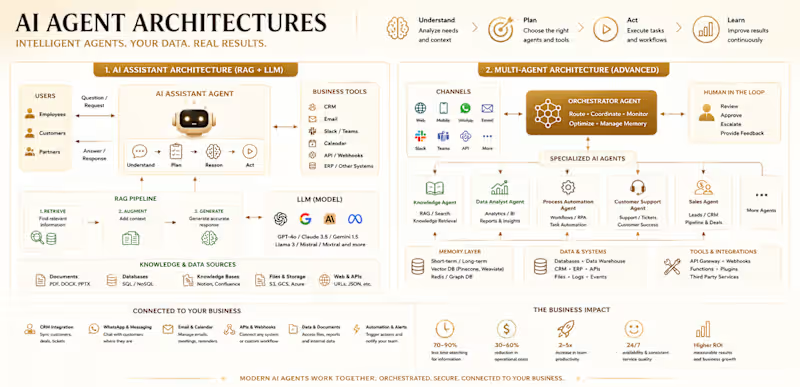
Golden Dragon Quantum Trading AI-Native Multi-Agent Intelligence for Active Crypto Trading Golden Dragon Quantum Trading is a highly customizable AI-native crypto trading intelligence and controlled execution platform. I designed the platform around a distributed multi-agent architecture: the trader communicates with one Main AI, while a network of specialized intelligent AI agents analyzes different market domains in parallel, including market structure, order books and liquidity, derivatives, volume and flow, whale activity, cross-exchange conditions, news, risk, and trading strategies. The architecture combines personalized trading strategies, manipulation and anomaly detection, whale and hidden-liquidity intelligence, multi-agent confirmation, hybrid quantum-classical computation, and a proprietary orchestration and real-time communication architecture. A separate System Control Core supervises system state and permissions, while Protective Gates validate risk, strategy, market, exchange, and execution conditions before authorized actions reach the Execution Robot. The platform is designed for multi-exchange operation, including Binance, Bybit, Bitget, OKX and Kraken. User funds remain in the traderโ€™s own exchange accounts. I also built the customer-facing product environment, including registration, authentication, subscriptions, payments, personal access tokens, exchange connection, multi-exchange selection, TradingView integration, multilingual functionality, and the Main AI trading workspace. My role: Founder, AI Systems Architect & Developer Project: Architecture, AI/ML, Multi-Agent Systems, Trading Intelligence, Backend, Cloud, Product Development
0
30
Cover image for Food as Healing AI is
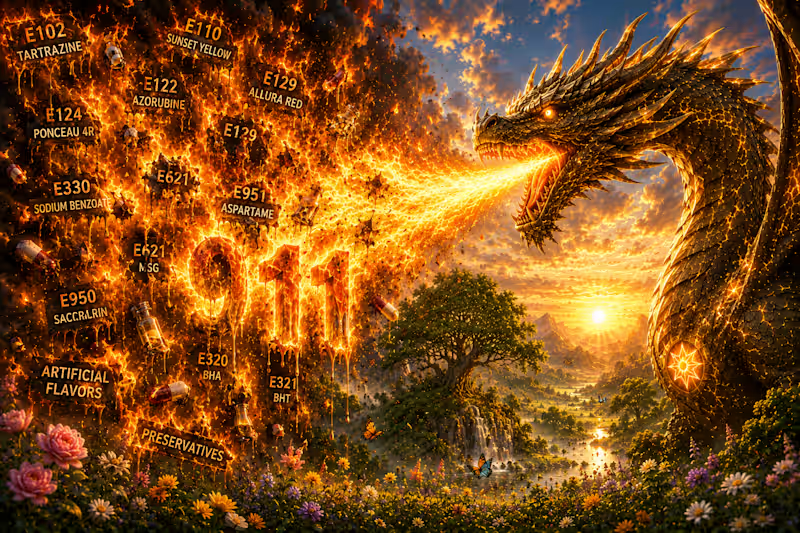
Food as Healing AI is a personal AI nutrition and food intelligence platform designed around the individual. The platform builds a persistent Personal Nutrition Profile from the user's goals, food habits, lifestyle, preferences, restrictions, ingredient policies, practical constraints, feedback, and optional user-provided laboratory context. Its food intelligence pipeline uses Vision/OCR, ingredient extraction and normalization, an ingredient and additive knowledge base, RAG, and structured product analysis to help users understand what is actually represented in a food product. A Personal Matching Engine is designed to connect structured product information with each user's individual food policy โ€” including hard exclusions, preferences, dietary patterns, nutrition goals, clean-label requirements, and ingredient rules. The broader architecture is modular and multi-agent. Specialized agents are designed for personal profiles, questionnaires, nutrition, ingredients, products, matching, shopping, meal planning, knowledge retrieval, and continuous feedback. The current technical foundation includes a Google Cloud backend, Supabase, RAG, prompt/AI orchestration, external AI model integration, an ingredient/additive knowledge base, and an image-based ingredient analysis prototype. The goal is not to provide another generic diet app or diagnostic system, but to create a personal AI food consultant that learns how an individual wants to eat and turns that profile into explainable everyday food decisions.
1
1
85