SEO Writing Projects in SydneySEO Writing Projects in SydneyGOOGLE GEMINIS summary of My InfoVid. 😉
The speaker describes their professional role and methodical approach to content creation:
Professional Identity: The speaker is a narrative architect and multiplatform content operator who specializes in transforming complex or disorganized information into structured, clear content systems.
Methodology: Drawing from a professional background in finance and accounting, the speaker applies a disciplined, data-driven process to content development.
Workflow: Each week, the speaker collects various raw materials—including founder notes, transcripts, AI drafts, and product documentation—to generate cohesive content.
Platform Specialization: This process produces high-performing content across three main channels:
LinkedIn: Authority posts and long-form founder essays.
YouTube: Talking head videos and high-retention scripts.
Website: Agency clarity, narrative hierarchy, and semantic structure.
Objective: Beyond mere creation, the speaker builds systems designed to ensure that messaging remains consistent, scalable, and searchable across platforms.
Here are samples of my Work:
700 word article & case study on Singapore regulatory framework
https://bit.ly/Singapore-MAS-ACRA-JoeyL
Why Founders Plateau with Content
https://bit.ly/KingTwins-Founders-vid
Turning Vision into clarity YT script
https://bit.ly/MomentOfClarity-Script
The AI Literacy Divide, Why Large Companies struggle with Agentic Systems (https://app.bitly.com/Bl95awHAFfJ/links/bit.ly/AILiteracyDivide/details)
bit.ly/AILiteracyDivide (https://bit.ly/AILiteracyDivide)
Check out my Portfolio Dashboard for 20+ articles and written posts on Agentic and AI intelligence and though leadership content. Most founders and creators know what they want to say — but not how to say it with clarity, authority, and narrative precision.
That gap costs them opportunities, weakens their message, and buries their ideas under noise.
Platforms move fast. Attention is brutal. And unclear writing gets punished instantly.
SOLUTION ?
I’ve now been officially recognised by Upwork as both a 'Rising Talent' and an "Approved Consultation Provider", validating the clarity systems I’ve been building behind the scenes.
I help founders, operators, and creators transform messy ideas into clean, structured, high‑impact writing that moves like strategy.
If you need clarity, narrative structure, or a professional second brain for your content : My talent & professionalism is where we begin.
Message Me and I will elevate your Voice with Your Message, to a whole new Level.
─────────────────────────────────────
Victor TYan
MIB,BCom,:Narrative Architect & Founder‑Voice Ghostwriter .The Future of Blog Images — Why Flora + SDXL Is the New Creative Pipeline**
In the last two years, the way companies produce blog images has shifted from manual prompting and inconsistent visuals to automated, brand‑safe pipelines powered by workflow engines like Flora and image models like Stable Diffusion XL (SDXL). This shift isn’t just technological ; t’s operational.
It changes how content teams think, plan, and scale.
Most companies today still generate images the old way:
someone opens an AI tool, writes a prompt, tweaks it, regenerates, downloads, crops, and hopes the final result matches the brand. It’s slow, inconsistent, and impossible to scale across dozens of posts per month.
Flora changes that.
Flora is a workflow‑native system designed for creative logic. It doesn’t generate images - it orchestrates them. It takes a blog summary, routes it through SDXL, generates multiple visual directions, lets the user choose, and then produces a full set of final images. The result is a repeatable, automated pipeline that removes the manual friction from content‑ops.
SDXL is the perfect engine for this. It’s open, customizable, and capable of producing consistent, brand‑aligned visuals when fine‑tuned. Unlike closed models, SDXL can be shaped to match a company’s identity ; colors, textures, tone, and visual language. When paired with Flora, it becomes a scalable image factory.
The real power is in the logic:
input → direction generation → selection → final images → QC → output.
This structure ensures every blog post receives images that feel intentional, cohesive, and aligned with the brand. No more random styles. No more mismatched tones. No more manual prompting.
For companies publishing at scale — especially in technical fields like cloud security; his workflow becomes a competitive advantage. It reduces production time, increases consistency, and frees teams to focus on strategy instead of image generation.
Flora + SDXL isn’t just a toolchain.
It’s the new creative pipeline for modern content teams.
⚙️ Stable Diffusion XL — The Engine Behind Modern Creative Automation
If Flora is the conductor, Stable Diffusion XL (SDXL) is the orchestra. It’s the model that turns creative logic into visual reality — the engine that powers automation, consistency, and scale for modern content teams.
Before SDXL, image generation was chaotic. Each prompt produced a different style, tone, and texture. Teams spent hours tweaking outputs, chasing brand alignment that never quite landed. SDXL changed that forever.
Released in mid‑2023 by Stability AI and the CompVis research group, SDXL became the first open‑source model capable of producing high‑resolution, brand‑consistent visuals at scale. It wasn’t just an upgrade — it was a philosophical shift.
Instead of “prompt and pray,” SDXL introduced control, fine‑tuning, and repeatability.
Companies could now train SDXL on their own brand assets — colors, typography, lighting, tone — and generate hundreds of images that looked like they came from the same designer. It turned AI art from novelty into infrastructure.
The magic lies in its architecture:
a dual‑encoder system that understands both semantic meaning and visual composition, allowing it to interpret complex prompts with precision. When paired with workflow engines like Flora, SDXL becomes a creative factory — producing multiple image directions, refining them through logic, and delivering final outputs that feel intentional.
For blog teams, this means no more mismatched visuals.
For founders, it means brand consistency without design bottlenecks.
For agencies, it means scalable creative production that feels human.
SDXL isn’t just an image model.
It’s the engine of creative automation — the silent powerhouse behind every modern workflow that values speed, consistency, and brand identity. “The Moment of Clarity: When Vision Finally Connects” - Turning Vision into Emotion.
90‑Second PAS Concept Video Script
Check The Video >>https://bit.ly/VID-VisionInto-Clarity
(Cinematic, emotionally intelligent, high‑contrast pacing)
[0:00–0:05 — HOOK | Fast, punchy]
What if the idea in your head is already brilliant… but the way it’s shown on screen is the reason nobody sees it?
[0:05–0:20 — PROBLEM | Slow, heavy, visual]
Most concepts die before they ever get a chance.
Not because the product is weak.
Not because the story is wrong.
But because the translation from vision to video collapses somewhere between “I know what I want” and “Why doesn’t this feel right?”
Founders feel it. Creators feel it. Teams feel it.
That quiet frustration of knowing the idea deserves more.
[0:20–0:40 — AGITATION | Rising tension, sharper cuts]
You try explaining it again.
You try rewriting the brief.
You try another editor, another animator, another round of revisions.
But the soul of the idea still slips through the cracks.
The pacing feels off.
The tone feels mismatched.
The message feels diluted.
And suddenly the concept that once felt electric… feels flat.
[0:40–0:45 — Micro‑pause | Silence as tension]
It shouldn’t be this hard.
Heres The Video >>https://bit.ly/VID-VisionInto-Clarity
[0:45–1:10 — SOLUTION | Warm, confident, cinematic lift]
A concept video should translate vision into emotion.
It should make people feel the idea before they understand it.
It should compress complexity into clarity.
It should turn “I think this could work” into “I need this.”
That’s what I build.
Not just videos — but concept engines.
Narratives that move.
Visuals that persuade.
Rhythms that stay in the mind long after the screen goes dark.
[1:10–1:25 — TRANSFORMATION | Expansive, inspiring]
Because when a concept is shown with precision, intention, and emotional intelligence…
it stops being a pitch.
It becomes a moment.
A shift.
A spark that makes people lean in and say,
“Oh. I get it now.”
[1:25–1:35 — CLOSE | Clean, confident, founder‑grade]
If you want your idea to land with clarity, power, and cinematic presence —
let’s build the version of your concept that finally feels like the one you’ve been trying to explain.
Heres The Video >>https://bit.ly/VID-VisionInto-Clarity Heres a massive Assignment project I did for Upwork. I think I did a great Job. 😉
TASK - Write a publish-ready landing page (2,000+ words) targeting the keyword: "humanized AI" for AISEO (https://aiseo.ai/).
You must use Claude Cowork as your primary tool throughout the entire process — research, outlining, drafting, and editing.
Requirements
Proper heading hierarchy (H1, H2, H3)
Primary keyword in title, intro, and naturally throughout
Meta title (≤60 characters) and meta description (≤155 characters)
3–5 internal linking suggestions to other AISEO pages/tools
2–3 external reference citations
Content should read naturally — not like raw AI output
SOLUTION 😊
“AISEO Landing Page — Publish-Ready Draft”
Primary Keyword: Humanized AI Target Buyer: SEO professionals, agency operators, in-house content teams Tone: 70% Educational / 30% Conversion | Authoritative · Strategic · Calm
[Meta Title — 58 characters] Humanized AI Content That Ranks & Reads Human | AISEO
[Meta Description — 152 characters] AISEO transforms AI-generated drafts into undetectable, EEAT-ready content. Built for professionals who need rankings — not just rewrites.
The full draft has 6 main sections (H2s), plus an intro:
Intro — The hook/diagnosis (no H2, opens the page)
The Problem Isn't Your AI Tool. It's What Comes Out of It.
What "Humanized AI" Actually Means for SEO in 2026
How AISEO Humanizes AI Text at the Professional Level
Real Results: Humanized AI Content That Passes and Performs
The Strategic Play — Humanized AI Content for Blogs and Long-Form
Start Writing Humanized AI Content Today
So 7 blocks total (intro + 6 sections), each with 2–3 H3 subsections sitting underneath them. That gives you 7 natural vertical breaks to work with when you restructure the layout.
⭐ SECTION 1 — INTRO (Verticalized + Refined)
Humanized AI: The Professional Standard for Content That Earns Trust in 2026
There is a moment every content professional recognises.
You paste your AI‑generated draft into a detection tool.
The score comes back red.
73% AI.
81%.
Sometimes higher.
The instinct is to treat this as a technical problem:
find the right tool
shuffle the sentences
swap the synonyms
run it again
watch the score drop
ship it
That instinct is the wrong diagnosis.
The professionals who have already solved this are quietly building publishing operations that:
outrank
out‑convert
outlast
…those still chasing detection scores.
Their insight is simple:
Detection is a symptom.
The real problem is cognitive texture.
Unmodified AI output lacks the intellectual signature that human readers — and Google’s quality systems — recognise as authority.
Humanized AI is not a workaround.
It is the new baseline for content that earns trust at scale.
→ Scroll to see why detection was never the real problem.
⭐ SECTION 2 — THE PROBLEM ISN’T YOUR AI TOOL (Verticalized + Refined)
The Problem Isn't Your AI Tool. It's What Comes Out of It
AI language models are extraordinarily capable.
They retrieve, synthesise, and structure information faster than any human writer.
But they optimise for plausibility — not authenticity.
The sentences are grammatically sound.
The logic holds.
The structure is clean.
But the prose is flat in a way that is difficult to name and immediately felt.
This is not a limitation the next model update will fix.
It is structural.
These systems generate the most probable next token — which means they produce, by definition, the most average sentence.
And in writing, average is the opposite of authority.
Why AI Detectors Are Getting Smarter — And Why That Misses the Point
Detection tools have become significantly more sophisticated over the past eighteen months.
GPTZero, Originality.ai (http://Originality.ai), and Turnitin now operate with accuracy levels that make evasion through basic rewording increasingly unreliable.
The tools that cleared detectors in 2023 no longer perform reliably in 2026.
But here is the more important point the arms‑race framing obscures:
Human readers have always been better detectors than any algorithm.
Readers do not need to run your content through a tool to know something is off.
They experience it as:
thinness
a lack of perspective where there should be one
neutrality where specificity was expected
polish that covers for an absence of genuine thought
They skim faster.
They leave sooner.
They do not share, cite, or return.
And the signals that matter most to long‑term SEO performance:
dwell time
return visits
backlinks
branded search growth
…all decline when content fails the reader’s instinctive credibility check.
That decline happens regardless of what any AI detector scores it.
The Human Trust Test: What Readers Are Actually Measuring
The characteristics that make content feel authoritative are specific and learnable.
They include:
variation in sentence rhythm
genuine perspective rather than careful balance
precise word choices that signal a mind engaged with the subject
the willingness to be specific where generality would be safer
AI models produce content that is:
neutral where it should hold a position
general where specificity would demonstrate knowledge
perfectly consistent in a way real expert writing never is
These are the signatures readers register — consciously or not — when deciding whether to trust what they are reading.
Passing this test is not a surface‑level problem.
It requires cognitive alignment:
the alignment between how information is presented and how a genuine expert would actually think about that topic.
→ This is the gap AISEO is designed to close.
⭐ Section 3 — Samples
3. Samples
Email Sequences (Sample Description)
A 7‑email nurture sequence for a B2B automation platform targeting operations managers. The sequence reframed the problem around hidden operational drag, built belief through micro‑case studies, and used soft‑close CTAs to increase booked demos without triggering resistance.
Talking‑Head VSL Scripts (Sample Description)
A 2‑minute talking‑head VSL for a consulting offer, structured around a tension‑based hook, a mechanism reveal, and a narrative pivot that positioned the founder as the only credible solution. The script was designed for cold audiences and optimized for retention in the first 8 seconds.
B2B Nurture Flow (Sample Description)
A modular nurture flow for a high‑ticket B2B service, built around insight‑driven emails that moved prospects from awareness → belief → urgency. Each email was engineered to shift one psychological lever at a time, reducing friction and increasing sales‑qualified conversations.
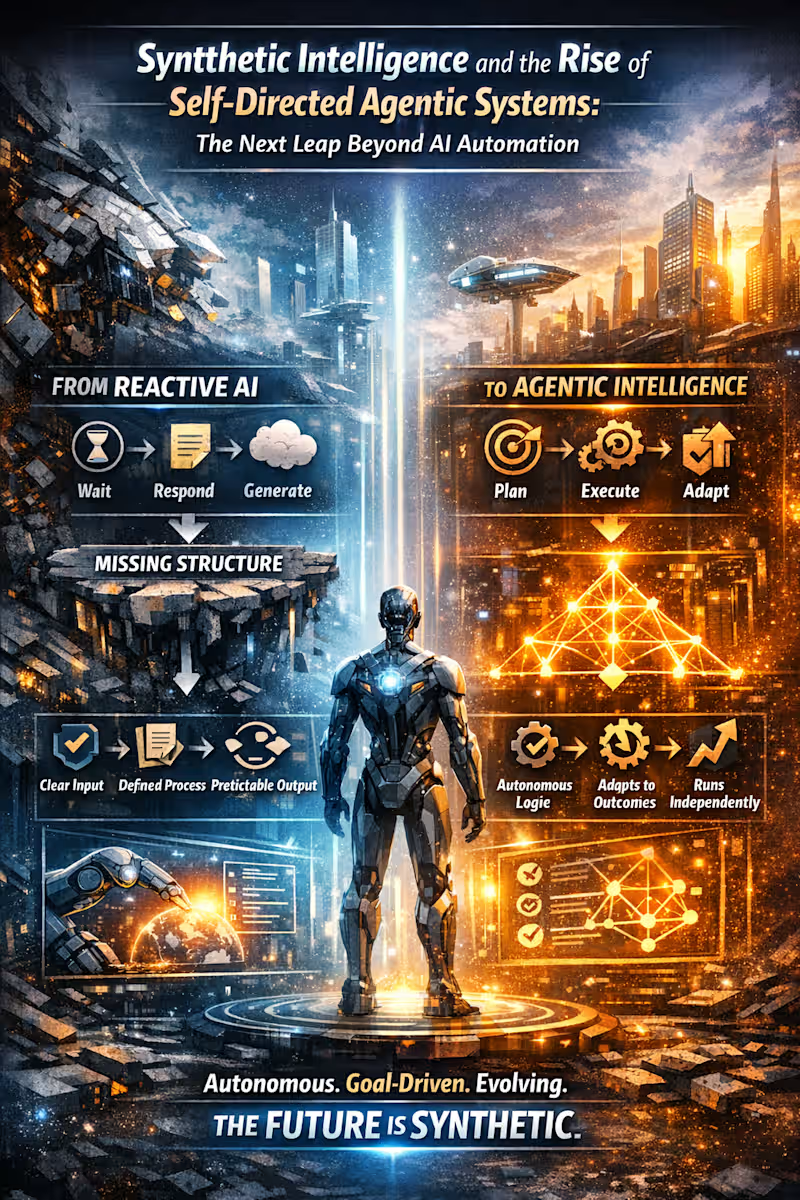
Synthetic Intelligence and the Rise of Self‑Directed Agentic Systems: The Next Leap Beyond AI Automation
For the past decade, artificial intelligence has been defined by a simple pattern: humans give instructions, machines respond. Even the most advanced large language models still operate inside this loop. They wait. They react. They generate. But they do not initiate. They do not reason across time. They do not self‑direct toward outcomes.
That era is ending.
A new class of systems—synthetic intelligence powered by agentic architectures—is emerging. These systems don’t just answer prompts; they pursue goals. They don’t just automate tasks; they orchestrate workflows. They don’t just generate content; they make decisions, evaluate outcomes, and adapt their strategies.
This shift is not incremental. It is foundational.
It represents the transition from AI as a tool to AI as a collaborator—a synthetic partner capable of navigating complexity, ambiguity, and multi‑step reasoning.
And for founders, operators, and innovators, understanding this shift is no longer optional. It is the difference between building for the present and building for the next decade.
From Reactive AI to Agentic Intelligence
Traditional AI systems—LLMs, chatbots, classifiers—are reactive. They respond to inputs but do not act independently. They lack:
persistent memory
long‑horizon planning
self‑evaluation
adaptive decision‑making
multi‑step autonomy
Agentic systems change this dynamic.
An agent is not just a model. It is a model wrapped in:
goals
tools
memory
environment awareness
feedback loops
the ability to take actions without being prompted
This is the architecture behind emerging agent frameworks: systems that can research, plan, execute, revise, and continue until a defined outcome is achieved.
But even agentic AI is only the beginning.
Synthetic Intelligence: A Higher‑Order Layer
Synthetic intelligence is not “AI but smarter.”
It is AI with structure, identity, and continuity.
Where AI generates outputs, synthetic intelligence generates direction.
Where agents complete tasks, synthetic intelligence completes missions.
Where traditional systems rely on human supervision, synthetic intelligence relies on synthetic self‑governance—a structured internal logic that allows it to:
set sub‑goals
evaluate trade‑offs
choose strategies
adapt to new information
maintain coherence over time
Synthetic intelligence is not a single model.
It is an ecosystem of coordinated agents, each with specialized capabilities, working together under a unifying cognitive framework.
Think of it as the difference between:
a single employee
vs.
an entire department with roles, processes, and shared objectives.
This is the architecture that will define the next generation of AI systems.
Why This Shift Matters for Founders and Operators
Every founder eventually hits the same wall:
the limit of human bandwidth.
You can automate tasks, but you cannot automate judgment.
You can delegate work, but you cannot delegate thinking.
Synthetic intelligence changes that.
It introduces a new category of operational leverage:
1. Autonomous Research and Strategy
Synthetic agents can:
scan markets
analyze competitors
identify opportunities
synthesize insights
propose strategies
Not as static reports, but as ongoing intelligence streams.
2. Multi‑Agent Workflows
Instead of one model doing everything poorly, synthetic ecosystems use:
a research agent
a reasoning agent
a planning agent
a writing agent
a verification agent
a refinement agent
Each one specialized.
Each one coordinated.
Each one improving the others.
3. Founder‑Level Decision Support
Synthetic intelligence can model:
trade‑offs
risks
second‑order effects
resource allocation
scenario planning
This is not automation.
This is augmented cognition.
4. Adaptive Execution
Unlike static automation, synthetic agents:
learn from outcomes
adjust their approach
refine their strategies
maintain continuity across tasks
This is the closest thing to a digital operator.
The Architecture Behind Synthetic Agentic Systems
A synthetic intelligence ecosystem typically includes four layers:
1. Cognitive Layer (Reasoning + Planning)
This is the “mind” of the system.
It handles:
long‑term goals
planning
prioritization
strategy
coherence
2. Agent Layer (Specialized Workers)
Each agent has:
a role
a toolset
a memory
a feedback loop
They execute tasks and report back.
3. Environment Layer (Tools + APIs + Data)
Agents interact with:
browsers
documents
databases
APIs
external systems
This is how synthetic intelligence affects the real world.
4. Governance Layer (Rules + Constraints)
This ensures:
safety
alignment
boundaries
ethical constraints
operational consistency
This is what separates synthetic intelligence from uncontrolled autonomy.
Why Synthetic Intelligence Outperforms Traditional AI
1. It thinks in sequences, not snapshots.
LLMs generate one output at a time.
Synthetic intelligence generates plans, iterations, and evaluations.
2. It maintains identity across time.
It remembers what it did, why it did it, and what it learned.
3. It handles ambiguity.
Synthetic agents can explore multiple paths, compare them, and choose the best one.
4. It collaborates with humans.
Not as a tool, but as a partner.
The Founder Psychology Behind Synthetic Intelligence
Founders who adopt synthetic intelligence early share three traits:
They think in systems, not tasks.
They value leverage over effort.
They understand that intelligence—not labor—is the new bottleneck.
Synthetic intelligence is not replacing founders.
It is amplifying them.
It gives founders:
more clarity
more bandwidth
more strategic depth
more execution power
This is why early adopters will outpace competitors by orders of magnitude.
The Future: Synthetic Organizations
The next evolution is not a single agent.
It is a synthetic organization:
synthetic analysts
synthetic researchers
synthetic strategists
synthetic operators
synthetic writers
synthetic verifiers
All coordinated.
All aligned.
All working toward your goals.
This is not science fiction.
This is the next operating system for work.
Conclusion: The Intelligence Revolution Has Entered Its Next Phase
AI was the spark.
Agentic systems were the ignition.
Synthetic intelligence is the engine.
We are entering a world where:
workflows run themselves
research is continuous
strategy is augmented
execution is autonomous
founders operate with superhuman leverage
The question is no longer:
“What can AI do?”
but
“What can synthetic intelligence build with you?”
And the founders who embrace this shift now will define the next decade of innovation.
Victor TYan
MIntBus,BCom,GradDipMus
www.syntheticintel.ai (http://www.syntheticintel.ai)
[PROBLEM]:
"The mortgage industry doesn't have an information problem; it has a Translation Crisis. Borrowers aren't "financially illiterate"—they are simply drowning in jargon-heavy content that feels like reading a 1998 tax code.
In an era where AI can explain quantum physics in a 30-second summary, there is zero excuse for mortgage content that intimidates the client. If your communication makes your borrowers feel "smaller" instead of "smarter," you aren't just losing clarity—you’re losing the multi-million dollar trust required to close the deal."
[SOLUTION]:
"Clarity is the new competitive advantage. I’ve architected a breakdown on how to move from "Technical Noise" to "Human-Centred Narrative." Learn how the hybrid model of AI Insight + Human Nuance creates "Narrative Engineering" that scales trust and converts overwhelmed browsers into confident buyers."
Every year, millions of homebuyers walk into the mortgage process feeling overwhelmed, confused, or intimidated. Not because the numbers are impossible to understand, but because the language around them is.
And here’s the uncomfortable truth:
The mortgage industry doesn’t suffer from a lack of information.
It suffers from a lack of translation.
Borrowers aren’t drowning in data — they’re drowning in unclear explanations.
They’re not confused because they’re “not financially literate.”
They’re confused because the industry still communicates like it’s 1998.
And in a world where AI can break down quantum physics into a TikTok‑sized summary, there’s no excuse for mortgage content that feels like reading a tax code.
AI Has Changed the Game — But Not in the Way Most People Think
Everyone’s talking about AI as if it’s going to replace mortgage professionals.
It won’t.
What it will replace is:
unclear communication
jargon‑heavy explanations
outdated content
slow responses
generic advice
AI is not here to eliminate experts.
AI is here to eliminate confusion.
The professionals who win in the next decade won’t be the ones with the most experience — they’ll be the ones who can explain the experience clearly.
AI can generate drafts, analyse rates, compare loan structures, and model repayment scenarios in seconds.
But AI cannot replace the human ability to:
build trust
understand emotion
guide decisions
translate nuance
calm fear
provide context
The future belongs to the professionals who combine AI‑powered insight with human‑powered clarity.
Borrowers Don’t Want More Content — They Want Better Content
Most mortgage content today falls into one of two categories:
1. Overly technical
Reads like a compliance document.
No story. No clarity. No emotional intelligence.
2. Overly simplified
Reads like a children’s book.
No depth. No authority. No trust.
The sweet spot — the place where real influence happens — is in the middle:
Clear, confident, human‑centred explanations that make people feel smarter, not smaller.
This is where AI‑assisted content creation becomes a superpower.
AI helps you:
research faster
generate ideas
structure content
analyse trends
simplify complex topics
But YOU provide the narrative.
YOU provide the clarity.
YOU provide the trust.
Clarity Is Now a Competitive Advantage
In a crowded mortgage market, clarity is no longer a courtesy — it’s a differentiator.
The brands that win will be the ones who:
explain fixed vs. variable rates in a way that feels intuitive
break down refinancing without fear‑based language
help first‑home buyers feel confident, not overwhelmed
use AI to enhance their content, not replace their voice
communicate with empathy, not ego
Clarity builds trust.
Trust builds action.
Action builds business.
And in a world shaped by AI, clarity is the only narrative that scales.
The Future of Mortgage Content Is Hybrid: AI + Human Insight
The next generation of mortgage professionals won’t be defined by how much they know — but by how well they can translate what they know.
AI accelerates the process.
Humans elevate the message.
The industry doesn’t need more noise.
It needs more narrative engineers — people who can take complex financial structures and express them in a way that feels simple, empowering, and actionable.
Because when clarity enters the conversation, confidence follows.
And confident borrowers make better decisions.
By Victor Tyan
AI‑Driven Narrative Engineer
Translating Complexity Into Market‑Ready Clarity













![Cover image for [PROBLEM]:
"The mortgage industry doesn't](https://media.contra.com/image/upload/q_auto,w_800/t0vmcxb0wtmmmudou8k9.avif)