
Mind of an engineer and the heart of an entrepreneur.
- $50k+
- Earned
- 1x
- Hired
- 15
- Followers
Mind of an engineer and the heart of an entrepreneur.

For every feature I shipped with an AI agent, I shipped more than two fixes.
1,000+ PRs. 84 days. Solo. The throughput was real — but 360 of those PRs were fixes against 150 features. That ratio is the part nobody puts in their recap post.
The core problem: the agent is a 20× author, not a 20× reviewer. I had no leverage on verification — just guards built from past failures, useless against anything new.
What I'd change: second agent for adversarial review only, and changes small enough that being wrong is cheap.
Agentic engineering doesn't remove the hard part. It moves it.
1
146

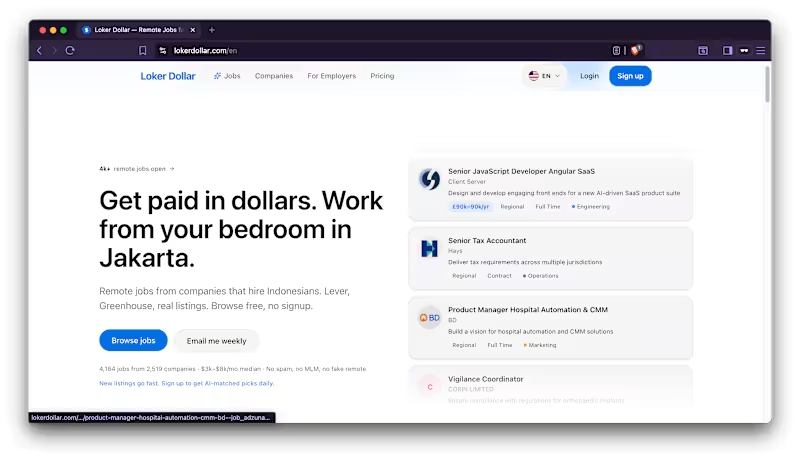
Built a RAG job-hunting agent for Indonesian developers applying to remote USD jobs.
28 days of real usage. Here's what I learned.
The problem: applying to 50+ remote jobs manually is exhausting. Wrong roles, no resume tailoring, hours wasted per application.
The workflow now:
One message → agent retrieves relevant jobs → ranks them → generates tailored resume + cover letter → user approves or skips.
Stack (still running $0 free tier):
· Embeddings: Cloudflare Workers AI qwen3-embedding-0.6b
· Vector search: Cloudflare Vectorize, cosine similarity
· Database: Cloudflare D1 / SQLite, one batched query
· Semantic cache: Cloudflare KV, cosine ≥0.92 threshold
· LLM: JSON-mode slot extraction + reply
Only variable cost: ~$0.002/turn LLM usage
28-day numbers:
· 235 sessions
· 329 return visits
· 743 agent turns
· 357 job cards surfaced → 46 approved applications
~20 approvals per 100 sessions (target was 10–15)
Total LLM cost: ~$1–4
Example matches from one natural-language query:
Linear — 96/100 · DatAds — 95/100 · Spotify — 100/100
Two decisions I'd make again:
· The scorer is deterministic — pure function, 7 weighted components, 0–100. No model drift. Users see exactly why a job scored highly. I didn't trust LLM ranking for something this consequential.
· There's a regex fallback behind every LLM extraction. If the model fails or times out, the conversation continues. Users never hit a dead end.
What's next:
· Tracking downstream outcomes — recruiter replies, interviews Detecting expired/duplicate posts more aggressively Calibrating scoring weights from real approval behavior
· The pipeline runs cheaply and generates real approvals. The next challenge is proving it improves actual job outcomes — not just application volume.
This is the kind of system I enjoy building: AI-native product on constrained infra, with real users and measurable north-star metrics.
If you're working on something similar — hiring pipelines, talent matching, AI agents for job seekers — I'd enjoy comparing notes. And if you're an Indonesian dev hunting remote USD roles, the product is live at lokerdollar.com (http://lokerdollar.com).
What would you build differently? 👇
#RAG (https://www.linkedin.com/search/results/all/?keywords=%23rag&origin=HASH_TAG_FROM_FEED) #CloudflareWorkers (https://www.linkedin.com/search/results/all/?keywords=%23cloudflareworkers&origin=HASH_TAG_FROM_FEED) #BuildInPublic (https://www.linkedin.com/search/results/all/?keywords=%23buildinpublic&origin=HASH_TAG_FROM_FEED) #AIEngineering (https://www.linkedin.com/search/results/all/?keywords=%23aiengineering&origin=HASH_TAG_FROM_FEED) #RemoteJobs (https://www.linkedin.com/search/results/all/?keywords=%23remotejobs&origin=HASH_TAG_FROM_FEED) #IndonesianDevelopers (https://www.linkedin.com/search/results/all/?keywords=%23indonesiandevelopers&origin=HASH_TAG_FROM_FEED)
3
174
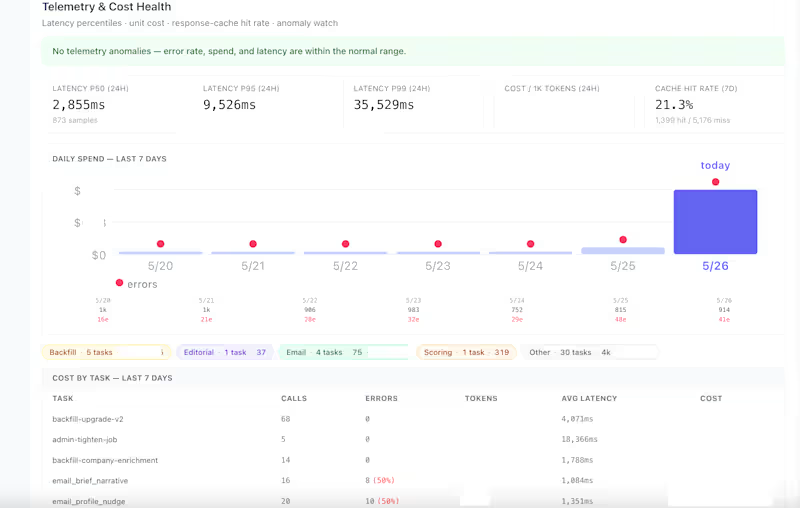
Most LLM telemetry posts brag about what they monitor. Here's mine — including what I'm still missing.
Built this for lokerdollar.com (http://lokerdollar.com), solo, in production:
Covered:
— p50 / p95 / p99 latency per task
— cost per 1k tokens + daily burn + per-task spend
— provider success rates + circuit breaker state
— cache hit rate, quota / rate limit tracking
— model leaderboard scored on live traffic
Gaps I'm still chasing:
— prompt versioning tied to quality signals
— TTFT for streaming UX (matters for chat tasks)
— per-user cost attribution
— semantic error taxonomy, not just HTTP codes
— push-based degradation alerts (today's playbook is reactive)
The lesson from running this solo: observability is never "done." It's a backlog that evolves with the product — and the gap list is more honest signal than the green checkmarks.
→ Open for AI platform / full-stack work. If you want this layer for your team, my DMs are open.
1
88


Full-Stack Web Developer & Designers


Creative Developer | Fullstack | 3D Product Config
Creative Developer | Fullstack | 3D Product Config




Fullstack Engineer (Web, Mobile AI, & Web3)
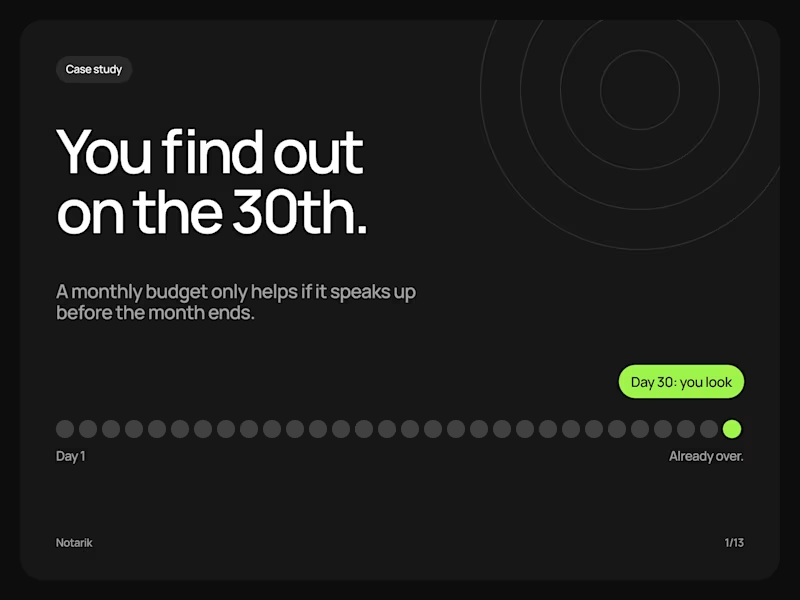
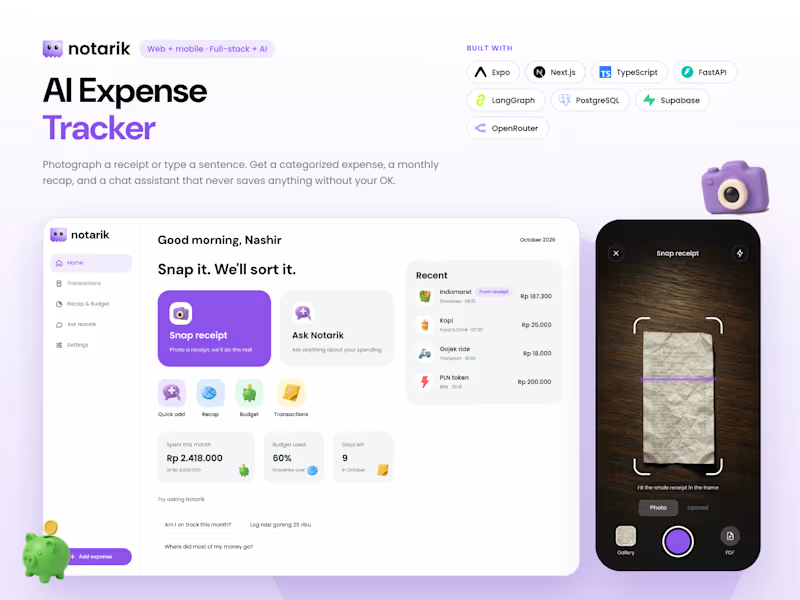
Most AI apps work like this: the model decides, the app saves, and the user finds out later that the numbers are wrong. 😬
For Notarik, I set one rule. The AI can only propose. Nothing gets saved until the user confirms. ✅
🧾 What it does
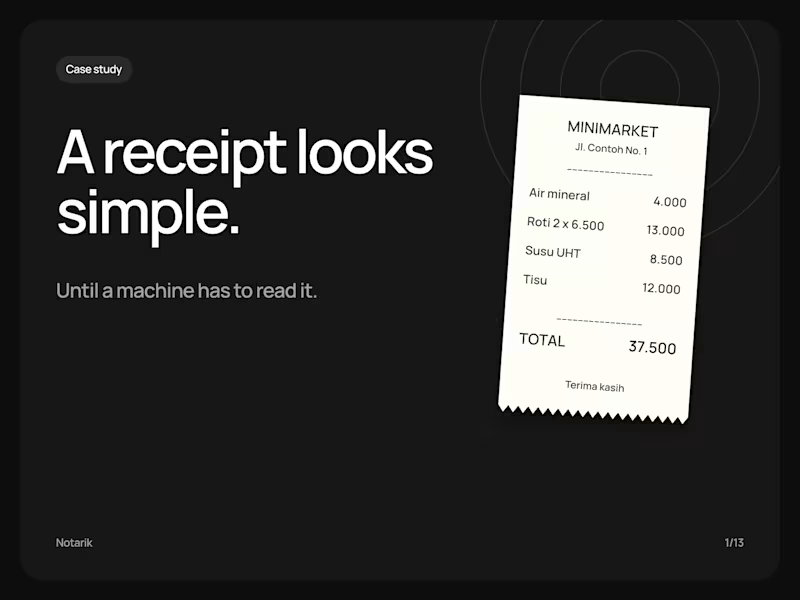
Take a photo of a receipt, or type "lunch 45k at the warung". You get a categorized expense, a monthly recap, and a chat assistant you can ask things like "where did my money go this month?":
🔒 The parts I care about most
• Receipt totals are checked by plain code, not by the model. If the math doesn't add up, it gets flagged.
• Money is stored as whole numbers (IDR), never decimals, so there are no rounding bugs.
• Every user's data is locked at the database level with Postgres row-level security. Even if the app has a bug, it can't show someone else's records.
• Text on a receipt is treated as untrusted. If a receipt says "ignore your instructions", it's just text.
• The agents have tests, so when I change a prompt I can see right away if it got worse.
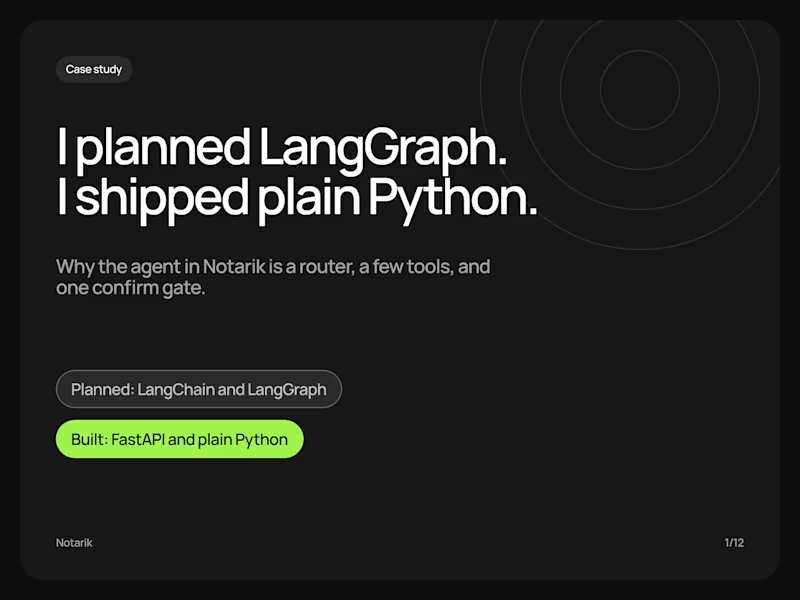
🛠 Built with Next.js, React Native, Python (FastAPI), LangGraph and PostgreSQL. One person, web and mobile, from design to API.
🤝 If you're building something where an AI touches real money, records or user data, this is the kind of work I like: agents that are useful and also safe to put in front of users.
👉 Try it live: https://notarik-app.nashir.tech
Want to talk about yours? Send me a message.
2
0
372

Full-Stack Developer | AI, Automation & Web Apps
New to Contra
Full-Stack Developer | AI, Automation & Web Apps



Brand, Website, Product, Motion, & Development for Startups
- $25k+
- Earned
- 10x
- Hired
- 5.0
- Rating
- 23
- Followers
Brand, Website, Product, Motion, & Development for Startups

For years we helped other startups and studios to build other people's websites, products & brands.
Today we're launching Componine Creative Studio.
A few things we care about:
→ Staying close to the work. You'll talk to the founder directly, not someone passing your brief down a chain.
→ Keeping things under one roof. Web, product, brand, motion, all in the same place.
→ Quality over quantity. We only take on a limited number of projects at a time, so nothing gets rushed or watered down.
New site is live. Visit Componine.com (https://www.componine.com/)
2
2
424



Designing Full App Architecture Solutions


Full-stack engineer: SaaS, ERP, CMS and marketing sites
Full-stack engineer: SaaS, ERP, CMS and marketing sites

Land of Moe
A custom baby blanket brand, and the storefront that sells it. Moms browse the patterns, pick the size and the back fabric, and the finished configuration lands in WhatsApp.
What I built
The catalogue: every pattern in one grid, filtered by the brand's own tags — animals, letters, colours, occasions — and sorted by price or date. Over a hundred tags, and search answers "bunny" with ninety-four patterns.
Product pages that configure the product: type, size, backside (printed fleece, or a minky dot colour), quantity, with the front and back of the pattern shown side by side.
An order that carries its own configuration into WhatsApp. Pattern, type, size, backside, price and quantity are written into the message before it is sent, so the conversation starts at the right blanket instead of at the beginning.
The pages the shop runs on: how to order, washing instructions, FAQ, about — plus a customer gallery built from the brand's own Instagram posts, so the social proof lives on the site and not only in the feed.
Behind the login, a back office where the patterns, tags, prices and pages live as data rather than hand-built pages.
Stack
Next.js, Tailwind CSS, Cloudflare.
Land of Moe has been making these since 2017, and everything is made to order, so the storefront is built around how an order actually happens.
1
197
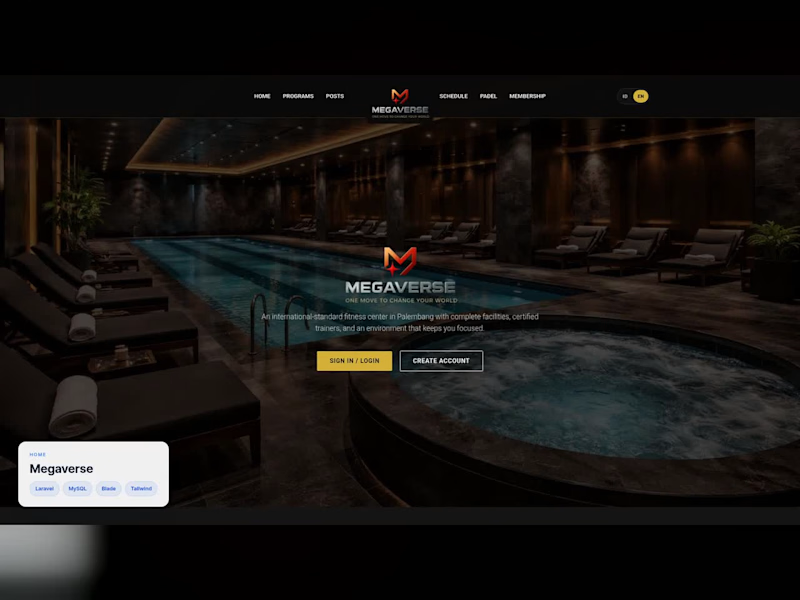
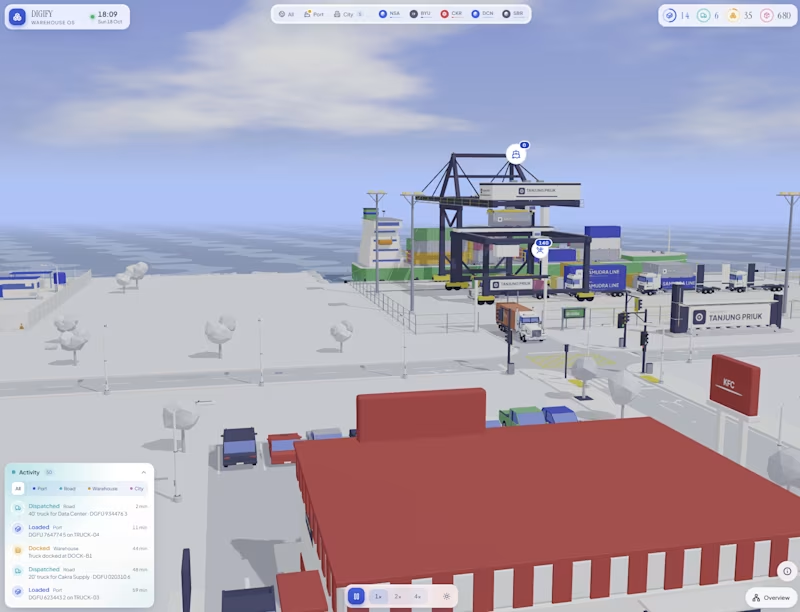
Megaverse is a fitness club in Palembang, built as one platform instead of four disconnected tools.
The public site sells the club: programs with intensity and duration, the padel club with court pricing and availability, and the club's postings. The member area is where members live day to day — registration with KTP and address, then profile, class booking, attendance and renewal history.
The front desk side covers renewals and payments, gate logs, and lockers with their rentals.
Behind that sits the business: a POS with products, suppliers, units and categories, employee and personal trainer records with specialisations, and finance with chart of accounts, journals, fiscal periods and fixed assets, with the heavy tables exported to Excel.
Laravel with Blade, Tailwind and MySQL.
Built together with Tengku Kevin Juldianto (dev.tengkukevin@gmail.com).
https://mega-verse.id
3
308
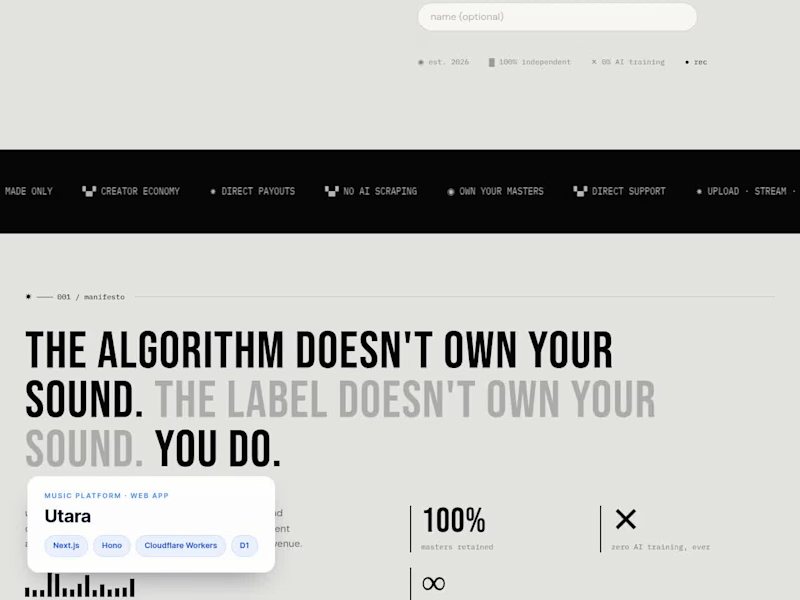
UTARA
A music platform for independent Indonesian artists. An artist uploads a release, it goes live on the platform, and listeners find it through artist pages and the catalogue. Payments run through Duitku, and the whole thing runs on the edge, so catalogue pages stay fast without a server to babysit.
What I built
Artist and listener accounts, with an upload flow that takes a release from draft to published.
Artist pages and a browsable catalogue, built for slow connections first.
Payments through Duitku.
A Hono API over D1 on Cloudflare Workers, with a Next.js front end on the same edge runtime.
Stack
Next.js, Hono, Cloudflare Workers, D1, Duitku.
It is early and I am building it in the open, so the parts that exist are the ones people actually asked for.
1
2
430
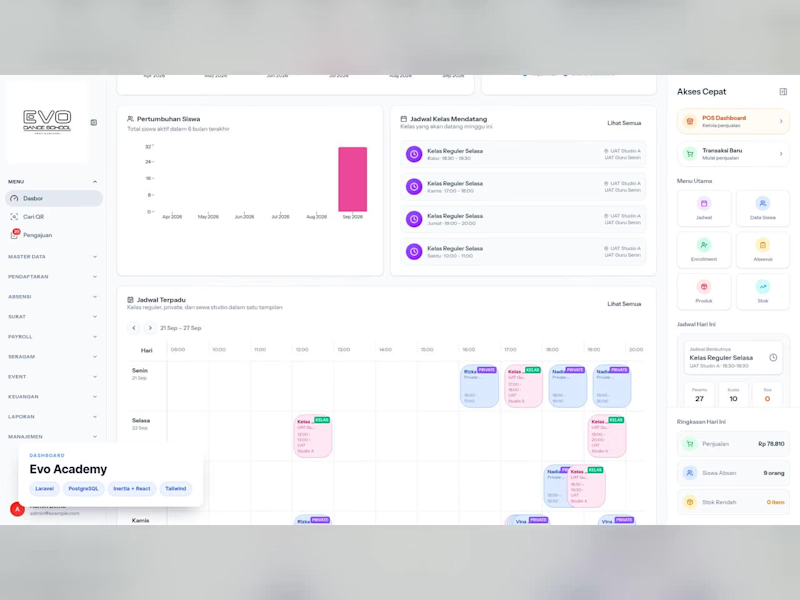
Evo Academy
The system a dance school actually runs on. Parents enquire, students enrol, teachers take attendance at the door, packages get billed monthly, teachers get paid, and the money lands in a real ledger instead of a spreadsheet.
What I built
Students, guardians and registrations, so the studio can enrol a new student in one screen.
Attendance per class session, on weekly schedules with teacher assignments.
Packages and recurring billing, so the monthly run is a report instead of a reconciliation.
Teacher payroll, calculated from the classes they actually taught.
A studio POS for walk-in payments, and bookkeeping that ties the day's takings together.
Stack
Laravel, PostgreSQL, React, Inertia, Tailwind CSS.
Built for one school first, which is why it fits the way a studio works instead of the way a generic school system thinks it should.
3
344