Motion Designer 2D/3D

Hey! 👋
Super stoked to release my first of many motion templates as part of this First Wave.
// Circular [ v1.0 ]
is a premium, fully customizable motion template designed to help you present your work with clarity, structure, and impact - for client projects, portfolios, or curated social media posts.
Built for both After Effects newcomers and experienced professionals, Circular isn’t just any template - it’s designed as a flexible creative tool.
Resizable to ANY format
Global & individual controls
Effortlessly add or remove content
You make it yours.
3
34
2.5K


Designing Impactful Brands for Innovators & Change-makers
- $1k+
- Earned
- 1x
- Hired
- 5.0
- Rating
- 25
- Followers
Designing Impactful Brands for Innovators & Change-makers


Product Designer for AI & Digital Products
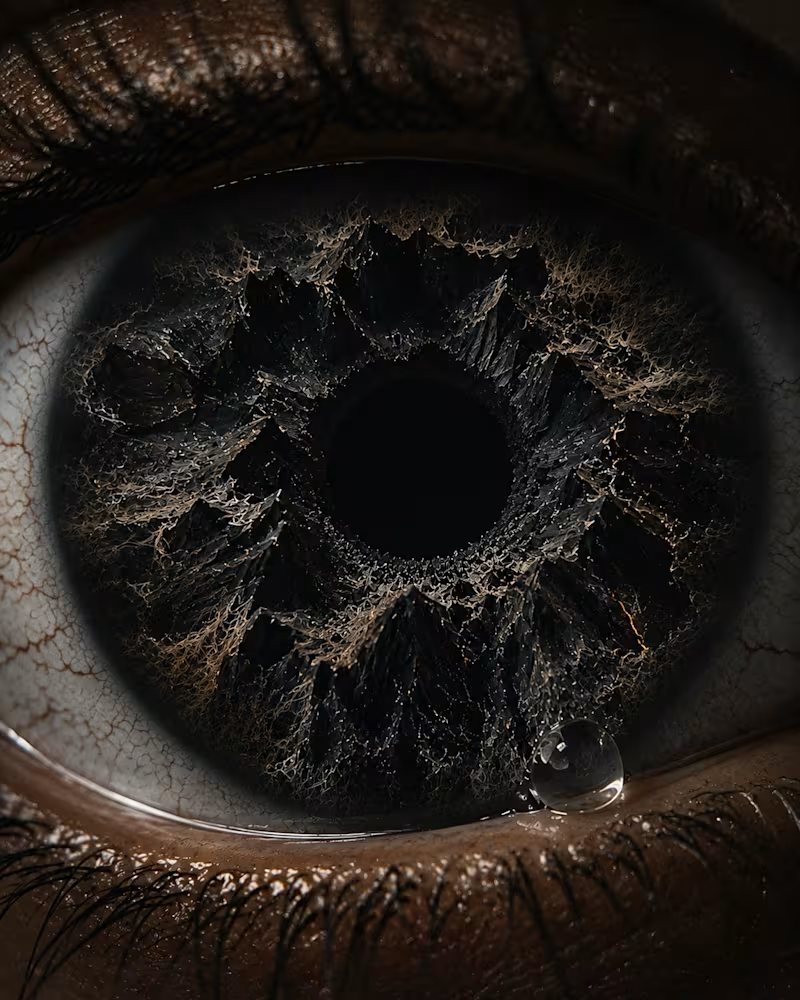
INNER CALDERA: Visual Exploration
This experiment started with a familiar visual trope: a landscape reflected inside an eye.
Instead of pushing it toward fire, spectacle, or a “lava iris,” I wanted to move in the opposite direction.
The idea became an ancient dormant caldera compressed into a living human iris.
The pupil remains completely black, almost eclipse-like. Around it, cooled obsidian forms irregular ridges, eroded peaks, mineral fractures, and barely visible residual heat. Natural iris fibers are still present between the geological structures, while moisture and tear film keep the eye unmistakably alive.
The main challenge was balancing two readings at once:
a real human eye
and
a geological landscape that feels millions of years old.
I explored multiple variations in topology, material behavior, depth, and light before selecting the versions where anatomy and geology felt like one continuous structure rather than a landscape pasted into an iris.
AI-assisted image exploration, iterative art direction, and visual selection.
#ArtDirection #DigitalArt #VisualExperiment
4
142
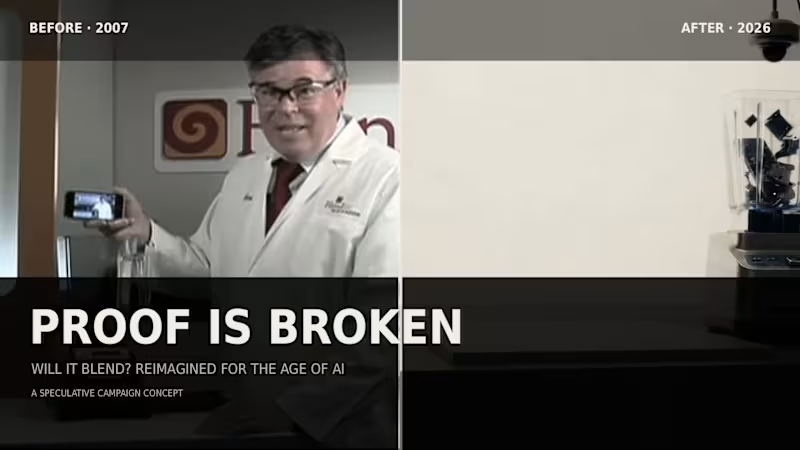
Day 15: PROOF IS BROKEN
In 2007, Blendtec’s Will It Blend? turned extreme product demonstrations into proof.
The formula was simple:
Watch the video. Believe the product.
But today, spectacular footage can be generated, enhanced, or fabricated. A visually impressive demonstration no longer guarantees credibility.
So I explored a new business problem:
How can a brand still prove product performance when video alone is no longer enough?
I reimagined the campaign around a new question:
WOULD YOU BELIEVE IT?
The new concept introduces The Proof Room—a controlled testing environment where the object, process, camera angles, and physical result are all visibly documented.
The campaign evolves from:
Will it blend?
to:
Can the demonstration be verified?
For this project, I created:
an original-versus-reimagined campaign film;
a complete storyboard;
AI-generated product and motion sequences;
a verification-based visual system;
a campaign poster and thumbnail;
sound design and final editing.
The final idea:
2
169
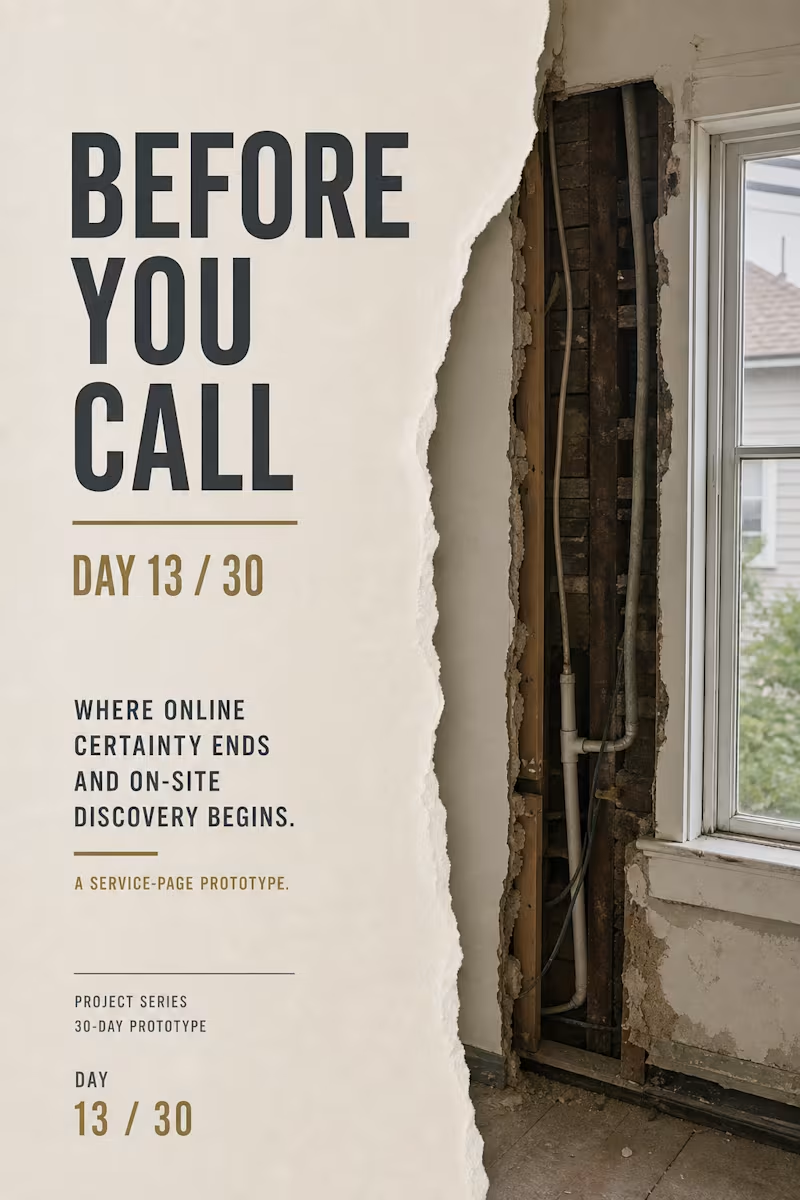
What can a website honestly know before someone steps inside the room?
For Day 13 of my 30 Days of Real Business Problems challenge, I built BEFORE YOU CALL, an illustrative service-page prototype for kitchen-remodelling businesses working with older homes.
The problem:
Most service websites try to remove uncertainty as quickly as possible. But in renovation, some uncertainty cannot be removed through a form, a calculator or a polished landing page.
Some things can be clarified before contact:
— the kind of project
— priorities and constraints
— what information would help
— how a useful first conversation could begin
Other things still require someone to stand inside the space:
— existing structure
— plumbing and electrical conditions
— measurements
— previous alterations
— how new work will meet what is already there
The central interaction is a visual threshold between those two territories:
WHAT WE CAN UNDERSTAND NOW
and
WHAT REQUIRES AN ON-SITE ASSESSMENT
No instant estimate.
No fake booking.
No false certainty.
The project was designed and built in Framer, then presented through an editorial montage made entirely from the real live interface.
I also used the first version of my reusable Universal Poster Compiler to translate the same idea into a physical poster metaphor: a clean editorial surface torn open to reveal the building reality underneath.
“Some things are only visible when we are there.”
Live prototype:
https://possible-place-516308.framer.app/
Day 13 / 30
Where should a service website stop simplifying and honestly admit that something still needs to be seen in person?
1
115
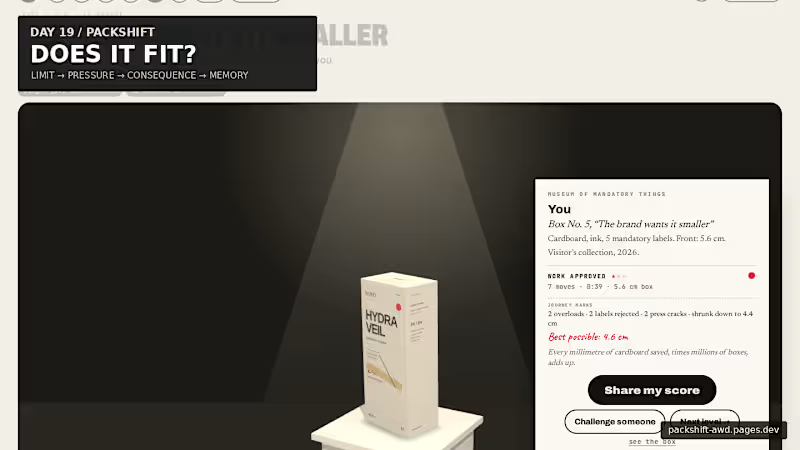
Packaging looks like graphic design. But every word takes physical space.
For Day 19, I built PACKSHIFT an interactive packaging experience where claims, languages, warnings and data become pressure on a finite surface.
It starts with the real 56 mm width of the carton.
Then you try to make everything fit.
Make the box smaller and the pressure becomes physical:
56 mm → pressure → CRACK → recovery → museum
The final package doesn’t just show the solution — it remembers the negotiation that produced it.
Underneath the public game is a deeper spatial compiler built with Blender + Three.js / React Three Fiber, where the same package can open, decompose, expose its dieline, redistribute information and refold.
Packaging is not a file. It is a compiled surface.
Full case study ↓
https://contra.com/p/3WBccUlM-packshift-packaging-is-a-compiled-surface
Live experience ↓
https://packshift-awd.pages.dev/
GitHub ↓
https://github.com/Faadil1/PACKSHIFT
Would love to know which moment lands most for you: Actual Size, the Hydraulic Press, or the Museum?
1
130

🇫🇷 Art director & Interactive designer


🇫🇷 Art director & Interactive designer

K-07
Most HMIs are designed for a single environment. Not just visually, but informationally. Each mode surfaces only what the pilot needs in that moment. Some data disappears intentionally.
In Rive, this runs as a three-state machine : Surface, Takeoff, Flight with each transition animated independently using data binding and nested state logic. We used Claude AI, Midjourney, Photshop and of course Rive to create this cool interactive project.
Stack: @Figma · @Rive · @Jitter · Midjourney · Photoshop · After Effects · Jitter · Claude AI
— Léo & Sacha
Linkedin post : https://www.linkedin.com/posts/leo-parpeix_rive-x-contra-k-07-is-a-vehicle-that-doesnt-ugcPost-7445361454611906560-rlUV?utm_source=share&utm_medium=member_desktop&rcm=ACoAABwQswwBirXDWTI_Tm0wbvFQbu1H6nTXTy4
2
4
525


Brand & Experience Designer

Creative Partner
Creative Partner



Art Direction & Branding for Print & Digital Success
Art Direction & Branding for Print & Digital Success